




























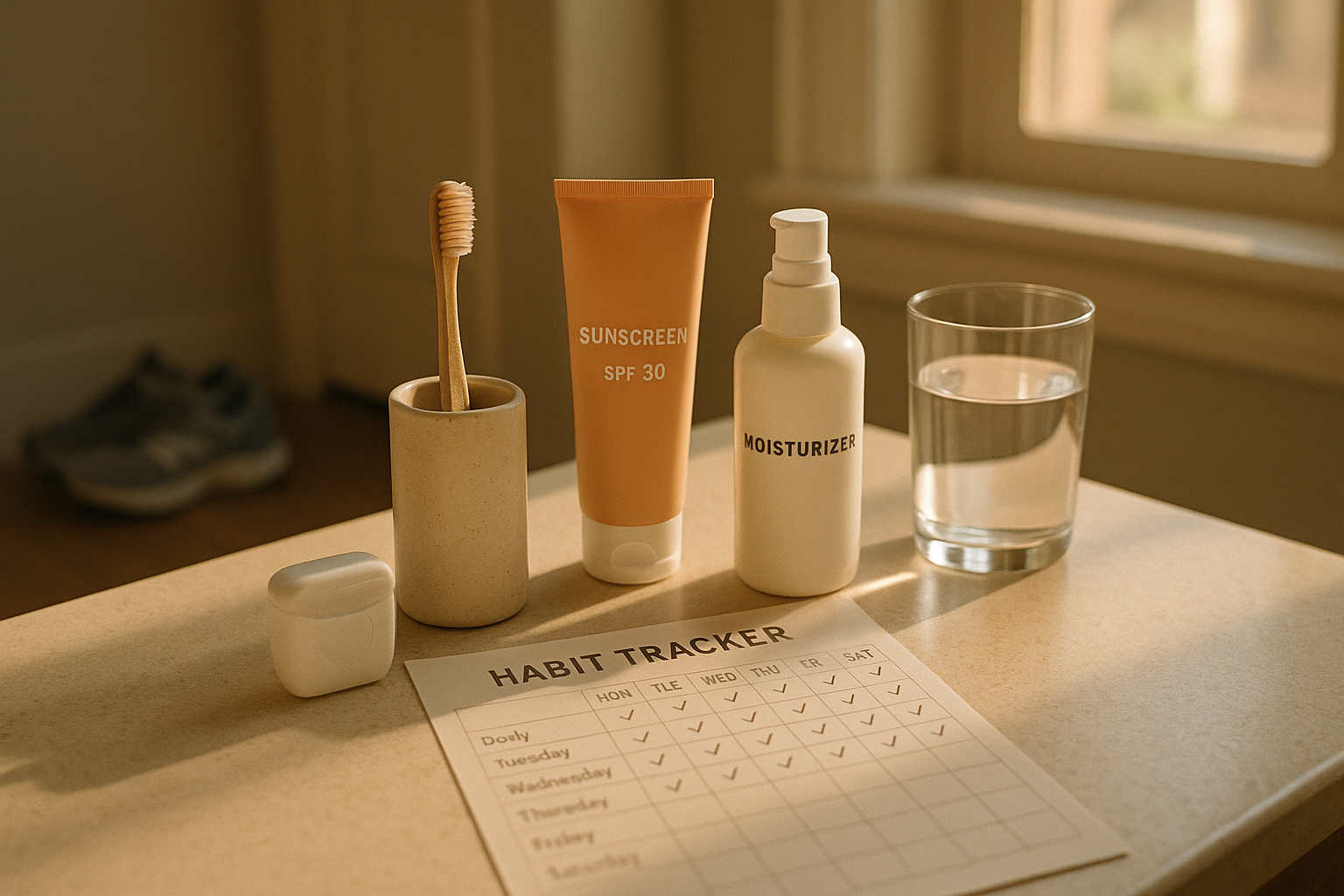
You don’t need a miracle product or a 30-day “reset” to look and feel better—you need dependable, repeatable actions that nudge your health forward every day. Building consistency means designing small, sustainable routines you can keep under real-life conditions, not just ideal ones. In practice, daily care compounds: your skin barrier stays calm, sleep stabilizes hormones, training builds capacity, and nutrition supports steady energy. In contrast, quick fixes deliver short-lived spikes—or collateral damage. In short: daily care wins because your body adapts to regular, appropriately dosed inputs, while quick fixes force abrupt changes your systems can’t maintain. Below are 12 evidence-backed principles to help you lock in that compounding advantage.
1. Start tiny so daily actions become automatic
Small, friction-free behaviors performed in the same context turn into habits that run on autopilot. That’s why “doable daily” beats “heroic occasionally.” When a behavior is easy, well-timed, and prompted, you don’t have to white-knuckle motivation; the action just happens. A classic approach is to anchor one new behavior to something you already do—apply moisturizer right after brushing, or fill a water bottle as you set the coffee to brew. Over weeks, repetition wires the routine until it feels odd to skip it. Research observing real-world habit formation finds that simple behaviors repeated in a consistent context typically take weeks to months to become automatic (median ≈66 days, range 18–254), which is a realistic planning horizon—not a reason to quit. The goal isn’t speed; it’s stickiness that survives busy days.
1.1 Why it works
Behavior becomes reliable when motivation, ability, and a prompt converge; increasing ability (making it easier) and using timely prompts spare you from motivation dips.
1.2 Mini-checklist
- Shrink the behavior until it’s “too small to fail.”
- Anchor it to a stable cue (e.g., after breakfast).
- Keep tools visible and within arm’s reach.
- Celebrate completion briefly to reinforce it.
- Track streaks lightly for feedback.
Synthesis: Start so small that “every day” is realistic; accumulation beats intensity when you’re building a routine.
2. Protect your skin barrier with calm, consistent basics
Healthy skin is built on gentle cleansing, daily moisturizing, and broad-spectrum SPF 30+—not on emergency peels or harsh scrubs. Your skin barrier (the outer layer that keeps moisture in and irritants out) thrives on steady support. Quick-fix habits—over-exfoliating, skipping sunscreen except on “sunny” days, or bouncing between trendy actives—often create irritation that requires weeks of recovery. Dermatology guidance is simple: choose a non-stripping cleanser, apply moisturizer suited to your skin type, and wear sunscreen correctly every day—even indoors near windows or on cloudy days. When you do need actives (like retinoids), you’ll tolerate them better on a stable base. Over time, that consistent foundation softens texture, steadies oil/water balance, and reduces flare-ups, which is far more sustainable than cycling through crisis treatments.
2.1 Numbers & guardrails (as of August 2025)
- Use broad-spectrum SPF 30+, water-resistant when outdoors; reapply ~every 2 hours in direct sun.
- Prefer zinc oxide/titanium dioxide if you’re sensitive; tint with iron oxides can better protect against visible light–induced dark spots.
2.2 Common mistakes
- Chasing instant “glass skin” with frequent acids.
- Treating sunscreen as optional.
- Switching entire routines weekly.
- Scrubbing to “clean” acne (irritation worsens it).
Synthesis: Treat SPF and moisturization like brushing teeth—non-negotiable daily care that prevents problems and multiplies the effect of everything else.
3. Prioritize regular sleep to stabilize recovery, mood, and hormones
Consistency in sleep duration and timing is a foundational “daily care” lever. Most adults need at least 7 hours each night; getting less is linked with impaired cognition, mood volatility, and poorer metabolic and immune function. Regular bed/wake windows cue your circadian system, making falling asleep and waking easier over time. Quick fixes like late-night caffeine, weekend sleep “binges,” or sedatives without lifestyle change can mask problems short term but often degrade sleep architecture. Anchor wind-down rituals (dim lights, screens off, light stretch or reading) and guard your sleep like a standing appointment—because it is.
3.1 How to do it
- Hold a ~60-minute wind-down window nightly.
- Keep wake time consistent (±30 minutes).
- Caffeine curfew ~8 hours before bed; alcohol sparingly.
- Keep bedroom cool, dark, and quiet.
3.2 Mini case
Shifting from 5–6 hours to 7–8 hours with fixed wake time typically improves energy within 1–2 weeks; skin and training recovery often follow within another 1–3 weeks, compounding in month 2+. (General pattern consistent with sleep guidance.) CDC
Synthesis: Sleep regularity is the quiet multiplier: set it first so everything else—skin, workouts, food choices—gets easier.
4. Eat for steady energy—slow, sustainable changes over “detoxes”
Daily nutrition isn’t a 3-day cleanse; it’s patterns you can repeat. Evidence-based guidance emphasizes gradual, steady weight change (about 1–2 lb per week if weight loss is appropriate), balanced meals across food groups, and behaviors like meal planning and self-monitoring—not severe restriction. Short, extreme diets often backfire with fatigue, rebound hunger, and weight cycling. Use plates and plans that fit your culture and schedule, aim for protein and fiber at each meal, and focus on consistency, not perfection.
4.1 How to start (one week)
- Plan 3–5 default breakfasts and lunches.
- Add a fruit/veg to two meals daily.
- Include protein (≈20–40 g) each main meal.
- Pre-portion snacks you actually enjoy.
- Track intake lightly for awareness.
4.2 Guardrails
- If rapid, medically supervised protocols are considered, do so with a clinician; unsupervised very-low-calorie diets (≤800 kcal) carry risks (e.g., gallstones). Obesity Action Coalition
Synthesis: Favor patterns you can practice all year; slow changes compound, while drastic cuts drain adherence.
5. Train by frequency and progression—not by sporadic “smash” sessions
Exercise pays off when you show up consistently and progress gradually. Public health and sports guidelines converge on 150–300 minutes/week of moderate aerobic activity (or 75–150 vigorous) plus 2+ days of muscle-strengthening work for adults. Boot-camp binges separated by long gaps don’t build capacity; dose-appropriate training does. Prioritize weekly frequency and progressive overload (small, planned increases in volume or intensity), and accept that recovery is part of training. Think “always train tomorrow” rather than “win today and limp for a week.”
5.1 Numbers & examples (as of August 2025)
- Aerobic: 5×30 minutes brisk walking = 150 min.
- Strength: 2–3 full-body sessions (8–12 reps, 1–3 sets) covering major muscle groups.
5.2 Common pitfalls
- Maxing out weekly volume in one session.
- Random workouts; no progression.
- Skipping deload weeks entirely.
Synthesis: Capacity grows with repetition and progression; consistent “good” sessions beat irregular “legendary” ones.
6. Make flossing and brushing daily—whitening isn’t a substitute
Oral health is classic daily care: brush twice daily with fluoride toothpaste (≈2 minutes) and clean between teeth once daily. Consistency prevents plaque buildup, gum disease, and cavities; quick fixes like sporadic whitening strips don’t address root causes and can irritate enamel or gums when overused. The best time to floss is the time you’ll actually do it—morning, midday, or evening; sequence matters less than regularity and technique. If string floss is hard, water flossers or interdental brushes are viable alternatives that many people find easier to adopt.
6.1 Mini-checklist
- Brush AM and PM for ~2 minutes.
- Floss once daily; use aids if needed.
- Replace brush heads ~every 3–4 months.
- Schedule regular hygienist cleanings.
6.2 Example
If nightly flossing feels unrealistic, anchor it to after dinner plates are cleared—keep picks or floss on the table as the visible prompt.
Synthesis: Treat interdental cleaning like sunscreen: a daily base habit that avoids costly, painful “fixes” later.
7. Introduce actives (like retinoids) slowly to prevent setbacks
Retinoids can improve acne and photoaging—but they’re a marathon tool, not a sprint. Dermatologists commonly advise starting with a gentle formulation and building up slowly (e.g., every other night), allowing your skin to adapt and minimizing irritation that derails routines. Pair with daily moisturizer and SPF 30+ to protect the barrier. The “more now” mindset leads to peeling and redness that cause people to quit; the “less, steadily” approach is how you actually keep retinoids long term and see results.
7.1 How to do it
- Start with a low-strength OTC retinol or as prescribed.
- Apply a pea-sized amount to dry skin; moisturize.
- Increase frequency over weeks based on tolerance.
- Pause and re-introduce if irritation flares.
7.2 Common mistakes
- Applying to damp skin (increases penetration/irritation).
- Skipping sunscreen (retinoids increase sun sensitivity).
Synthesis: Slow titration keeps you consistent—the only path that unlocks retinoids’ long-term benefits.
8. Use “if-then” plans to safeguard your routine on messy days
Even solid habits get stress-tested by travel, deadlines, or illness. Implementation intentions—simple “If X happens, then I’ll do Y” plans—reliably increase goal follow-through by pre-deciding your response to obstacles. Example: “If I work late, then I’ll do a 10-minute mobility circuit and a short walk instead of skipping movement entirely.” Meta-analytic evidence shows meaningful improvements in goal attainment when people adopt if-then planning; it’s a low-effort tool with high reliability. cancercontrol.cancer.gov
8.1 Templates
- If I forget sunscreen in the morning, then I’ll keep a travel tube at my desk and apply before lunch.
- If I can’t cook, then I’ll order the two-veg + protein option from my saved list.
- If I miss a workout, then I’ll walk 20 minutes after dinner.
8.2 Tips
- Tie plans to your real friction points.
- Keep the fallback tiny and specific.
- Rehearse the sentence once; then move on.
Synthesis: Pre-decide your “Plan B.” It turns disruptions into detours instead of dead ends.
9. Track the behavior (lightly) to keep momentum and course-correct
What you measure, you can manage. In behavior change research, self-monitoring (logging diet, activity, or weight) consistently correlates with better outcomes, including weight loss. The magic isn’t in perfect data; it’s in immediate feedback that tightens the loop between action and result. Use the simplest tool that you’ll keep using—paper tally marks, a wall calendar, or a minimal app—and focus on streaks and trends, not day-to-day noise. When the graph or checkmarks dip, you’ll spot it early and adjust.
9.1 Options
- Paper habit grids for daily skin + floss + SPF.
- Weekly weigh-ins at the same time/day.
- 3×/week strength sessions checked off in a shared note.
9.2 Guardrails
- Track inputs (behaviors) more than outputs (scale).
- Review weekly; tweak one variable at a time.
Synthesis: Light tracking sustains adherence precisely because it’s simple enough to survive busy weeks.
10. Make sun protection a year-round, default behavior
UV exposure is daily, not seasonal, and cumulative damage drives photoaging and skin cancer risk over time. That’s why dermatology groups repeatedly emphasize broad-spectrum SPF 30+ as a daily baseline, with reapplication in outdoor conditions. Sunscreen is not a “beach day” product; it’s a routine one. Keep a bottle where you actually leave the house (by the keys) and a small tube in your bag. Tinted mineral formulas with iron oxides can better protect against visible light that contributes to hyperpigmentation, which many deeper skin tones experience—another reason to make SPF a daily default.
10.1 Practical setup
- Face/neck/back-of-hands every morning.
- Reapply outdoors every ~2 hours; set a timer.
- Pair with hats/shade for stronger protection.
10.2 Region-specific note
In high-UV regions and at altitude, reapplication discipline matters even more; sweat-resistant formulas help maintain coverage. (General dermatology guidance.)
Synthesis: Treat sunscreen like your seatbelt—automatic and daily—because protection compounds only when it’s routine.
11. Respect recovery: plan rest so you can train again tomorrow
Consistency is impossible without recovery. Programming rest days and lighter sessions allows tissues to repair, nervous systems to reset, and motivation to rebound. The U.S. Physical Activity Guidelines emphasize weekly volumes rather than daily heroics; choosing moderate movement on “off” days preserves the habit loop and keeps soreness in check. Swap the mindset of “earn rest by overdoing it” for “schedule rest so I can keep going.” On rest days, light walks, mobility, or easy cycling keep blood flowing without taxing reserves. The payoff is fewer injuries and steadier progress across months.
11.1 Mini-checklist
- Cap week-over-week volume increases (~5–10%).
- Insert at least 1–2 lower-intensity days/week.
- Sleep 7+ hours to consolidate adaptations.
11.2 Common mistake
- “Weekend warrior” peaks followed by midweek inactivity—great at generating soreness, poor at building capacity.
Synthesis: Build in recovery on purpose; it’s the cost of doing business for consistent training.
12. Practice short, regular stress-management instead of sporadic retreats
Ten minutes of mindfulness, breathing, or gentle movement most days often beats rare, intensive interventions. A large systematic review of randomized trials finds meditation programs can produce small to moderate reductions in psychological stress—effects that accrue with practice. A daily “pressure valve” habit makes it easier to stick to every other routine (sleep, nutrition, social choices) because stress is one of the main triggers for routine-breaking. Keep it simple: brief guided audio, box breathing between meetings, or a short body scan before bed.
12.1 How to do it
- Pick one method and one time (e.g., after lunch).
- Use a 5–10 minute timer; accept imperfect sessions.
- Pair with a physical cue (sit in the same chair).
12.2 Numbers & expectations
Benefits are dose-dependent; most studies examine 1–2 sessions per day over 6–8 weeks. Aim for 5+ days/week, then scale if helpful.
Synthesis: Modest, regular practices lower strain and raise adherence, which is why they outperform occasional “reset weekends.”
FAQs
1) What does “Building consistency” actually mean in daily care?
It means designing small, sustainable behaviors (skin basics, sleep schedule, movement, dental hygiene) you can execute under normal constraints—busy workdays, travel, social plans. You engineer cues, simplify steps, and make the default easy so the routine happens with minimal willpower. Over time, repetition in the same context makes the behavior automatic (habits).
2) How long before daily habits “work”?
Expect weeks to months. In a real-world study, habit automaticity increased asymptotically with a median of ~66 days to reach a plateau, ranging 18–254 days depending on the behavior’s complexity and the person. That’s why tiny, repeatable steps matter: they survive long enough to stick.
3) Is SPF really necessary every day?
Yes. Dermatology guidance recommends daily use of broad-spectrum SPF 30+, applied correctly and reapplied in outdoor exposure. Consistency prevents cumulative UV damage that contributes to skin cancer and photoaging. Tinted mineral options help protect against visible light–induced hyperpigmentation.
4) What’s a practical weekly exercise target if I’m starting from zero?
Aim for 150 minutes of moderate aerobic activity (e.g., five 30-minute brisk walks) and two strength sessions that train major muscle groups. Break it up as needed; volume across the week matters more than any single “perfect” session.
5) Do I need to floss if I use a premium toothbrush or mouthwash?
Yes—brushing and interdental cleaning do different jobs. Brush twice daily with fluoride toothpaste and clean between teeth once daily using floss or another interdental tool you can do consistently. Sequence and time of day are less important than daily completion and proper technique.
6) Are “detoxes” or very-low-calorie plans ever smart?
Not for routine self-care. Evidence-based guidance supports gradual, sustainable change (about 1–2 lb/week if weight loss is appropriate) with balanced eating and activity. Extreme deficits increase side-effect and rebound risks and are best avoided unless medically supervised for specific clinical reasons.
7) What’s the difference between retinol and a retinoid prescription—and how do I start?
Retinoids include both prescription forms (e.g., tretinoin, tazarotene) and OTC retinol. Start with the gentlest option you can tolerate, use every other night, moisturize, and go slow. Daily sunscreen is non-negotiable. The aim is tolerance you can maintain for months and years, not maximum strength on day one. American Academy of Dermatology
8) Do habit trackers really help or are they busywork?
Tracking works when it’s simple and tied to action. Systematic reviews show self-monitoring—of diet, activity, or weight—associates with better outcomes in weight-management programs. Use the least-effort tool that keeps you aware (paper grids, weekly check-ins) and review trends weekly.
9) How do I keep routines during travel or hectic weeks?
Use if-then plans: “If I land late, then I’ll do 10 minutes of mobility before bed.” Pack travel-sized SPF and floss picks; switch to bodyweight circuits and brisk walks; keep wake time similar. The goal is maintaining the shape of your routine so you can resume full volume seamlessly.
10) Can brief daily mindfulness really do anything measurable?
Yes—expect small to moderate improvements in psychological stress with consistent practice over 6–8 weeks, per randomized-trial reviews. Think of it as a training plan for attention and stress reactivity; short daily reps compound like any other practice. PMC
Conclusion
Quick fixes are seductive because they promise transformation without the work that sustains it. But biology, behavior, and experience all reward the opposite: small, repeated inputs at the right dose. When you build consistency, you preserve your skin barrier, capture the benefits of sleep, progress your training, and eat in a way your future self can keep doing. The 12 principles here give you a blueprint: start tiny, anchor to cues, protect your barrier, train and rest on a schedule, floss and brush daily, add actives slowly, pre-plan “if-then” responses, and track lightly so you can adjust. None of this is flashy, and that’s the power—it survives real life. Choose one principle to implement this week, and set it up so “daily” is easy. Then stack the next. Ready to start? Pick your smallest next action and do it today.
References
- How to select a sunscreen — American Academy of Dermatology, updated 2025. https://www.aad.org/public/everyday-care/sun-protection/shade-clothing-sunscreen/how-to-select-sunscreen
- How to apply sunscreen — American Academy of Dermatology, updated 2025. https://www.aad.org/public/everyday-care/sun-protection/shade-clothing-sunscreen/how-to-apply-sunscreen
- Sunscreen FAQs — American Academy of Dermatology, accessed Aug 2025. https://www.aad.org/media/stats-sunscreen
- Physical Activity Guidelines for Americans, 2nd edition — U.S. Department of Health and Human Services, 2018. https://health.gov/sites/default/files/2019-09/Physical_Activity_Guidelines_2nd_edition.pdf
- World Health Organization 2020 guidelines on physical activity and sedentary behaviour — British Journal of Sports Medicine (open access), 2020. https://pmc.ncbi.nlm.nih.gov/articles/PMC7719906/
- Sleep in Adults: Facts and Stats — Centers for Disease Control and Prevention, May 15, 2024. https://www.cdc.gov/sleep/data-research/facts-stats/adults-sleep-facts-and-stats.html
- Modelling habit formation in the real world — Lally P, van Jaarsveld CHM, Potts HWW, Wardle J. European Journal of Social Psychology, 2010. https://onlinelibrary.wiley.com/doi/abs/10.1002/ejsp.674
- Fogg Behavior Model (B=MAP) — BJ Fogg, Behavior Model site, 2025. https://www.behaviormodel.org/
- Implementation Intentions and Goal Achievement: A Meta-Analysis of Effects and Processes — Gollwitzer PM, Sheeran P. Advances in Experimental Social Psychology, 2006. https://www.sciencedirect.com/science/article/pii/S0065260106380021
- Self-Monitoring in Weight Loss: A Systematic Review of the Literature — Burke LE, Wang J, Sevick MA. Journal of the American Dietetic Association, 2011. https://pmc.ncbi.nlm.nih.gov/articles/PMC3268700/
- Steps for Losing Weight — Centers for Disease Control and Prevention, Jan 17, 2025. https://www.cdc.gov/healthy-weight-growth/losing-weight/index.html
- Floss/Interdental Cleaners — American Dental Association, Sept 21, 2021. https://www.ada.org/resources/ada-library/oral-health-topics/floss
- Home Oral Care — American Dental Association, Aug 8, 2024. https://www.ada.org/resources/ada-library/oral-health-topics/home-care
- Meditation Programs for Psychological Stress and Well-being: A Systematic Review and Meta-analysis — Goyal M et al., JAMA Internal Medicine, 2014. https://jamanetwork.com/journals/jamainternalmedicine/fullarticle/1809754