

























Your body and immediate environment are yours to protect. “Physical boundaries” are the rules, limits, and preferences you set for distance, touch, and control over your space—at home, at work, and in public. In short: physical boundaries are how you decide who gets close, when, and how. This guide distills the topic into 12 practical, research-aware principles you can apply today. You’ll learn how to map your personal space, use clear scripts, design rooms that signal privacy, teach kids consent, navigate crowds, and respond when boundaries are crossed. This article offers general information only—not legal or medical advice.
Quick definition: Physical boundaries are personal limits about distance, touch, and access to your body and immediate environment. They help you feel safe, respected, and in control.
1. Map Your Personal Space Zones
Start by naming the distances at which you feel comfortable. Most people prefer different “zones” for different relationships and contexts—the space you want with a partner on the sofa isn’t the same as what you need with a stranger in a queue. A classic framework distinguishes four rough zones: intimate (closest), personal, social, and public. Treat these numbers as guides, not rules: your comfort can shift with mood, culture, and setting (subway vs. park; clinic vs. cafe). Write down your ideal ranges and your “green/amber/red” tolerances for each one. The act of mapping clarifies what to ask for, and noticing shifts (e.g., when tired or overstimulated) tells you when to take breaks or widen space.
Numbers & guardrails
- A widely cited model (proxemics) describes approximate ranges: intimate 0–45 cm (0–18 in), personal 45–120 cm (18–48 in), social 1.2–3.5 m (4–12 ft), public 3.5 m+ (12 ft+). Use as a starting map, not a mandate.
- Large cross-cultural studies show preferred distances vary globally—build cultural curiosity into your expectations.
Mini-checklist
- Define your “default” ranges by relationship: partner, close friend, colleague, stranger.
- Note situations that tighten or widen your comfort (crowds, loud venues, illness, grief).
- Agree on shared language with family/roommates (e.g., “arm’s length,” “one cushion apart”).
Closing thought: when you can name your zones, you can negotiate them—calmly, early, and clearly.
2. Use Polite, Clear Scripts (Your “Boundary Voice”)
Clarity beats hints. A short, courteous sentence protects your space better than a dozen signals. Lead with I-language (“I need…”) and one specific ask (“Let’s do a handshake instead of a hug,” “Please stand an arm’s length away”). People generally respect directness, and clear scripts help you act under stress. Decide on lines you can say even when surprised, and practice them out loud until they feel natural. In close relationships, explain the “why” (sensory overload, cultural norm, injury) to build trust; in public, you don’t owe a reason—polite brevity is enough.
How to do it
- Handshake, not hug: “I’m not a hugger, but I’m happy to shake hands.”
- Spacing in queues: “Could we give each other a bit more space? Thank you.”
- Home threshold: “Please text before dropping by; I keep the door locked.”
- Seated buffer: “I’m saving this seat to keep some space—thanks for understanding.”
- Elevator/cab: “I’m more comfortable on this side—could we keep a bit of room?”
Common mistakes
- Over-explaining to strangers (you can be brief).
- Smiling while saying “no” (mixed signals).
- Apologizing for needs that are reasonable and safe.
Closing thought: a two-second script can prevent a two-minute awkward dance and a two-hour stress spiral.
3. Signal with Nonverbal Cues (So Your Body Matches Your Words)
Your posture, orientation, and gestures often decide whether people approach, pause, or step back. Align your body with your boundary. Angle your torso away to widen distance; plant both feet and keep shoulders squared to hold ground; lift a relaxed hand at waist height to stop a step-in; wear visible headphones or read a book to signal “not available.” Keep your bag to the side that faces others in a queue to create a natural buffer. On transport, choose end seats or stand near poles that protect one side. In social settings, position yourself near a table or wall to reduce “approach angles.”
Tools/Examples
- Micro-moves: half-step back; pivot 30–45°; shift eye gaze to neutral point (not confrontational).
- Props that help: tote, slim backpack, foldable umbrella, magazine—held on your “public side.”
- Home cues: a visible coat rack by the door, slippers for guests (signals “remove shoes”), a small bench that marks the entry zone.
Mini-checklist
- Does your body orientation match your words?
- Are your hands visible and relaxed (non-threatening but firm)?
- Is there a surface or prop creating a natural boundary on your approach side?
Closing thought: when your words and posture sing the same melody, people “hear” your boundary faster.
4. Set Touch Rules & Consent at Home
Home is where boundaries shape daily safety and comfort. Decide together what kinds of touch are welcome, when to ask first, and how to decline kindly. In families, teach kids that bodies belong to them—no forced hugs to relatives; asking before tickling; using correct anatomical language. In shared apartments, agree on greetings (wave, fist bump) and couch norms (e.g., “one cushion rule”). With partners, set non-negotiables (no surprise touches from behind, no waking with rough jostling), and create signals for “not now” that are honored without sulking. Write the rules down, put them on the fridge, and revisit each season.
Why it matters
- Teaching consent early protects autonomy and reduces risk; approachable resources like the NSPCC “PANTS” rule give parents practical language.
- Pediatric guidance emphasizes modeling body autonomy and using accurate terms for body parts; both make it easier for kids to speak up.
Mini-checklist
- Family phrase for consent: “Ask, wait, respect.”
- Clear “opt-out” signals kids can use without penalty.
- Written house rules for greetings, couch space, and bedtime touch.
Closing thought: consent culture starts in the living room—simple, specific, and practiced daily.
5. Design Your Space to Communicate Boundaries
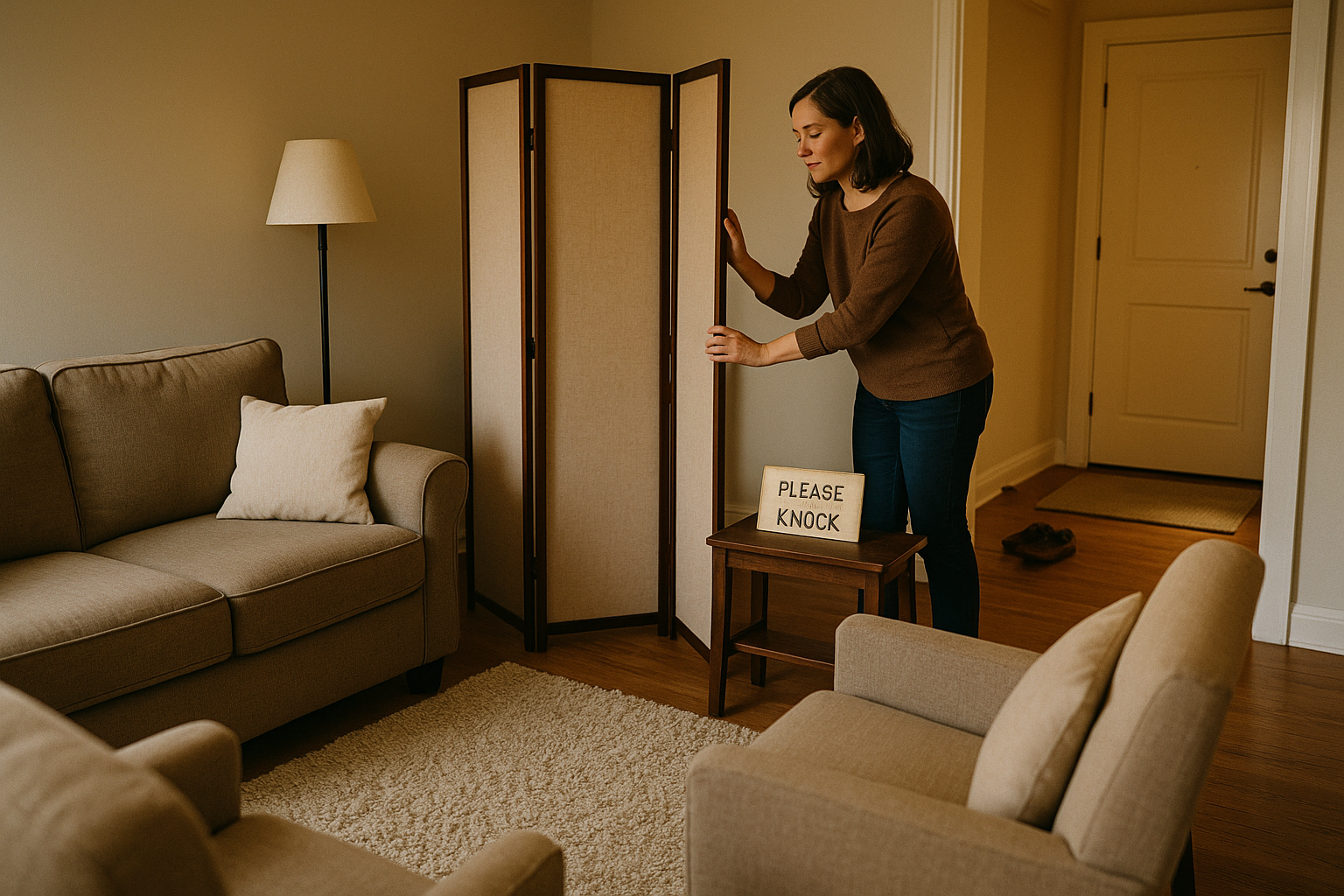
Good layouts do half the boundary work for you. Use furniture to define zones: a rug plus a chair angled 15–30° can mark a conversation area with a natural “edge.” A folding screen near a bedroom door creates a decompression buffer. Hooks, trays, and a small entry bench tell guests where to pause. For apartments with thin walls, soft furnishings, curtains, and bookcases cut noise and visual intrusion. Outside, motion-sensing lights, plants that limit sightlines, and clear numbering make the threshold distinct. These choices reduce awkward policing—people read the space and follow its script.
Tools/Examples (CPTED-informed)
- Natural access control: clear paths to the door, defined entry zone.
- Territorial reinforcement: welcome mat, planters, house name/number.
- Natural surveillance: sightlines from kitchen to entry; lighting that avoids dark corners.
- Maintenance: tidy thresholds signal “this space is cared for.”
These align with Crime Prevention Through Environmental Design (CPTED) principles that use design to support safety and reduce unwanted intrusion. Office of Justice ProgramsCOPS Portal
Mini-checklist
- Does each room have visible zones (work, rest, conversation)?
- Is the entry pause-friendly (bench, hooks, good light)?
- Are noise-softening elements in places that matter (rugs, curtains, bookshelves)?
Closing thought: design speaks before you do—let your layout politely say “this is my space.”
6. Agree on Visitor Policies (Notice, Timing, and Access)
Surprise visits feel different depending on culture and closeness. If drop-ins jar you, build a simple policy everyone can follow: text first, confirm a window, ring once, and wait for a reply. Set quiet hours (e.g., 9 pm–9 am) and preferred days. Decide which rooms are private (bedroom, home office) and which are shared (kitchen, lounge). For roommates, specify guest caps (“no more than 2 at a time”), frequency, and length of stay (e.g., “max 3 nights/month per guest unless all agree”). Store spare keys securely and keep a lost-key plan.
How to do it
- Post a friendly note by the bell: “We’re often working—please text before knocking.”
- Share a guest policy doc in your house chat.
- Use a digital calendar slot labeled “visiting hours” when you’re open to drop-ins.
- For deliveries, opt for “leave at door” and a box/bench to signal placement.
Mini-checklist
- Quiet hours set and shared?
- Private rooms labeled or kept closed?
- Spare key log and who holds them?
Closing thought: a clear plan turns “Sorry, now’s not good” into “Sure—how about Saturday 4–6?”
7. Navigate Crowds, Queues, and Public Transport
Public spaces compress our boundaries, so plan small moves that restore control. In queues, keep one arm’s length where possible and angle your body to protect your front/side. Step to the side to let overtakers pass rather than resisting in place. On trains, choose end seats, stand with a pole on your “approach side,” and keep your bag on the outer shoulder. In elevators, face the door and maintain a neutral gaze; step forward a half-step if someone behind is crowding. Late nights? Move to brighter, busier areas and keep headphones visible but volume low.
Region-specific notes
- In dense cities and peak hours (e.g., South Asian markets or metro rush), your “ideal” distance may be impossible. Use nonverbal shields (bag, elbow fold) and plan off-peak travel or alternate routes to preserve comfort.
- Cultural expectations for queuing differ; observe local norms while still protecting core non-negotiables (no unwanted touch, no blocking escape routes).
Mini-checklist
- End seat or pole-side spot?
- Bag on approach side?
- Exit path visible?
Closing thought: small positional choices add up to big comfort in crowded minutes.
8. Manage Noise and Sensory Boundaries
Sound invades space as surely as footsteps. At home, soft materials (rugs, curtains, acoustic panels), door sweeps, and bookcases reduce bleed. In shared housing, agree on quiet hours and “headphone zones.” In open offices, advocate for focus rooms, phone booths, and visual cues like desk flags for “do not disturb” blocks. For sleep, white-noise machines and earplugs are inexpensive wins. When outdoor or neighbor noise is chronic, document times and levels before approaching building management or local authorities; there may be guidelines for healthy exposure.
Numbers & guardrails
- Health bodies in Europe recommend evidence-based limits for environmental noise exposure (transport, leisure) to protect well-being; use them as talking points when negotiating building or workplace changes. IRIS
Mini-checklist
- Bedroom door sweep installed?
- Headphones policy in shared areas?
- Documented noise times for a calm, factual request?
Closing thought: treat noise like any other intruder—reduce entry points and agree on norms.
9. Set Workplace & School Boundaries (Policies + Personal Practice)
Boundaries at work and school blend etiquette with policy. Learn the official definitions of harassment and your reporting pathways. Set your desk norms (no surprise shoulder taps; use chat or knock first) and put them in your status message or a small desk sign. Block “maker time” on your calendar and protect it. In open plans, wear visible headphones when focused, and relocate for sensitive calls. If you supervise, model respectful distance and ask consent before physical demonstrations. If incidents occur, document who/what/when/where contemporaneously and escalate per policy.
Why it matters
- Harassment policies explicitly cover unwelcome conduct—including physical or verbal—based on protected characteristics; kn owing the definitions and channels helps you act quickly and safely.
- Enforcement guidance evolves (e.g., updates on what counts as workplace harassment and protected categories); staying current helps you and your organization respond appropriately.
Mini-checklist
- Desk sign or status text for “please knock/chat first”?
- Focus blocks visible on your calendar?
- Incident log template ready (date, time, location, witnesses)?
Closing thought: personal habits + clear policy knowledge = confident boundary-keeping at work or school.
10. Teach Kids and Teens to Set (and Respect) Boundaries
Kids thrive when adults normalize consent and space. Start young: ask before hugs, use correct body-part names, and praise kids for saying “no” respectfully. For school-age children, practice scripts for peers (“Please don’t sit so close,” “No tickling for me”) and discuss public cues (bathroom privacy, locker-room etiquette). Teens need language for dating and parties, including bystander strategies and exit plans. Use age-appropriate resources and revisit the topic periodically; boundaries mature as kids do.
Tools/Examples
- The NSPCC “PANTS” guide gives parents simple rules (“Privates are private,” “Always remember your body belongs to you”) and conversation tips.
- Pediatric sources encourage modeling body autonomy and clear language, which lowers stigma and makes help-seeking easier if something goes wrong.
Mini-checklist
- Family code word kids can use to exit uncomfortable situations.
- Weekly “what did we notice about space?” chat—keep it light.
- Practice saying “no” three ways: verbal, nonverbal, and exit.
Closing thought: when kids learn to draw their own lines, they grow into adults who respect everyone’s.
11. Respond Calmly to Boundary Violations (From “No” to Next Steps)
Plan your response before you need it. Start with a clear “no” or request (“Please step back,” “Don’t touch me”). If behavior continues, exit physically if possible and recruit allies (driver, guard, staff). Document details as soon as you’re safe—notes, timestamps, and, where lawful, photos/screenshots. For patterns at school or work, use formal reporting channels. In serious or unsafe situations, prioritize your safety and contact local authorities; when unsure, crisis lines or victim-support orgs can guide next steps. Afterward, debrief with a trusted person to reset emotionally.
Why it matters
- Public-health and safety organizations promote layered strategies—personal tactics, environmental design, and formal channels—to reduce violence and protect well-being. World Health Organization
- For school contexts (U.S. example), official resources outline escalation routes when local responses fall short. Use your region’s equivalents.
Mini-checklist
- One-sentence “no” you can say under stress.
- Exit route pre-scanned on arrival.
- Documentation habit: who/what/when/where.
Closing thought: a calm script, an exit, and a record give you both immediate relief and future options.
12. Adapt to Culture and Context—Without Losing Your Non-Negotiables
Boundaries aren’t one-size-fits-all. Cultural norms shape how close people stand, who greets whom, and when touch is appropriate. In some places a hug is friendship; in others, a nod is respect. When you travel, observe and ask trusted locals about distance and greeting norms—but keep your health and safety non-negotiables intact. If you’re sensory-sensitive, plan quiet breaks; if you’re in gender-segregated spaces, learn local expectations and choose the option that feels safe. Keep your boundary scripts short, friendly, and translated if needed.
Numbers & guardrails
- Research comparing preferred interpersonal distances across countries confirms meaningful variation; expect to adjust your “defaults” while keeping core consent intact. SAGE Journals
Mini-checklist
- Two greeting options ready (hand on heart, handshake).
- A translated card or phone note stating a simple boundary (“I prefer no hugs—thank you”).
- Pre-planned decompression ritual (quiet cafe, short walk, prayer/meditation).
Closing thought: be flexible with form, firm with consent—the respectful middle is where comfort lives.
FAQs
1) What exactly are “physical boundaries,” and how are they different from emotional boundaries?
Physical boundaries govern your body, distance, touch, and access to your immediate environment (who sits where, who enters a room, how close someone stands). Emotional boundaries, by contrast, protect your time, attention, and feelings (what topics are okay, how often you communicate). Both interact: when emotional resources are low, you may widen your physical space; when physical space is compressed (commuting, crowds), you may guard your attention more tightly.
2) How can I tell someone they’re too close without embarrassing them?
Use a neutral, non-accusatory cue and a simple ask: “Could we give each other a bit more space?” Pair it with a small step back and a friendly nod. Avoid diagnosing motives (“you’re invading my space”) and keep it brief. Most people correct quickly when given a clear social cue; if not, repeat once, then relocate if possible.
3) Are there “standard” distances I can rely on?
There are widely taught ranges (intimate, personal, social, public), but they’re guidelines, not laws. Culture, relationship, setting, and individual needs all shape comfort. Use ranges to start conversations—then customize. When negotiating at home or work, pick a shared reference (“arm’s length,” “one cushion apart”) so everyone knows what you mean.
4) What if family members say I’m “being rude” when I ask for space?
Reframe the ask around comfort and care: “I’m more present and relaxed when we have a bit more room—thank you.” Offer alternatives (hand on heart, fist bump, sitting side-by-side instead of shoulder-to-shoulder). Consistency helps people recalibrate; so does modeling—honor their boundaries too.
5) How do I teach kids about boundaries without scaring them?
Keep it positive and age-appropriate: “Your body belongs to you,” “Ask before touching others,” and “You can always tell me anything.” Use simple, accurate language for body parts, practice scripts in everyday moments, and celebrate when kids use clear “no’s.” Brief, frequent chats beat one big lecture, and modeling consent in daily life makes lessons stick.
6) My office is open plan—how can I protect focus and space?
Combine signals and systems: headphones and a visible status (“focus—please message first”), scheduled quiet blocks on your calendar, and a norm of using phone rooms for calls. Ask for structural support (acoustic panels, desk dividers, meeting-lite mornings). Document disruptions if you need a policy conversation; health-based accommodations may be relevant depending on your region and role.
7) What’s a reasonable guest policy for roommates?
Agree on notice (e.g., 24 hours), frequency (e.g., up to 3 nights/month per guest), caps (no more than 2 guests at once), quiet hours, and private room rules. Write it down in your house chat, and review each semester or season. Clarity reduces resentment and makes exceptions feel fair because the baseline is known.
8) How do I handle boundary pushback from someone who “means well”?
Acknowledge intent, keep your line: “I know you’re excited, and I still prefer a handshake.” If they keep pushing, switch to a firmer version: “No, thank you—I’m not comfortable with that.” Repeat once; then change context (step back, sit elsewhere) or end the interaction. Good intentions don’t override your consent.
9) When should I escalate a boundary issue at work or school?
Escalate when behavior continues after a clear ask, when you feel unsafe, or when conduct meets your institution’s definition of harassment. Document specifics (who, what, when, where), save messages if relevant, and use the official channel. If internal responses fail, consult external resources appropriate to your region.
10) How can I balance cultural respect with my own comfort while traveling?
Observe and adopt local greetings and spacing where you can, but keep non-negotiables—no unwanted touch, safe exits, and the right to say no. Learn a polite local phrase for declining, have two alternative greetings ready, and plan decompression breaks. Respect for culture doesn’t require self-abandonment.
Conclusion
Physical boundaries are everyday choices that help you feel safe, respected, and at ease in your body and space. Start by mapping your personal zones and writing down the scripts you’ll use when you’re tired or surprised. Make your home and desk do part of the talking—layouts and small cues reduce the need to police every interaction. Teach kids consent early, and model it in family life. In public, rely on short moves and clear signals; in workplaces and schools, pair personal habits with policy knowledge. When lines are crossed, a calm “no,” an exit, and a record protect both your present comfort and future options. Most of all, be flexible about form (greetings, local norms) but firm about consent—your non-negotiables are valid.
Try this today: write three boundary scripts you can say in two seconds, practice them once, and arrange one room so it shows people where to pause.
References
- Proxemics (entry with distance zones chart), Wikipedia, n.d. https://en.wikipedia.org/wiki/Proxemics
- Sorokowska, A., et al. “Preferred Interpersonal Distances: A Global Comparison,” Journal of Cross-Cultural Psychology, 2017. https://journals.sagepub.com/doi/10.1177/0022022117698039 and open-access preprint https://wrap.warwick.ac.uk/id/eprint/100226/7/WRAP-preferred-interpersonal-distances-global-comparison-Realo-2017.pdf
- Harassment, U.S. Equal Employment Opportunity Commission (EEOC), n.d. https://www.eeoc.gov/harassment and EEOC Youth page https://www.eeoc.gov/youth/harassment
- Shepardson, D. “EEOC says workplace bias laws cover bathrooms, pronouns, abortion,” Reuters, Apr 29, 2024. https://www.reuters.com/legal/government/eeoc-says-workplace-bias-laws-cover-bathrooms-pronouns-abortion-2024-04-29/
- “Environmental Noise Guidelines for the European Region,” World Health Organization (WHO Europe), 2018. WHO summary via International Journal of Environmental Research and Public Health, 2018. https://pmc.ncbi.nlm.nih.gov/articles/PMC6266190/
- “Violence Prevention Alliance—Approach,” World Health Organization, n.d. https://www.who.int/groups/violence-prevention-alliance/approach
- “Talk PANTS: Conversation to help keep children safe,” NSPCC, n.d. https://www.nspcc.org.uk/keeping-children-safe/support-for-parents/pants-underwear-rule/
- “Sexual Behaviors in Young Children: What’s Normal, What’s Not,” HealthyChildren.org (American Academy of Pediatrics), Apr 17, 2023. https://www.healthychildren.org/English/ages-stages/preschool/Pages/Sexual-Behaviors-Young-Children.aspx
- Jarosińska, D., et al. “Development of the WHO Environmental Noise Guidelines for the European Region: An Introduction,” Int. J. Environ. Res. Public Health, 2018. https://www.mdpi.com/1660-4601/15/4/813
- Zahm, D. “Using Crime Prevention Through Environmental Design in Problem Solving,” COPS Office, U.S. DOJ, 2023. https://knowledgebank.criminaljustice.ny.gov/system/files/documents/2023/09/using-crime-prevention-through-environmental-design.pdf
- “Get Help Now,” StopBullying.gov (U.S. Dept. of Health & Human Services), last reviewed Feb 5, 2025. https://www.stopbullying.gov/resources/get-help-now