





















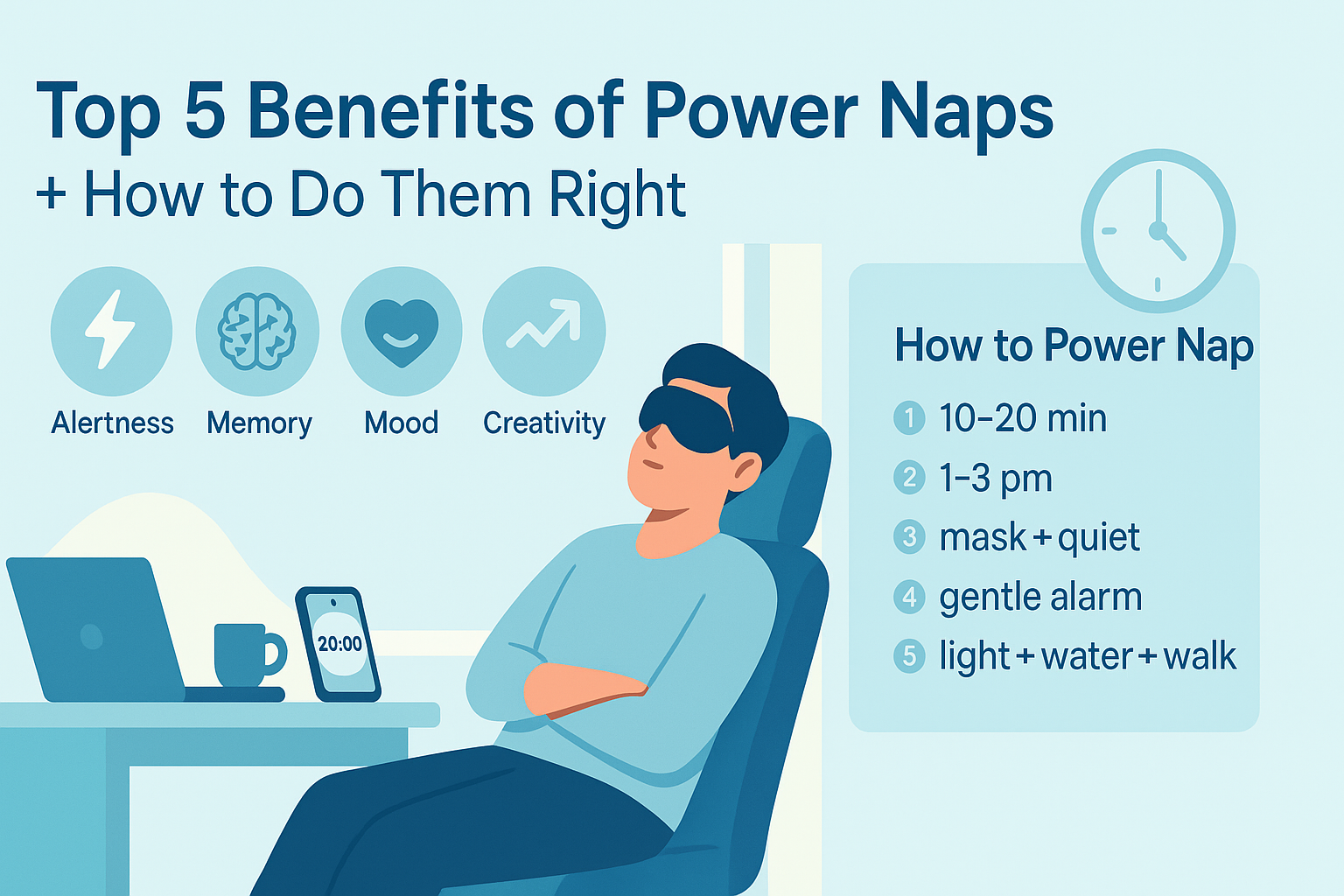
Power naps—short, intentional daytime sleeps that typically last 10–30 minutes—can do far more than take the edge off a sleepy afternoon. Done well, they sharpen alertness, enhance learning and memory, support creativity, lift mood, and help you perform more safely and productively for the rest of the day. This guide shows you exactly how to build smart, research-aligned power naps into a busy schedule—without sabotaging your night sleep.
Medical disclaimer: The strategies here are educational and general. If you have a medical condition (especially insomnia, excessive daytime sleepiness, depression, untreated sleep apnea, heart or blood pressure issues), are pregnant, take sedating medications, or operate heavy machinery, speak with a qualified clinician for personalized advice before adopting regular naps.
Who this is for: students, professionals, entrepreneurs, shift workers, caregivers—anyone who wants dependable energy and sharper thinking during the day.
What you’ll learn: the five biggest benefits of power napping, how to nap step-by-step, safety and timing rules, troubleshooting, and a simple 4-week plan to make power naps a sustainable habit.
Key takeaways
- Keep naps short and early. Aim for 10–25 minutes, ideally in the early afternoon (roughly 1–3 p.m.), to avoid grogginess and protect nighttime sleep.
- Plan your wake-up. Use a timer, bright light, a splash of water, light movement, or caffeine strategies to reduce post-nap fog.
- Measure what matters. Track simple KPIs like perceived alertness, errors, and time to complete focus tasks.
- Match the nap to the goal. Need a quick reset? Take 10–20 minutes. Need deeper learning or insight? A longer, well-timed nap window may help.
- Naps complement, not replace, night sleep. Most adults still need ~7–9 hours per night; naps are a booster, not a substitute.
Benefit 1: Sharper Alertness and Faster Reaction Time
What it is and why it matters
A properly timed power nap can rapidly restore vigilance—the ability to sustain attention and react quickly. This is particularly useful during the early-afternoon “dip” when circadian biology and a steady rise in sleep pressure combine to slow you down. Restoring alertness lowers mistakes, improves situational awareness, and helps you perform tasks that demand speed and accuracy.
Requirements & low-cost setup
- Timer or phone alarm with gentle ramping tone or vibration.
- Eye mask & earplugs (or a hoodie and a quiet corner).
- Cool, dark, quiet place—conference room, parked car in the shade, break room with a chair that reclines.
- Optional: white-noise app; small travel pillow.
Low-cost alternative: A folded sweater as a pillow, a clean scarf as a light-blocking cover, and your phone timer.
Step-by-step (beginner-friendly)
- Pre-set your alarm for 15–20 minutes; sit or recline.
- Block light and noise (mask/earplugs) and focus on slow nasal breaths (4 seconds in, 6 seconds out) for ~1 minute.
- Let the mind idle. Don’t “try” to sleep—aim for relaxed wakefulness. If sleep comes, great; if not, even quiet rest can improve alertness.
- Wake and re-activate. Upon the alarm: stand, stretch, hydrate, wash your face, and get bright light.
Beginner modifications & progressions
- If you wake groggy: shorten the nap window to 10–15 minutes.
- If you can’t fall asleep: treat it as a “quiet reset”—you’ll still feel better.
- Progression for busy days: stack two micro-rests (8–10 minutes each) separated by a brief walk.
Recommended frequency, duration & KPIs
- Frequency: 3–5 days per week or as needed on high-demand days.
- Duration: 10–20 minutes; experiment in 2–3 minute increments.
- KPIs: self-rated alertness (1–10), average response time in a simple reaction-time app, number of errors on repetitive tasks, and time-to-focus (minutes until you feel “locked in”).
Safety, caveats & common mistakes
- Mistake: napping late in the day; it can undermine night sleep.
- Mistake: letting naps drift past 30 minutes, which increases sleep inertia (post-nap grogginess).
- Caveat: if you feel irresistibly sleepy most days, investigate your night sleep, stress, or potential sleep disorders.
Mini-plan example (2–3 steps)
- 2:05 p.m.: mask+earplugs, 18-minute timer.
- 2:23 p.m.: alarm → stand, light stretch, cool water on face.
- 2:26 p.m.: bright light or a short walk; begin a high-focus task.
Benefit 2: Better Learning and Memory Consolidation
What it is and why it matters
Short daytime sleep can stabilize and integrate new information. During light sleep (and, when reached, slightly deeper stages), the brain rehearses and strengthens memory traces, helping you recall facts, procedures, and skills later. This is useful before exams, presentations, coding sprints, or learning physical skills.
Requirements & low-cost setup
- Notebook or app to jot key items right before the nap (what you want to remember).
- Timer set for 15–30 minutes.
- Calm environment with stable temperature.
Low-cost alternative: Use your phone’s Notes app and airplane mode.
Step-by-step
- Prime the brain: spend 5–10 focused minutes reviewing material or practicing a skill you want to retain.
- Nap 15–25 minutes in early afternoon.
- Brief reactivation: immediately after waking, spend 3–5 minutes recalling key points from memory before checking notes.
Beginner modifications & progressions
- If you can’t fall asleep: do a 15-minute “eyes-closed quiet rest.” Memory can still benefit from rehearsal plus rest.
- Progression for exam periods: 1–2 short nap windows per day (late morning and early afternoon), both capped at ~20 minutes.
Recommended frequency, duration & KPIs
- Frequency: before or after intense learning blocks; daily during study weeks.
- Duration: 15–25 minutes.
- KPIs: recall accuracy (% correct without notes), time to relearn, and error rates during practice.
Safety, caveats & common mistakes
- Mistake: cramming then taking a long late-day nap that disrupts night sleep.
- Caveat: naps do not compensate for chronic sleep restriction; consistent night sleep drives long-term learning capacity.
Mini-plan example
- 12:40 p.m.: 10 minutes of flashcards or code review.
- 12:50 p.m.: 20-minute nap.
- 1:12 p.m.: 3-minute recall from memory; quick quiz to verify.
Benefit 3: Improved Mood and Stress Buffering
What it is and why it matters
Even a brief nap can reset emotional tone—reducing irritability, improving patience, and softening the stress load so you approach the afternoon with more composure. Good mood isn’t just “nice to have”; it predicts collaboration quality, creative problem solving, and resilience.
Requirements & low-cost setup
- Wind-down cue: a short, repeatable ritual (two slow breaths, a phrase like “rest, not effort”).
- Eye mask & earplugs or a quiet corner.
- Timer set for 10–20 minutes.
Low-cost alternative: Sit upright with head support if you can’t lie down.
Step-by-step
- Name the state: quickly jot or rate your mood and stress (1–10).
- Nap 10–20 minutes.
- Re-emerge gently: stretch, hydrate, and expose yourself to bright light.
- Re-assess mood/stress to notice the change.
Beginner modifications & progressions
- If anxiety spikes when trying to sleep: switch to a 10-minute “non-sleep deep rest” (NSDR) or breath practice.
- Progression: pair a brief nature walk with your post-nap routine for additional mood lift.
Recommended frequency, duration & KPIs
- Frequency: any day you feel mounting stress; 3–4 days/week during heavy workloads.
- Duration: 10–20 minutes.
- KPIs: mood rating change (pre vs. post), irritability incidents, and perceived stress score (1–10).
Safety, caveats & common mistakes
- Mistake: doom-scrolling before or after the nap; it cancels mood benefits.
- Caveat: if you need multiple long naps, screen for insufficient night sleep or mood disorders.
Mini-plan example
- 1:10 p.m.: mood 5/10, stress 7/10.
- 1:12 p.m.: 15-minute nap.
- 1:29 p.m.: quick stretch + water; mood 7/10, stress 4/10.
Benefit 4: Enhanced Creativity and Problem-Solving Insight
What it is and why it matters
Short daytime sleep can facilitate “aha” moments—sudden insights that reorganize how you see a problem. This benefit is prized by designers, engineers, writers, founders, and analysts who need breakthroughs rather than incremental tweaks.
Requirements & low-cost setup
- Idea capture tool (paper or app) by your resting spot.
- Timer set for 20–30 minutes.
- A single “seed question” to hold lightly before you rest.
Low-cost alternative: A sticky note with the problem statement and your phone’s notes app.
Step-by-step
- Frame the question in one sentence (e.g., “What is the simplest onboarding flow that halves friction?”).
- Review constraints for 3–5 minutes, then set your timer for 20–25 minutes.
- Nap or rest without actively thinking about the problem.
- On waking, capture first thoughts—even fragments—before checking messages.
Beginner modifications & progressions
- If you rarely doze off: use a 15-minute quiet-eyes-closed rest; insight can still emerge.
- Progression: try a slightly longer window (up to ~30 minutes) on days when a deep problem needs a fresh view.
Recommended frequency, duration & KPIs
- Frequency: 2–3 times weekly during creative projects.
- Duration: 20–30 minutes.
- KPIs: number of novel ideas captured, solution quality ratings from peers/clients, time saved by the breakthrough.
Safety, caveats & common mistakes
- Mistake: scheduling this too late in the day; keep it early afternoon to protect night sleep.
- Caveat: insight benefits aren’t guaranteed every time—track trends over weeks, not one-offs.
Mini-plan example
- 1:00 p.m.: define the question; 3-minute review.
- 1:05 p.m.: 22-minute nap.
- 1:28 p.m.: write 3–5 ideas immediately; choose one to prototype today.
Benefit 5: More Productive Work and Fewer Errors
What it is and why it matters
When fatigue builds, mistakes multiply: misclicks, typos, missed steps, and poor decisions. A strategic power nap restores cognitive control, steadies attention, and can reduce error-prone behavior across the afternoon—especially in repetitive or safety-relevant tasks.
Requirements & low-cost setup
- Nap space policy (even informal): a quiet room or parked car.
- Timer and post-nap activation routine (light, water, brief walk).
- Optional: caffeine strategy (see “caffeine-nap” below) if tolerated.
Low-cost alternative: Car visor shade + travel pillow; set climate to comfortable.
Step-by-step
- Flag high-risk windows (complex tasks after lunch, long drives, post-meeting slumps).
- Nap 10–20 minutes before the risk window.
- Re-activate deliberately (light, movement, hydration).
- Start with structured tasks for 10–15 minutes before complex decision-making.
Beginner modifications & progressions
- If schedules are tight: slot a 10–12 minute micro-nap; micro-rests still reduce errors.
- Progression: combine a short walk or 2 minutes of light calisthenics post-nap to accelerate clarity.
Recommended frequency, duration & KPIs
- Frequency: before known fatigue-prone tasks or commutes; daily if workload demands.
- Duration: 10–20 minutes.
- KPIs: errors per hour, rework time, quality control pass rates, and subjective effort.
Safety, caveats & common mistakes
- Mistake: starting safety-critical work immediately after waking. Give yourself 10–15 minutes of low-risk tasks while residual grogginess clears.
- Caveat: if you rely on several naps daily to function, audit night sleep, stress, and workload.
Mini-plan example
- 12:55 p.m.: 15-minute nap scheduled before a long spreadsheet session.
- 1:12 p.m.: bright light + water + 2-minute walk.
- 1:15 p.m.: begin with simple checks, then move to complex formulas.
Quick-Start Checklist (Pin this somewhere you’ll see)
- Choose a standard nap window (e.g., 1:15–1:40 p.m.) 3–5 days/week.
- Keep it short: aim for 10–20 minutes; set a gentle alarm.
- Dark + quiet + cool: mask, earplugs, or a hoodie; shade if in a car (engine off, windows ventilated, safe location).
- Post-nap ritual: water, bright light, stretch, short walk.
- Track two numbers daily: alertness (1–10) and time-to-focus (minutes).
- Protect nights: if naps delay bedtime, move them earlier and shorten them.
Troubleshooting & Common Pitfalls
“I feel worse after napping.”
You likely slept too long or too late. Shrink to 10–15 minutes and schedule earlier. Use bright light and light movement when you wake.
“I can’t fall asleep.”
You don’t have to. Ten minutes of eyes-closed, phone-free rest still helps. Try a breath ratio of 4-in/6-out for a minute, then let your mind idle.
“Naps are disrupting my bedtime.”
Move your nap earlier (before ~2:30–3:00 p.m.) and shorten it to 10–15 minutes. Avoid caffeine late in the day.
“I wake up groggy.”
Grogginess (sleep inertia) fades. Minimize by keeping naps short, finishing with light exposure and cool water on your face. Give yourself a 10–15-minute runway of low-stakes tasks.
“My workplace doesn’t ‘allow’ naps.”
Frame naps as a focus and safety tool. Propose a pilot: 15-minute early-afternoon rest in a quiet space for two weeks, paired with simple productivity/error metrics.
“I crash mid-morning, not after lunch.”
You may be short on night sleep. Prioritize a better sleep schedule first. If needed, try a mid-morning micro-rest (8–12 minutes), but ensure nights remain solid.
“I’m tempted to nap in the evening.”
That’s more likely to harm nighttime sleep. If exhausted, take a very short rest (<10 minutes) and dim lights in the evening; aim for an earlier bedtime.
“Should I use caffeine?”
Caffeine can shorten reaction time but may not help everyone. If tolerated, try a small dose (e.g., a small cup of coffee) right before a 15–20-minute nap; many people wake as the caffeine kicks in.
How to Measure Results (Simple KPIs)
- Alertness (1–10): rate before and 10 minutes after the nap.
- Time-to-focus: minutes it takes to feel mentally “locked in” post-nap.
- Errors per hour: in repeated tasks (typos, redo steps).
- Task throughput: time to complete a standard block of focused work.
- Mood & stress (1–10): quick pre- and post-ratings.
Tip: Chart these in a simple weekly tracker. Look for trends over 2–4 weeks, not single days.
The “Caffeine-Nap” (Optional)
What it is: Drink a small coffee right before a 15–20-minute nap. Caffeine absorption rises as you wake, potentially reducing grogginess and boosting alertness.
Who should skip it: anyone sensitive to caffeine, those with reflux, anxiety triggered by stimulants, or late-day naps that could collide with bedtime.
How to try it safely:
- Keep it early (roughly 1–2 p.m.).
- Keep it small (≈ 100–150 mg caffeine or less).
- Set a 15–20-minute timer, nap, then stand up, hydrate, and move.
Four-Week Starter Plan (Roadmap)
Goal: integrate one consistent, short, early-afternoon power nap most weekdays; improve alertness, focus time, and mood without harming night sleep.
Week 1 — Setup & Baseline
- Pick a fixed window (e.g., 1:15–1:35 p.m., weekdays).
- Prepare your nap kit: mask, earplugs, timer, water bottle.
- Track: pre/post alertness, time-to-focus, and bedtime (ensure it’s unaffected).
Week 2 — Dial in Duration
- Experiment: 12, 15, 18, or 20 minutes; find the shortest window that lifts you without grogginess.
- Add a post-nap ritual: 2-minute walk + bright light + water.
- Skip or shorten if you’ll be within 6 hours of bedtime.
Week 3 — Match Nap to Demands
- On heavy learning days, prime (5–10 minutes review) before the nap.
- On creative days, seed one problem before resting.
- Optional: test a caffeine-nap once or twice; log effects on alertness and bedtime.
Week 4 — Sustain & Share
- Review four weeks of KPIs; choose a “default” nap length.
- Identify 1–2 high-risk error windows to protect with a planned nap.
- Share results with your team/manager if helpful (e.g., fewer errors, faster task times).
Safety Notes You Shouldn’t Skip
- Don’t nap when you must be immediately safety-critical upon waking (e.g., operating machinery). Give yourself a short, low-risk runway first.
- Never nap in a running car or unsafe location. If using a vehicle as a rest space, park safely, engine off, windows ventilated, doors locked.
- If you snore loudly, stop breathing during sleep, or feel excessively sleepy despite adequate night sleep, seek evaluation for sleep disorders.
- Pregnancy, certain medications, and some health conditions change how your body responds to naps; consult your clinician.
FAQs
1) What is the ideal length of a power nap?
Most people do best at 10–20 minutes. If you consistently feel groggy, shorten by 2–3 minutes. If you feel nothing, try 18–22 minutes.
2) When during the day should I nap?
Aim for early afternoon—roughly 1–3 p.m.—to align with the natural energy dip and avoid disrupting night sleep.
3) Will napping ruin my nighttime sleep?
Not if you keep naps short and early. If bedtime drifts later, move the nap earlier and reduce it to 10–15 minutes—or pause naps for a few days.
4) Do I have to fall fully asleep for a nap to help?
No. Quiet, eyes-closed rest can still improve alertness and reduce stress. Many beginners benefit even before true sleep occurs.
5) What can I do about post-nap grogginess (sleep inertia)?
Limit nap length, wake to a gentle alarm, get bright light, hydrate, and move for 1–2 minutes. Give yourself 10–15 minutes before demanding tasks.
6) Is a longer nap ever useful?
Sometimes. A 60–90-minute nap can complete a full sleep cycle and may help after major sleep loss. Use sparingly and keep it early; otherwise, it may affect bedtime.
7) Are power naps safe if I have high blood pressure or heart issues?
Short, early-afternoon naps are generally well-tolerated, but research is mixed about frequent or long daytime naps. Speak with your clinician to tailor a plan.
8) What if my workplace doesn’t support naps?
Propose a 15-minute focus break pilot with basic metrics (errors, throughput). Offer a low-cost setup (quiet room, eye masks). Emphasize safety and productivity.
9) Is a “coffee nap” really better than a plain nap?
For some, a small dose of caffeine before a 15–20-minute nap reduces grogginess and speeds alertness on waking. Others feel jittery—test carefully and early in the day.
10) Can naps help with creativity?
Yes—short naps can increase the odds of insight, especially when you lightly “seed” a problem before resting and capture ideas immediately after waking.
11) Do power naps help athletes or people doing physical work?
They can. Short naps improve reaction time, coordination, and decision-making under fatigue, which supports both sport and manual tasks.
12) How many days a week should I nap?
Start with 3–5 days/week, then adjust. If you need multiple naps daily to function, audit night sleep and overall recovery.
Conclusion
Power naps are a simple, low-cost way to unlock more alertness, better learning, steadier mood, creative insights, and fewer errors—without sacrificing your evenings. Keep them short and early, pair them with a smart wake-up ritual, and track a few KPIs so you can see the payoff in black-and-white.
Call to action: Choose a 15-minute window this week, set your timer, and give your first true power nap a try—your afternoon self will thank you.
References
- Can a quick snooze help with energy and focus? The science behind power naps, Harvard Health Publishing, December 4, 2024 — https://www.health.harvard.edu/staying-healthy/can-a-quick-snooze-help-with-energy-and-focus-the-science-behind-power-naps
- Power Nap: What It Is and How To Do It, Sleep Foundation, updated 2023 — https://www.sleepfoundation.org/sleep-hygiene/power-nap
- Napping, Sleep Foundation, updated 2023 — https://www.sleepfoundation.org/napping
- Sleep Inertia: How to Combat Morning Grogginess, Sleep Foundation, updated July 10, 2025 — https://www.sleepfoundation.org/how-sleep-works/sleep-inertia
- How Much Sleep Do We Really Need?, Sleep Foundation, updated July 11, 2025 — https://www.sleepfoundation.org/how-sleep-works/how-much-sleep-do-we-really-need
- Coffee Nap: What It Is and Does It Work?, Sleep Foundation, July 16, 2025 — https://www.sleepfoundation.org/sleep-hygiene/coffee-nap
- Time to wake up: reactive countermeasures to sleep inertia, Industrial Health, 2016 — https://pmc.ncbi.nlm.nih.gov/articles/PMC5136610/
- The effects of napping on cognitive functioning, Progress in Brain Research, 2010 — https://pubmed.ncbi.nlm.nih.gov/21075238/