




























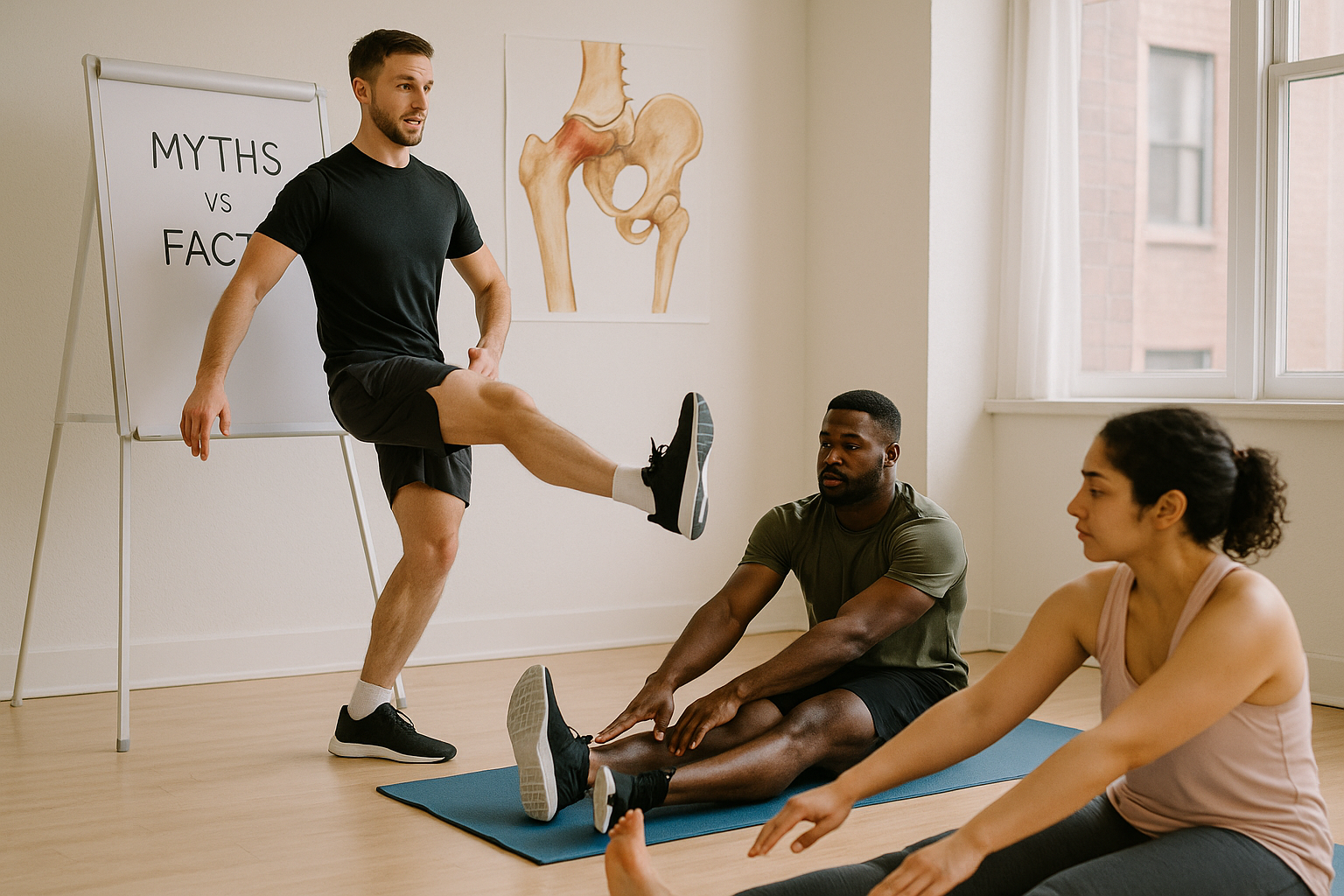
Flexibility should help you move better, feel better, and perform better—not waste your time or get you hurt. Yet the internet is full of half-truths that make stretching confusing. This guide cuts through the noise with evidence-backed answers you can actually use. You’ll learn what flexibility really is (and isn’t), when different stretch types make sense, how much to stretch, and how to progress safely whether you’re an office worker, lifter, runner, or weekend dancer. Put simply: flexibility training works when the method matches the goal. For quick context, here’s the big idea in one line: most “rules” about stretching are too absolute—success comes from the right dose, timing, and pairing with strength.
Fast-start plan (skim-friendly): Warm up dynamically, hold gentle static stretches after hard sessions or on off-days, build end-range control with light strength work, and progress volume slowly (10–20% per week).
1. “Stretching Before Workouts Prevents Injuries”
Stretching by itself before exercise does not reliably prevent injuries; a well-designed dynamic warm-up tailored to the task does more for risk reduction. Reviews of static pre-exercise stretching (the classic “hold for 30 seconds” before you move) show little to no protective effect on injury rates in general populations, while warm-ups that include light cardio, movement-specific drills, and controlled range-of-motion work are consistently helpful. The nuance is timing and type: static holds can still have a place for flexibility goals but are best used after training or in separate sessions. For sport or running days, prioritize raising tissue temperature, rehearsing movement patterns, and gradually increasing intensity.
- Why it matters: Injury prevention is multi-factorial—workload management, sleep, nutrition, and strength matter more than a few static holds.
- What to do instead (pre-session):
- 3–8 minutes of light cardio to raise temperature.
- 4–6 dynamic mobility drills (leg swings, hip circles, inchworms) matching your activity.
- 1–3 low-intensity “rehearsal” sets of the first exercise.
- Common mistakes:
- Long static holds immediately before sprints/lifts.
- Skipping progressive intensity ramps.
- “One-size-fits-all” stretch routines regardless of session goal.
1.1 Numbers & Guardrails
- Keep pre-session dynamic work to ~5–10 minutes; ramp intensity gradually.
- Save longer static holds (30–60 seconds) for cool-downs or off-days.
- Track soreness and acute spikes in volume; prevention is more than stretching.
Bottom line: For reducing injury risk, a task-specific dynamic warm-up beats static stretching alone. Use static stretching elsewhere for flexibility goals.
2. “Static Stretching Kills Performance”
Static stretching doesn’t automatically “kill” performance. The real issue is dose and timing. Longer static holds (≥60 seconds per muscle) can transiently reduce peak strength and power for minutes afterward; shorter holds (<60 seconds total per muscle) produce trivial or no meaningful decrements, especially when followed by an active warm-up. In other words, if you need maximal explosiveness, avoid long pre-event holds—but brief, low-intensity static stretches won’t ruin your session and can help if you’re stiff.
- Key takeaways:
- <60 seconds per muscle: minimal effect on strength/power.
- ≥60 seconds per muscle: expect small, temporary decreases.
- A full warm-up (dynamic + practice sets) offsets small downsides.
2.1 How to Apply
- Competing or testing maxes? Skip long static holds beforehand.
- Recreational training? If a muscle feels tight, 20–30-second holds won’t derail you.
- Pair any static holds with dynamic drills (e.g., 2×20s hip flexor stretch, then walking lunges).
2.2 Mini Case
A sprinter replaced 2×60s static hamstring holds with 2×20s + 3×10 dynamic leg swings and build-up strides. Reported “pop” improved while hamstring tightness stayed manageable.
Bottom line: Static stretching isn’t the villain—long pre-event holds are. Keep preworkout holds brief and follow with dynamic work.
3. “No Pain, No Gain”
Good flexibility training should not be painful. The target is tightness or slight discomfort, not sharp pain, pinching, tingling, or joint pain. Pain provokes protective guarding, reduces tolerance to stretch, and can reinforce unhelpful movement patterns. Most guidelines advise easing to the edge of range and breathing there; with consistency, your stretch tolerance improves and range follows.
- Checklist (sensation cues):
- Acceptable: stretching tension, mild burn, pressure (3–5/10 effort).
- Not acceptable: sharp joint pain, numbness/tingling, tearing sensations.
- If pain ≥6/10, back off the angle or change the drill.
3.1 How to Progress Without Pain
- Increase time under gentle tension (2–4 sets × 20–30s), not force.
- Use contract–relax (PNF-light): 5–6s gentle isometric, then ease deeper.
- Add heat or do stretches after light activity to reduce perceived stiffness.
Bottom line: Pain isn’t a badge of honor; consistent, comfortable stretching outperforms forcing range.
4. “Flexibility = Mobility”
They’re related but not identical. Flexibility is passive range—the angle you can reach when an external force helps. Mobility is active, usable range—the motion you control with your own muscles. You can be flexible but lack mobility (e.g., you can be put into a deep squat but can’t hold one). Performance and resilience rely more on mobility, which requires strength at end range, coordination, and motor control—things stretching alone doesn’t build.
- Mobility recipe:
- Gain passive range with static or PNF holds.
- Own it with controlled articular rotations (CARs) and end-range isometrics.
- Integrate into patterns (deep goblet squats, heel-elevated split squats).
4.1 Mini-Checklist
- For every new range you open, perform 1–2 sets of end-range lifts (e.g., lift-off or isometric at the new angle).
- Use slow eccentrics to teach control into the new range.
Bottom line: Flexibility gives access; mobility gives control. Train both for durable gains.
5. “Adults Can’t Get More Flexible”
Adults—including older adults—can significantly improve range of motion with 2+ weeks of consistent stretch training. Programs using static or PNF methods show meaningful ROM gains across ages, with some evidence that older adults benefit from longer holds (30–60s). While connective tissues do change with age, the nervous system’s tolerance to stretch adapts at any age when given regular, gentle exposure.
- Practical template (all ages):
- Frequency: 2–3×/week minimum; daily is fine if gentle.
- Dose: 2–4 sets × 20–30s per muscle (30–60s for older adults).
- Progression: Expand total weekly time under stretch by 10–20%.
5.1 Region-Specific Notes
- For prolonged sitting cultures, emphasize hip flexors, hamstrings, and thoracic spine.
- For floor-sitting cultures, add ankle dorsiflexion and deep-squat control.
Bottom line: Age is not a brick wall; consistency and appropriate dosing drive improvement.
6. “Stretching Eliminates DOMS”
Stretching before or after exercise does not meaningfully reduce delayed-onset muscle soreness (DOMS). High-quality reviews show any soreness reduction is tiny (a few points on a 100-point scale) and not clinically significant. Soreness reflects micro-damage, inflammation, novelty, and load spikes—things stretching doesn’t fix.
- What helps DOMS more:
- Load management and gradual progressions.
- Light active recovery (walking, easy cycling).
- Sleep and adequate protein (generally 1.2–2.0 g/kg/day if training).
6.1 Mini Case
A lifter replaced long post-leg-day static holds with a 10-minute easy spin and hip CARs. DOMS perception unchanged; next-day stiffness improved.
Bottom line: Stretch for range, not to “cure” soreness. For DOMS, manage training stress and recover smartly.
7. “Ballistic Stretching Is Dangerous and Should Never Be Used”
“Ballistic” means fast, bouncing end-range motions. It’s been labeled risky for the general public because aggressive bouncing can exceed tissue tolerance. But in skilled, coached settings (e.g., sprinters, martial artists, dancers), ballistic or high-velocity stretching can be used safely and may acutely increase ROM similar to other methods. The key is progression, control, and context. For most people, dynamic (not bouncing) stretches are the better pre-workout choice; ballistic drills are optional tools for advanced needs.
- Use with caution if you:
- Are returning from injury.
- Have hypermobility or joint laxity.
- Lack baseline control in the end range.
7.1 Safer Alternatives
- Dynamic swings with small amplitude, gradually increasing.
- Rhythmic end-range isometrics to prep tissues for speed without bounce.
Bottom line: Not inherently evil—but ballistic stretching is a niche tool best reserved for trained populations with coaching.
8. “Foam Rolling ‘Breaks Up’ Fascia to Make You Flexible”
Foam rolling doesn’t smash adhesions like a rolling pin. Tissues are far tougher than that; the pressures applied aren’t sufficient to “break up” fascia. Yet foam rolling can increase ROM acutely, likely via nervous-system modulation—reducing sensitivity and altering tone—rather than structural change. Used briefly in warm-ups, it can help you move more comfortably into dynamic drills; used after sessions, it may reduce perceived stiffness.
- How to use it:
- 30–60 seconds per area, 1–2 passes.
- Breathe, avoid grimacing; seek pressure + relaxation, not pain.
- Follow with active drills to “lock in” range.
8.1 Don’ts
- Don’t grind tender spots for minutes.
- Don’t substitute rolling for training the new range.
Bottom line: Foam rolling is a useful primer, not a tissue remodeler. Pair it with active mobility or strength.
9. “More Flexibility Is Always Better”
Extreme flexibility without control can increase injury risk, especially around vulnerable joints (knees, shoulders, spine). People with generalized joint hypermobility have higher odds of certain ligament injuries and may have poorer outcomes after reconstruction if they return to high-impact sport without added stability training. The sweet spot is adequate range for your tasks plus strength and coordination at those ranges.
- Signals you may need stability, not more stretch:
- “Loose” joints that frequently feel unstable or “give way.”
- Pain at end range rather than in the muscle belly.
- Great passive range but poor balance or control.
9.1 What to Emphasize
- End-range isometrics (e.g., terminal knee extension holds).
- Balance and proprioception work (single-leg tasks, perturbations).
- Heavier, slow-tempo lifts through full, controlled range.
Bottom line: The goal isn’t max bendiness; it’s usable range with strength.
10. “Yoga Alone Covers All Flexibility Needs”
Yoga improves flexibility, balance, and body awareness, and it’s an excellent entry point for many. But no single modality covers everything. If you have sport-specific needs (e.g., ankle dorsiflexion for deep squats, hip rotation for running mechanics), you may need targeted stretches and end-range strength that standard flows don’t emphasize. Likewise, if you’re performance-focused, you’ll want progressive overload and tissue-specific work that complements your yoga practice.
- Augment yoga with:
- End-range lifts (e.g., Nordic hip lifts, calf raises with 2–3s pauses).
- Task-specific drills (e.g., wall ankle mobilizations for squat depth).
- Load progressions (tempo squats, split squats) to own new ranges.
10.1 Mini Case
A vinyasa-regular could touch the floor in forward folds but struggled with squat depth. Adding ankle dorsiflexion drills and paused goblet squats yielded pain-free, deeper squats in 6 weeks.
Bottom line: Yoga is great—but pair it with targeted, loaded work for complete mobility.
11. “You Must Be Warm to Stretch; Morning Stretching Is ‘Bad’”
It’s okay to stretch gently when you’re not fully warm, especially for daily maintenance. You’ll likely feel stiffer in the morning because of fluid shifts and overnight immobility, so reduce intensity and keep movements slow and small to start. For maximal performance sessions, yes—use a proper dynamic warm-up. For general mobility, low-intensity morning stretches can be a healthy habit.
- Morning routine (5–8 minutes):
- Neck and t-spine CARs, cat–cow, hip openers.
- 2×20–30s gentle calf and hamstring holds.
- Finish with 5 slow bodyweight squats.
11.1 Guardrails
- Keep effort ~3–4/10; avoid fast bouncing first thing.
- If a joint is irritated on waking, choose active mobility instead of holds.
Bottom line: Gentle is fine when “cold.” Save intense ranges and fast work for after you’ve warmed up.
12. “Only Stretching Improves Flexibility—Strength Work Can’t”
Strength training through full range of motion can improve flexibility as much as traditional stretching in many contexts. Deep squats, split squats, RDLs, calf raises with full excursion—done with control—build strength and range together. This is especially effective for people who dislike stretching or who need range that’s immediately usable under load.
- How to program:
- Choose long-range exercises (e.g., heel-elevated goblet squats, Cossack squats).
- Use slow eccentrics (3–5s down) to explore range safely.
- Sprinkle end-range isometrics (5–10s) between sets.
12.1 Mini Checklist
- Train big joints (ankles, hips, shoulders) 2–3×/week with full-ROM lifts.
- If you still feel stiff, add 5–10 minutes of targeted static work after training.
Bottom line: You don’t have to choose—loaded full-ROM strength work is mobility training.
13. “Stretching Permanently Lengthens Muscles”
Most short- to medium-term flexibility gains come from increased stretch tolerance—your nervous system allows deeper positions—not from permanently lengthening muscle fibers. That said, chronic stretching over weeks to months can produce lasting ROM increases, and pairing stretching with strength helps you keep and use the range. Think “training the system,” not “remodeling putty.”
- Practical implications:
- Expect acute gains after a session, some of which fade within hours.
- Build chronic gains with regular practice (≥2 weeks) and end-range strength.
- Maintain with low weekly “doses” once you’ve reached your goal.
13.1 Numbers & Guardrails
- Typical prescription: 2–4 sets × 20–30s, 2–3×/week (30–60s for older adults).
- Reassess every 4–6 weeks; adjust volume based on progress and soreness.
Bottom line: You’re training your nervous system and capacity, not magically lengthening muscle overnight. Consistency cements lasting change.
FAQs
1) How long should I hold a static stretch?
For most adults, 20–30 seconds per set works well, repeated 2–4 times. Older adults may benefit from 30–60-second holds. Longer isn’t always better; accumulating time under gentle tension beats forcing a single long hold.
2) How many days per week should I stretch?
Aim for 2–3×/week as a minimum. Daily gentle stretching is fine if you keep intensity low. Progress total weekly volume by 10–20% to avoid flares.
3) Is PNF stretching better than static stretching?
Both improve ROM. PNF (contract–relax) can yield slightly larger short-term gains for some muscles, but it’s also more fatiguing. If you’re lifting heavy the same day, stick to simple static holds post-session and use PNF on lighter days.
4) Does stretching improve posture?
Indirectly. Stretching can reduce stiffness that contributes to certain postures, but sustainable change comes from strength + habit change (e.g., strengthening mid-back, glutes, deep neck flexors) and workload management (break up long sitting).
5) Should I stretch before or after lifting?
Before lifting, use a dynamic warm-up and keep any static holds brief (<60s per muscle). After lifting, or on off-days, use longer static holds to target flexibility goals.
6) Can strength training replace stretching entirely?
For many, full-ROM strength plus dynamic warm-ups provides enough mobility. If you have specific range goals (splits, overhead mobility), add targeted static/PNF work.
7) What about foam rolling—before or after?
Use it before to reduce perceived stiffness and ease into dynamic drills, or after for comfort. Keep it short (30–60s/area) and pair it with active work.
8) Is morning stretching safe?
Yes—if it’s gentle. Expect more stiffness on waking. Start with active mobility, then short holds. Save fast or deep end-range work for later in the day or after a warm-up.
9) How do I know if I’m over-stretching?
Signs include joint pain, lingering soreness >48 hours, or declining performance. Reduce range, sets, or frequency, and add end-range strength to stabilize.
10) Does stretching help running economy or speed?
It can help if restricted ROM limits your stride, but excessive pre-run static stretching may transiently reduce power. Favor dynamic drills and strides pre-run; do static holds later.
11) I’m hypermobile—should I stretch?
Prioritize control and strength at end range. Gentle mobility work is fine, but build stability (isometrics, balance drills) and avoid aggressive end-range holds without guidance.
12) What’s the fastest way to improve flexibility?
There’s no hack, but combining short daily doses (5–10 minutes), longer sessions 2–3×/week, and end-range strength yields steady results in 2–6 weeks for most goals.
Conclusion
Flexibility training isn’t about dogma—it’s about matching method to mission. Static stretching is valuable, just not everywhere; dynamic warm-ups shine before activity; PNF can boost stubborn ranges; foam rolling is a helpful primer; and full-range strength training turns range into usable mobility. The big levers are consistency, appropriate dosing, and owning new positions with strength. Start small, stay gentle, and pair range work with the movements you care about—walking, lifting, running, yoga, or sport-specific skills. Over a few weeks, you’ll notice deeper angles, smoother motion, and fewer “tightness” roadblocks.
Your next step: Pick two target areas (e.g., ankles, hips). For each, do 2–4×20–30s static holds after training, add one full-ROM strength move (slow eccentric), and keep a weekly note of how it feels. Repeat for 4–6 weeks.
References
- Kay AD, Blazevich AJ. Effect of Acute Static Stretch on Maximal Muscle Performance: A Systematic Review. Medicine & Science in Sports & Exercise. 2012. https://pubmed.ncbi.nlm.nih.gov/21659901/
- Behm DG, Chaouachi A. A review of the acute effects of static and dynamic stretching on performance. European Journal of Applied Physiology. 2011. https://pubmed.ncbi.nlm.nih.gov/21373870/
- Chaabene H, Behm DG, Negra Y, Granacher U. Acute Effects of Static Stretching on Muscle Strength and Power. Frontiers in Physiology. 2019. https://pmc.ncbi.nlm.nih.gov/articles/PMC6895680/
- Herbert RD, de Noronha M, Kamper SJ. Stretching to prevent or reduce muscle soreness after exercise. Cochrane Review. 2011 (updated summary 2022). https://www.cochrane.org/evidence/CD004577_stretching-prevent-or-reduce-muscle-soreness-after-exercise
- Weppler CH, Magnusson SP. Increasing Muscle Extensibility: A Matter of Increasing Length or Modifying Sensation? Physical Therapy. 2010. https://academic.oup.com/ptj/article/90/3/438/2737895
- Cheatham SW, Kolber MJ, Cain M, Lee M. The Effects of Self-Myofascial Release Using a Foam Roller. International Journal of Sports Physical Therapy. 2015. https://pubmed.ncbi.nlm.nih.gov/26618062/
- Wilke J, Müller A-L, Giesche F, et al. Acute Effects of Foam Rolling on Range of Motion. Journal of Bodywork and Movement Therapies. 2020. https://pubmed.ncbi.nlm.nih.gov/31628662/
- Garber CE, Blissmer B, Deschenes MR, et al. ACSM Position Stand: Quantity and Quality of Exercise for Developing and Maintaining Fitness in Healthy Adults. Medicine & Science in Sports & Exercise. 2011. https://pubmed.ncbi.nlm.nih.gov/21694556/
- Konrad A, Tilp M, et al. Chronic Effects of Stretching on Range of Motion: Systematic Review with Meta-Analysis. Sports Medicine – Open. 2023. https://pmc.ncbi.nlm.nih.gov/articles/PMC10980866/
- Afonso J, Rocha T, Nikolaidis PT, et al. Strength Training versus Stretching for Improving Range of Motion: A Systematic Review and Meta-Analysis. Healthcare (MDPI). 2021. https://www.mdpi.com/2227-9032/9/4/427
- Zsidai B, et al. Generalised joint hypermobility increases ACL injury risk and is associated with inferior outcome after ACL reconstruction: a systematic review. British Journal of Sports Medicine. 2023. https://bjsm.bmj.com/content/57/15/972
- Konrad A, Budini F, Tilp M. Effects of acute static, ballistic, and PNF stretching on muscle–tendon properties and ROM. Scandinavian Journal of Medicine & Science in Sports. 2017. https://pmc.ncbi.nlm.nih.gov/articles/PMC5479471/