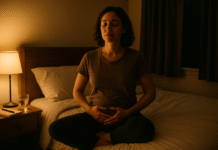















When your goal is to drift off faster and sleep deeper, the most effective yoga is slow, supported, and breath-led. Below are 10 yoga poses for relaxation and sleep you can do in 10–30 minutes before bed to calm your nervous system and ease physical tension. In short: choose comfortable, low-effort shapes, hold each pose for 3–10 minutes, and breathe slowly through your nose to signal “rest-and-digest.” For a fast-start routine, pick 3–5 poses, dim the lights, and keep your phone out of the room. This guide is educational and not a substitute for medical care; if you’re pregnant, injured, or managing a health condition, check with a clinician before starting.
1. Supported Child’s Pose (Balasana)
Supported Child’s Pose melts shoulder and back tension while promoting a “safe” curled posture that naturally soothes the nervous system. Start here if your mind is racing; the gentle pressure of the torso on the thighs slows the breath and lengthens your exhale, which lowers heart rate. Use a bolster (or two stacked pillows) to make it completely restorative, and aim to stay long enough for your breath to find a calm rhythm—about 3–5 minutes. This pose is especially helpful after screen-heavy evenings because it rounds the spine and relaxes the eyes.
1.1 Why it helps
A forward-folded, supported shape decreases muscular effort, invites diaphragmatic breathing into the back body, and can reduce sympathetic (fight-or-flight) activation. Many people report their first deep sigh of the evening here, which is a practical sign you’re downshifting.
1.2 How to do it (steps)
- Kneel on a mat with big toes together and knees wide enough to fit a bolster lengthwise between them.
- Fold forward, resting chest and belly on the bolster; turn your head to one side.
- Slide your elbows forward and drape your forearms on the floor; relax your jaw and tongue.
- Breathe in for ~4 seconds and out for ~6–8 seconds through your nose.
- Halfway through, turn your head to the other side.
- To exit, bring hands under shoulders and rise slowly.
1.3 Numbers & guardrails
Hold 3–5 minutes. If kneeling is uncomfortable, place a folded blanket between calves and hamstrings, or sit on blocks. If hips don’t reach heels, add extra padding.
Synthesis: When fully supported and breath-led, Child’s Pose signals safety to your body and primes you for deeper relaxation in the next pose.
2. Legs-Up-the-Wall (Viparita Karani)
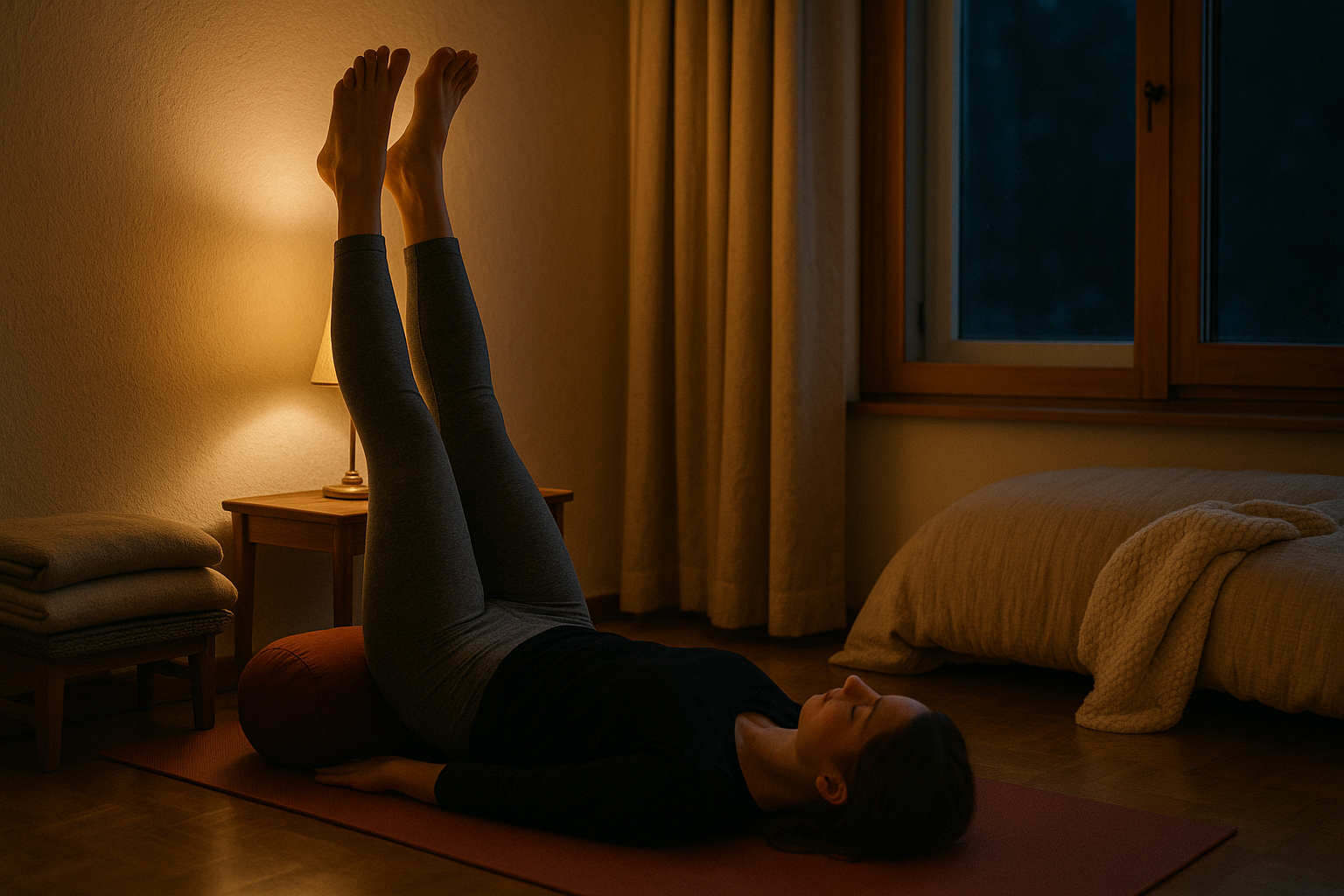
Legs-Up-the-Wall is a gentle inversion that relieves heavy legs, eases lower-back compression, and encourages a slower heart rate. It’s a favorite pre-sleep reset because it requires almost no effort yet changes how blood and lymph move through the lower body. The quiet, still position helps the mind settle, making it an ideal bridge between a busy evening and bed. People who stand or sit for long hours often feel immediate relief in the calves and hamstrings.
2.1 Why it helps
Mild elevation of the legs reduces muscular demand and can ease venous pooling in the lower limbs after long days, while the neutral spine invites diaphragmatic breathing. Stillness here also makes it easy to lengthen your exhale—a cue linked with parasympathetic activation.
2.2 How to do it (steps)
- Sit sideways with your hip touching a wall; lie down and pivot to bring both legs up the wall.
- Optionally slide a folded blanket under your sacrum for a slight pelvic tilt.
- Rest arms at about 45° from your sides with palms up.
- Close your eyes; inhale through the nose for ~4–5 seconds, exhale for ~6–8.
- If hamstrings feel tight, bend knees or slide farther from the wall.
2.3 Numbers & guardrails
Hold 3–8 minutes. If you feel tingling in the feet, bend your knees and place soles together in a diamond shape. In late pregnancy or if lying flat is uncomfortable, elevate the torso with pillows or switch to side-lying.
Synthesis: With minimal setup, Viparita Karani reduces physical load and creates the quiet needed for sleep-friendly breathing patterns.
3. Reclined Bound Angle (Supta Baddha Konasana)
Reclined Bound Angle gently opens the hips and chest while supporting the back, making it a deeply restful option for people who sit all day. The open, supported posture counters slumping without requiring muscular effort, which can reduce perceived stress and invite fuller belly breathing. Positioning props correctly is the secret: once supported, your breath can expand in all directions and your shoulders release into gravity.
3.1 Why it helps
Relaxed hip external rotation can decrease low-grade tension in the pelvis and lower back. Gentle chest opening offsets rounded-shoulder posture and can make slow nasal breathing feel easier. The symmetry and support are inherently soothing.
3.2 How to do it (steps)
- Place a bolster or 2–3 pillows lengthwise; sit with your low back near the edge.
- Lie back so your spine and head are fully supported.
- Bring soles of feet together; let knees fall outward.
- Place blocks, cushions, or rolled blankets under your thighs so there’s no stretch sensation.
- Rest hands on belly or at sides; breathe in for ~4–5, out for ~6–8.
3.3 Numbers & guardrails
Hold 4–8 minutes. If your inner thighs grip or knees hover uncomfortably, raise the supports. If your low back arches, slide support higher under the ribcage or add a small cushion under the head.
Synthesis: Supta Baddha Konasana is the “set-and-forget” hip opener—once supported, your breath and nervous system do the rest.
4. Supine Spinal Twist (Supta Matsyendrasana)
A gentle twist helps release the paraspinal muscles and the often-overlooked side-body, which can reduce the fidgety urge to stretch in bed. This pose is less about range and more about feeling the breath ripple across the ribs. Twisting also offers a clear “before and after” contrast; many people notice their breath is longer and quieter when they return to center.
4.1 Why it helps
By passively rotating the spine and opening the chest, you relieve residual tension from sitting and reaching. The broad contact of the back with the floor heightens interoception—awareness of internal sensations—which is calming for many.
4.2 How to do it (steps)
- Lie on your back, knees bent, feet on the floor.
- Shift hips 2–3 inches right; draw knees to chest and lower them left.
- Extend arms in a T or cactus; turn head right if comfortable.
- Place a pillow between knees or under them if they hover.
- Breathe smoothly for 8–12 cycles, sensing rib movement.
- Return to center; switch sides.
4.3 Numbers & guardrails
Hold 2–4 minutes per side. Keep both shoulders heavy; adjust knee support to avoid pulling. If low-back sensitivity arises, make it gentler with feet stacked instead of knees together.
Synthesis: Short, supported twists “wring out” restlessness and set up easier, slower breathing for the rest of your wind-down.
5. Supported Seated Forward Fold (Paschimottanasana)
When the hamstrings or back feel tight, a fully propped forward fold can be profoundly calming. Unlike active stretching, this version uses a high bolster to bring the ground up to you, letting your spine round and your head rest. The contact of forehead to support is a classic downshift signal; combine that with long exhales and you have a reliable path toward sleepiness.
5.1 Why it helps
Forward folds tend to decrease arousal by containing the senses and compressing the belly softly, which encourages diaphragm-led breathing. The head support and quiet visual field reduce cognitive load.
5.2 How to do it (steps)
- Sit with legs straight; place a bolster (or stacked pillows) over your thighs, highest near the knees.
- Hinge forward until your belly and chest meet the support; rest forehead.
- If hamstrings pull, bend knees over a rolled blanket.
- Let arms drape; breathe with a 1:1.5 inhale-to-exhale ratio (e.g., 4 in, 6 out).
- Soften the jaw and eyelids; swallow occasionally to relax the throat.
5.3 Numbers & guardrails
Hold 3–6 minutes. If you feel tingling or sharp stretch, add height and bend knees more. People with back disc issues should keep the fold shallow and well supported, or skip and choose Child’s Pose.
Synthesis: By turning effort into support, this forward fold quiets visual and muscular noise—the perfect primer before reclined poses.
6. Constructive Rest with Diaphragmatic Breathing
Constructive Rest (semi-supine, knees bent) is the most accessible position to practice diaphragmatic breathing without straining your back. It flattens the thoracolumbar junction just enough to let the breath spread evenly and helps many people release their shoulders. Because there’s no stretch to monitor, your attention can settle purely on the breath—ideal for transitioning to sleep.
6.1 Why it helps
Slow nasal breathing with an extended exhale is correlated with reduced heart rate and increased heart-rate variability, both markers of relaxation. Practicing this in a neutral position builds the breathing skill you’ll use in every other pose and in bed.
6.2 How to do it (steps)
- Lie on your back with knees bent, feet hip-width; place a pillow under the head.
- Slide a folded blanket under your head/shoulders if the chin lifts.
- Rest one hand on belly, the other on lower ribs.
- Inhale gently through the nose, feeling both hands rise; exhale longer than you inhale.
- Try a 4–6 pattern (4-second inhale, 6-second exhale) for 2–3 minutes.
- Optional: add a 2-second pause after exhale.
6.3 Mini checklist
- Mouth closed; tongue resting on the roof of the mouth.
- No shrugging; shoulders melt into the floor.
- If breath feels strained, shorten counts.
Synthesis: Constructive Rest plus slow nasal breathing is your master key—simple, repeatable, and effective on nights when you can’t force sleep.
7. Supported Bridge (Setu Bandha Sarvangasana)
With a block or firm cushion under the sacrum, Supported Bridge gently opens the front body and releases the hip flexors, which can be tight from sitting. The lift is small and passive, yet it often produces an immediate “ahh” in the low back. Because your throat stays open and the chest lifted, many people find it easier to extend the exhale here without feeling compressed.
7.1 Why it helps
A passive pelvic lift reduces lumbar compression and encourages breath into the sides and back ribs. The subtle inversion of the pelvis (not the head) can feel grounding without the intensity of full inversions.
7.2 How to do it (steps)
- Lie on your back, knees bent.
- Lift hips slightly; place a yoga block (lowest or middle height) or firm cushion under the sacrum (not the low back).
- Let the pelvis be heavy on the support; relax the glutes.
- Rest arms at sides; breathe 4–5 in, 6–8 out.
- To exit, press feet, lift hips, remove support, lower slowly.
7.3 Numbers & guardrails
Hold 2–5 minutes. If you feel tingling, lower the block height. Avoid if active back pain worsens in extension; choose Constructive Rest instead.
Synthesis: Supported Bridge creates space where many of us feel stuck—the front hips and low back—so your body can finally unclench before bed.
8. Supine Figure Four (Thread the Needle)
This supine hip opener targets the deep rotators without the strain of classic Pigeon Pose. Tight hips often translate into low-back tension; easing them on your back is both efficient and safe close to bedtime. Because your head and shoulders are down, you can combine the pose with slow nasal breathing or even a short body scan.
8.1 Why it helps
Gentle external rotation can reduce tug on the sacrum and low back while the floor stabilizes the pelvis. The stillness allows attention to move inward, aligning with the intention to sleep soon after.
8.2 How to do it (steps)
- Lie on your back; place right ankle over left thigh, just above the knee.
- Draw the left knee toward the chest, threading the right hand through the legs to clasp behind the left thigh.
- Keep your tail heavy; flex the right foot.
- Breathe slowly for 8–10 cycles; then switch sides.
- If clasping is hard, use a strap or hold the shin.
8.3 Numbers & guardrails
Hold 2–4 minutes per side. Keep the sacrum grounded; if your tail lifts, place the bottom foot on the floor and stay there. If knee discomfort arises, back off and support the shape with a strap.
Synthesis: Supine Figure Four releases stubborn hip tension with zero balance demands, paving the way for deeper rest in your final poses.
9. Cat–Cow (Marjaryasana–Bitilasana) to Neutral
A small dose of slow Cat–Cow can dissipate daytime stiffness and make stillness more comfortable. Think of it as “flossing” the spine before you settle. Keep it minimal and breath-led so you lower arousal rather than revving up.
9.1 Why it helps
Coordinating movement with breath improves interoception and quiets mental noise, especially when the exhale is longer. Gentle spinal flexion/extension prepares the back to relax in Savasana.
9.2 How to do it (steps)
- Come to hands and knees, wrists under shoulders and knees under hips.
- Inhale, gently arch (Cow), widening collarbones; exhale, round (Cat), letting the head hang.
- Move slowly for 6–10 rounds, lengthening the exhale each time.
- After the last round, return to neutral and sit back on heels for 3 quiet breaths.
9.3 Numbers & guardrails
Spend 1–2 minutes total. Keep the range small; no need to push into end ranges at night. If wrists are unhappy, make fists or do the movement seated.
Synthesis: A minute of breath-led spinal waves reduces fidgeting and makes the next long hold feel genuinely restful.
10. Savasana with Yoga Nidra (Guided Rest)
Savasana (Corpse Pose) is the capstone: a supported, symmetrical rest where you can layer in a short yoga nidra—guided body scan and imagery—to shift into a sleep-like state. Because there’s no stretching or balancing to manage, your whole attention can drift into the narration or the rhythm of your breath. Many people fall asleep during or right after this step, which is a success when practiced at bedtime.
10.1 Why it helps
Guided relaxation techniques like yoga nidra are associated with reduced perceived stress and may improve sleep onset and quality. The structured sequence (body scan, breath awareness, imagery) gives your mind a non-stimulating task—exactly what a racing mind needs.
10.2 How to do it (steps)
- Lie on your back; place a pillow under the knees and a light blanket over the body.
- Support the head so the forehead is level with or slightly higher than the chin.
- Start a 5–10 minute yoga nidra recording or guide yourself: notice sounds, body contact, breath, then rotate attention through body parts from toes to head.
- Keep breathing gently through the nose; allow thoughts to pass without engagement.
- If you’re likely to fall asleep, set your device to stop playback automatically.
10.3 Numbers & guardrails
Stay 5–15 minutes. If lying flat is uncomfortable, elevate the torso or rest on your side with a pillow between the knees. If anxiety spikes in stillness, shorten the session and emphasize exhale-lengthening.
Synthesis: Savasana plus a short nidra script is the final nudge—your body rests, your mind softens, and sleep becomes the next natural step.
Optional 15-Minute Pre-Sleep Flow (quick reference)
- Supported Child’s Pose — 3 minutes
- Legs-Up-the-Wall — 4 minutes
- Supine Twist — 2 minutes/side
- Savasana with short yoga nidra — 4 minutes
Breath rule: Inhale through the nose, exhale through the nose or softly through the mouth, keeping exhale longer.
FAQs
1) How long before bedtime should I do these poses?
Most people benefit from practicing 30–60 minutes before lights out, after screens are off and the room is dim. That timing leaves space to transition to hygiene tasks without rushing. If evenings are hectic, even 10–15 minutes of two or three poses can help; the key is consistency and slow breathing rather than long sessions.
2) What if yoga stimulates me and makes it harder to sleep?
Skip strong flows and any shape that feels “stretchy.” Use ample props so there’s no strain, keep lights low, and emphasize a longer exhale (e.g., 4-in, 6–8-out). If movement wakes you up, go straight to Constructive Rest and Savasana with a short nidra; many people find stillness-only routines most sedating.
3) I have back pain—are these poses safe?
Gentle, supported versions are generally well tolerated, but safety is individual. Avoid extremes (deep twists, aggressive forward folds) and choose well-supported options like Child’s Pose, Constructive Rest, and Savasana. If pain increases, stop and consult a clinician or physical therapist for personalized guidance before resuming.
4) Can I combine these poses with other sleep strategies?
Yes. Pair them with a stable bedtime, a cool, dark room, and a consistent wind-down ritual. Many people add a warm shower, light reading, or journaling. If chronic insomnia persists, ask about cognitive behavioral therapy for insomnia (CBT-I), which is considered first-line treatment; yoga can be a supportive add-on.
5) How often should I practice to see results?
Aim for most nights, even if just 10 minutes. Practice creates familiarity; your body learns to associate these shapes and breath patterns with winding down. Improvements tend to come from regular, brief sessions rather than occasional long ones.
6) Which breathing pattern is best at night?
Keep it easy and nose-led with a longer exhale. A simple 4-in/6-out rhythm is effective for many. If counts feel strained, shorten them; comfort matters more than perfection. Over a few minutes, most people notice heart rate settling and thoughts slowing.
7) Are there poses I should avoid before bed?
Anything vigorous or balance-heavy (handstands, fast Sun Salutations) can be stimulating. Deep backbends may feel energizing for some. Close to bedtime, favor supportive, floor-based shapes held for several minutes with soft eyes and minimal effort.
8) What props do I need if I don’t own yoga gear?
Household items work well: firm pillows as bolsters, folded blankets or towels as blocks, and an eye pillow made from a sock filled with rice. A wall is your best prop for Legs-Up-the-Wall. Wear warm layers so your body doesn’t have to “work” to stay comfortable.
9) Will yoga fix chronic insomnia?
Yoga can reduce stress and help many people fall asleep faster, but chronic insomnia is multifactorial. Evidence supports behavioral treatments like CBT-I as first-line care; yoga and relaxation practices can complement those approaches. If sleep troubles persist for weeks, involve a healthcare professional.
10) Is yoga nidra the same as meditation?
They overlap but aren’t identical. Yoga nidra is typically practiced lying down with a guided body scan and imagery aimed at a sleep-like state. Seated meditation usually emphasizes upright posture and open awareness. Both can support sleep; choose the one that feels most calming to you.
Conclusion
Wind-down yoga works because it replaces effort with comfort, movement with stillness, and busy thoughts with simple breath cues. The 10 poses above create a dependable pathway: soften the back and hips, elevate the legs, lengthen the exhale, and finish with guided rest. Keep sessions short, dimly lit, and consistent, and you’ll teach your body that these shapes mean “night mode.” If you already follow a bedtime routine, insert one or two of the most soothing poses where they fit. If you’re starting from scratch, try the 15-minute sequence once a night for a week and notice what changes—fall-asleep time, nighttime awakenings, or how you feel in the morning. Pair your practice with steady sleep habits and, if needed, evidence-based care for persistent insomnia. Ready to begin tonight? Roll out a mat, grab a pillow, and start with Supported Child’s Pose.
CTA: Roll a pillow under your chest, dim the lights, and take your first slow exhale—tonight’s practice starts now.
References
- Yoga: Effectiveness and Safety, National Center for Complementary and Integrative Health (NCCIH), reviewed July 2024, NCCIH
- How Yoga Can Improve Your Sleep Quality, Sleep Foundation, July 29, 2025, Sleep Foundation
- Behavioral and Psychological Treatments for Insomnia: Patient Guide, American Academy of Sleep Medicine (AASM) PDF, 2021, AASM
- Yoga nidra for sleep, Sleep Foundation, Feb 27, 2024, Sleep Foundation
- How to Build a Better Bedtime Routine for Adults, Sleep Foundation, July 22, 2025, Sleep Foundation
- Yoga for better sleep, Harvard Health Publishing, June 15, 2020, Harvard Health
- Breath of Life: The Respiratory Vagal Stimulation Model, Frontiers in Human Neuroscience (NIH/PMC), Oct 2018, PMC
- The effect of chronic yoga interventions on sleep quality: Meta-analysis, Healthcare (NIH/PMC), 2025, PMC
- Cognitive Behavioral Therapy, Sleep Education by AASM, June 29, 2023, Sleep Education
- Relaxation Exercises to Help Fall Asleep, Sleep Foundation, July 24, 2025, Sleep Foundation
- Yoga for Health: What the Science Says, NCCIH (for clinicians), 2024, NCCIH
- Increased well-being: Another reason to try yoga, Harvard Health Publishing, Jan 16, 2024, Harvard Health