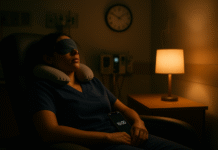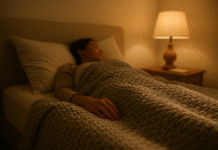





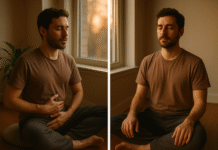












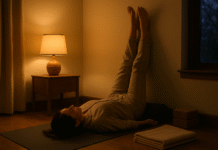





If your mind is racing and your body feels wired, breathing may be the fastest way to shift gears into sleep. “Breathing exercises to relax before bed” are simple, timed patterns that slow your breathing rate and lengthen your exhale, signaling your nervous system to downshift so you can drift off more easily. In plain terms: slow, nasal, belly-led breaths with a slightly longer exhale help many people fall asleep faster and wake less at night. For a quick start, try this mini routine: lie down, place one hand on your belly, inhale through your nose for 4, and exhale for 6–8; repeat for 2–3 minutes. If you have a lung or heart condition, are pregnant, or feel dizzy with breath holds, skip holds and consult a clinician first. Relaxation techniques work best alongside good sleep habits and, when needed, evidence-based insomnia care.
1. 4-7-8 Breathing (A Rapid “Brake Pedal” for the Nervous System)
4-7-8 breathing can calm a keyed-up body within a minute by pairing a comfortable inhale, a brief breath hold, and a long, slow exhale. The pattern teaches your nervous system to tolerate stillness, while the extended exhale nudges heart rate down and eases muscle tension—both useful when you’re tossing and turning. Most people feel a gentle “melting” sensation in the shoulders and jaw after a few rounds, and many report less clock-watching anxiety. The technique is simple, portable, and quiet, so you can use it in bed without waking a partner. Because it includes a 7-count hold, those who experience lightheadedness with holds (or who are pregnant) should reduce or skip the hold. Start with just four cycles; more is not necessarily better at bedtime.
1.1 How to do it (step-by-step)
- Get comfortable lying on your back; tongue rests lightly behind your front teeth.
- Inhale through your nose for a count of 4 (steady, not a gulp).
- Hold your breath gently for a count of 7 (no straining).
- Exhale audibly through your mouth for a count of 8, lips slightly pursed.
- Repeat 4 cycles; if you feel calmer, you can do up to 8 cycles.
1.2 Numbers & guardrails
- Total cycle ≈ 19 seconds; 4 cycles ≈ 76 seconds.
- If the 7-count hold feels long, try 4-2-6 or 4-0-8 for a week and build up.
- Avoid if breath holds trigger dizziness; focus on slow exhale instead.
1.3 Common mistakes
- Forcing the hold (should be light, not a strain).
- Gasping on the inhale after an overlong exhale.
- Counting too fast (use a calm, metronome-like cadence).
Bottom line: 4-7-8 offers a quick, structured pattern to reduce arousal; adjust counts to comfort and prioritize the long exhale.
2. Box Breathing (Even Counts to Quiet a Busy Mind)
Box breathing—sometimes called square breathing—uses equal-length inhale, hold, exhale, and hold phases to create symmetry that steadies attention. At bedtime, the even counts help people who ruminate or ping-pong between thoughts; counting anchors the mind while the slow pace lowers physiological arousal. The brief post-exhale pause can be especially soothing if you tend to feel “air hungry” when you try prolonged exhales. Start with 3–4 rounds; the goal is a gentle quieting, not drowsiness on command. If you have low blood pressure or dislike breath holds, keep the counts short (e.g., 3-3-3-3) or skip the holds entirely. British Heart Foundation
2.1 How to do it (step-by-step)
- Lie on your side or back; soften jaw and brow.
- Inhale 4 counts → Hold 4 → Exhale 4 → Hold 4.
- Visualize drawing a square in the air with each side matching the count.
- Complete 4–6 cycles, then breathe normally and notice the quiet.
2.2 Mini-checklist
- Even pace: all four segments similar length.
- No strain: holds are gentle; shorten if you feel any urge to gasp.
- Posture: shoulders drop; belly soft; tongue relaxed.
2.3 Why it matters
Evenly paced breathing reduces variability spikes and can stabilize heart-breath coupling, which many people subjectively feel as “settled.” Patient education resources commonly include box breathing for stress and sleep wind-down.
Bottom line: Use box breathing when your mind won’t stop counting problems—count your breath instead.
3. Diaphragmatic (Belly) Breathing with a Longer Exhale
Diaphragmatic breathing is the foundation of nearly every relaxation technique because it engages the dome-shaped diaphragm, expands the lower lungs, and naturally slows your rate. Practiced supine with one hand on your chest and one on your belly, it gives instant feedback—belly rises, chest stays relatively quiet. At night, pairing a 1:1.5–1:2 inhale-to-exhale ratio (for example, in 4, out 6–8) deepens the calming effect without requiring breath holds. This pattern is ideal if you’re new to breathwork, sensitive to carbon-dioxide shifts, or recovering from illness. It’s also a great “reset” if other techniques feel fiddly. The key is softness: you’re not filling to 100% or forcing air out; you’re guiding a smooth wave.
3.1 How to do it
- Place one hand on your chest, one on your belly; close your lips; inhale through the nose.
- Feel the belly rise first; ribs widen slightly; chest stays relatively still.
- Exhale through the nose (or lightly pursed lips) 1.5–2× as long as the inhale.
- Practice 5–10 minutes before bed; start with 4-6 (in-out) and adjust.
3.2 Numbers & guardrails
- Target 6–10 breaths/min initially; some settle around 5–8 at rest.
- Stop if you feel dizzy; shorten the exhale or return to normal breathing.
- If you have COPD/asthma, coordinate with your care team and consider pursed-lip exhale to prevent air trapping.
3.3 Common mistakes
- Shoulders lifting on inhale (use the belly hand as a cue).
- Exhaling forcefully (keep it quiet and unhurried).
- Mouth-breathing (nasal breathing humidifies and filters air).
Bottom line: Mastering a soft, belly-led breath with a slightly longer exhale is the safest, most versatile bedtime tool.
4. Resonance (Coherent) Breathing at ~6 Breaths/Minute
Resonance breathing aims for a sweet spot—about 5.5–6 breaths per minute for many adults—where heart and breath rhythms synchronize. This can increase heart rate variability (HRV), a marker of flexible stress response, and many people describe a grounded, heavy-limbed calm ideal for sleep. You don’t need gadgets, but a metronome or app can help you find your comfortable pace; common patterns are in 4–5 seconds, out 5–6 seconds. Unlike 4-7-8 or box breathing, there are no holds, making it suitable if breath retention feels unpleasant. Because individuals vary, treat ~6 bpm as a starting point, not a rule. Aim for 5–10 minutes in dim light, then let your breathing return to automatic.
4.1 How to do it
- Set a timer for 5 minutes and a gentle metronome at 10–12 seconds per cycle.
- Breathe nasally: in 4–5s, out 5–6s; keep shoulders still.
- If you have a smartwatch, glance at HR drop and “relaxation” cues, then close your eyes.
4.2 Tools & examples
- HRV-capable wearables, simple metronome apps, or “coherent breathing” tracks.
- If counting bugs you, sync to a slow song with a ~60 bpm pulse and “inhale for 4 beats, exhale for 5–6 beats.”
4.3 Numbers & guardrails
- Evidence shows HRV benefits at ~0.1 Hz (≈ 6 bpm) on average, but the exact “resonance frequency” can shift over time; don’t chase precision at bedtime.
Bottom line: A gentle ~6-per-minute breath often feels like flipping the “rest-and-digest” switch—no breath holds required.
5. Alternate Nostril Breathing (Nadi Shodhana) for Steady Focus
Alternate nostril breathing guides air through one nostril at a time using a simple finger seal, producing a smooth, unhurried flow that many find centering. Beyond tradition, research suggests it can modestly lower heart rate and blood pressure in some people—useful when bedtime anxiety elevates both. It’s a tactile practice: the hand positions keep your mind engaged just enough to interrupt rumination while your breath slows. Skip this if you’re congested or have a deviated septum that makes one nostril difficult. Keep the pace slow and comfortable; breath holds are optional and not required for a calming effect.
5.1 How to do it (basic cycle)
- Sit or lie comfortably. Rest the left hand on your belly.
- With the right hand: lightly close the right nostril with the thumb; inhale through the left.
- Switch: close the left with ring finger; exhale through the right.
- Inhale through the right; switch and exhale through the left. That’s 1 cycle.
- Continue 5–8 cycles, no holds needed; keep breaths soft and even.
5.2 Mini-checklist
- No force: seal gently; avoid pressing hard on cartilage.
- Quiet breath: aim for whisper-quiet airflow.
- Even length: match inhale and exhale (e.g., in 4, out 4), then extend exhale slightly if it feels nice.
5.3 Common mistakes
- Rushing the switches; add a micro-pause between transitions.
- Overcomplicating with ratios before the basics feel smooth.
- Practicing with a stuffy nose (leads to strain and frustration).
Bottom line: When thoughts spiral, the simple choreography of nostril switching can tether attention and lower arousal for lights-out calm.
6. Progressive Muscle Relaxation (PMR) Paired with Breath Rhythm
PMR alternates gentle tensing and releasing of muscle groups while you breathe slowly, dissolving “hidden” tension that keeps you alert. At night, pairing a soft inhale to prepare and a long exhale to release makes the method even more soothing. Evidence suggests PMR can reduce anxiety and improve perceived sleep quality in certain groups; it’s a recognized component of relaxation-based care for insomnia. You’ll move from your feet to your face, inviting heaviness into each area. Keep the effort modest—think 3 out of 10—not a workout. If you have pain or recent injury, skip that area and simply breathe. Nature
6.1 How to do it (head-to-toe, 5–10 minutes)
- Feet & calves: Inhale; gently tense for 5 seconds; exhale 7–8 seconds and release.
- Thighs & glutes: Repeat the inhale-tense/exhale-release cycle.
- Belly & lower back: On exhale, imagine warm heaviness spreading.
- Hands & forearms; shoulders & upper back; jaw & eyes: Tense lightly on inhale, fully release on a long exhale.
- Finish with two long, soft exhales and notice the whole-body sinking sensation.
6.2 Why it helps at bedtime
- Tension in the jaw, shoulders, and diaphragm often “blocks” breathing ease.
- Pairing exhale with release links breath and body, reinforcing the relaxation response.
- As a taught skill within insomnia care, PMR earns a conditional recommendation in guidelines and shows benefits in specific trials.
6.3 Mini-checklist
- Low effort: 30–40% squeeze, never to pain.
- Slow exhale: let the release ride the breath.
- Skip holds: no breath retention required.
Bottom line: PMR plus a longer exhale unties muscular knots that keep you “too awake to sleep.”
7. Pursed-Lip Exhale (A Longer, Easier Out-Breath)
If long exhales make you feel short of air, pursed-lip breathing can help you exhale longer without strain. Lightly puckering your lips creates gentle back-pressure—like blowing through a straw—that slows airflow and keeps airways open a touch longer. This technique is widely taught for shortness of breath and can double as a bedtime wind-down, especially after an anxious day. It pairs well with diaphragmatic breathing: inhale softly through the nose, then exhale through pursed lips 2–3× longer than the inhale. There are no holds, and the tactile cue of the lips helps you “feel” the exhale all the way out.
7.1 How to do it
- Relax your neck and shoulders; place a hand on your belly.
- Inhale through your nose for 2–3 seconds.
- Purse your lips (as if cooling a spoon of tea).
- Exhale gently through pursed lips for 4–6+ seconds; avoid force.
- Continue for 2–5 minutes, then let your breath return to normal.
7.2 Numbers & guardrails
- Aim for an exhale twice as long as the inhale.
- If you have chronic lung disease, this is often safe and helpful, but always follow your provider’s plan.
- Use it anytime a long exhale feels forced—pursed lips make “slow” automatic.
7.3 Common mistakes
- Blowing hard (creates tension); think soft candle, not birthday cake.
- Shoulder lifting on inhale; let the belly lead.
- Mouth inhaling; keep inhales nasal for moisture and warmth.
Bottom line: Pursed-lip exhale is training wheels for the long, slow out-breath that signals “sleep time” to your body.
FAQs
1) Which breathing exercise should I start with if I’ve never done this before?
Begin with diaphragmatic breathing with a longer exhale (e.g., in 4, out 6–8) for 3–5 minutes. It has no breath holds, uses the diaphragm, and teaches the core skill that underpins other methods. Once that feels easy, try 4-7-8 or box breathing for additional structure. If you feel air hungry, switch to pursed-lip exhales to lengthen out-breaths comfortably. These options align well with general sleep-health advice to use gentle relaxation rather than forcing sleep. Sleep Foundation
2) How long should I practice before bed?
Most people do well with 5–10 minutes total. For example, 2–3 minutes of diaphragmatic breathing, 2–3 minutes of resonance breathing around 6 breaths/min, and 1–2 minutes of 4-7-8. If you get sleepy sooner, stop—this isn’t a performance. Consistency matters more than duration; nightly practice trains your system to wind down on cue.
3) Can these techniques replace treatment for insomnia or sleep apnea?
No. Breathing exercises are supportive, not curative, for chronic sleep disorders. For chronic insomnia, cognitive behavioral therapy for insomnia (CBT-I) is the gold standard, with relaxation as one component. For sleep apnea, seek medical evaluation—breathwork won’t treat airway collapses. Use these tools to reduce pre-sleep arousal while pursuing appropriate care.
4) I get dizzy with breath holds. What should I do?
Skip holds and emphasize longer exhales using diaphragmatic or pursed-lip breathing. If you still feel lightheaded, shorten counts, breathe more quietly, and stop if symptoms persist. People with certain conditions (e.g., pregnancy, cardiovascular or pulmonary disease) should avoid aggressive breath retention and consult a clinician before doing hold-heavy patterns.
5) Does breathing through my nose really matter?
Yes. Nasal breathing filters, warms, and humidifies air; it can also foster a slower, quieter rhythm and improve comfort compared to mouth breathing. Many clinical resources teach nasal inhale + gentle exhale (nose or pursed lips) for relaxation and shortness of breath. If your nose is congested, try a saline rinse before practice or choose pursed-lip exhale patterns. MedlinePlus
6) What’s special about ~6 breaths per minute?
Around 5.5–6 breaths/min often aligns with a 0.1 Hz rhythm where heart and breath oscillations synchronize, which can boost HRV and promote calm. It’s an average starting point, not a strict prescription; your personal “sweet spot” may be slightly faster or slower and can change over time. Use feel and sleepiness—not numbers alone—to guide you. ScienceDirect
7) Is alternate nostril breathing safe?
For most healthy adults, yes—when done gently without strain or prolonged holds. Studies suggest modest reductions in heart rate and blood pressure, but the goal at bedtime is comfort and attention anchoring. Avoid if you’re significantly congested or have structural nasal issues that make it frustrating. PMC
8) What if I wake at 3 a.m. and can’t get back to sleep?
Use box breathing 3-3-3-3 or resonance breathing for 3–5 minutes while keeping your eyes closed and room dark. If you’re still awake after ~20 minutes, get up briefly, keep lights low, and do diaphragmatic breathing in a chair before returning to bed. Pairing breathwork with consistent sleep hygiene often shortens these awakenings.
9) Can kids do these exercises?
Yes—with simpler counts and a playful frame. Try belly buddy breathing (a plush toy on the belly rises on inhale, falls on exhale) or a gentle in 3, out 4–5 cadence. Avoid breath holds with young children. Make it a game, not a performance test, and keep sessions to 2–3 minutes. Guidance from pediatric clinicians is helpful for kids with respiratory conditions. American Lung Association
10) Will these techniques lower my blood pressure at night?
Slow, paced breathing—particularly with longer exhales—can produce temporary reductions in heart rate and blood pressure for some people. Systematic reviews suggest a small to moderate effect, but breathing is not a substitute for medical management. Treat it as a supportive habit that may ease stress-related spikes. ScienceDirect
11) Are apps or wearables necessary?
No, but they can help with pacing and habit building. A simple timer, metronome app, or audio track with counts is enough. If you already wear an HRV-capable device, it can provide biofeedback during resonance breathing sessions; just avoid turning it into a numbers game at 11 p.m.
12) How do these exercises fit into a larger bedtime routine?
Think of breathwork as the final 10% of your routine that amplifies other good habits: dim lights an hour before bed, limit late caffeine, and keep a consistent sleep window. If persistent insomnia is a pattern, talk with a sleep professional about CBT-I and use these breathing practices as your nightly wind-down. Sleep FoundationSleep Education
Conclusion
Breathing is the simplest lever you can pull at night: it’s free, always with you, and exquisitely connected to how safe and sleepy your body feels. Done well, these seven patterns all share the same DNA—soft nasal inhales, relaxed shoulders, and longer, gentler exhales that invite heaviness. Start with diaphragmatic breathing to build feel and control; use 4-7-8 or box breathing when you crave structure; lean on resonance breathing if you like a metronome-like rhythm; try alternate nostril breathing when your thoughts won’t sit still; and add pursed-lip exhales if long out-breaths feel hard. Practice for five to ten minutes nightly and pair it with consistent sleep habits. If sleep problems persist, combine these tools with evidence-based care like CBT-I. Tonight, pick one technique, dim the lights, and give your nervous system a clear bedtime signal—inhale softly, exhale long, and let the day go.
CTA: Pick one technique above and practice it for two minutes before bed tonight—then note how quickly your body settles.
References
- Relaxation Exercises to Help Fall Asleep, Sleep Foundation, Updated July 24, 2025 — Sleep Foundation
- Mind and Body Practices for Sleep Disorders (Provider Digest), National Center for Complementary and Integrative Health (NCCIH), accessed Aug 2025 — NCCIH
- How To Do the 4-7-8 Breathing Exercise, Cleveland Clinic, Sept 6, 2022 — Cleveland Clinic
- Learning Diaphragmatic Breathing, Harvard Health Publishing, Mar 10, 2016 — Harvard Health
- Effects of Diaphragmatic Breathing on Health: A Narrative Review, Frontiers in Physiology (PMC), 2020 — PMC
- Methods for Heart Rate Variability Biofeedback (HRVB): Rationale and Protocols, Frontiers in Neuroscience (PMC), 2023 — PMC
- A Practical Guide to Resonance Frequency Assessment for HRV Biofeedback, Frontiers in Neuroscience, 2020 — https://www.frontiersin.org/articles/10.3389/fnins.2020.570400/full Frontiers
- Resonance frequency is not always stable over time and physiological states, Scientific Reports, 2021 — Nature
- Effectiveness of Progressive Muscle Relaxation, Deep Breathing, and Guided Imagery, Global Advances in Health and Medicine (PMC), 2021 — PMC
- Updated Guidelines From the American Academy of Sleep Medicine for Chronic Insomnia, American Family Physician, Jan 2022 — AAFP
- Effectiveness of Alternative Nostril Breathing on Blood Pressure: Systematic Review & Meta-analysis, Cardiology, July 15, 2024 — Karger
- Pursed-Lip Breathing, MedlinePlus Medical Encyclopedia (image/instructions), Apr 9, 2024 — MedlinePlus
- Pursed-Lip Breathing – StatPearls (NCBI Bookshelf), updated 2023 — NCBI
- Diaphragmatic Breathing Exercises & Benefits, Cleveland Clinic, last reviewed Mar 30, 2022 — Cleveland Clinic
- Best Breathing Exercises for Sleep, Sleep Foundation, July 22, 2025 — Sleep Foundation