



























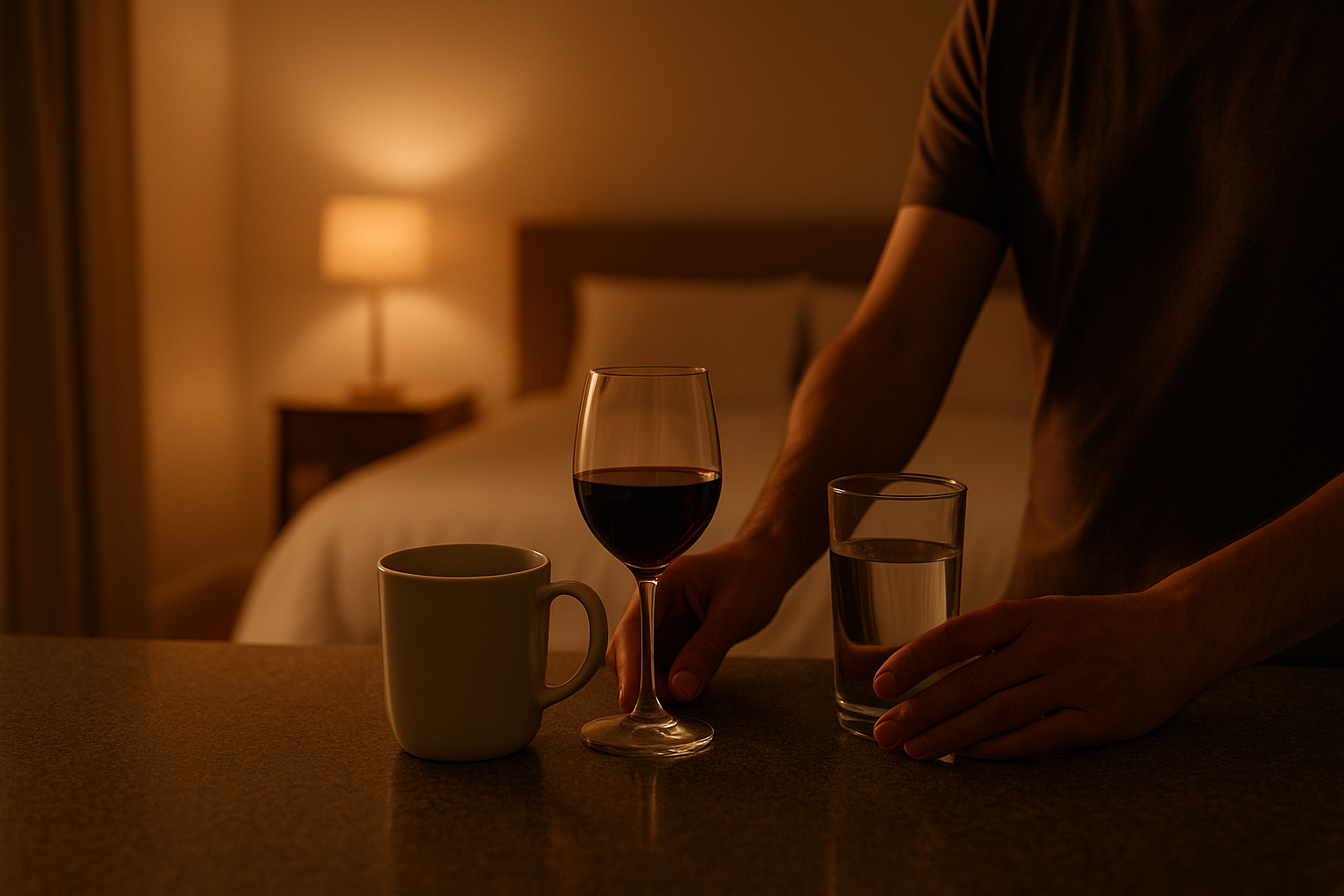
Good sleep starts hours before your head hits the pillow. Two of the biggest swing factors are caffeine and alcohol: one keeps you alert longer than you expect; the other can knock you out quickly but splinters the night that follows. This guide translates the science into nine practical rules you can use tonight. You’ll learn how to set a realistic caffeine cut-off, cap your daily dose without withdrawal headaches, and retire the “nightcap” so your sleep cycles can do their job. Quick take: keep caffeine earlier and lighter, keep alcohol rarer and earlier—and sleep gets deeper, steadier, and easier to maintain. For context, most adults do best at ≤400 mg of caffeine per day and, if they drink, should keep alcohol light and earlier; less is better for health (as of August 2025).
This article is educational and not a substitute for personalized medical advice. If you’re pregnant, managing a health condition, or take medications, talk with your clinician about individual limits.
1. Set a caffeine cut-off 6–10 hours before bedtime
The simplest way to protect your sleep is to stop caffeine early enough that only a trace remains by bedtime. As a rule of thumb, avoid caffeine for at least six hours before you plan to sleep; many people feel even better with an 8–10-hour buffer. Start this section with your bedtime in mind: if lights-out is 10:30 p.m., plan your last coffee no later than 2:30–4:30 p.m.—and earlier if you’re sensitive. This guardrail is based on two facts: caffeine’s half-life is long and varies widely, and a single afternoon dose can still shrink total sleep time hours later. Build your day around this buffer and you’ll shorten sleep-onset delay, reduce awakenings, and blunt next-day sleep inertia.
1.1 Numbers & guardrails
- Caffeine’s half-life ranges roughly 2–12 hours depending on genetics, hormones, liver enzymes, smoking status, and medications.
- A controlled study found 400 mg taken 6 hours before bedtime still reduced sleep by >1 hour on average.
- For most people, a 6-hour minimum works; 8–10 hours is better if you have insomnia, anxiety, reflux, or are particularly sensitive.
Mini-checklist
- Decide your target bedtime first.
- Count backward 6–10 hours for your last-caffeine time.
- Put a repeating reminder in your phone or smartwatch.
- Keep an appealing uncaffeinated backup (sparkling water, herbal tea) on hand.
- Track sleep for a week and tighten the buffer if needed.
When you lead with time—not willpower—you remove dozens of daily decisions and let your biology work for you.
2. Cap your daily caffeine dose—and track it
Dose matters as much as timing. For healthy adults, ≤400 mg/day is generally considered a prudent ceiling; pregnant or breastfeeding individuals should keep total intake lower (often cited ≤200 mg/day), and teens should minimize caffeine and avoid energy drinks. But averages hide the outliers: the same 200 mg that barely wakes one person can rattle another. The key is to pick a cap that both respects safety ranges and fits your sensitivity, then actually monitor the mg you drink and eat (coffee, tea, soda, energy drinks), plus pills and powders. Treat caffeine like a tool you deploy early and purposefully—not a background drip all day.
2.1 Typical sources & estimates (per serving)
- Drip coffee (8 oz): ~95 mg (varies widely by bean and brew)
- Espresso (1 oz): 40–60 mg
- Black tea (8 oz): 40–70 mg; green tea (8 oz): 20–45 mg
- Energy drink (8–16 oz): 70–200+ mg (read labels)
- Cola (12 oz): 30–40 mg
- Dark chocolate (1 oz): 15–25 mg
- “Decaf” coffee (8 oz): 2–15 mg U.S. Food and Drug Administration
2.2 Tools & tracking
- Label literacy: Many cafés publish caffeine ranges; packaged drinks list mg/serving.
- App or note: Log cups/ounces and mg for a week; adjust your cap as needed.
- Split-dosing: If you like volume, try half-caf or 1 shot instead of 2—same ritual, less stimulant.
- A/B test: Compare sleep metrics (time to fall asleep, awakenings) on ≤200 mg vs 300–400 mg days.
Your dose ceiling should make you alert by day and comfortably sleepy by night; if it doesn’t, lower it until it does.
3. Audit hidden caffeine—and time your substitutes
Even with a clean cut-off and cap, “sneaky” caffeine can keep circulating into bedtime. Decaf coffee still contains small amounts; some green teas run higher than expected; pre-workout powders often pack triple-digit mg per scoop; and over-the-counter pain relievers frequently include caffeine as an enhancer. Chocolate after dinner seems innocent but can add enough stimulant for a sensitive sleeper. Start with a pantry sweep and a glance at medication labels; then plan caffeine-aware swaps for afternoons and evenings so you don’t feel deprived (sparkling water with citrus, rooibos, chamomile, golden milk, or a magnesium-rich cacao—but earlier in the evening).
Hidden sources to check
- Decaf coffee (2–15 mg per cup) and cold brew “decaf”
- Green/yerba mate teas, bottled teas with added extract
- Energy “shots” and pre-workout mixes (often 150–300+ mg/scoop)
- Pain relievers (some migraine formulas add 65 mg caffeine)
- Dark chocolate desserts, coffee-flavored ice creams
Region notes
- Labeling of caffeine per serving is common in the U.S., less consistent elsewhere; check brand sites when in doubt.
- “Units” systems exist for alcohol (see Rule 7), but not for caffeine; treat your log as your personal “unit” record.
The more you swap on autopilot after lunch, the less you’ll need to think about sleep at night.
4. Taper smartly to avoid withdrawal (and rebound insomnia)
If you’ve drifted into a high daily dose or late-day habits, don’t slam on the brakes; taper. Stopping abruptly can cause headache, daytime sleepiness, brain fog, and irritability—symptoms that tempt you to chug more and set up a cycle that undermines sleep. A 7–14 day step-down is enough for most people: reduce 25–50% every few days, move all remaining caffeine earlier, and replace the ritual (not just the liquid). Plan your first week to be lighter on cognitive load and heavier on daylight, hydration, and short movement breaks that carry you through the afternoon dip without caffeine.
Taper plan (example for 400 mg/day baseline)
- Days 1–3: 300 mg total, all before noon
- Days 4–6: 200 mg total, last dose by 10 a.m.
- Days 7–10: 100 mg (or decaf), morning only
- Days 11–14: 0–50 mg, stick with morning ritual sans stimulant
4.1 Mini case
A software engineer sleeping 6.5 hours/night logs ~450 mg caffeine spread to 5 p.m. After a 10-day taper (Rule 4) and an 8-hour cut-off (Rule 1), time to fall asleep drops from 35 to 12 minutes, awakenings shrink from 3 to 1, and subjective morning alertness improves. No supplements added; only timing and dose.
4.2 Common mistakes
- Swapping afternoon coffee for energy drinks (often more caffeine, more sugar)
- Going cold turkey during a high-stakes week
- Assuming decaf = zero
- Tapering dose but not moving it earlier
Make tapering a finite project; when you pass the two-week mark, you’ll likely keep the gains without thinking about them.
5. Rewire daytime energy without more caffeine
Caffeine shouldn’t have to carry all your daytime alertness. If you routinely need a late latte to function, the fix is upstream. Build a non-caffeine “energy stack” that lifts vigilance in biologically aligned ways, then use a modest morning dose as an optional booster. The best ingredients are light, movement, hydration, and protein, each of which nudges different alertness systems without taxing sleep pressure later. Align your stack with your work demands: creative tasks may get more from daylight + a brisk walk; focus-heavy blocks may get more from a protein-forward meal and five minutes of breathwork.
5.1 How to do it
- Light: Get 5–15 minutes of outdoor light within an hour of waking; repeat after lunch.
- Move: Insert 3–5 minute movement snacks every 60–90 minutes; add a 10–20 minute walk in the late afternoon.
- Hydrate: Start the day with 300–500 ml water; sip consistently.
- Protein + fiber: Front-load 25–40 g protein at breakfast; add colorful veg/whole grains at lunch.
- Nap smart: If exhausted, try a 10–20 minute power nap before 3 p.m. (never late in the day).
- Breath breaks: 2–3 rounds of extended exhale (e.g., 4-second inhale, 6–8-second exhale) to reset.
5.2 When to add caffeine
- If you still feel flat after light/movement/hydration/food, add 50–150 mg before noon.
- Save larger doses for true sleep loss days—not for routine afternoons.
When baseline alertness comes from habits, your small, early caffeine dose works better—and your nights stay intact. (For context, caffeine timing strongly influences alertness and sleep quality; even afternoon doses can disrupt sleep.) AASM
6. Retire the nightcap: stop alcohol 3–4 hours before bed
Alcohol may help you fall asleep faster, but it fragments sleep later and suppresses REM in the first half of the night. The result: more awakenings, lighter sleep, and a “tired but wired” morning. If you choose to drink, put hard space between your last sip and lights-out; 3–4 hours is a reasonable buffer for most. Also pace slowly, sip water between drinks, and eat a protein-rich meal earlier in the evening. If your sleep is fragile, avoid alcohol entirely on nights when you must be sharp the next day. This change alone often reduces 2–4 a.m. awakenings.
6.1 Why it matters
- Alcohol initially sedates but then activates as blood alcohol falls, prompting rebound wakefulness.
- It reduces REM early, which can shift emotional processing and dream pressure later.
- It increases sleep disruption in the second half of the night, even at modest doses.
Mini-checklist
- Decide your drink-free bedtime buffer (3–4 hours).
- Pair any drink with food and water.
- Avoid alcohol on high-stakes nights.
- Never combine alcohol with sedatives or sleep meds unless your doctor explicitly approves.
Treat alcohol like a spice, not a sauce—used sparingly, earlier, and never as a sleep aid.
7. Drink less—and define “a drink” precisely
“Moderation” only helps when you measure it the same way health guidelines do. In the U.S., 1 standard drink equals 14 g of pure alcohol: 12 oz (355 ml) beer at 5%, 5 oz (148 ml) wine at 12%, or 1.5 oz (44 ml) spirits at 40%. As of August 2025, U.S. guidance says adults who choose to drink should keep it to 2 drinks or fewer in a day for men and 1 drink or less for women, and that less is better for health. In the U.K., low-risk guidance is ≤14 units per week for men and women, spread across several days with drink-free days. Knowing these numbers helps you plan realistically and place alcohol earlier in the day when you do partake.
7.1 Numbers & guardrails
- U.S.: If you drink, ≤1/day (women), ≤2/day (men); don’t “save up” for binges.
- U.K.: ≤14 units/week; e.g., ~6 pints of average beer or 10 small glasses of lower-strength wine.
- “Less is better”: No one should start drinking for health benefits; sobriety is always an option.
- Factor ABV%: 8% beers and 15% wines change the math fast.
7.2 Practical swaps
- Choose lower-ABV beer or wine.
- Alternate water between alcohol servings.
- Switch to tall spritzers (more volume, less alcohol).
- Make mocktails your default after dinner.
Accurate definitions make it easier to keep alcohol earlier, lighter, and friendlier to sleep.
8. If you snore or have sleep apnea, avoid alcohol near bedtime
If you snore, gasp, or feel unrefreshed despite enough time in bed, alcohol can make things worse by relaxing throat muscles and increasing airway collapsibility. Meta-analyses indicate alcohol raises the risk and severity of obstructive sleep apnea (OSA). That translates to more oxygen dips, arousals, and next-day fog—effects you’ll feel even from one late drink. If you suspect OSA, prioritize screening and treatment; in the meantime, avoid alcohol entirely within 4–6 hours of bedtime, skip it on travel nights, and keep to low-risk limits (Rule 7) when you drink earlier in the day.
8.1 Signs you should get checked
- Loud snoring, witnessed breathing pauses, or gasping
- Dry mouth or morning headaches
- Unrefreshing sleep despite 7–9 hours in bed
- High blood pressure, daytime sleepiness, or trouble focusing
8.2 What to do next
- Ask your clinician about home sleep apnea testing or a sleep lab study.
- If diagnosed, treat OSA (e.g., CPAP, oral appliance); it often improves mood, blood pressure, and productivity.
- Pair treatment with alcohol timing changes; many patients report fewer awakenings immediately.
Protecting your airway is one of the fastest ways to upgrade sleep quality; alcohol timing is part of that protection.
9. Run a 14-day caffeine & alcohol reset and measure the gains
Knowledge sticks when you see results. For the next two weeks, run a structured trial: lock in your caffeine cut-off (Rule 1), dose cap (Rule 2), hidden-source audit (Rule 3), taper if needed (Rule 4), and daytime energy stack (Rule 5). On the alcohol side, set your 3–4-hour buffer (Rule 6), use precise drink definitions (Rule 7), and avoid alcohol on nights when sleep quality matters or if you have OSA risk (Rule 8). Track just a handful of metrics and compare your baseline week to your experiment week. Most people notice they fall asleep faster, wake up fewer times, and feel clearer in the morning—without feeling deprived.
9.1 What to track (simple)
- Time to fall asleep (minutes)
- Number of awakenings and time awake after sleep onset
- Total sleep time
- Morning alertness (1–5 scale) and afternoon sleepiness (1–5)
- Caffeine mg and last-caffeine time; drinks and last-drink time
9.2 Example weekly target
- Caffeine: ≤200–300 mg, all before noon; cut-off = 8 hours before bedtime
- Alcohol: 0–3 drinks/week, all ≥3–4 hours pre-bed; drink-free weekdays
In two weeks you’ll have your numbers—and a system you can keep with almost no friction.
FAQs
1) What’s the fastest way to know if caffeine is hurting my sleep?
Pick a 7-day trial: keep total caffeine ≤200 mg and move all of it to before noon. If you fall asleep faster and wake fewer times, caffeine timing/dose were factors. To confirm, re-introduce an afternoon coffee once and see if your sleep regresses. If it does, keep the early window.
2) Is decaf coffee okay at night?
Usually yes, but remember decaf isn’t zero. A cup can contain 2–15 mg of caffeine, which is trivial for most but not for the very sensitive. If you notice restlessness after decaf, switch to herbal options. If you’re tapering, decaf is a helpful bridge for the ritual without the stimulant.
3) What if I need caffeine for a late-night drive or exam?
Safety first. If you must be alert late, small, strategic doses (e.g., 50–100 mg at set intervals) can help, but expect sleep disruption afterward. Plan recovery sleep the next day, avoid stacking doses, and don’t add alcohol “to crash”—it degrades sleep further.
4) Does alcohol help me sleep if I have insomnia?
It can shorten sleep-onset, but it fragments the rest of the night and can worsen anxiety on waking. It’s not a treatment for insomnia and often makes the problem stickier. Behavioral strategies (consistent schedule, wind-down, light and caffeine timing) are more effective and sustainable.
5) How late is too late for caffeine?
For most, ≥6 hours pre-bed is the minimum buffer; 8–10 hours is better if you’re sensitive or struggling with insomnia. Because half-life varies, use your logs to find your personal edge: if 2 p.m. coffees still show up at 10:30 p.m. bedtime, move your last dose earlier.
6) What counts as “one drink,” and do guidelines differ internationally?
In the U.S., it’s 14 g pure alcohol: 12 oz beer (5%), 5 oz wine (12%), or 1.5 oz spirits (40%); guidance is ≤1/day for women, ≤2/day for men for those who choose to drink. In the U.K., “low risk” is ≤14 units/week, spread across multiple days with drink-free days.
7) I snore. Is a glass of wine with dinner really a problem?
If it’s with dinner and 4–6 hours before bed, probably less so; if it’s close to bedtime, alcohol can worsen snoring and OSA by relaxing airway muscles. If your partner notices pauses or gasps, avoid alcohol near bedtime and talk with your clinician about screening.
8) Are energy drinks worse for sleep than coffee?
Often yes: energy drinks may deliver higher caffeine per serving plus other stimulants and sugar, and are easy to sip late. Labels vary; many cans contain 2+ servings. Coffee’s caffeine varies too, but you’re more likely to drink it earlier and in known amounts. Teens should avoid energy drinks. AACAP
9) I’m pregnant—what’s safe for caffeine and alcohol?
Discuss specifics with your clinician. Many authorities advise ≤200 mg/day caffeine in pregnancy and avoiding alcohol entirely due to fetal risk. If nausea or headaches tempt caffeine use, keep doses small, earlier, and count all sources.
10) Can I “catch up” on sleep after a night of drinks?
You can recover some sleep debt with a longer night and an early nap the next day, but alcohol-driven REM loss and fragmentation aren’t fully erased in 24 hours. Use the experience to refine your buffer and weekly plan (Rule 9) and keep late drinks rare.
11) Does smoking or medication change how caffeine affects me?
Yes. Smoking, certain meds, and genetics can change caffeine metabolism, shortening or prolonging its half-life. If you notice unusual sensitivity or insomnia despite small early doses, lower the cap and move doses earlier; discuss with your clinician if you take interacting meds.
12) Is there a “healthiest” alcoholic drink for sleep?
Not really. What matters most for sleep is whether you drink, how much, and how close to bedtime—not the specific beverage. Choose lower-ABV options, drink with food, alternate with water, and stop 3–4 hours before bed (Rules 6–7).
Conclusion
Better sleep from caffeine and alcohol changes is less about perfection and more about timing, dose, and intention. Caffeine is a powerful tool when you keep it earlier and lighter—a morning boost that doesn’t haunt your nights. Alcohol, even in modest amounts, is a sleep disruptor when it creeps toward bedtime; when you drink, keep it earlier, slower, and sparing. The nine rules here align biology with daily life: a clear 6–10-hour caffeine buffer, a personal mg cap you can actually track, an audit of hidden sources, a smart taper, a non-caffeine energy stack, a 3–4-hour alcohol buffer, precise drink definitions, extra caution if you snore or have sleep apnea, and a two-week reset that proves the gains in your own data.
Treat this as a cycle you can repeat anytime your habits drift. Your reward is sleep that feels deeper, steadier, and easier to sustain—along with calmer days and more reliable energy. Ready to try it? Start today with an earlier last coffee and a drink-free wind-down.
References
- Spilling the Beans: How Much Caffeine is Too Much? U.S. Food & Drug Administration, Aug 28, 2024. https://www.fda.gov/consumers/consumer-updates/spilling-beans-how-much-caffeine-too-much
- Scientific Opinion on the safety of caffeine (EFSA Journal 2015;13(5):4102). European Food Safety Authority, May 27, 2015. https://www.efsa.europa.eu/en/efsajournal/pub/4102
- Caffeine Effects on Sleep Taken 0, 3, or 6 Hours before Going to Bed. Journal of Clinical Sleep Medicine, Nov 2013. https://pmc.ncbi.nlm.nih.gov/articles/PMC3805807/
- Sleep and Caffeine. American Academy of Sleep Medicine (Sleep Education), Oct 6, 2022. https://sleepeducation.org/sleep-caffeine/
- Guidance on Alcoholic Beverages. DietaryGuidelines.gov (U.S. Departments of Agriculture and Health and Human Services), accessed Aug 2025. https://www.dietaryguidelines.gov/alcohol/info
- Alcohol units: calculating alcohol units. NHS, updated 2022. https://www.nhs.uk/live-well/alcohol-advice/calculating-alcohol-units/
- UK Chief Medical Officers’ Low Risk Drinking Guidelines. Department of Health & Social Care (UK), 2016. https://assets.publishing.service.gov.uk/media/5a80b7ed40f0b623026951db/UK_CMOs__report.pdf
- Alcohol and sleep I: effects on normal sleep. Sleep Medicine Reviews, 2013. https://pubmed.ncbi.nlm.nih.gov/23347102/
- The Effects of Alcohol on Quality of Sleep. Psychiatry Investigation, 2015. https://pmc.ncbi.nlm.nih.gov/articles/PMC4666864/
- Alcohol and the risk of sleep apnoea: a systematic review and meta-analysis. Journal of Thoracic Disease, 2018. https://pmc.ncbi.nlm.nih.gov/articles/PMC5840512/
- Caffeine content for coffee, tea, soda and more. Mayo Clinic, Feb 6, 2025. https://www.mayoclinic.org/healthy-lifestyle/nutrition-and-healthy-eating/in-depth/caffeine/art-20049372
- How long does it take caffeine to wear off? Sleep Foundation, Jul 16, 2025. https://www.sleepfoundation.org/nutrition/how-long-does-it-take-caffeine-to-wear-off