



























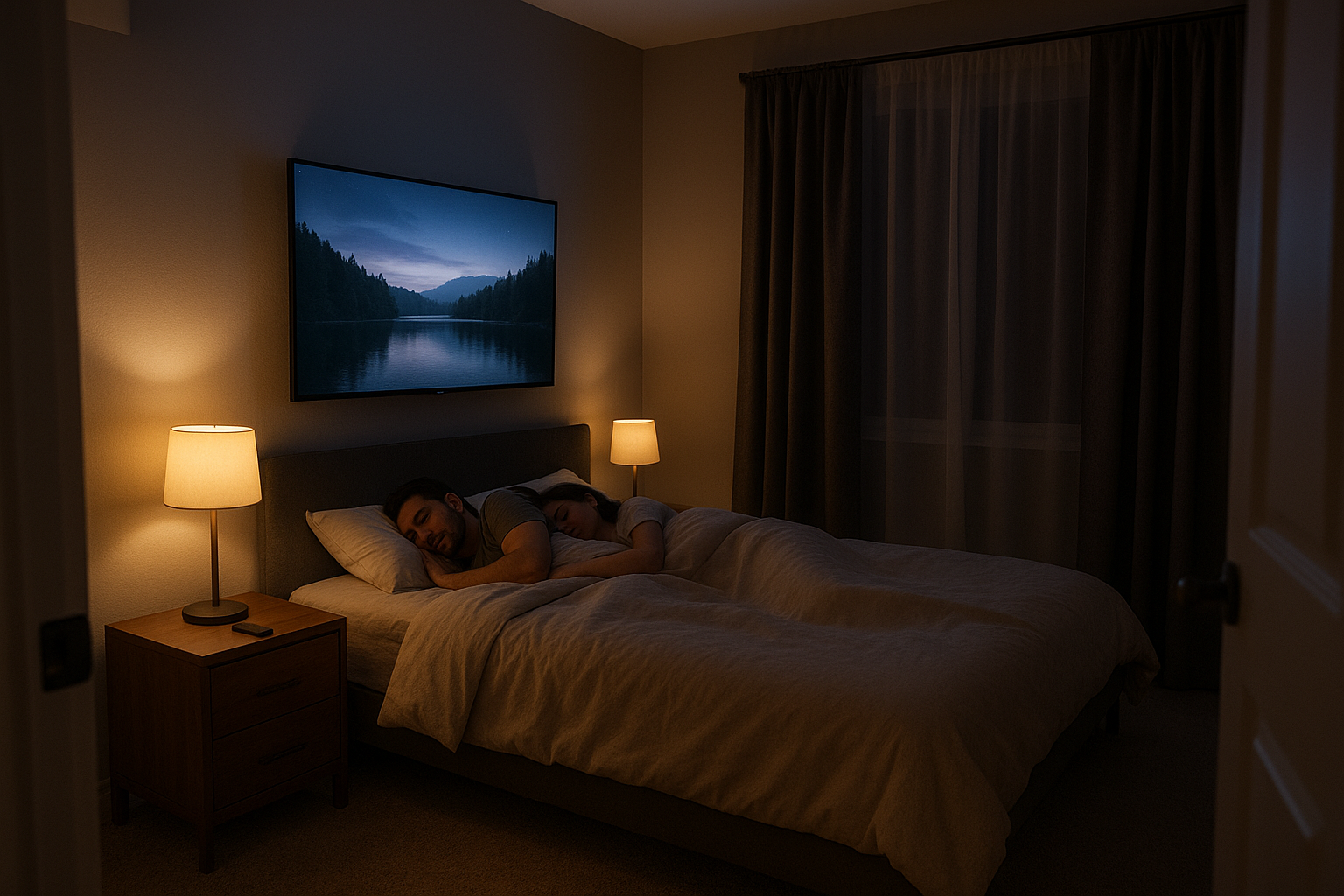
Is a TV in the bedroom bad for sleep—or can it actually help you unwind? The short answer: for many people, bedroom TVs delay sleep and fragment rest; for a smaller group, carefully controlled, low-arousal viewing can reduce anxiety and mask noise. If you keep a TV, use strict guardrails (timers, night modes, content choices) to protect your melatonin and sleep schedule.
Educational note: This article is for general information and isn’t a substitute for personal medical advice. If you have persistent insomnia, loud snoring, or daytime sleepiness, speak with a qualified clinician.
1. Con — Evening Blue Light Delays Melatonin and Pushes Bedtime
Blue-rich light from TVs can suppress melatonin and shift your body clock later, making it harder to fall asleep and wake on time. This effect is strongest in the hour or two before bed, when your brain expects darkness. While light from any source can be alerting, short-wavelength (blue) light is particularly potent at signaling “daytime” to the circadian system. In practice, watching a bright TV in a dim bedroom often adds just enough light to prolong sleep onset—even if the show itself feels relaxing. For shift workers or night owls, this can snowball into later and later bedtimes, reduced total sleep, and groggier mornings. The impact varies by person and content, but physiology still applies: less evening light generally equals easier sleep.
1.1 Why it matters
- Blue light exposure in the evening suppresses melatonin and can shift circadian phase later.
- TVs, like other LED screens, emit blue-weighted light that’s most disruptive at night.
- The darker your room, the more noticeable the TV’s light becomes to your brain.
1.2 Numbers & guardrails
- Start dimming household lights 2–3 hours before bed; if you watch, set the TV to its warmest “night” mode and reduce brightness to the lowest comfortable level.
- Sit farther away (e.g., ≥2.5–3× screen height) to reduce retinal illuminance.
- Favor audio-forward, low-contrast scenes over bright, fast-cut visuals.
Bottom line: Less evening light makes sleep easier. If you keep a bedroom TV, treat brightness, color temperature, and distance as levers to protect melatonin.
2. Pro — Familiar, Low-Arousal TV Can Help Some People Unwind
For some sleepers, a gentle, familiar show can reduce pre-sleep worry and make the transition to bed feel safer and calmer. The predictability of rewatching an old sitcom or nature program can occupy just enough attention to crowd out rumination without spiking adrenaline. This “cognitive blanket” effect is most likely when content is emotionally neutral, the room is otherwise dark and quiet, and viewing ends before true drowsiness. In people who don’t struggle with insomnia, a short, soothing episode may serve as part of a wind-down routine—especially if the alternative is doomscrolling on a phone inches from the face. The key distinction: the TV is a deliberate tool, not an endless feed.
2.1 How to do it
- Pick genuinely boring or calming content you’ve already seen; avoid cliffhangers, sports, and news.
- Cap total viewing to a single short episode (≤30 minutes) with a hard stop.
- Use subtitles off and volume low and steady; consider a sleep timer.
2.2 What the evidence suggests
- Many adults report watching TV before bed; habit and relaxation are common reasons.
- Controlled broadband/white-noise-like sound can shorten sleep onset in lab models; while a TV isn’t white noise, a stable audio track may feel soothing if volume is constant.
Bottom line: If TV helps you relax, keep it brief, predictable, and quiet—and stop before you’re sleepy so you let natural drowsiness take over. Sleep Foundation
3. Con — Autoplay and Binge-Watching Prolong Wakefulness
Even if one episode is calming, platforms are engineered to roll you into the next. Autoplay, cliffhangers, and infinite catalogs invite “just one more,” stretching past your intended bedtime. Beyond time loss, binge-watching correlates with poorer sleep quality and more fatigue—likely from cognitive arousal and delayed shutdown. Surveys also show a majority of people have sacrificed sleep to keep watching, a classic form of “bedtime procrastination.” If you’re already short on sleep, the added hour or two compounds quickly, hurting mood, memory, and next-day performance.
3.1 Guardrails that work
- Disable autoplay and “next episode” previews.
- Decide your stop time before you start; set a second alarm 10 minutes before it.
- Keep the remote out of reach once the sleep timer is set.
3.2 Evidence snapshot
- Binge-viewing frequency is linked to poorer sleep and more insomnia symptoms.
- AASM surveys report large shares of adults lose sleep due to binge-watching and other digital distractions.
Bottom line: Your favorite series is designed to keep you up. Take back the controls or move viewing out of the bedroom.
4. Con — TV in Bed Breaks “Stimulus Control” and Can Worsen Insomnia
One of the most effective behavioral treatments for insomnia teaches your brain to associate bed with sleep (and sex) only. Watching TV in bed does the opposite: it pairs the mattress and pillows with wakeful, stimulating activity. Over time, your brain learns that bed = being awake, so when you finally switch off, you lie there wired. Clinicians call this “stimulus dyscontrol,” and fixing it is central to cognitive behavioral therapy for insomnia (CBT-I). Even if you don’t have insomnia now, regular in-bed TV makes it more likely you’ll stay awake longer when sleep is fragile (after stress, travel, or illness).
4.1 What best-practice looks like
- Use the bed only for sleep and sex; don’t watch, read, or work in bed.
- If you can’t sleep after ~20 minutes, get up, do something quiet in low light, and return only when sleepy.
- Keep a consistent wake-up time to anchor your body clock.
4.2 Evidence & guidelines
- Modern insomnia guidelines list “no TV in bed” as a core instruction of stimulus control.
- AASM patient education on CBT-I teaches the same rule for restoring sleep–bed linkage.
Bottom line: If sleep is precious or you struggle with insomnia, keep the bed screen-free. It’s one of the simplest, most proven changes you can make.
5. Pro — TV as Sound Masking (With Strict Limits)
In noisy apartments or neighborhoods, a low, steady audio track can help mask disruptive sounds from traffic, pets, or neighbors. The principle is similar to white noise: a consistent blanket of sound reduces the salience of sudden peaks that would otherwise trigger micro-arousals. When done carefully—screen dimmed to near-black, sleep timer engaged, and content with minimal volume swings—a bedroom TV can function as a makeshift masker while you drift off. It’s not the ideal tool, but for some households it’s the only device big enough to fill the room.
5.1 Safer sound-masking setup
- Choose audio-only content (radio app, long ambient track) and turn the screen off or to black.
- Set a sleep timer (30–60 minutes) and disable ads/previews where possible.
- Prefer a dedicated white-noise machine or fan if you can; these hold volume more constant.
5.2 Research context
- Broadband/white-noise sounds shorten sleep-onset latency in experimental models of transient insomnia, likely by stabilizing the auditory environment. A TV won’t reproduce noise as consistently as a purpose-built device, so treat it as a workaround, not a cure.
Bottom line: If outside noise ruins your nights, controlled audio can help—but a TV should be a last resort behind true sound maskers.
6. Con — Volume Spikes, Bright Ads, and Status LEDs Fragment Sleep
Unlike white-noise machines, TVs vary in brightness and loudness from scene to scene. Explosions, laugh tracks, auto-played trailers, and even app notification chimes can trigger micro-arousals that you don’t remember but that still fragment sleep. Bright title cards or screen savers can also add unexpected light pulses in an otherwise dark room. Even a tiny standby LED can feel glaring at 2 a.m. for light-sensitive sleepers. The result is lighter sleep, more awakenings, and the sense of never reaching deep rest—even after a “full” night in bed.
6.1 Practical fixes
- Turn off previews and “auto-play trailers,” enable “reduce loud sounds,” and use the TV’s “night mode.”
- Cover or disable status LEDs; choose truly black screen savers.
- Place the TV out of your direct line of sight (e.g., to the side rather than straight ahead).
6.2 What experts note
- Nighttime device sounds and blinking lights can cause unwanted awakenings; experts recommend tech-free bedrooms or, at minimum, minimizing electronic disturbances at night.
Bottom line: Inconsistent audio and light are the enemy of deep sleep. If a TV must stay, tame the spikes or move to audio-only.
7. Pro — A Shared, Intentional Ritual Can Help Couples Sync Up
For some couples, a short, predictable episode watched together becomes a gentle way to end the day. When both partners agree on content, timing, and a clear “lights-out,” a shared ritual can reduce friction, coordinate schedules, and make the bedroom feel cozy. This works best when the TV is a finite step in a routine (wash up → stretch → one calm episode → lights out), rather than the centerpiece. It can also replace phones in bed, which tend to be brighter, closer to the eyes, and more interactive. The trick is consent and boundaries; unilateral “I need the TV to sleep” often backfires.
7.1 Couple-friendly ground rules
- Choose low-arousal shows you both like; no news, thrillers, or sports.
- Agree in advance: one episode, sleep timer on, then lights out.
- Keep the bedroom otherwise designed for sleep (cool, dark, quiet).
7.2 When to skip the TV
- If one partner has insomnia, the standard advice is to keep the bed screen-free to protect stimulus control.
- If sound/light bothers one partner, consider earbuds, an e-ink book light, or separate wind-down in the living room.
Bottom line: As a brief, agreed-upon step, TV can support connection; as an open-ended habit, it strains sleep (and relationships). University Hospitals Birmingham
8. Con — For Kids and Teens, Bedroom TVs Are Linked to Later Bedtimes and Poorer Sleep
Children and adolescents are especially sensitive to evening light and media stimulation. Bedroom TVs and late-night viewing are associated with delayed bedtimes, shorter sleep, and next-day impairment at school. Major pediatric and public-health organizations recommend no screens in kids’ bedrooms and avoiding screens in the hour before bed. For young children, screen limits are even stricter; for teens, setting family rules and removing devices from bedrooms at night often pays immediate dividends. If you co-sleep or room-share, an adult’s bedroom TV can easily spill over into a child’s sleep.
8.1 Guidance at a glance
- AAP: Avoid screens in bedrooms; no screens 1 hour before bed; create a family media plan.
- WHO: Under 5s should minimize sedentary screen time; focus on active play and adequate sleep.
- Practical: Replace screens with calm activities—stories, dim-light reading, drawing.
8.2 Household tips
- Remove TVs from children’s rooms; charge devices outside bedrooms.
- Use parental controls to enforce content ratings and shutoff times.
- Model your own evening screen limits—kids copy what they see. PMC
Bottom line: For developing brains, a screen-free bedroom is the default. Protect sleep now to safeguard learning, mood, and growth.
9. Pro — Smart Settings Can Reduce Harm if the TV Stays
If removing the TV isn’t feasible, modern sets and apps offer tools to limit impact. “Night” or “warm color” modes reduce blue emission; brightness limiters and “reduce loud sounds” tame spikes; sleep timers prevent all-night play; and “disable autoplay” stops the next episode trap. Moving the TV farther away, turning on subtitles off, and using darker themes also lower retinal light and arousal. None of this makes a bedroom TV optimal—but it can turn an outright sleep disrupter into a manageable compromise while you build better routines.
9.1 Setup checklist
- Display: Warmest color temp, lowest comfortable brightness, dark theme.
- Audio: Night mode, loudness equalization on, volume low and steady.
- Playback: Autoplay off, sleep timer 30–60 minutes, ads/previews suppressed.
- Habits: Start earlier in the evening; stop before you’re sleepy; never watch in bed if you have insomnia.
9.2 Why it helps
- Reducing blue light and brightness lessens melatonin suppression.
- Sleep timers and autoplay controls cut bedtime procrastination risk.
- Consistent routines anchor your circadian rhythm.
Bottom line: Use the tech against itself—let settings enforce boundaries you might not in the moment.
10. Con — Less Sleep Tonight Means Groggier Tomorrow
The simplest cost of a bedroom TV is minutes lost. Push bedtime back by 30–90 minutes and you will either wake up later (shrinking your morning) or accumulate sleep debt (shrinking your performance). Chronic short sleep undermines attention, mood, metabolic health, and immune function. Even if your total sleep time looks fine, fragmented or shallow sleep from dynamic audiovisual input can leave you feeling unrefreshed. Most of us can’t afford to give away even half an hour on work or school nights—especially if we’ve already ceded daytime focus to phones.
10.1 Quick math example
- Usual bedtime 11:00 p.m. → lights out 12:15 a.m. after “just one more.”
- Alarm still 6:30 a.m. → 75 minutes lost = ~9% less sleep.
- Repeat 4 nights = ~5 hours of weekly debt—enough to feel like jet lag.
10.2 What surveys show
- Large surveys find many adults lose sleep to binge-watching and late-night media. Sleep organizations recommend disconnecting at least 30–60 minutes before bed to protect duration.
Bottom line: A little later tonight feels harmless; the cumulative debt does not. Protect your bedtime like a meeting with your future self.
11. Con — Middle-of-the-Night TV Prolongs Wakefulness
Waking at 2 a.m. is common; turning on the TV then is what turns a brief wake-up into a full hour. Bright light re-alerts your brain, stimulating mind and body when you most need calm. Dynamic audio also raises the arousal floor, making it harder to drift back off. The gold standard in insomnia care is to avoid screens if you wake in the night: keep lights dim, do something quiet elsewhere (stretch, breath work, a paper book), and return to bed only when drowsy. Training this pattern reduces anxiety about wakefulness and teaches your brain that bed means sleep, not entertainment.
11.1 Night-wake plan
- Don’t check the time; cover clocks and face them away.
- If restless after ~20 minutes, leave the bed and do a low-light, quiet activity.
- Keep phones and remotes out of arm’s reach; the more friction, the better your odds.
11.2 Reduce future wakes
- Cut evening liquids, limit alcohol, and lock down a consistent schedule.
- Make the bedroom darker and quieter; remove or unplug electronics that tempt you when awake.
Bottom line: A midnight movie keeps your brain in “on” mode. If you wake, stay dark, stay quiet, and stay out of bed until drowsy.
FAQs
1) Is watching TV before bed always bad?
Not always. Some people fall asleep more easily after a calm, familiar episode with low brightness and a strict cutoff. But physiology still matters: evening light (especially blue-rich) and engaging content can delay sleep and fragment rest. If you notice later bedtimes or groggier mornings, the TV is likely hurting more than helping. Start with earlier viewing, a sleep timer, and warm color modes.
2) How long before bed should I turn the TV off?
A pragmatic rule is to stop screens 1–2 hours before lights-out; many sleep organizations advise at least 30–60 minutes. If TV is your wind-down, push it earlier in the evening and finish before you feel drowsy so natural melatonin can rise without interruption. Autoplay off + sleep timer on makes this easier to stick to.
3) Are blue-light filters on TVs useful?
They help, but they aren’t a free pass. Warmer color temperatures and “night modes” reduce blue output and may lessen melatonin suppression; combine them with lower brightness, greater viewing distance, and earlier stop times for best results. Filters can’t fix stimulating content or late-night bingeing.
4) Is a TV better than a phone in bed?
Usually, yes—but neither is ideal. Phones are closer to your eyes, brighter per retinal area, and more interactive; TVs are farther away and can be set dimmer. If you must pick, a distant, dim TV with a short, calm show is less disruptive than an arm’s-length phone session—but both should end well before sleep.
5) Can TV sound act like white noise?
Sometimes, if you choose static audio and keep volume steady. True white-noise machines are better because they avoid sudden volume changes and bright light. If a TV is your only option, use audio-only sources, a black screen, and a sleep timer.
6) What if my partner can’t sleep without the TV?
Negotiate boundaries: one short, calm episode at low brightness with a hard cutoff, then lights out. If that still bothers you, try earbuds for them, a dedicated sound machine, or separate wind-downs in another room. If anybody has insomnia, the priority is keeping the bed screen-free to preserve stimulus control.
7) Should kids have a TV in their bedroom?
No. Pediatric groups advise keeping screens out of children’s bedrooms and avoiding screens in the hour before bed. For young kids, limits are stricter; for teens, enforce shutdowns and charge devices outside the room. Protecting sleep now supports mood, behavior, and learning.
8) I fall asleep to TV fine—why change?
Falling asleep isn’t the only metric; continuity and depth matter. TVs can pepper the night with micro-arousals from sudden light and sound, leaving you less restored. Try a two-week experiment: same schedule, TV out of the bedroom, and use a white-noise machine instead. Compare morning energy and midday alertness.
9) Is there new research saying screens aren’t that harmful?
Some recent reporting highlights individual differences and suggests light alone may play a smaller role than engagement for some people. But leading organizations still recommend curbing evening screens, and controlled studies continue to show light and stimulation can delay sleep. Personalize—but start with lower light and earlier cutoffs.
10) What’s the single best change if I won’t remove the TV?
Set a nightly sleep timer (30–60 minutes), disable autoplay, enable the warmest display mode, and stop before you feel sleepy. That single package defangs the biggest risks: runaway time and bright, blue-weighted light right before bed.
Conclusion
A bedroom TV can be a comfort or a crutch. The comfort comes from predictability and shared ritual; the crutch shows up as later bedtimes, lighter sleep, and groggy mornings. The physiology is straightforward: light at night and engaging media make sleep harder, while steady routines, darkness, and quiet make it easier. Most people will sleep better with screens out of the bedroom entirely—especially anyone with insomnia, kids in the home, or a demanding morning schedule. If removing the TV is a non-starter, set it up to do the least harm: warmest display, lowest comfortable brightness, autoplay off, sleep timer locked, side placement out of direct view, and content that is quiet and familiar. Treat that plan as a stepping stone toward moving viewing earlier, and reclaim your bed as a cue for sleep, not for “one more episode.”
CTA: Tonight, try a 7-day experiment—sleep timer on, autoplay off, and TV out of bed by 10 p.m.—then notice how your mornings feel.
References
- Technology in the Bedroom — Sleep Foundation, Updated July 11, 2025. Sleep Foundation
- Blue Light: What It Is and How It Affects Sleep — Sleep Foundation, Updated July 11, 2025. Sleep Foundation
- Blue light has a dark side — Harvard Health Publishing, Updated July 24, 2024. Harvard Health
- Evening use of light-emitting eReaders negatively affects sleep, circadian timing, and next-morning alertness — PNAS, 2015. PNAS
- Binge Viewing, Sleep, and the Role of Pre-Sleep Arousal — Journal of Clinical Sleep Medicine, 2017. Journal of Clinical Sleep Medicine
- Over three-fourths of Americans lose sleep due to digital distractions — American Academy of Sleep Medicine (Press Release), Dec 4, 2023. AASM
- Behavioral and psychological treatments for chronic insomnia disorder in adults — Journal of Clinical Sleep Medicine (Clinical Practice Guideline), 2021. PMC
- Cognitive Behavioral Therapy (CBT-I) — Sleep Education by AASM, June 29, 2023. Sleep Education
- Broadband Sound Administration Improves Sleep Onset Latency — Frontiers in Human Neuroscience (PMC), 2017. PMC
- External Auditory Stimulation as a Non-Pharmacological Sleep Aid — Int. J. Environ. Res. Public Health (Review), 2022. PMC
- Media and Young Minds — Pediatrics (AAP Policy Statement), 2016. AAP Publications
- WHO Guidelines on physical activity, sedentary behaviour and sleep for children under 5 years — World Health Organization, 2019. World Health Organization