
















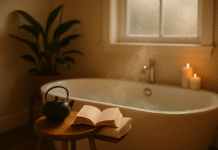



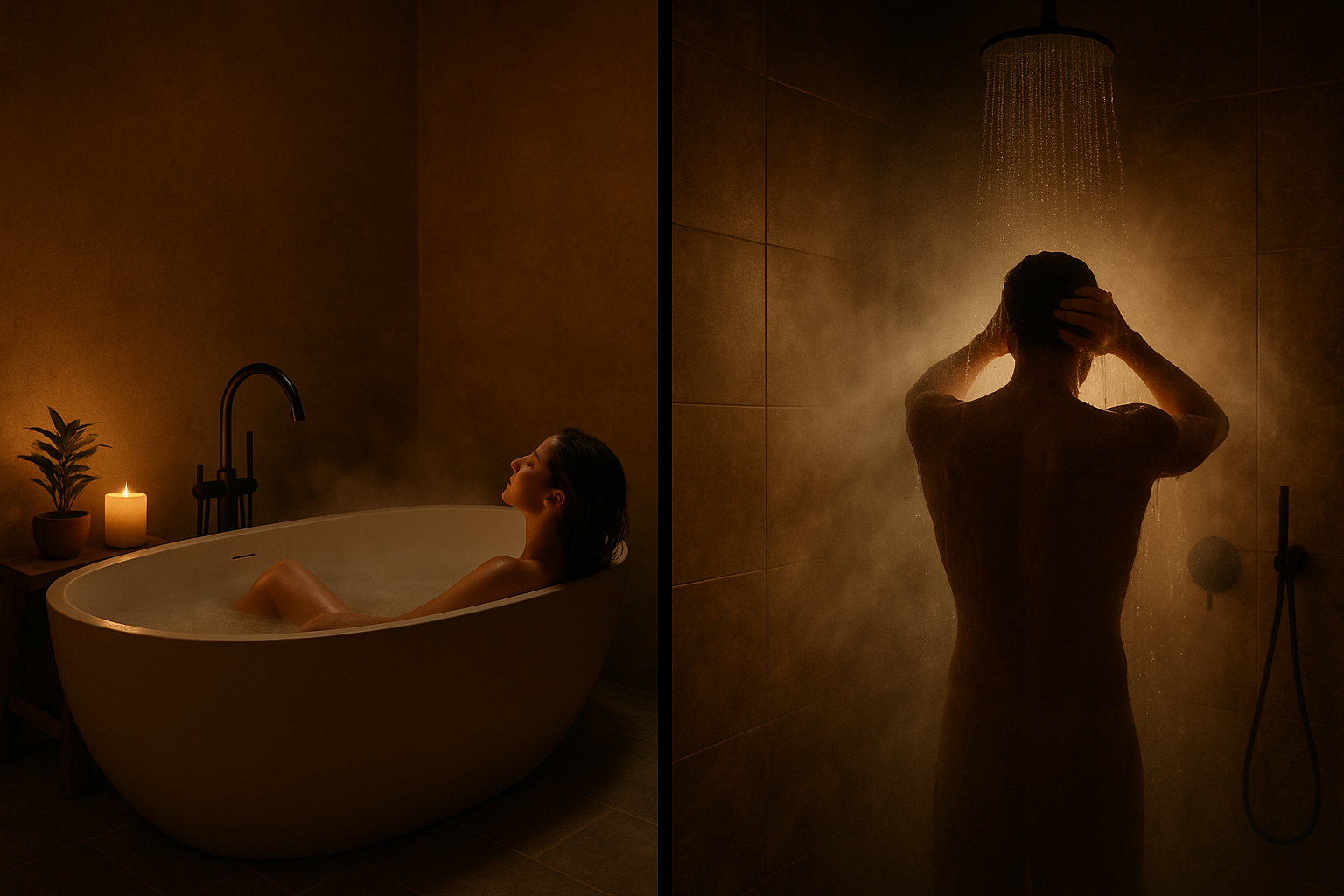
If your goal is pure relaxation, a warm bath generally has the edge because full-body immersion and hydrostatic pressure create deeper physiological calm. That said, a brief warm shower (about 10 minutes) one to two hours before bed can deliver similar sleep benefits while using far less water. Below, nine factors help you choose confidently.
Quick safety note: This guide is educational, not medical advice. If you’re pregnant, have heart or skin conditions, low blood pressure, or heat sensitivity, consult your clinician before heat or additives.
1. Sleep Readiness & Thermoregulation
A warm bath or shower helps you fall asleep faster by warming your skin and then allowing your core temperature to drop after you dry off; this drop is a well-known circadian cue for sleep. Between the two, immersion tends to feel more sedating for many people, but research shows either a warm bath or shower can improve sleep efficiency if you time it right. The key variables are temperature, duration, and timing relative to bedtime. As of August 2025, a meta-analysis finds best results with water around 40–42.5 °C (104–108.5 °F), for roughly 10 minutes, taken 1–2 hours before lights-out. That window lets your core cool slightly as you unwind, which shortens sleep onset latency and can enhance subjective sleep quality. If you prefer showers, you can still capture most of the sleep benefit—think “short and warm,” not “scalding and long.”
Why it matters
- Warm water triggers peripheral vasodilation, moving heat to the skin so your core can cool after toweling off—one of the body’s natural “go to sleep” signals.
- Even a brief, well-timed warm shower improves sleep metrics, not only baths.
How to do it
- Temperature: Aim ~40–42 °C (104–108.5 °F).
- Duration: ~10 minutes.
- Timing: Start 60–120 minutes before bedtime to allow post-bath cooling.
- Bedroom handoff: Dim lights, cool the room, and keep a consistent wind-down routine.
Numbers & guardrails
- Meta-analysis: warm water 40–42.5 °C, ~10 minutes, 1–2 hours before bed improved sleep onset and efficiency.
Bottom line: For sleep, both can work; baths feel more cocooning, but a short, warm evening shower captures most of the same circadian advantage.
2. Deep Calm From Hydrostatic Pressure (Immersion Physiology)
Baths relax you in a way showers can’t fully match because immersion changes circulation and sensory input. When you’re submerged, gentle hydrostatic pressure along with buoyancy counteracts gravity, increases central blood volume, and can reduce perceived stress. Short bouts of warm-water immersion have been shown to improve measures like arterial stiffness and coronary perfusion, while also lowering anxiety markers in some contexts. Showers deliver warmth and tactile comfort without the pressure effect, which is why the “weighted blanket” feeling of a bath often registers as deeper calm. However, immersion shifts fluids—some people may feel light-headed on standing, so mindful exit habits matter.
Why it matters
- Hydrostatic pressure from immersion affects venous return and fluid distribution, contributing to that “held” sensation. Wiley Online Library
- Short warm-water immersion can acutely improve aortic/peripheral stiffness and coronary perfusion; relaxation likely follows. PubMed
Mini case
- Example: 5–10 minutes of warm immersion up to the chest can feel notably calming; many report slower breathing and a “floaty” heaviness. Objective measures show increased limb blood flow and reduced vascular resistance even without large core temp changes.
Checklist for a calmer soak
- Submerge to mid-chest or shoulders for the pressure benefit.
- Keep water warm, not scalding (details in Section 8).
- Rise slowly; sit at the edge for ~30 seconds before standing.
Bottom line: If you crave profound “melt into it” calm, immersion’s hydrostatic effects give baths a real physiological advantage.
3. Stress Hormones, Mood & the Ritual Effect
Relaxation isn’t just temperature; it’s hormones, context, and ritual. Warm immersion has been linked to reductions in anxiety and salivary cortisol, and observational data associates regular tub bathing with lower cardiovascular risk—possibly via repeated, gentle heat stress and relaxation. Showers, meanwhile, excel as a fast, reliable mood cue; the steady “rain” doubles as broadband sound that masks external noise (like a built-in white-noise machine), which some studies find shortens time to fall asleep in noisy environments. In practice, the more you enjoy the ritual, the stronger the relaxation payoff. If you treat a bath like a mini-spa session with dim light and fewer interruptions, your body learns that cue. If your shower is your sanctuary—with the bonus of consistent sound masking—you’ll get similar psychological de-loading.
Why it matters
- Warm immersion can lower anxiety markers; studies note reductions in BP and cortisol after hot-water sessions.
- White noise can reduce sleep-onset latency and improve sleep in noisy settings; showers provide a natural version of this masking. Evidence is mixed overall but promising in noise-heavy environments.
- Frequent tub bathing has been associated with lower incident CVD in large cohorts, suggesting a beneficial lifestyle pattern (association ≠ causation). PubMed
Tools/Examples
- Bath ritual: 10–20 minutes, soft lighting, calming playlist, no notifications.
- Shower ritual: 5–10 minutes, warm steady spray, brief breathing practice (e.g., 4-second inhale, 6-second exhale), towel-dry in a dim room.
Bottom line: Baths encourage a slower, more ceremonial wind-down; showers can be surprisingly soothing when leveraged as a timed, white-noise-backed reset.
4. Skin Barrier: Comfort vs. Irritation (And Additives)
Relaxation can vanish fast if your skin flares. For sensitive or eczematous skin, lukewarm water and short sessions are key—regardless of bath or shower. Dermatology groups emphasize warm (not hot) water, minimal harsh cleansers, gentle pat-drying, and immediate moisturization (“within three minutes”) to trap hydration. Baths soak the stratum corneum longer, which can soothe itching for some but over-soften and de-lipidize skin for others—especially at high temps or with fragranced products. Essential oils in bathwater can be irritating or allergenic; they float on water unless properly emulsified, increasing the chance of skin contact reactions. If you love scents, diffuse them in the room instead of adding straight to the tub.
Mini-checklist (eczema-friendly)
- Keep water lukewarm; avoid hot.
- Use fragrance-free, gentle cleansers sparingly.
- Pat dry; moisturize while skin is still damp.
- Avoid bubble bath and undiluted essential oils; consider oatmeal soaks instead.
Why it matters
- AAD and eczema organizations advise warm (not hot) water and immediate post-bath moisturization to reduce transepidermal water loss.
- Essential oils can trigger irritant or allergic contact dermatitis; caution with topical use and ensure proper dilution/emulsification if used.
Bottom line: For skin-driven comfort, showers often win because they’re shorter and cooler by default; if bathing, keep it lukewarm and simple, then moisturize promptly.
5. Steam, Humidity & Clear Breathing
When you’re congested, a steamy shower can feel instantly relieving. That perceived ease comes from warm, humid air helping secretions feel less sticky and the general soothing of inflamed passages. However, clinical evidence for steam inhalation’s effectiveness is mixed, and safety is a concern—burn centers regularly caution against leaning over bowls of boiling water at home. Showers are safer than stovetop bowls because water is enclosed and less likely to spill, but keep temperatures comfortable to avoid scalding or dizziness. If congestion is frequent, consider a cool-mist or warm-mist humidifier in the bedroom rather than relying solely on extra-hot bathing.
Why it matters
- Evidence for steam inhalation in colds is inconsistent; some reports highlight scald injuries from DIY setups.
- UK health guidance specifically warns against letting children breathe steam from a bowl due to scald risk.
Safer soothing options
- Steamy shower instead of bowl; keep water warm, not boiling.
- Saline nasal rinse, hydration, and room humidification at night.
- Short, warm shower before bed pairs well with the sleep cue from Section 1. Verywell Health
Bottom line: For stuffy noses, a warm shower is the safer, simpler route; enjoy the steam sensibly and avoid risky DIY inhalation methods.
6. Sore Muscles & Recovery Feel
Heat relaxes muscles and can reduce pain perception, which is why many people swear by a hot soak after long days. The research on muscle recovery is nuanced: some trials report that hot-water immersion reduces soreness or stress hormones, while others find it’s no better than passive rest for strength recovery. Cold water tends to outperform heat for soreness at 24 hours in some studies, yet recent work suggests hot water may rival or beat cold for pain markers in certain protocols. Practically, a warm bath’s buoyancy also unloads joints, which feels good even when lab measures of performance don’t shift much.
What the evidence says
- Some controlled studies: hot-water immersion is not consistently superior to passive recovery for function or soreness.
- Meta-analyses and reviews of hydrotherapy show mixed but generally favorable effects on pain and perceived fatigue. Medical Journals Sweden
- Warm immersion can lower anxiety and blood pressure acutely—a separate pathway to “feeling better.”
Practical protocol (comfort-first)
- 10–15 minutes at ~38–40 °C (100–104 °F), then gentle stretching.
- If you’re sore and sleep-deprived, time it 1–2 hours before bed.
- Alternate option: contrast showers (brief warm → 30–60 seconds cool) for alertness and comfort without a tub. Verywell Health
Bottom line: For pain perception and a sense of release, baths feel indulgently effective; for athletic recovery metrics, results are mixed—choose what makes you feel restored. Frontiers
7. Water, Time & Energy Use
Relaxation also depends on practicality. Showers typically use far less water and energy than filling a tub, especially with efficient heads. As of August 2025, the U.S. EPA caps standard showerheads at 2.5 gpm (~9.5 L/min); WaterSense-labeled models use ≤ 2.0 gpm (~7.6 L/min). The average shower lasts ~8 minutes and uses roughly 16–17 gallons (60–65 L). By contrast, common baths use ~70–150 L (18–40+ gal) depending on tub size and fill level, with some standard tubs holding 150–300 L when full. If you’re eco- or budget-minded, a short shower with a WaterSense head is the clear winner for daily relaxation. Baths become a purposeful, occasional ritual rather than an every-evening habit.
Numbers & guardrails
- Average shower: ~8 minutes, ~16–17 gallons (60–65 L).
- Flow limits: 2.5 gpm standard; WaterSense ≤ 2.0 gpm.
- Typical baths: ~100–180 L in many markets; half-fills still often exceed a short shower. lunaspas.comronalbathrooms.com
Tips to relax without waste
- Use a timer or favorite 2-song playlist to cap shower length.
- Install a WaterSense 2.0 gpm (or local equivalent) head.
- Reserve full baths for weekly deep-relax sessions; consider foot baths for a quick immersion feel.
Bottom line: For day-to-day relaxation, a warm shower is gentler on your water and energy bills; make baths an intentional treat.
8. Safety, Temperature & Special Populations
Relaxation should never trade off with safety. Hot water can scald quickly, and overly hot baths or hot tubs can be risky in pregnancy or for those with certain conditions. Consumer safety agencies advise setting water heaters to about 120 °F (49 °C) to reduce scald risk. In pregnancy, avoid hot tubs/very hot soaks that raise core temperature; leading guidance recommends keeping maternal core under ~38–39 °C (~100.4–102.2 °F). For anyone, long, very hot sessions can cause light-headedness on standing—especially after a deep soak. Showers reduce drowning risk and are easier to exit, but steamy, very hot showers can still cause dizziness; keep a steady grab bar if needed.
Mini-checklist (everyone)
- Target warm, not scalding; consider a thermometer at first.
- Set heater near 120 °F (49 °C); test taps after adjustments.
- Rise slowly; hydrate; avoid alcohol during hot soaks. PMC
Special notes
- Pregnancy: Skip hot tubs/very hot prolonged immersion; if bathing, keep temps comfortable and durations short. American Pregnancy Association
- Hypertension/heart concerns: Warm immersion can acutely lower BP in some settings, but consult your clinician before routine hot soaks. Taylor & Francis Online
Bottom line: Warm and brief beats hot and long. Choose the format you can do safely, with temperature controls and steady exits.
9. Add-Ons & Enhancers (Epsom Salts, Aromas, and Sound)
Extras can amplify relaxation—but choose wisely. Epsom salts (magnesium sulfate) feel soothing to many, yet current evidence does not robustly support systemic magnesium absorption through skin; enjoy them for sensory pleasure, not guaranteed magnesium repletion. Aromatherapy (especially lavender) has some evidence for improved sleep quality and reduced stress, but essential oils can irritate or sensitize skin—never add undiluted oils straight to bathwater, and avoid if you have eczema or very sensitive skin. For showers, lean into the built-in broadband sound by pairing a short warm shower with a white-noise playlist afterward if your environment is noisy.
Tips that actually help
- Bath: If using scents, diffuse in the room or use a properly emulsified, low-dose product; skip if skin is reactive.
- Shower: Keep a warm, steady spray; after, run a sound machine (white/pink noise) at safe volumes to extend the masking effect.
- Either: Dim lights, tidy the space, and give yourself a true 10–20-minute “off-duty” window.
Evidence snapshot
- Transdermal magnesium claims remain unsupported by robust data; small trials are mixed.
- Lavender/aromatherapy shows benefits in some populations but use with skin-safety caution. ScienceDirect
- White noise can shorten sleep-onset latency in noisy settings; overall evidence quality varies. PubMedJournal of Clinical Sleep Medicine
Bottom line: Use add-ons for experience, not cures. Keep skin safety first and let sound, light, and routine carry most of the relaxation load. PubMed
FAQs
1) Which relaxes you more overall: a warm bath or a warm shower?
Most people report deeper relaxation from a bath due to immersion and hydrostatic pressure. However, a 10-minute warm shower taken 1–2 hours before bed can match many sleep benefits, with less water use and simpler safety. Choose based on how you like to unwind and your constraints (time, skin, water use). PubMed
2) What exact temperature should I aim for to relax but avoid overheating?
Aim for warm, not hot: roughly 38–42 °C (100–108 °F). Stay closer to 38–40 °C if you’re sensitive to heat. Always test with your hand first, limit duration, and keep the bathroom ventilated.
3) How long should a relaxing bath or shower last?
Showers: ~10 minutes is plenty for relaxation and sleep prep. Baths: 10–20 minutes typically feels restorative without drying skin or risking light-headedness. If your skin is dry or eczematous, go shorter and lukewarm.
4) Do baths really lower stress hormones?
Some studies note reduced anxiety, blood pressure, and cortisol after warm-water immersion, especially with spa-like protocols, though results vary. Consider heat exposure as part of a broader routine (breathing, dim light).
5) Which is better for sore muscles after workouts?
For soreness feel, warm baths can help; for performance recovery, evidence is mixed. Cold water may reduce soreness at 24 h in some trials, while others suggest hot water benefits pain markers. Use what makes you feel best, and prioritize sleep. ScienceDirectPLOS
6) I’m pregnant—can I still relax in warm water?
Yes, but avoid hot tubs/very hot prolonged immersion that raises core temperature. Keep baths comfortably warm and brief, and avoid dizziness on standing. When in doubt, ask your clinician.
7) Are Epsom salts effective for relaxation?
They can make water feel silky and create a spa vibe, which many people find soothing. But strong evidence for magnesium crossing the skin and raising body levels is lacking; enjoy for sensory pleasure, not supplementation.
8) What about essential oils—okay in the tub?
They can irritate or sensitize skin, especially when poured undiluted into bathwater (they float and contact skin). If you use them, ensure proper dilution in a carrier plus an emulsifier, or diffuse in the room instead. Skip if your skin is sensitive or eczematous. DermNet®PMC
9) Is a steamy shower good for a cold?
It may feel soothing, but clinical benefits are mixed. Never use bowls of boiling water for steam inhalation due to scald risk, especially with children. Safer: saline rinses and a bedside humidifier. PMC
10) How do water and energy costs compare?
A typical 8-minute shower uses ~16–17 gallons (60–65 L), versus ~70–150 L for many baths. A WaterSense 2.0 gpm head trims usage further; baths are best reserved for occasional deep-relax sessions.
11) Can baths help blood pressure?
In people with hypertension, hot-water immersion can acutely reduce systolic BP in controlled settings, but this isn’t a substitute for treatment. If you have cardiovascular disease, ask your clinician before routine hot soaks.
12) What’s the safest way to exit a relaxing soak or shower?
End warm sessions slowly. In a bath, sit up, dangle legs, and take 3–4 steady breaths before standing. Use non-slip mats and grab bars if you’re dizziness-prone. Keep heater at ~120 °F (49 °C) to reduce scald risk.
Conclusion
When the question is “Which relaxes you more—bath or shower?”, the honest, useful answer is: the one that fits your physiology and your life. Baths offer immersion and hydrostatic pressure for a deep, weighted calm—an unmatched, spa-like ritual. Showers deliver a nimble, water-wise reset that pairs perfectly with sleep-friendly timing and built-in sound masking. If skin comfort is paramount, short, lukewarm sessions and immediate moisturization matter more than the format. If congestion bothers you, a steamy shower is safer than bowl-based steam. For sore muscles, heat feels good—even when lab outcomes are equivocal—while the biggest recovery multiplier remains consistent, quality sleep.
A practical plan: make showers your nightly baseline (10 minutes, warm, 1–2 hours before bed), and reserve baths for once-or-twice-weekly deeper resets with mindful temperature and duration. Keep your water heater around 120 °F, rise slowly, and curate light, music, or gentle scents safely. Your most relaxing choice is the one you can repeat comfortably, safely, and joyfully—tonight and every week. Pick your ritual, run the warm water, and exhale.
CTA: Tonight, try a 10-minute warm shower 90 minutes before bed—then notice how quickly you drift off.
References
- Haghayegh S., et al. “Before-bedtime passive body heating by warm shower or bath to improve sleep.” Sleep Medicine Reviews, 2019. ScienceDirect
- U.S. EPA WaterSense. “Showerheads.” EPA, accessed Aug 2025. US EPA
- U.S. EPA WaterSense. “Shower Better—Learning Resource.” EPA, 2017. US EPA
- National Eczema Association. “Bathing for Eczema.” NEA, Mar 20, 2025. National Eczema Association
- American Academy of Dermatology. “Atopic dermatitis: Self-care.” AAD, accessed Aug 2025. American Academy of Dermatology
- Weenink R.P., et al. “The circulatory effects of increased hydrostatic pressure during immersion and submersion.” Frontiers in Physiology, 2021. PMC
- Sugawara J., et al. “Acute effects of short-term warm water immersion on arterial stiffness and coronary perfusion.” Frontiers in Physiology, 2021. Frontiers
- Cullen T., et al. “Underwater massage during hot water immersion: effects on BP, anxiety and cortisol.” Physiology & Behavior, 2024. ScienceDirect
- Consumer Product Safety Commission. “Publication 5098—Tap Water Scalds.” CPSC, 2012. U.S. Consumer Product Safety Commission
- American College of Obstetricians and Gynecologists. “Can I use a sauna or hot tub early in pregnancy?” ACOG, accessed Aug 2025. ACOG
- Roxburgh B.H., et al. “Both hot- and thermoneutral-water immersion reduce 24-h BP in hypertension.” Journal of Applied Physiology, 2025. PMC
- Gröber U., et al. “Myth or Reality—Transdermal Magnesium?” Nutrients, 2017. PMC
- NHS Fife. “Steam Inhalation—Leaflet.” NHS Fife, 2021. NHS Fife
- Ebben M.R., et al. “The effects of white noise on sleep.” Sleep Medicine, 2021. ScienceDirect
- Ukai T., et al. “Habitual tub bathing and risks of incident CHD and stroke.” Heart (BMJ), 2020. Heart
- Scarborough A., et al. “Steam inhalation: more harm than good?” Clinical Risk, 2020. PMC
- Jackman J.S., et al. “Effect of hot water immersion on acute physiological responses.” European Journal of Applied Physiology, 2023. PMC
- Haghayegh S., et al. “A warm bedtime bath can help you cool down and sleep better.” NLM/NPR Research News, 2019. NCBI
- U.S. EPA WaterSense. “Supporting Statement—Showerheads (2.0 gpm spec).” EPA, 2010. US EPA
- NHS (UK). “Respiratory tract infections (RTIs).” NHS, accessed Aug 2025. nhs.uk
- Home Water Works. “Showers.” Alliance for Water Efficiency, accessed Aug 2025. Home Water Works