






















The 4-7-8 breathing technique—also known as the “relaxing breath”—is a simple ratio-based pattern: inhale for a count of 4, hold for 7, and exhale for 8. It’s designed to slow the body’s arousal systems, lengthen the out-breath, and nudge your nervous system toward calm. In practice, it can help you downshift after a stressful moment, ease pre-sleep restlessness, and build a steadier baseline over time. This guide explains how to do it correctly, why it works, who should modify it, and how to turn it into a durable daily habit.
Quick definition: 4-7-8 is a paced-breathing ratio that emphasizes a long, unforced exhale and a brief breath-hold, which together can slow heart rate and increase relaxation.
Quick steps (for reference):
- Sit upright, place the tongue tip on the ridge behind your upper front teeth.
- Exhale completely through the mouth with a gentle “whoosh.”
- Close the mouth; inhale quietly through the nose for 4 counts.
- Hold for 7 counts.
- Exhale through the mouth for 8 counts. Repeat for 4 cycles initially.
Brief disclaimer: Breathing techniques can support (not replace) medical care. If you have a respiratory, cardiovascular, neurological, or pregnancy-related condition—or if breath-holds make you dizzy—use the modifications in Essential 5 and talk with a clinician before starting.
1. What the 4-7-8 Pattern Is—And Why the Ratio Matters
The 4-7-8 breathing technique is a ratio, not a stopwatch rule. The counts (4, 7, 8) keep the phases proportional: a short, quiet nasal inhale, a brief mid-cycle pause, and a long, complete exhale through the mouth. The exact number of seconds per count is flexible; your “one-one-thousand” may differ from someone else’s. What matters is preserving the 4:7:8 relationship and keeping the exhale unhurried and longer than the inhale. This places mechanical and autonomic emphasis on the out-breath, which tends to favor a parasympathetic (rest-and-digest) response and a calmer heart rhythm. Authoritative instructions from Dr. Andrew Weil—who popularized this method—stress keeping the ratio constant while letting the overall pace be comfortable.
1.1 Why it matters
Breath ratios are not trivial. Studies of slow, paced breathing show increased heart-rate variability (HRV) and baroreflex sensitivity, markers linked to better autonomic flexibility. Longer exhalations in particular are associated with larger vagal (parasympathetic) effects during each cycle, contributing to a sense of calm and improved beat-to-beat variability. While most research examines slow breathing at or near ~6 breaths per minute (sometimes called “resonance breathing”), the logic behind 4-7-8 is similar: it lengthens the exhale and reduces overall breathing frequency.
1.2 Numbers & guardrails
- Preserve the ratio more than the speed; if holding for 7 is hard, shorten all counts equally (e.g., 3-5-6) and progress over days.
- A single 4-7-8 cycle equals 19 counts; if each count ≈ one second, that’s ~3 breaths per minute. Many people naturally count faster, resulting in a rate closer to 4–6 breaths per minute.
- Start with 4 cycles per session; pace and depth should feel easy, not dramatic.
Synthesis: Think of 4-7-8 as a rhythm template for softness on the exhale—if you keep the proportions gentle and comfortable, you’re doing it right.
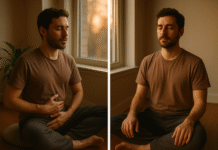
2. Form First: The Step-By-Step Technique (With Pacing, Posture, and Tongue Placement)
Correct form makes 4-7-8 easier and more effective. Sit upright with a long spine, shoulders loose, and your tongue tip resting against the ridge just behind your upper front teeth. Begin by exhaling fully through the mouth with a soft “whoosh,” which helps empty stale air and resets your count. Then close your mouth and inhale through your nose for 4 counts (quietly, diaphragmatically—your belly rises subtly). Gently hold for 7 counts without strain. Finally, exhale through the mouth for 8 counts, as if fogging a mirror—but lightly. Repeat for 4 cycles. Early on, it’s common to feel warmth or slight lightheadedness; that’s your cue to keep the breath smaller and the counts brisk while maintaining the ratio.
2.1 Mini-checklist
- Tongue & mouth: Tongue stays at the ridge; exhale around it through pursed lips.
- Noise level: Inhale nearly silent; exhale can be audible but gentle.
- Depth: Avoid “big gulps.” Aim for smooth, medium volume breaths.
- Count integrity: If a 7-count hold feels long, reduce everything proportionally (e.g., 3-5-6) and build up.
- Sets: Begin with 4 breaths per session; most people practice twice daily for consistency.
2.2 Common pitfalls (and fixes)
- Forcing the hold: If the 7-count feels strained, shorten your ratio; the nervous system responds to comfort, not willpower.
- Over-breathing: Giant inhales can cause dizziness. Keep the inhale modest and the exhale easy. Educational materials for 4-7-8 explicitly note you can speed up while maintaining the ratio until you adapt.
- Doing too many breaths early on: Classic guidance is no more than four breaths at a time for the first month, then you can extend to eight per session if you like.
Synthesis: Honor the ratio, minimize effort, and cap early sessions at four breaths to build a steady, sustainable practice.
3. The Physiology: How 4-7-8 Taps the Vagus Nerve, HRV, and Baroreflex
Practically, 4-7-8 works by slowing breathing and lengthening exhalation, which tends to increase vagal activity and modulate heart rhythms. During inhalation, heart rate naturally rises; during exhalation, it falls—a phenomenon called respiratory sinus arrhythmia. Extending the exhale (and keeping the overall pace slow) amplifies this oscillation, often increasing HRV. Meta-analyses and controlled studies of slow or resonance-frequency breathing (~6 breaths/min) show short-term reductions in heart rate and systolic blood pressure, and improvements in HRV indices; protocols emphasizing longer exhalation ratios can raise HRV more than equal ratios. 4-7-8 is not the same as resonance breathing, but it shares key ingredients: slow rhythm and an out-breath bias.
3.1 What about the “7” hold?
The mid-cycle breath-hold is brief and unforced. In practice, it may increase CO₂ slightly, encouraging the urge to exhale and making the subsequent out-breath naturally longer. Breath-hold science is better studied in athletes and divers than in everyday stress management, so we should avoid grand claims. Still, gentle holds are commonly used in clinical breath training without adverse effects when done comfortably and briefly. PMC
3.2 HRV, baroreflex & calm
Slow, paced breathing can enhance baroreflex sensitivity—the reflex that helps stabilize blood pressure—while increasing HRV in the short term. These shifts are associated with feeling calmer and more settled. Newer reviews and trials (as of 2024–2025) continue to find immediate physiological changes (lower HR, lower SBP; mixed effects on DBP), with modest improvements in perceived stress and anxiety. Long-term cardiovascular outcomes remain under study.
Synthesis: 4-7-8 leverages well-documented effects of slow, exhale-biased breathing on the heart–brain loop; it’s a practical route to nudge HRV and pressure reflexes toward calm, especially in the moment.
4. Where 4-7-8 Helps Most: Sleep, Acute Stress, and “Spikes”
You can use 4-7-8 in two ways: reactively (to handle a spike of stress, craving, or pre-sleep arousal) and proactively (as a daily practice to build a calmer baseline). In sleep contexts, slow breathing near bedtime has reduced awakenings and sleep transitions in small randomized crossover trials, and longer programs of paced breathing have improved subjective sleep quality and vagal activity versus controls. For daytime stress, short bouts of guided slow breathing have lowered anxiety and heart rate across healthy adults, older adults, and even school-aged children in pilot randomized designs. 4-7-8 is one of several exhale-weighted patterns that can accomplish this, and its simplicity makes it portable—no device required.
4.1 Practical use cases
- Bedtime wind-down: Do one set (4 breaths) after lights out; if you’re still wired, wait 60–90 seconds and do a second set.
- Acute stress reset: Standing in a queue, before a meeting, after a difficult call—one set can blunt the adrenaline edge.
- Craving or anger: The long exhale widens the gap between impulse and action.
- Performance anxiety: Before a presentation, two sets can slow HR and steady the voice. Immediate physiological effects (HR↓, SBP↓) are commonly observed with slow breathing bouts.
4.2 What results to expect (and when)
- Immediate: A sense of settling, fewer intrusive thoughts, sometimes a yawn or body “exhale.”
- Short-term (days–weeks): Faster recovery from spikes; better pre-sleep routine adherence.
- Longer term: Evidence for durable cardiovascular changes is still developing; think of 4-7-8 as a lifelong skill for stress regulation rather than a standalone treatment.
Synthesis: Use 4-7-8 for quick resets and as a small anchor habit; its greatest value is building a repeatable pathway from “amped” to “even.”
5. Safety First: Who Should Modify 4-7-8 and How to Do It
For most healthy people, 4-7-8 is gentle. But breath-holds and long exhales can feel uncomfortable if you have asthma, COPD, other lung disease, certain heart conditions, dizziness/panic sensitivity, or if you’re pregnant. The safest path is to shorten the counts while keeping the ratio, or skip the hold initially (e.g., 3-0-4 or 4-0-6), then re-introduce a small hold if comfortable. Early lightheadedness often reflects over-breathing or forcing the hold; the fix is smaller inhales and softer, pursed-lip exhales. General clinical guidance warns that over-breathing can drop CO₂ and trigger dizziness, chest tightness, or tingling—signals to pause and breathe normally.
5.1 Modifications & guardrails
- For asthma/COPD: Emphasize gentle, pursed-lip exhalation; reduce or remove the breath-hold; keep volumes modest. Check with your clinician. (Disease-specific education favors diaphragmatic and pursed-lip breathing for symptom control.)
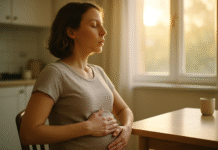
- During pregnancy: Breathing work is generally fine, but avoid uncomfortable holds or any technique that provokes dyspnea; prioritize comfort and consult your care team if unsure.
- Dizziness or panic-prone: Start with 2–3 easy cycles or try 3-5-6; stop if symptoms escalate, then resume later at a gentler pace.
- Post-meal or reflux: Long holds can feel tight—wait ~60 minutes after a large meal.
5.2 A note on “more is better”
Early teaching materials advise no more than four breaths per session for the first month, then up to eight later; this keeps things restorative, not stimulating. If you feel woozy, stop and resume later with smaller breaths.
Synthesis: Comfort is the guide. If a hold or exhale feels forced, shrink the count, skip the hold, or pause—then rebuild gradually.
6. Troubleshooting: Fixing the Top 7 Mistakes (So 4-7-8 Feels Good)
4-7-8 should feel steady and soothing within a few sessions. If it doesn’t, you’re likely running into one of a handful of common errors. The good news: each has a simple remedy. Addressing these will often transform the technique from “effortful” to “automatic.”
6.1 The frequent culprits (and fixes)
- Counting seconds, not ratio: You don’t need a stopwatch; keep the 4:7:8 proportions and let the pace be natural.
- Huge inhales: Oversized breaths amplify dizziness. Aim for medium inhales and easy, pursed-lip exhales.
- Strained holds: If you’re bracing your neck or face, shorten the hold or remove it temporarily; re-add a gentle pause later.
- Too many cycles: Cap at four cycles early on; practice twice daily rather than cramming 20 breaths at once.
- Racing mind: Pair counting with a tactile cue (thumb to finger) or a metronome/pacer.
- Positioning: Slouching compresses the diaphragm; sit tall or lie on your side if sitting is uncomfortable.
- No external guide: Early on, visual, haptic, or audio pacers can smooth timing and boost adherence. Devices and phone apps that cue 0.1-Hz slow breathing and display HRV are increasingly available and usable.
6.2 Mini example: From wobble to smooth
Day 1, you try 4-7-8 with big breaths and white-knuckle holds—you feel dizzy and give up. Day 2, you switch to 3-5-6 with smaller breaths; dizziness disappears. Day 5, you’re at 4-6-7. Day 14, you’re comfortable with 4-7-8, four cycles twice daily. That’s success.
Synthesis: Solve for comfort and consistency; when in doubt, scale down the breath size or counts and add simple cues.
7. The 4-Week Practice Plan: Build a Habit You’ll Actually Keep
Consistency—not heroics—delivers the benefits. Most people succeed by anchoring 4-7-8 to existing routines (after morning hygiene, lights out at night) and by keeping early sessions short. Below is a simple progression that respects traditional guardrails and modern evidence on what makes breath interventions stick.
7.1 The progression
- Week 1: 4 cycles, twice daily (morning/evening). Keep the rhythm small and easy. If the 7-count hold pinches, try 3-5-6 for a few days.
- Week 2: Still 4 cycles, 2×/day. Add one reactive use (e.g., before a meeting). Track mood or pre-sleep calm in a notes app.
- Week 3: If comfortable, you may extend an evening session to 6–8 cycles; keep morning at 4. Consider using a gentle pacer or haptic prompt and note perceived stress changes.
- Week 4 and beyond: Maintain 2×/day; add situational sets when needed. Optional: experiment with a slightly slower pace while keeping the 4:7:8 ratio, or alternate with resonance-style breathing on separate days if you’re exploring HRV biofeedback. Frontiers
7.2 Habit aids that work
- Temptation bundling: Pair 4-7-8 with something you already do (set the kettle, then breathe).
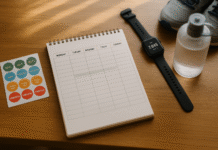
- Light accountability: A simple calendar streak or watch reminder keeps the chain going.
- Device support: Visual/haptic pacers or devices that cue slow breathing can boost adherence and subjective sleep quality in pilots.
Synthesis: Small, regular sessions beat occasional marathons. Keep the ritual tiny, repeatable, and pleasant—and it will carry you when stress runs high.
FAQs
1) What exactly is the 4-7-8 breathing technique?
It’s a ratio-based pattern: inhale through the nose for 4 counts, hold for 7, exhale through the mouth for 8—with the tongue resting behind the top teeth. The ratio is what matters; you can go faster or slower as long as the proportions stay the same. Start with four cycles per session, usually twice daily.
2) Does 4-7-8 really help with sleep?
Evidence for slow, paced breathing at bedtime shows fewer awakenings and smoother sleep transitions in small randomized trials; longer programs have improved subjective sleep quality and vagal activity. While not a cure for insomnia, 4-7-8 is a practical way to quiet arousal before lights out—easy to test for yourself over two weeks.
3) How quickly should I expect results?
You’ll often feel an immediate downshift (slower heart rate, longer exhale). Meta-analyses report short-term reductions in heart rate and systolic blood pressure with slow breathing, and modest reductions in perceived stress. Durable cardiovascular changes take longer and vary person to person; think skill-building, not “hack.”
4) How many cycles should I do?
Traditional guidance: four cycles per session for the first month, then up to eight if you like. Many people keep it at four because it’s quick and sustainable. If you get dizzy, you’re likely over-breathing—shrink the breaths or shorten the counts.
5) Is 4-7-8 safe if I’m pregnant or have asthma/COPD?
Breathing practice is generally fine, but skip or shorten holds and keep breaths small if you have respiratory conditions or are pregnant. If anything feels tight or panicky, stop and return to easy, normal breathing. When in doubt, ask your clinician—especially if you have uncontrolled symptoms. PMC
6) How is 4-7-8 different from box breathing or resonance breathing?
Box breathing is symmetrical (4-4-4-4). Resonance breathing targets ~6 breaths/min to maximize HRV via baroreflex resonance. 4-7-8 is asymmetric with a long out-breath and a brief hold; it isn’t tuned to resonance for everyone, but it still slows breathing and biases the exhale, which can feel very calming. PMCScienceDirect
7) Can children use 4-7-8?
Yes—with shorter counts, no straining, and gentle coaching. In school settings, short guided slow-breathing sessions have reduced anxiety in randomized pilots. The goal is to make it playful and comfortable, not perfect. PubMed
8) What if I can’t hold my breath for 7 counts?
No problem. Keep the ratio but shrink the numbers (e.g., 3-5-6). As your comfort grows, lengthen the counts gradually. Many people also remove the hold temporarily, then re-introduce a small pause later.
9) Will 4-7-8 lower my blood pressure?
A single session of slow-paced breathing commonly lowers heart rate and systolic blood pressure for a short period. Reviews suggest modest emotional benefits and short-term cardiovascular shifts; long-term BP change for the general population is less certain. Use 4-7-8 as a complement to medical care and lifestyle measures.
10) Are apps or devices helpful?
If you struggle with timing or consistency, visual/haptic pacers and HRV-biofeedback tools can help you find a comfortable rhythm and stick with it. Early studies report good usability and subjective sleep gains with tactile pacers, and guidance devices exist for 0.1-Hz breathing. MDPI
11) Does the exhalation length really matter?
Yes. Longer exhalations are associated with greater vagal activation and HRV increases during slow breathing, which lines up with the calming sensation people report. That’s why 4-7-8 emphasizes an 8-count exhale. PubMed
12) Is there research on 4-7-8 specifically?
There are a few direct studies (e.g., in sleep-deprived adults) and a large body of research on slow/exhale-biased breathing more broadly. The consensus: immediate physiological calming is reliable; subjective stress often improves; and the best outcomes come from regular, comfortable practice, not straining.
Conclusion
Mastering the 4-7-8 breathing technique doesn’t require perfect lungs, long practice blocks, or a monk-like mindset—it requires consistency and comfort. The ratio’s power lives in its simplicity: a soft inhale, a brief pause, and a long, easy exhale that tells your heart and brain it’s safe to relax. Evidence supports the immediate physiological shifts common to slow, exhale-weighted breathing—lower heart rate, modest blood-pressure reductions, and increased HRV—alongside improvements in perceived stress and pre-sleep arousal for many people. Over weeks, the technique becomes less of a tool and more of a reflex: a reliable path from “amped” to “even” that you can trigger in a minute or less.
Your next step is small: four breaths, twice a day for two weeks, plus one “in the wild” set during a stressful moment. Keep the ratio, shrink the counts if needed, and stay kind to your lungs—if it feels forced, you’re doing too much. You can expand later to six or eight breaths at night, try a gentle pacer, or explore resonance-style breathing on alternate days. The goal isn’t performance; it’s permission to exhale.
CTA: Try four 4-7-8 breaths right now—then put a two-week reminder on your calendar and make calm a daily habit.
References
- Video: Breathing Exercises: 4-7-8 Breath — DrWeil.com, accessed 2025. DrWeil.com
- 4-7-8 Breath (Relaxation Exercise) — Rutgers School of Nursing (adapted from Andrew Weil), 2010/2020 PDF. Rutgers Nursing
- How To Do the 4-7-8 Breathing Exercise — Cleveland Clinic, Sep 6, 2022. Cleveland Clinic
- Do Longer Exhalations Increase HRV During Slow-Paced Breathing? — Meehan ZM et al., Applied Psychophysiology and Biofeedback, 2024. PMC
- Slow-Paced Breathing: Influence of Inhalation/Exhalation Ratio — Laborde S et al., Sustainability, 2021. MDPI
- The Impact of Resonance Frequency Breathing on HRV — Steffen PR et al., Frontiers in Public Health, 2017. Frontiers
- Psychophysiological Effects of Slow-Paced Breathing at Six Breaths per Minute — Laborde S et al., Psychophysiology, 2022. Wiley Online Library
- The Effect of Slow-Paced Breathing on Cardiovascular and Emotional States: Meta-analysis — Shao R et al., Mindfulness, 2024. SpringerLink
- The Effects of Presleep Slow Breathing on Sleep — Kuula L et al., Scientific Reports, 2020. Nature
- Influence of a 30-Day Slow-Paced Breathing Intervention — Laborde S et al., Nature-indexed (PMC), 2019. PMC
- Hyperventilation — Symptoms, Causes & Treatment — Cleveland Clinic, Jul 1, 2024. Cleveland Clinic
- Hyperventilation — Johns Hopkins Medicine, accessed 2023. Hopkins Medicine
- Breathing Exercises — American Lung Association, accessed 2025. American Lung Association
- Heart Rate Variability Biofeedback & Slow Breathing Review — Bates ME et al., Frontiers in Neuroscience, 2022. PMC
- Evaluation of a Tactile Breath Pacer for Sleep Problems — Vermeylen S et al., PLOS ONE (PMC), 2022. PMC
- Post-Stroke Slow-Paced Breathing & Autonomic Function — Larson M et al., Frontiers in Physiology, 2020. Frontiers
- Effects of Sleep Deprivation and 4-7-8 Breathing Control — Vierra J et al., Physiology & Behavior, 2022. PMC
- Heart Rate Variability Modulation Through Slow-Paced Breathing — Mauro M et al., The American Journal of Medicine, 2025. American Journal of Medicine