



















A dedicated workout space doesn’t need a spare room; it needs intention, a few smart choices, and consistent cues that make moving your body the default. In this guide, you’ll learn exactly how to claim a corner, make it safe and motivating, and kit it out without overspending. A dedicated workout space is simply a prepped, clutter-free zone with the right surface, lighting, air, and storage—often as small as 2×2 meters (6.5×6.5 feet)—so exercise starts quickly and feels good. This article is educational and not medical advice; if you have health conditions, consult a professional.
At a glance (quick-start): pick a location, clear 2×2 m if possible, lay grippy flooring, add bright lighting and airflow, mount storage, choose 3–5 versatile tools, and post your plan where you’ll see it.
1. Define Your Workouts and Space Requirements First
The fastest way to create a dedicated workout space is to start with what you actually plan to do—then size and kit the area to fit. Decide whether your core week looks like bodyweight circuits, dumbbell strength, mobility/yoga, indoor cycling, or a mix. This sets clear requirements: a mat footprint for yoga, headroom for presses and skipping, or stable anchor points for bands. Begin by listing three priority movements you want every week; your space only needs to serve those well. From there, map minimal clearances: room to lie fully flat, extend your arms overhead, and step into lunges without hitting a wall or furniture. When your space matches your intent, setup friction drops dramatically and consistency rises—because everything you need is within reach and everything you don’t is out of the way.
1.1 Why it matters
- Matching space to tasks reduces decision fatigue and mess.
- Proper clearances reduce trip hazards and awkward lifting angles.
- It prevents overspending on gear you won’t use.
1.2 Mini-checklist
- Pick 3–5 “must-do” moves (e.g., goblet squats, push-ups, rows, hip hinges, carries).
- Note special needs: overhead reach, floor work, anchor point, cardio device.
- Confirm you can lie flat plus 30–45 cm (12–18 in) buffer around your mat.
Synthesis: Purpose-built beats overbuilt; prioritizing function ensures your space stays used, not just “nice to have.”
2. Claim a Zone and Clear It to Bare Essentials
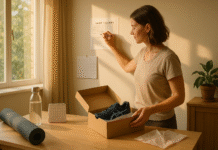
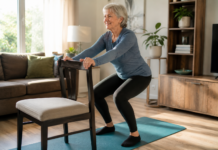
Pick a fixed spot—even a single corner—and make it non-negotiable. Consistency flows from seeing your cues daily: your mat rolled out, your timer, your dumbbells where they belong. Clear the area to the walls, remove low tables and loose rugs, and create a safe, open rectangle you can return to instantly. If you’re in a small apartment or shared home, choose a spot with the fewest interruptions and the easiest cleanup (e.g., bedroom corner, living room edge near a window, or balcony with shade). A firm rule helps: nothing in this zone unless it serves your training. This visual clarity reduces excuses and keeps setup under one minute.
2.1 How to do it
- Measure and mark: Tape a 2×2 m square (or the largest rectangle you can spare).
- Declutter fast: Box up non-fitness items and move them out of sight.
- Stability check: Ensure the surface is level and dry; remove loose mats and runners.
2.2 Common mistakes
- “Floating” gear that migrates around the home.
- Overcrowding with furniture or décor.
- Keeping the zone multipurpose (laundry today, workout tomorrow).
Synthesis: A clearly claimed zone, even tiny, turns “when I have time” into “now.”
3. Lay Down the Right Surface: Grip, Cushion, and Cleanup
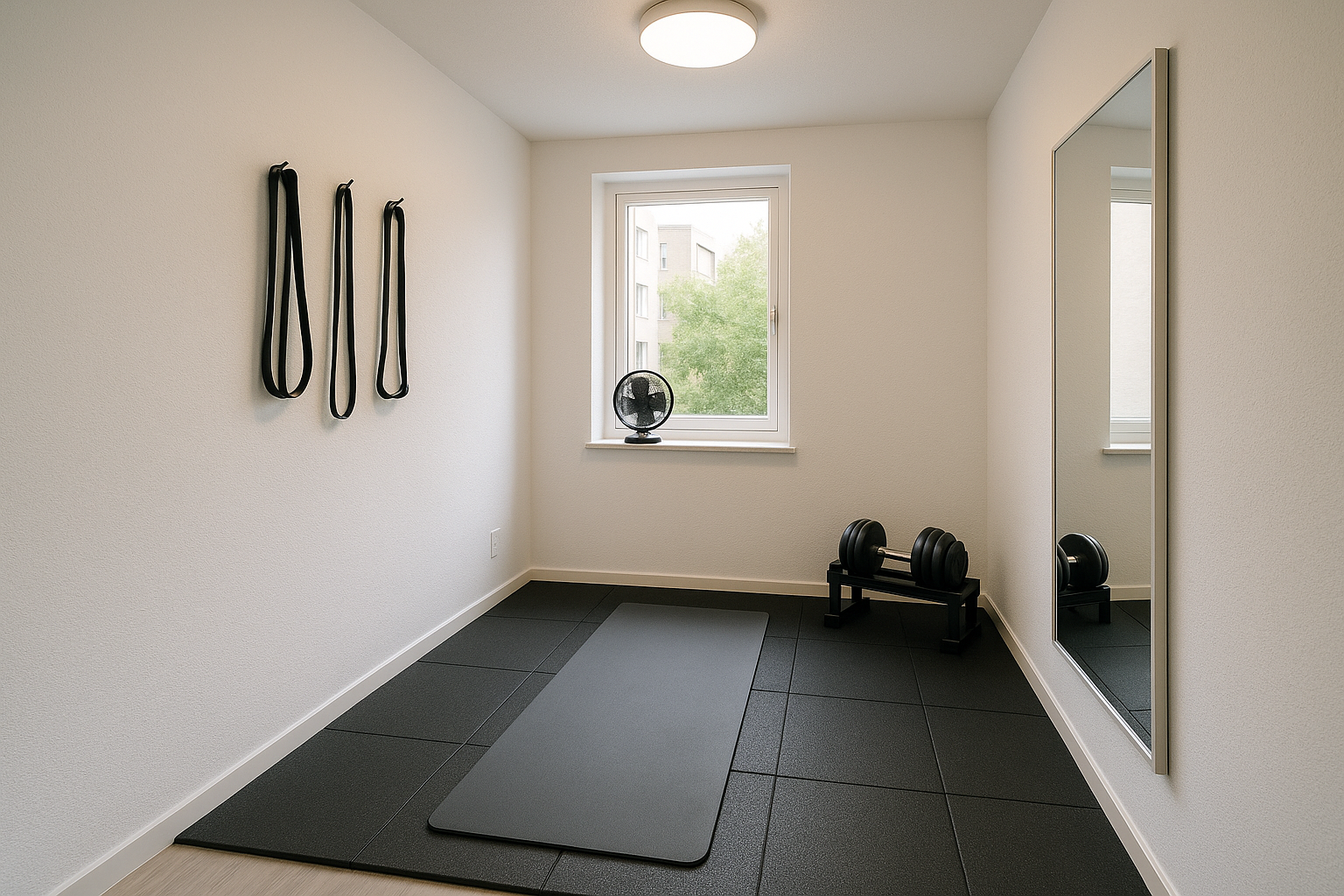
Your floor determines safety, joint comfort, and noise. The ideal surface is grippy, slightly compliant, and easy to sanitize—think interlocking rubber tiles or a quality exercise mat over a stable base. Hard tile and polished wood can be slippery with sweat; plush carpets feel unstable for heavy lifts. In small spaces, modular tiles let you build a training “island” that protects your base floor. Prioritize traction for lateral moves and burpees, a bit of give for jumping, and enough firmness for balance work and presses. Keep a microfiber towel and a mild cleaner nearby and wipe down after sessions to prevent slick spots.
3.1 Numbers & guardrails
- Use non-slip flooring; test traction with lateral shuffles.
- Avoid thick, spongy foam for heavy dumbbell work; it compromises stability.
- Add a landing pad or thicker tile where you set weights down.
3.2 Tools/Examples
- Interlocking rubber tiles, heavy-duty mat, low-profile landing pad.
- Floor tape to define edges and prevent tile creep.
- Small floor squeegee for quick sweat cleanup.
Synthesis: If the floor is safe and grippy, every movement feels better—and you’ll come back tomorrow.
4. Get Lighting and Sightlines Right (Mirror Optional but Helpful)
Bright, even lighting improves mood, alertness, and form. Aim for a well-lit zone—you should be able to read small text comfortably on your phone mid-set. Many home gyms feel “dull” because they rely on one warm ceiling bulb; add a brighter bulb or an LED panel and a task lamp at shoulder height to reduce shadows. A full-length mirror helps you check neutral spine, knee tracking, and bar path without a coach. Place it about 30–60 cm (12–24 in) above the floor, secured to a wall. If your space has a window, position your mat to capture daylight without glare from direct sun.
4.1 How to do it
- Use bright, diffused LED lighting; avoid harsh shadows across the floor.
- Place mirror(s) where you can view side and front angles for compound lifts.
- Avoid backlighting that turns you into a silhouette.
4.2 Mini-checklist
- Can you clearly see your knees and feet during squats?
- Is the mat evenly lit corner to corner?
- Are cords and lamps out of traffic lanes?
Synthesis: Good light and sightlines help you move well and stay motivated—small upgrades, big payoff.
5. Prioritize Airflow and Fresh Air for Comfort and Hygiene
Stale, humid air makes workouts feel harder and encourages odors. Give your space consistent airflow: open a window, run a pedestal fan or ceiling fan, and consider a small HEPA purifier if dust or allergies are issues. For windowless rooms, crack the door and use a fan to move air through. If you use a garage or balcony, plan shade and cross-breezes for hot months. In colder climates, ventilate briefly before and after training to refresh the room without over-chilling your body mid-workout. Better air means better perceived exertion and longer sessions.
5.1 How to do it
- Position a fan to blow across your torso and out of the space, not into your face.
- Air out the room post-workout for a few minutes to reduce humidity and smells.
- Store damp towels out of the workout zone.
5.2 Region-specific note
- Check local air quality and heat index; schedule intense sessions at cooler, cleaner times of day.
Synthesis: Move air, feel better; it’s that simple—and it keeps your space fresh for tomorrow’s session.
6. Control Noise and Vibration (and Keep the Peace)
Noise travels—especially footfalls and dropped weights. Protect floors and neighbor relations by using rubber tiles and controlled lowers, not drops. For cardio devices (rowers, bikes, treadmills), add a vibration-damping mat and level feet. Shut doors and run a fan for white noise if early-morning workouts disturb others. Keep speakers at a respectful volume or use bone-conduction/over-ear headphones so you can still hear your surroundings. If you train above a bedroom or below a neighbor, time jumping sessions for reasonable hours, and substitute low-impact options when needed.
6.1 Practical steps
- Put thick mats under loud equipment (bike/treadmill).
- Practice soft landings on jumps; control descents on lifts.
- Use felt pads under benches or racks; level equipment to prevent wobble.
6.2 Mini case
- Swapping from hard tile to rubber tiles with a landing pad can cut perceived noise dramatically and prevent neighbor complaints.
Synthesis: Thoughtful noise control protects hearing, relationships, and your right to keep training at home.
7. Build Vertical Storage and a “One-Minute Reset”
Clutter kills momentum. Mount hooks for bands and jump ropes, add a slim shelf or cubby for small items, and use a low rack or box for dumbbells or kettlebells. Keep only what you use weekly in arm’s reach; the rest goes in a bin or closet. Label shelves or use clear containers so everything has a home. Your goal: after a session, you can reset the space in one minute—mat wiped, weights returned, timer docked, towel hung. That ritual anchors the habit and keeps your space inviting.
7.1 How to do it
- Wall hooks for bands, towel, and timer.
- Narrow cart or shelf for shoes, straps, chalk, and cleaner.
- Low dumbbell rack or sturdy storage box against a wall.
7.2 Quick pitfalls
- Stacking too tall; heavy items should stay low.
- Storing sharp-edged gear at knee height near the mat.
Synthesis: Storage isn’t décor; it’s a habit engine. One minute to reset means tomorrow starts fast.
8. Choose a Lean, Modular Equipment Kit (Start Small)
You don’t need a truckload of gear. Start with a high-leverage kit that covers strength, cardio, and mobility: a quality mat, adjustable dumbbells or two kettlebells, long resistance band + loop bands, a sturdy door anchor, and a timer. Add a pull-up bar or suspension trainer if you have a safe doorway or ceiling beam. For cardio, a jump rope, step platform, or compact bike/rower can fit most spaces; choose one, not all. Let your goals lead: if strength is primary, prioritize loadable implements; if conditioning is primary, choose something you’ll actually use 3–4 times per week.
8.1 Budget tiers (example)
- Essentials (~$75–$200): Mat, bands, jump rope, timer.
- Strength (~$250–$600): Adjustable dumbbells or two kettlebells, pull-up bar.
- Premium/space-aware: Compact rower or bike; foldable bench.
8.2 Common mistakes
- Buying bulky machines you won’t use.
- Skipping load progression tools (extra plates, heavier bells).
- Ignoring anchors and clearances for bands or suspension trainers.
Synthesis: Buy less, use more; modular gear evolves with you and respects your space.
9. Engineer Safety Into the Layout
Safety is design: clear pathways, stable surfaces, and planned anchor points. Keep sharp corners out of reach, route cords away from footpaths, and anchor anything that can tip (mirrors, racks, pull-up bars). Give yourself landing zones: a defined area to set weights down without hitting toes or tiles. If you train alone, avoid absolute max attempts on unstable surfaces; use loads you can control cleanly. Post an emergency contact list and store a basic first-aid kit nearby. If you have cardiovascular or orthopedic concerns, complete a screening questionnaire and get clearance before intense training.
9.1 Mini-checklist
- No loose rugs or cords across the mat.
- Anchored mirror and pull-up/suspension gear.
- First-aid kit, phone within reach, water nearby.
9.2 How to do it
- Test anchors with slow, controlled pulls at workout height.
- Keep heavy gear low; never above knee height unless secured.
- Practice bail-outs (e.g., how you’ll safely set a dumbbell if grip fails).
Synthesis: A safe layout turns “be careful” into “I’m covered”—and that confidence improves performance.
10. Add a Tiny Tech Stack: Timing, Tracking, and Cues
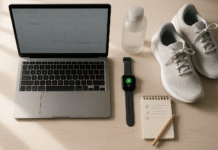
Technology is there to eliminate excuses and guide effort, not to distract. Use a simple interval timer (phone app or physical), a heart-rate monitor if you train zones, and a notes app or whiteboard for logging sets. Mount a small clock in view. If you enjoy music, set a pre-made playlist so you don’t scroll mid-session. Consider a cheap tablet/old phone on a stand for form checks and follow-along videos. Keep chargers and cables off the floor and label them. The test: can you start a session in under 60 seconds with a single button press?
10.1 Tools/Examples
- Interval timer app; whiteboard and marker.
- Heart-rate strap or watch; phone stand.
- Prebuilt playlists or audio-only coaching.
10.2 Common pitfalls
- Over-tracking metrics you don’t use.
- Notifications on during workouts; enable Do Not Disturb.
- Trip hazards from charging cables.
Synthesis: Minimal, purposeful tech creates focus and feedback without clutter.
11. Make It Motivating: Cues, Rituals, and Visual Wins
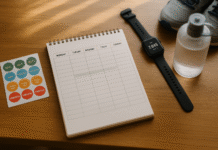
Motivation grows from frictionless starts and visible progress. Place your plan where you’ll see it: a weekly grid on the wall or a card on your dumbbell rack. Use visual cues like a mat left open or shoes under the shelf. Establish a two-minute opening ritual—fill your water, start the timer, do five breaths, then your first warm-up move. Track small wins: checkmarks, reps, or streaks. Add one personal touch (a plant, a framed quote, natural light), but keep the space simple so the gear stays front-and-center.
11.1 Mini-checklist
- Written weekly plan in view.
- Two-minute ritual to start every session.
- Quick win tracker: calendar X’s, app streak, or whiteboard tally.
11.2 Why it works
- Visible plans reduce decision-making.
- Rituals trigger action.
- Progress marks fuel adherence and confidence.
Synthesis: Design your environment so the space invites you to begin; your habits will do the rest.
12. Keep It Clean and Ready: Maintenance as a Habit
A clean space is a used space. Sweat and dust build up fast, especially on mats and bands. Adopt a short post-workout routine: spray and wipe the mat, towel dry handles, coil bands, and crack a window or run the fan for a few minutes. Wash towels after each session and let shoes dry outside the zone. Schedule a weekly deeper reset: vacuum edges, re-level equipment feet, retighten any wall anchors, and inventory your kit for wear. This prevents odors, preserves grip, and signals your brain that this is an active, cared-for area—not a storage corner.
12.1 Maintenance checklist
- After each session (2–3 minutes): Wipe mat and handles, coil bands, reset timer, airflow.
- Weekly (10–15 minutes): Vacuum, tighten anchors, check mirror stability.
- Monthly: Inspect bands for cracks; replace if needed. Evaluate lighting and fan performance.
12.2 Common mistakes
- Letting damp towels and shoes live in the space.
- Skipping anchor checks for months.
- Allowing clutter creep from non-fitness items.
Synthesis: Treat maintenance as training; a ready space removes excuses before they form.
FAQs
1) How much space do I really need for a dedicated workout space?
Most people can train effectively in about 2×2 meters (6.5×6.5 feet). That’s enough for floor work, lunges, carries, and most dumbbell lifts. If you want a cardio device, measure the machine’s footprint plus 30–45 cm (12–18 in) of clearance at the sides and behind, and ensure you can fully extend your arms overhead without hitting the ceiling.
2) What are the must-have items to start?
Begin with a quality mat, a set of bands (long and loop), a timer, and either adjustable dumbbells or two kettlebells you can progress with for 6–12 months. Add a pull-up bar or suspension trainer if you have a safe anchor. This kit covers strength, mobility, and conditioning without crowding your home.
3) Do I need a mirror?
A full-length mirror is optional but helpful for checking form—neutral spine, knee tracking, and shoulder position. Place it securely where you can see both front and side angles. If you prefer not to mount a mirror, record short form videos on a phone stand and review between sets.
4) What lighting should I use?
Aim for bright, even lighting so you can read small text comfortably mid-session. In practice, general exercise areas feel good around a few hundred lux with minimal shadows. Use a bright ceiling fixture plus a diffused task light if corners are dim, and avoid strong backlighting that creates glare or silhouettes.
5) How do I handle ventilation in a small apartment?
Open a window when possible and run a fan to increase airflow across your torso. After training, air the room for a few minutes to reduce humidity and odors. If air quality outdoors is poor, use a fan to move indoor air and consider a small HEPA purifier; position it so it doesn’t blow dust directly into your face during sets.
6) Are early-morning workouts too noisy for neighbors?
They don’t have to be. Use rubber flooring, a landing pad, and controlled lowers instead of drops. Pick quieter cardio (bike or rower over treadmill sprints), keep speakers modest or use headphones, and time jump training for reasonable hours. Level equipment feet to reduce vibration through the floor.
7) What safety steps should I take if I train alone?
Keep a clear path around your mat, anchor mirrors and pull-up bars securely, and route cords away from foot traffic. Train loads you can control, especially on unstable surfaces. Keep a phone, water, and a basic first-aid kit nearby. If you have health concerns, complete a screening questionnaire and seek medical clearance before intense efforts.
8) How do I stay motivated to use the space regularly?
Make the space visually ready: mat down, gear in place, plan on the wall. Use a two-minute start ritual and track small wins—checkmarks, reps, or weekly streaks. Keep the space tidy with a one-minute reset after each session so tomorrow looks inviting, not like a cleanup project.
9) What’s a smart first purchase if I’m on a tight budget?
Start with a durable mat and a set of long and loop bands. Together they unlock dozens of movements for strength and mobility. If you have a bit more budget, add adjustable dumbbells or a pair of kettlebells that challenge your lower-body lifts while allowing upper-body control.
10) How often should I clean and inspect my setup?
Wipe the mat and handles after every session and air out the room briefly. Weekly, vacuum edges, re-level equipment, and retighten anchor points. Monthly, inspect bands for cracks and replace at the first sign of wear. This keeps grip reliable, air fresh, and equipment safe.
11) Can I combine a workspace and workout space?
Yes—just protect boundaries. Use folding screens, tape lines, or a rolling cart so your workout kit stays contained and setup is one minute or less. Keep cables and office chair bases out of your training rectangle, and store heavy equipment low to avoid tipping near desks.
12) What if my ceiling is low?
Choose movements that respect your vertical clearance—no overhead jumps under a fan. Swap jumping rope for lateral hops or low-impact power moves. For presses, sit or half-kneel to avoid hitting the ceiling, and angle mirrors to maintain sightlines even in tight quarters.
Conclusion
You don’t need a dedicated room to train consistently—you need a dedicated workout space that’s safe, bright, breathable, and ready at a glance. When your zone is defined, the surface is grippy, the light is clear, and the gear is lean and reachable, setup friction disappears. Add airflow and noise control for comfort and harmony, storage for a one-minute reset, and a tiny tech stack for timing and tracking. Then anchor it all with simple rituals and visible cues so the habit runs on rails. Start small today: claim a corner, lay a mat, hang two hooks, and print your weekly plan. Protect the habit with maintenance, and let the space evolve as your strength and stamina grow.
Call to action: Choose your corner and place your mat today—your next workout begins the moment you see it.
References
- WHO Guidelines on Physical Activity and Sedentary Behaviour, World Health Organization, 2020. https://iris.who.int/bitstream/handle/10665/336656/9789240015128-eng.pdf
- Physical Activity Recommendations for Different Age Groups, Centers for Disease Control and Prevention, Apr 16, 2024. https://www.cdc.gov/physical-activity-basics/guidelines/index.html
- Steps for Getting Started With Physical Activity, Centers for Disease Control and Prevention, Apr 17, 2024. https://www.cdc.gov/healthy-weight-growth/physical-activity/getting-started.html
- ACSM Physical Activity Guidelines (overview), American College of Sports Medicine, accessed 2025. https://acsm.org/education-resources/trending-topics-resources/physical-activity-guidelines/
- Create a Customized Home Workout Space, Harvard Health Publishing, Jan 1, 2025. https://www.health.harvard.edu/heart-health/create-a-customized-home-workout-space
- 3 Strategies for Safer Home Workouts, Harvard Health Publishing, Aug 1, 2023. https://www.health.harvard.edu/exercise-and-fitness/3-strategies-for-safer-home-workouts
- Standards 62.1 & 62.2: Ventilation and Indoor Air Quality, ASHRAE, expanded/revised 2022. https://www.ashrae.org/technical-resources/bookstore/standards-62-1-62-2
- Recommended Lighting Levels in Buildings (IES summary), Archtoolbox, Mar 7, 2021. https://www.archtoolbox.com/recommended-lighting-levels/
- Understand Noise Exposure (NIOSH Recommended Exposure Limit), National Institute for Occupational Safety and Health (CDC), accessed 2025. https://www.cdc.gov/niosh/noise/prevent/understand.html
- Patient Involvement With Home-Based Exercise Programs: A Systematic Review, Physiotherapy Theory and Practice (PMC), 2018. https://pmc.ncbi.nlm.nih.gov/articles/PMC5856927/
- A Behavioral Perspective for Improving Exercise Adherence, Healthcare (PMC), 2024. https://pmc.ncbi.nlm.nih.gov/articles/PMC11102891/