




























Analog tools aren’t old-fashioned—they’re effective. If you’ve ever felt app fatigue or notification overload, using a bullet journal or paper planner is a calm, flexible way to track habits without friction or distractions. Bullet journal habit tracking simply means recording your daily actions—like water intake, workouts, sleep, study time—in a visual layout you update by hand. Done well, it creates visibility, accountability, and momentum. In this guide you’ll learn nine practical, field-tested strategies that work in any notebook or planner. You’ll set up simple layouts, connect habits to triggers, reflect without guilt, and keep your system sustainable. Quick definition: bullet journal habit tracking is the analog practice of logging habits on paper using spreads (monthly, weekly, daily) and collections so you can see progress and adjust fast.
How to start (quick steps): 1) Pick a small set of habits that matter now. 2) Choose a spread (monthly, weekly, or daily). 3) Define your trigger and minimum version. 4) Log daily with one mark. 5) Review weekly to fix bottlenecks. This article is educational and for general information only; it isn’t medical, mental health, or professional advice.
1. Pick a Simple System: Bullet Journal Basics That Support Habits
The fastest way to build consistency is to reduce decisions, and a lean bullet journal framework does exactly that. Start by anchoring habits to the core pieces of the Bullet Journal® method: an Index to find your trackers, a Future Log for long-range intentions, Monthly Logs to see patterns, and Daily Logs to capture what happened today. If you’re using a traditional planner with pre-printed pages, the same logic applies—think of your Index as sticky tabs or a color code, your Future Log as a yearly overview page, and your Monthly/Weekly spreads as your habit “dashboard.” Keep the structure light so you’ll actually use it. Most people stall not because they lack motivation, but because their system is elaborate, slow, or out of sight. A small, obvious layout you can update in under a minute beats any fancy template you forget.
Your opening move is clarity. Decide which 3–5 habits are your lead dominoes for this month (e.g., “walk 20 minutes,” “lights out by 11,” “log lunch,” “10 push-ups,” “read 10 pages”). Write a one-line definition for each so there’s no ambiguity later. Place your tracker where you’ll see it every day—inside your Weekly spread or on the left page of your Daily log—so marking it off becomes as automatic as closing the notebook.
Quick setup checklist
- Add an Index entry named “Habit Trackers” with page numbers.
- Create a Future Log note for quarterly goals (e.g., “build sleep consistency”).
- Define Monthly/Weekly logs and where habit tracking will live.
- Choose 3–5 habits with minimum viable definitions.
- Put your journal and pen where you perform the first habit.
1.1 Why these pieces matter
- Index prevents “lost tracker syndrome,” speeding retrieval.
- Future Log frames intent so monthly priorities aren’t random.
- Monthly/Weekly logs show patterns and bottlenecks.
- Daily logs keep the behavior concrete and reviewable.
Mini example: You label Index “Habit Trackers p. 8–9.” Future Log: “Q4—sleep 7+ hrs avg.” Monthly Log includes a one-page grid. Each evening, you mark sleep ≥7h and steps ≥7,000. After two weeks, you notice weekends slip; you move “walk” to mornings. Small fix, big lift.
Close with this thought: A minimal set of pages that you can find and update quickly is the foundation of every other strategy in this guide.
2. Build a Monthly Habit Tracker Grid You’ll Actually Use
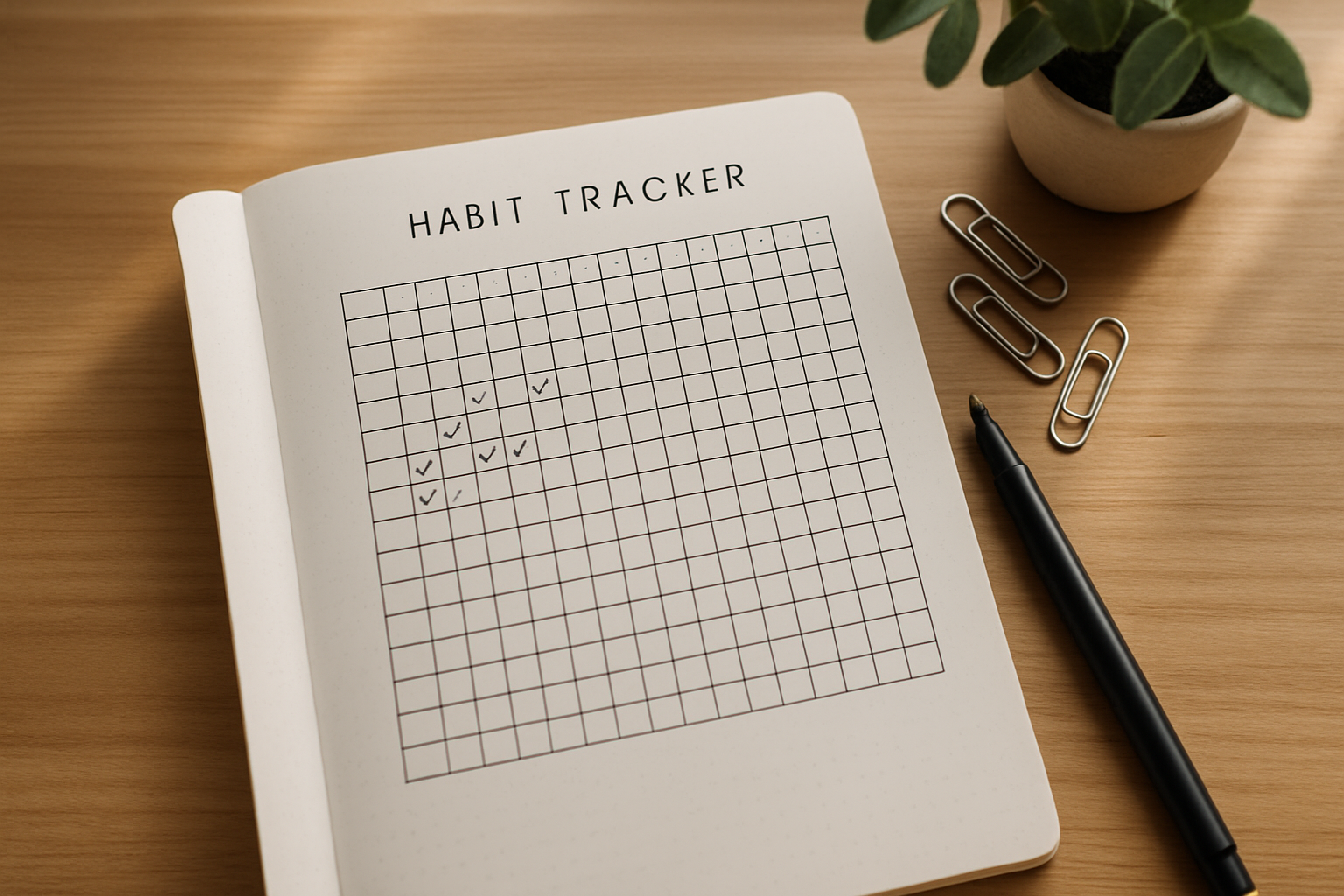
A monthly grid is the classic bullet journal habit tracker because it visualizes consistency at a glance. Make a simple table with habits down the left and days across the top (1–31). Each evening, mark a box with a ✓, a dot, or a colored slash. Aim for legibility over decoration; the less time it takes to update, the more likely you are to keep it up. Don’t track everything—track what moves the needle. If you have more than six habits, split them across two months or create a second grid for “nice-to-have” behaviors so your main grid stays tight. Remember, a tracker is a mirror, not a judge; its job is to show reality, not to scold you.
Open your grid with minimum criteria that are easy to hit on tough days. For instance, “read 1 page” or “2-minute stretch” keeps the chain alive and trains identity (“I’m the kind of person who reads/stretch”). Over time, you can raise the bar, but start small. To interpret your grid, scan for streaks and holes. A three-day hole around the same weekday is a cue problem, not a character flaw; fix the cue first.
How to draw it fast
- Left margin: write 4–6 habits maximum.
- Top row: dates 1–31; leave extra boxes blank.
- Key: ✓ = done, • = partial, — = rest day.
- Mark daily in the evening routine (60–90 seconds).
- Use a note column at the right for context (“late shift”).
2.1 Numbers & guardrails
- Target ≥80% completion for foundational habits (sleep routine, meds, hydration).
- For skill habits (workouts, language), aim 3–5 days/week instead of daily to avoid burnout.
- After two weeks, remove or replace any habit you never log—reduce friction first.
Mini case: Sana tracks “8k steps,” “no phone in bed,” “green veg,” and “10-min yoga.” After 30 days, her grid shows 85% on veg and yoga but only 50% on steps. She moves walking to 7:30 p.m. with her dad; next month steps jump to 78%. The grid didn’t motivate by itself; it revealed when to change strategy.
3. Create Weekly Routines Dashboards to Bridge Goals and Daily Life
Monthly trackers show patterns; weekly dashboards drive execution. A weekly routines page (or spread) lists the recurring habits that matter this week, paired with checkboxes for Mon–Sun. This sits next to your appointments and tasks, so habits compete less with urgent to-dos. Think of it as your “operating schedule” for behaviors: when and where each habit happens, plus a tiny checkbox to record the rep. Put your highest-impact habit in the first row, and link it to a specific trigger like “after brushing teeth” or “after afternoon tea.” The advantage of weekly framing is realism—weeks vary less than months, and you can tune next week based on what actually happened.
Don’t overload the dashboard. Five to seven rows are plenty. Include at least one recovery or rest habit (e.g., “in-bed by 11” or “30-min wind-down”). If you’re training or studying, match habit frequency to your energy cycle—heavy days get a lighter supporting habit (mobility, review, vocabulary). At the end of the week, total your checkmarks and write a one-line note: “5/7 yoga worked; move to mornings.”
Suggested layout
- Left column: habit + trigger (e.g., “20-min walk after lunch”).
- Seven small boxes: Mon–Sun checkboxes.
- Tiny notes area: environment tweaks (“keep shoes by door”).
- Anchor the page opposite your calendar to see conflicts early.
- End with a Weekly Score (e.g., 24/35 boxes) to track trend.
3.1 Tools/Examples
- Use highlighter bands to block recurring slots (e.g., Tue/Thu 6–6:30 p.m.).
- Add mini habits under big ones (e.g., “5 push-ups” beneath “gym”).
- For planners with small boxes, create a habit key and mark with symbols.
Mini example: Bilal’s weekly dashboard lists “Arabic vocab after dinner,” “30-min walk at lunch,” “prep lunchboxes 9 p.m.,” and “lights out 11 p.m.” He hits 27/35 boxes. The next week, football practice disrupts dinners, so he moves vocab to mornings and sets a 2-minute minimum. Checkmarks rebound.
Wrap-up: A weekly routines dashboard translates intention into schedule and exposes conflicts before they kill momentum.
4. Use Daily Logs and Rapid Logging to Capture Real-Time Habit Cues
Daily logs are the engine room of analog habit tracking. They capture tasks, events, and notes as they happen, and they’re the best place to connect cues with behaviors. Begin each day by writing your top three habits at the top margin with tiny boxes. As you rapid-log your day (short bullets, minimal detail), annotate habit-relevant moments: an E (event) for “slept 6h,” a dot note for “ate late,” a task bullet for “walk.” This living record builds context you can’t get from a simple grid—why you missed, what helped, and which cues actually fired.
Use signifiers to make patterns pop. A star highlights key habits (“⭐ walk 20m”), an exclamation shows insight, and arrows mark migration to tomorrow. If you miss a habit, write the reason in five words or fewer (“rain,” “late shift,” “guests,” “forgot shoes”). Don’t moralize. Your job isn’t to grade yourself; it’s to make the next attempt easier. At day’s end, scan the page and mark your monthly or weekly tracker. You’ll feel the satisfying loop of capture → act → reflect.
Rapid logging tips
- Keep bullets short and concrete (“walked 12 mins after lunch”).
- Use consistent symbols for habit events and insights.
- Preload habits at the top each morning.
- Batch update trackers during your evening routine.
- Use a single pen to reduce friction; form over flourish.
4.1 Common mistakes
- Overdecorating daily logs so they’re slow to use.
- Hiding habit marks in margins you never review.
- Capturing everything, then never reading it.
- Skipping reasons for misses, losing problem-solving data.
Mini case: Ayesha logs “Yoga 10m” in the morning margin, then notes “slept 5h” and “tea at 10 p.m.” Three evenings in a row show late caffeine. She moves tea to 6 p.m. and adds “chamomile 9 p.m.” Her next week’s sleep log improves by two nights. The daily log found the lever.
5. Map Triggers with Implementation Intentions and Habit Stacking
Habits follow cues, so write them. Implementation intentions are simple “If X, then Y” plans that connect a reliable trigger to your action (“If I pour coffee, then I’ll fill my water bottle”). In your journal, create a small page titled “Triggers & Stacks.” List each habit with its cue and minimum version. This converts vague wishes into executable scripts. Pair this with habit stacking—attaching a new habit to an existing routine—to turn routines into rails. Analog tracking helps because you physically rehearse the plan when you write it, reinforcing memory and follow-through.
Keep stacks realistic and environment-aware. Attach morning habits to hygiene or breakfast; attach evening habits to clean-up or book-in-bed. For work habits, stack after standing meetings or lunch. If a cue fails, don’t abandon the habit—swap the cue. Your “Triggers & Stacks” collection is a living document; review weekly and rewrite any stack that feels brittle or vague.
How to write strong stacks
- Specific cue: “after brushing teeth,” not “in the morning.”
- Minimum viable action: “1 push-up,” “read 1 page.”
- Same context: place the tools where the cue happens.
- Failover cue: a backup (“if I skip breakfast, do it after shoes on”).
- Review cadence: tweak every Sunday.
5.1 Examples by context
- Home (AM): After I boil water, I’ll drink 300 ml.
- Work (PM): After I end my 4 p.m. call, I’ll walk 10 minutes.
- Evening: After I put dishes away, I’ll prep tomorrow’s gym bag.
- Study: After I open laptop, I’ll review 10 flashcards.
Mini example: Omar wants to stretch daily but forgets. He writes, “After my evening shower, I will stretch 2 minutes beside the bed.” He places a yoga strap on the nightstand. The cue fires because it’s tied to a reliable routine and the tool is visible. After two weeks, he raises it to 5 minutes.
Close: Written “if–then” plans and stacks make habits robust because they live where your day actually unfolds.
6. Track Streaks and Lapses with Gentle Rules (The Two-Day Rule)
Streaks are motivating because they’re visible progress, but they can backfire if you treat one miss as failure. In your journal, pair streak tracking with a recovery rule—commonly, “never miss twice.” Create a simple line or box next to each habit labeled “Streak,” and write the current count. When you miss, circle the date and write a one-line reason. The objective is not perfection; it’s resilience. Analog streaks are powerful because you control the frame: you can mark planned rest days without breaking the chain and you can record context so a lapse becomes a lesson.
Define what counts. If your minimum is “read 1 page,” then one page sustains the streak. If it’s a training plan, plan rest days into the tracker and mark them with an em dash rather than a blank. Use the two-day rule to prevent spirals: if you miss today, tomorrow’s a must, even at the minimum. This keeps the identity intact (“I’m still a walker/reader/lifter”) and cuts shame that would otherwise stall you.
Streak mechanics
- Write the current streak number beside each habit name.
- Planned rest days use a symbol (—) so the chain remains intact.
- Missed days get a circle and a 3–5 word reason.
- Two-day rule: minimum version the very next day.
- Monthly reset: record best streak length and average.
6.1 Mini numbers to track
- Best streak this month and to date.
- Average days/week (e.g., 4.3/7).
- Recovery time after a miss (≤1 day with the two-day rule).
Mini case: Nida’s sleep routine has a 12-day streak. A wedding breaks it. She marks “—” for two planned late nights and “○” for an unexpected third. The next night she sets a 10:45 p.m. alarm and completes the minimum wind-down (brush teeth, journal 3 lines). Streak resumes. The journal turned a wobble into a plan.
7. Run Weekly and Monthly Reviews to Fix Bottlenecks Fast
Without review, trackers become pretty charts. A five-minute weekly review and a ten-minute monthly review are enough to make continuous improvements. Each Sunday, total your checkboxes and write one “keep,” one “drop,” and one “tweak.” Each month, flip to your habit grid and ask three questions: Which habit produced outsized benefits? Which one stubbornly lags? What environmental change would raise the floor? Use objective, small metrics—percentage completed, best streak, average start time—to decide what to try next. Write the experiment as a one-line hypothesis in your journal (“If I pack gym bag at 9 p.m., I’ll hit morning workouts ≥3×/week”).
Include reflections, not self-judgments. If your grid shows you’re at 50% for meditation, ask whether the cue is weak, the minimum is too big, or the payoff is distant. Choose one fix and test it for seven days. Monthly, archive or park low-priority habits in a “Later” collection so your main tracker stays focused. Reviews also protect against aesthetic drift—when spreads become art projects instead of tools.
Weekly review (5 minutes)
- Total checkboxes; note the percentage.
- Write Keep / Drop / Tweak.
- Choose 1 experiment for the coming week.
- Adjust triggers in the “Stacks” collection.
- Turn to the next Weekly dashboard and set it up.
7.1 Monthly review (10 minutes)
- Circle top habit (biggest benefit).
- Box stubborn habit; plan one environment change.
- Record best streak and avg days/week.
- Move any “nice-to-haves” to Later.
- Draft next month’s grid with fewer, clearer habits.
Mini example: Farah sees 90% hydration but 40% mobility. She moves mobility to pair with evening TV and adds a foam roller beside the sofa. Next month mobility jumps to 72%. The review made the invisible obvious.
8. Create Collections for Protocols (Sleep, Nutrition, Training) with Templates
Collections are standalone pages dedicated to a topic. For habits, they’re perfect for protocols: sleep routines, mobility sequences, meal prep plans, medication schedules, or training templates. A good collection answers “What exactly do I do?” in one glance. For sleep, list your wind-down steps and lights-out target. For mobility, sketch a 10-minute routine. For nutrition, write three default breakfasts and two lunch templates. Your habit trackers point to these pages; your daily logs execute them. Collections remove decision fatigue—when it’s time to act, you just follow the script you previously designed.
Keep collections concise and updatable. Use checkboxes for steps and leave margin space to note tweaks. If a protocol supports a tracked habit, write the collection’s page number next to the habit name in your tracker. For long-term goals (run a 10K, learn conversational Spanish), include milestones and a tiny progress bar. Update protocols monthly; archiving older versions teaches you how you improved the system.
Common protocol collections
- Sleep: wind-down checklist, screens-off time, lights-out time, weekend variation.
- Mobility/Strength: 10–20 min routine, sets/reps, equipment list, deload plan.
- Nutrition: default meals, grocery staples, prep days, “emergency” options.
- Study: spaced repetition schedule, resource list, review cadence.
- Medication/Health: day/time, dosage checklist, refill dates.
8.1 Template anatomy
- Purpose line (“10-min mobility for desk days”).
- Steps with boxes (✓ as you go).
- Timing window (e.g., 9:30–10:00 p.m.).
- Link to tracker page numbers and cues.
- Space for “What I changed” notes.
Mini case: Hasan keeps missing evening vitamins. He creates a “Health PM” collection: brush teeth → vitamins → fill water → journal 3 lines. He tapes a small sticky in the bathroom and puts vitamins on the sink shelf. His streak goes from 3/7 to 6/7 in two weeks. Protocol beat memory.
9. Keep It Sustainable: Minimal Viable Spread, Tools, and Aesthetics
The best analog tracking system is the one you keep using when life gets messy. That means minimal viable spreads, not maximal art. Choose an A5 or B5 dotted notebook, a pen you enjoy, and a highlighter. Limit embellishment to elements that improve scanning (headings, light color bands). If you love decorating, schedule it for a weekly or monthly setup session so daily logging stays fast. If you hate decorating, great—pure text and boxes work perfectly. Your sustainability levers are friction, visibility, and enjoyment. Reduce friction with repeatable layouts; increase visibility by placing the journal where the habit starts; increase enjoyment by using tools you like.
Protect energy by pre-drawing only what you’ll use this week or month. If a layout requires a ruler every night, simplify it. If you routinely ignore a tracker, move it next to your Daily log or bake it into your Weekly dashboard. Keep a “Spreads I Actually Use” page in the back with page numbers—when overwhelmed, flip there. Finally, remember that analog can coexist with digital: you might schedule workouts in your phone calendar but log them in the journal to see streaks and notes.
Sustainability checklist
- One pen, one notebook within arm’s reach of the first habit.
- Update time: 60–90 seconds each evening.
- Pre-draw this week’s dashboard; keep grids simple.
- Visible home for the journal (kitchen counter, nightstand, backpack).
- Permission to change spreads that aren’t earning their keep.
9.1 Kit suggestions (optional)
- Notebook: A5/B5 dotted grid, opens flat.
- Pens: fast-drying fineliner or ballpoint; one mild highlighter.
- Tabs: two colors—Trackers and Reviews.
- Ruler: small metal or card edge for quick grids.
Mini example: Mariam drops elaborate themes and uses a single highlighter stripe for headers. She keeps the journal by the kettle to mark hydration on morning tea. Her nightly update takes 70 seconds. Six months later, she’s still tracking because it’s easy, not because it’s pretty.
FAQs
1) What is bullet journal habit tracking in one sentence?
It’s the analog practice of recording daily behaviors in a paper notebook—using simple spreads like monthly grids, weekly dashboards, and daily logs—so you can see progress, tweak cues, and stay consistent. A small, fast layout beats fancy designs you won’t maintain.
2) Is a paper habit tracker better than an app?
It depends on your preferences. Paper shines for focus, memory, and customizability; apps excel at reminders and data aggregation. Many people combine both: schedule reminders digitally, then log results on paper for context and reflection. The “best” choice is the one you’ll actually use daily.
3) How many habits should I track at once?
Start with three to five. Tracking too many creates friction and dilutes attention. Once your completion rate holds around 80% for a month, add one new habit. If a habit stays below 50% for two weeks, shrink it or swap the cue before giving up.
4) How long does it take for a habit to stick?
There’s no universal number, but research suggests new habits often stabilize over weeks to months depending on complexity and context. Instead of chasing a magic day, use streaks, minimum versions, and weekly reviews to keep momentum while you iterate on the cue and environment.
5) What’s the “two-day rule” and why does it help?
It’s a simple recovery rule: never miss a habit two days in a row. It protects identity (“I’m a person who does this”) and prevents one lapse from becoming a slide. In practice, it means doing the smallest viable version the very next day to re-engage the routine.
6) How do I track habits in a pre-printed planner?
Use your weekly view as a dashboard by adding tiny checkboxes next to recurring tasks, or dedicate a sidebar to 5–7 habits with Mon–Sun boxes. For monthly overviews, draw a small grid on a notes page and reference it in your weekly spreads.
7) What if I hate drawing grids?
Skip them. Use simple weekly checkboxes or daily margin boxes. Or print a one-page grid once a month and tape it in. The structure is a means to an end; choose the simplest layout that makes logging fast and reviewing obvious.
8) How do I handle planned rest days without breaking my streak?
Designate rest days with a special symbol (e.g., em dash) so the chain remains intact. Planned rest is part of the system, not a failure. You can also track “compliance to plan” instead of raw repetitions when training cycles include rest.
9) How can I make my tracker more motivating?
Increase visibility (put the journal where the habit starts), lower the minimum (2-minute versions), and tie habits to meaningful triggers. Add small rewards (tick a big box after seven days) and write short reasons for misses to guide fixes instead of self-criticism.
10) How do I review progress without getting discouraged?
Use short, objective reviews: total your checkmarks, then write one “keep,” one “drop,” and one “tweak.” Choose a single experiment for the next week. This keeps feedback specific and forward-looking, replacing shame with curiosity and iteration.
11) Can I mix analog and digital habit tracking?
Yes. Many track in the journal for focus and context while using digital calendars for reminders. For example, set a phone alarm for a 10 p.m. wind-down, then check off “sleep routine” in your paper tracker and jot one line about what helped.
12) What supplies do I actually need to start?
A notebook and a pen. Optional: a highlighter, a small ruler, and two sticky tabs. Everything else is nice-to-have. The simpler the kit, the easier it is to keep going when life gets busy.
Conclusion
Analog habit tracking works because it makes your efforts visible, reduces decision fatigue, and gives you a steady place to reflect and adjust. In this guide you built a lean foundation: a findable Index entry, a monthly grid that displays patterns, a weekly routines dashboard that ties habits to your calendar, and daily logs that capture real cues. You also learned to script your behaviors with implementation intentions, protect momentum with streak rules, run short reviews that actually change outcomes, and keep your system sustainable with minimal gear and layouts you’ll reuse. None of this requires artistic spreads or long sessions—most days you can be done in under 90 seconds.
Your next step is simple: choose three habits, draw a small weekly dashboard, and commit to the two-day rule for the next 14 days. Let your notebook become a quiet, reliable coach—one checkmark at a time.
CTA: Pick your three habits and draw this week’s dashboard right now—then mark your first box today.
References
- The Bullet Journal Method (official overview), Bullet Journal / Ryder Carroll, 2023, https://bulletjournal.com/pages/learn
- Lally, P., van Jaarsveld, C. H. M., Potts, H. W. W., & Wardle, J. “How are habits formed: Modelling habit formation in the real world.” European Journal of Social Psychology, 2010, https://onlinelibrary.wiley.com/doi/10.1002/ejsp.674
- Gollwitzer, P. M. “Implementation intentions: Strong effects of simple plans.” American Psychologist, 1999, https://psycnet.apa.org/record/1999-15034-004
- Mueller, P. A., & Oppenheimer, D. M. “The pen is mightier than the keyboard: Advantages of longhand over laptop note taking.” Psychological Science, 2014, https://journals.sagepub.com/doi/10.1177/0956797614524581
- Risko, E. F., & Gilbert, S. J. “Cognitive offloading.” Trends in Cognitive Sciences, 2016, https://www.sciencedirect.com/science/article/pii/S1364661316300030
- Michie, S., Abraham, C., Whittington, C., McAteer, J., & Gupta, S. “Effective techniques in healthy eating and physical activity interventions: A meta-regression.” Health Psychology, 2009, https://psycnet.apa.org/record/2009-14784-004
- Gardner, B., Lally, P., & Wardle, J. “Making health habitual: The psychology of ‘habit-formation’ and general practice.” British Journal of General Practice, 2012, https://bjgp.org/content/62/605/664
- Clear, J. Atomic Habits (Book summary page), 2018, https://jamesclear.com/atomic-habits
- Fogg, B. J. Tiny Habits (Publisher page), 2019, https://www.penguinrandomhouse.com/books/575183/tiny-habits-by-bj-fogg-phd/
- Doran, G. T. “There’s a S.M.A.R.T. way to write management’s goals and objectives.” Management Review, 1981 (archival summary), https://community.mis.temple.edu/mis0855002fall2015/files/2015/10/S.M.A.R.T-Way-Management-Review.pdf