























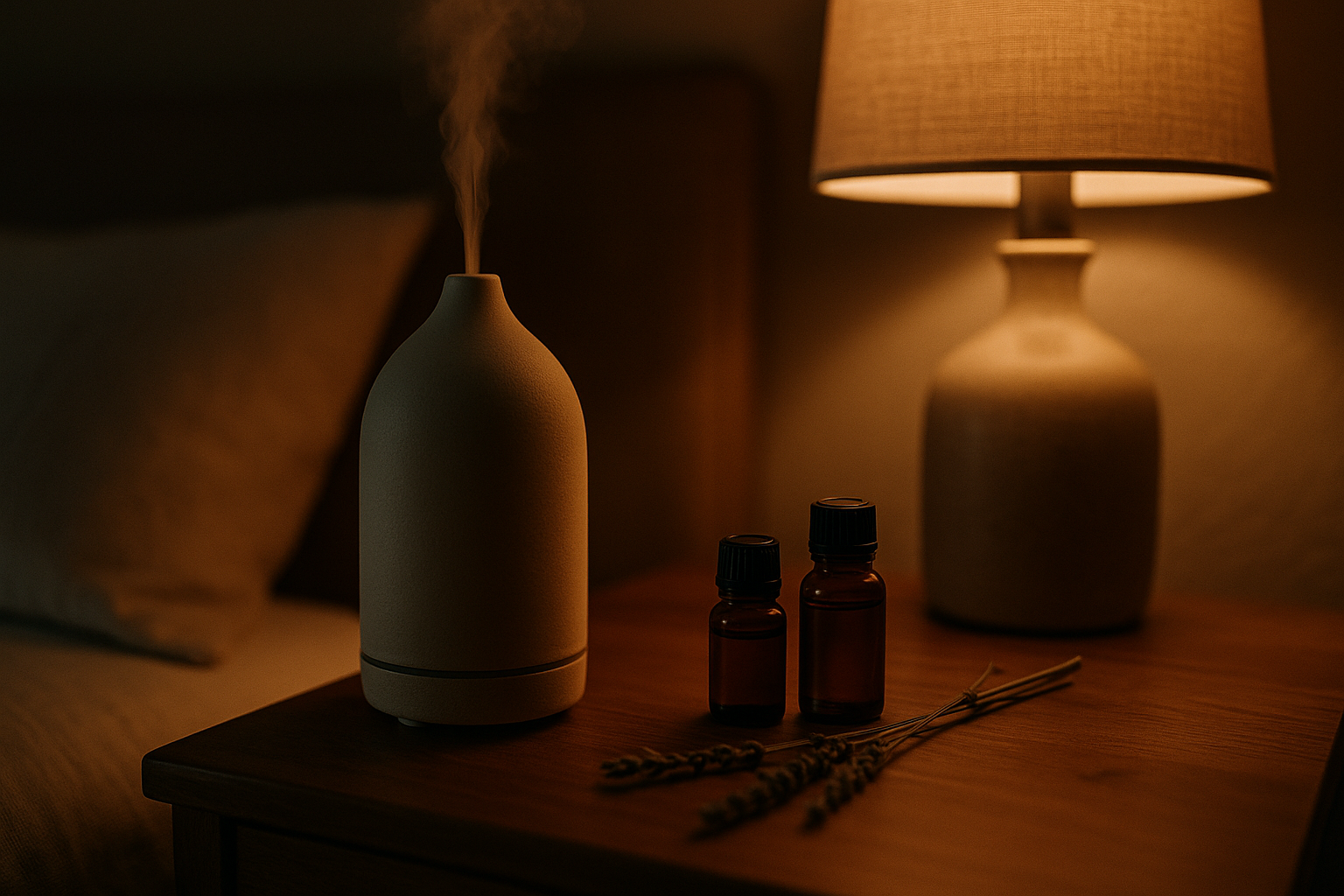
If falling asleep feels like fighting the tide, the right scents can help shift your body and mind into “night mode.” Aromatherapy uses essential oils—highly concentrated plant extracts—via inhalation or properly diluted skin application to nudge stress down and invite calm. In practice, this means choosing sleep-friendly oils, using them at safe concentrations, and timing diffusion so your bedroom feels soothed—not perfumed—when lights go out. In simple terms: pick a calming oil, diffuse for 20–30 minutes before bed, and keep safety in view. Short answer: aromatherapy won’t replace clinical care, but it can create a sleep-conducive environment and reduce pre-sleep arousal for many people.
Quick how-to: choose one oil (start with lavender), diffuse 3–5 drops per 200 mL water for 20–30 minutes before bed, ventilate lightly, keep pets/kids out during diffusion, and never apply undiluted oils to skin. For topicals like a “pillow spray,” keep total dilution around 0.5–1% for face/neck textiles.
Note: This guide is informational and not medical advice. If you’re pregnant, nursing, managing a health condition (e.g., asthma), or take prescription medication, talk to a clinician before using essential oils. Keep oils away from children and pets, and avoid ingestion.
1. Lavender (Lavandula angustifolia)
Lavender is the first-line scent most people try for winding down, and for good reason: its aroma profile tends to lower perceived stress and smooth the transition into sleep. Practically, that means diffusing a few drops during your wind-down period or using a light pillow spray so the fragrance is present—but not overwhelming—when you lie down. Lavender won’t “knock you out,” but many small clinical trials and reviews link lavender with improvements in sleep quality and pre-sleep anxiety, especially as part of a broader routine. If you’re coming from zero aromatherapy experience, start here, use modest amounts, and evaluate your response over a week rather than a single night. Keep expectations measured: scent supports sleep hygiene; it doesn’t treat sleep disorders on its own.
1.1 How to use it
- Diffuse 3–5 drops in 200 mL water for 20–30 minutes before lights out; cycle off at bedtime.
- For a pillow spray: 0.5–1% dilution in distilled water + solubilizer; mist lightly on bedding 10–15 minutes before bed.
- For a bath: 2–4 drops mixed into a tablespoon of carrier oil or fragrance-free liquid soap before adding to water (avoid undiluted drops in bath).
1.2 Numbers & guardrails
- Typical topical dilution for adults: 1–2% (that’s ~6–12 drops per 30 mL carrier oil). Avoid facial application near eyes.
1.3 Common mistakes
- Running a diffuser all night in a small, closed room (can irritate airways and isn’t needed).
- Over-spraying pillows (strong scent can be stimulating for some).
- Using on children or around pets without vet/pediatric guidance.
Bottom line: Lavender is a gentle, evidence-supported starting point for pre-sleep relaxation—use sparingly, time it before bed, and integrate with solid sleep hygiene.
2. Roman Chamomile (Chamaemelum nobile)
Roman chamomile’s apple-like aroma reads immediately calming, making it a solid choice when restlessness is driven by worry or muscle tension. It’s often favored by people who find lavender too floral or who want a softer, less herbaceous profile. While much of chamomile’s research involves tea or oral extracts, inhalation studies and broader aromatherapy trials suggest benefits for anxiety and subjective sleep quality. Used well, chamomile earns its place in a calming toolkit without heavy perfume notes. Set the tone 30–45 minutes before bed; think of it as background comfort rather than a focal scent. If you’re scent-sensitive, this is one of the gentler options to trial first. ScienceDirect
2.1 How to use it
- Diffuse 3–4 drops (solo) or 2 drops chamomile + 2 drops lavender for a classic blend.
- Add 1 drop to 1 tsp (5 mL) of carrier oil and massage into shoulders/neck (≈1%).
- Try a “linen corner” swipe: 1 drop heavily diluted (≤0.5%) on a cloth tucked into pillowcase corner.
2.2 Numbers & guardrails
- Adult dilution: 0.5–1% for pre-sleep topicals; avoid mucous membranes.
- Asteraceae allergy caution (if you react to ragweed, daisies, etc., patch test or avoid).
2.3 Mini-checklist
- Gentle diffusion? ✔
- Allergies reviewed? ✔
- Over-fragrancing avoided? ✔
Bottom line: Roman chamomile is a low-key, low-intensity calmer that pairs beautifully with lavender when you need extra softness without heaviness.
3. Bergamot (Citrus bergamia) — Evening Calm, Daytime Caution
Bergamot delivers a bright, tea-like citrus that paradoxically relaxes more than it energizes; many find it eases “racing mind” evenings. It’s excellent in diffusion or pre-bedroom airing—but topical use requires phototoxicity awareness. Cold-pressed bergamot contains bergapten, which can cause severe sun reactions if applied to skin before UV exposure. For night routines where skin contact is possible (e.g., an anhydrous balm), use bergapten-free “FCF” bergamot or keep dilutions extremely low and avoid sunlight for 12–18 hours. In diffusion, phototoxicity isn’t a concern, but ventilation still matters. If you like citrus but don’t want a “sparkling” feel, bergamot is the mellowest citrus choice for evenings. NHR Organic Oils
3.1 How to use it
- Diffuse 2–3 drops bergamot + 2 drops lavender for a round, calm citrus-floral.
- For topical blends, choose “Bergamot FCF” and keep within conservative dilutions.
3.2 Numbers & guardrails
- IFRA guideline for leave-on products with phototoxic bergamot is around 0.4%; FCF reduces risk but still dilute sensibly. Never apply then sunbathe.
3.3 Common mistakes
- Using regular (non-FCF) bergamot on skin before daytime outdoor exposure.
- Treating citrus oils like perfumes—too much can be stimulating rather than soothing.
Bottom line: Bergamot’s soft citrus can “declutter” anxious evenings—diffuse it, and if using on skin, go FCF and keep dilutions low.
4. Sweet Marjoram (Origanum majorana)
Sweet marjoram is the quiet achiever of sleep blends: herbaceous, slightly sweet, and notably grounding. People who carry tension in the jaw, neck, or shoulders often reach for marjoram at night because its scent profile reads “cozy” without being floral. It’s especially helpful when stress shows up as muscle tightness and shallow breathing. As with all essential oils, evidence is mixed overall, but marjoram appears frequently in aromastick and blend studies that report calmer mood and improved subjective sleep. It shines as a blend partner rather than a soloist—think lavender + marjoram for steady calm or chamomile + marjoram for “comforting” nights.
4.1 How to use it
- Diffuse 2 drops marjoram + 2 drops lavender + 1 drop cedarwood for a wood-herbal balance.
- Dilute to 1% in a carrier and apply to upper back/shoulders 20–30 minutes before bed.
- Add to a pre-bed steam inhale (1 drop in a bowl of hot water, breathe at arm’s length for 2–3 minutes).
4.2 Numbers & guardrails
- Adult topical dilution: 0.5–1% near bedtime to avoid overwhelming scent.
- Avoid undiluted skin use; ventilation matters if you have sensitive airways.
4.3 Mini-checklist
- Keep it subtle? ✔
- Blend thoughtfully? ✔
- Stop if irritation occurs? ✔
Bottom line: Sweet marjoram adds a grounded, “warm blanket” quality to bedtime blends—use lightly and let it support, not dominate.
5. Cedarwood (Cedrus atlantica or Juniperus virginiana)
Cedarwood brings a dry, pencil-shavings woodiness that many find reassuring and sleep-friendly, particularly when florals feel cloying. It’s a solid anchor note: it slows the overall aroma and helps lighter oils linger without going sharp. People who prefer minimally sweet scents often do best with a cedar-forward blend. There’s longstanding traditional use for calm, and while clinical data are limited, cedar-rich environments are commonly perceived as restful. Use it to “weight” airy blends so they read soothing rather than stimulating. If you crave the feel of a cabin at night—quiet, woody, safe—cedarwood earns a test run.
5.1 How to use it
- Diffuse 2 drops cedarwood + 2 drops lavender for a grounded floral-wood base.
- Add 1% cedarwood in a carrier for a light pre-sleep foot rub (socks on afterwards).
- Pair with sandalwood or marjoram for deeper, less floral profiles.
5.2 Numbers & guardrails
- Keep diffusion modest; wood oils can linger. Cycle 20–30 minutes on, then off.
- Skin care: 1% dilution is typically sufficient for pre-sleep routines; patch test first.
5.3 Common mistakes
- Over-diffusing in small rooms (can feel heavy).
- Mixing too many woods at once (results in a muddy profile).
Bottom line: Cedarwood is your steadying bass note—use it to turn bright blends into tranquil, bedtime-ready air.
6. Sandalwood (Santalum album / Santalum spicatum)
Sandalwood offers a creamy, meditative wood note that feels luxurious yet understated—great when you want calm without overt florals or citrus. It’s prized for its smooth dry-down and long-lasting sillage, so a little goes a long way. Many people find sandalwood ideal for mindful pre-bed rituals—reading, stretching, or journaling—because it sits close to the skin and doesn’t shout. In diffusion or at very low topical percentages, it can cue your brain to shift from “doing” to “resting.” If you dislike “perfume-y” bedrooms, sandalwood’s soft, grounded character is a strong fit.
6.1 How to use it
- Diffuse 1–2 drops solo, or with 2 drops lavender for a serene blend.
- Add 0.5–1% in a carrier for pulse-point application 30 minutes pre-bed.
- Try a “closet card”: 1 diluted drop on a card placed in your wardrobe so pajamas carry a whisper of scent.
6.2 Numbers & guardrails
- Keep to very low quantities—sandalwood is potent; more is not better.
- Choose sustainably sourced oils (e.g., Australian S. spicatum) when possible.
6.3 Mini-checklist
- Low dose? ✔
- Sustainable source considered? ✔
- No overnight diffusion? ✔
Bottom line: Sandalwood is the quiet, meditative wood that turns routine into ritual—use sparingly for a plush, calming bedtime atmosphere.
7. Ylang Ylang (Cananga odorata)
Ylang ylang is a rich, exotic floral that—at tiny doses—can reduce “edge” without feeling sleepy in the daytime. At night, these micro-amounts help uncoil tension and decrease perceived stress; at higher doses, it can skew heady or cloying. If you struggle with a racing heart when you finally stop scrolling, a whisper of ylang ylang layered into lavender or cedarwood can feel smoothing. The goal is not “perfumey” romance; it’s a gentle melt of muscular and mental tightness that sets up sleep.
7.1 How to use it
- Diffuse 1 drop ylang ylang + 3 drops lavender + 1 drop cedarwood.
- For a roll-on: 0.5% dilution (about 3 drops per 30 mL carrier), applied to inner wrists/under jawline 20 minutes before bed.
- Add a micro-drop to your bath blend (with a dispersant) for a luxe feel.
7.2 Numbers & guardrails
- Start at 0.25–0.5% for topicals; too much can be nauseating for some.
- Patch test; discontinue if headache develops. Ventilate gently.
7.3 Common mistakes
- Assuming “more equals more relaxing.”
- Pairing with heavy sweet notes (can tip from calming to cloying fast).
Bottom line: Ylang ylang at low doses rounds off rough edges—measure carefully and keep it in the background for best sleep support.
8. Clary Sage (Salvia sclarea)
Clary sage reads earthy-herbal with a faint tea note and is valued by many for “settling” restlessness, particularly when stress shows up as mental chatter. It can be especially helpful in evening wind-downs that include stretching or breath work. Clary sage is more polarizing than lavender or chamomile—some adore it, others don’t—so test in a small space first. Use it when you want grounded, practical calm during pre-bed routines rather than a noticeable “scented” room. As always, aromatherapy complements (not replaces) evidence-based insomnia treatments; check with a clinician if you have persistent sleep issues. PubMed
8.1 How to use it
- Diffuse 2 drops clary sage + 2 drops chamomile for a calm, herbal blend.
- Make a simple rub at 1% dilution for shoulders/neck 30 minutes before bed.
- Pair with a 4-7-8 breathing set (four counts inhale, seven hold, eight exhale) while scent diffuses.
8.2 Numbers & guardrails
- Adult topical: keep to 0.5–1% near bedtime.
- Avoid undiluted use; consult your clinician if pregnant/nursing.
8.3 Mini-checklist
- Test scent preference? ✔
- Keep dose low? ✔
- Combine with breathwork? ✔
Bottom line: Clary sage brings a grounded, herbal calm that pairs well with evening relaxation routines and gentle breathing practices.
9. Neroli (Citrus aurantium var. amara)
Neroli offers a tender, honeyed citrus-blossom aroma that many describe as “mood-relieving” more than sedating—which is exactly why it works before bed. If your barrier to sleep is looping thoughts and apprehension, small trials suggest citrus-flower aromatics can ease perceived anxiety and smooth the slide into rest. Neroli also layers beautifully with lavender, chamomile, and sandalwood without turning sugary. Use it on nights when you want reassurance, not heaviness; during the day, save it for decompressing after stressful events to keep your evening routine consistent. ScienceDirect
9.1 How to use it
- Diffuse 2 drops neroli + 2 drops lavender 30 minutes before bed; turn off at lights out.
- Create a linen mist at 0.5% total dilution; spray lightly on a cloth tucked inside the pillowcase.
- Add to a post-shower body oil at 1% (ankles/wrists), allowing 20 minutes before bed.
9.2 Numbers & guardrails
- Stay within 0.5–1% for evening topicals; neroli is potent and pricey—sparingly is best.
- As with all oils, avoid mucous membranes and undiluted skin contact.
9.3 Common mistakes
- Over-misting linens (strong top notes can feel stimulating).
- Using with numerous florals at once (muddy, overpowering blends).
Bottom line: Neroli is bedtime reassurance in a bottle—use tiny amounts for a gentle lift that calms the mind without sedating the senses.
Safety, Pets, and Practicalities (Read This Before You Start)
- Diffusion basics: 20–30 minutes on, then off; aim for a light background scent, not a room-filling perfume. People with asthma or chronic lung disease may be sensitive to airborne oils—if you notice cough, throat tickle, or shortness of breath, stop and ventilate.
- Topical dilutions: For adults, 0.5–1% for evening use (≈3–6 drops per 30 mL carrier); up to 2% is a common general maximum for body use. Face/neck and pre-sleep applications generally stay at the low end.
- Citrus caution: If you use phototoxic citrus oils (e.g., non-FCF bergamot), avoid sun/UV exposure for 12–18 hours or choose FCF versions.
- Kids, pregnancy, meds: Consult a clinician before use; essential oils aren’t benign simply because they’re “natural.” Never ingest unless directed by a qualified professional.
- Pets: Cats and birds are especially sensitive. Diffuse in pet-free rooms, keep doors open so animals can leave, and store oils securely. If your pet shows signs of exposure (drooling, weakness, breathing changes), seek veterinary care.
FAQs
1) What’s the fastest way to try aromatherapy for sleep tonight?
Set a simple routine: 3–5 drops of lavender in a 200 mL ultrasonic diffuser, run for 20–30 minutes while you dim lights and put your phone away, then turn the diffuser off at lights out. If you’re scent-sensitive, crack a window slightly and start with 2–3 drops. This approach lets you test benefits without changing your whole routine.
2) Is there strong scientific proof that essential oils improve sleep?
Evidence is promising but mixed. Reviews note improvements in subjective sleep quality and anxiety for some people, yet studies are often small and vary in methods. Aromatherapy helps create a relaxing environment; it’s not a primary treatment for insomnia. If sleep problems persist, see a sleep clinician for guideline-based care such as CBT-I. AASM
3) How much oil should I put in a diffuser?
For most 200–300 mL ultrasonic diffusers, 3–5 total drops is plenty. More isn’t better: heavy scent can irritate airways or paradoxically feel stimulating. Time diffusion to your wind-down window, then shut it off to sleep. People with asthma, COPD, or allergies should proceed cautiously and stop if symptoms occur. American Lung Association
4) Can I put essential oils directly on my pillow?
Avoid neat (undiluted) oils on fabric—they can irritate eyes and skin and may stain. If using a linen spray, keep dilution around 0.5–1% and mist lightly 10–15 minutes before bed so volatile components dissipate. Keep bottles out of reach of children and pets.
5) Which oil should I try if I dislike florals?
Start with woods and herbs: cedarwood, sandalwood, or sweet marjoram. Use them alone or as anchors under a single drop of lavender or neroli so the result feels calm, not perfumed. Stick to small amounts and short diffusion cycles to avoid heaviness.
6) Is bergamot safe before bed?
Yes, when diffused in modest amounts. For skin contact, prefer bergamot FCF (bergapten-free) or avoid UV exposure for 12–18 hours after application. Phototoxic reactions can be severe; keep dilutions low and don’t use before daytime sun. AromaWeb
7) Can I use aromatherapy if I have sleep apnea or use CPAP?
Aromatherapy doesn’t treat sleep apnea. Avoid adding oils directly to CPAP equipment; it can damage devices and irritate airways. If you enjoy scent, diffuse in the room before bed and stop when you put on the mask. For sleep apnea treatment, follow clinician-guided therapies.
8) Is aromatherapy safe around babies and children?
Children are more sensitive to concentrated aromas. Diffuse in another room, use very short intervals, and avoid topical application unless directed by a pediatric professional. Keep all oils locked away and never ingest. If anyone develops irritation or breathing changes, stop use and ventilate.
9) What if I have pets?
Diffuse only in rooms pets can leave; avoid topical use they might contact or lick. Cats and birds are especially sensitive, and certain oils pose higher risks. If a pet shows drooling, wobbliness, or breathing issues, seek veterinary care immediately and ventilate the area. BC SPCA
10) Can I combine aromatherapy with other sleep aids?
Yes—pairing light diffusion with proven sleep hygiene (consistent schedule, cool/dark room) is sensible. If you’re considering supplements (e.g., melatonin, magnesium, valerian), discuss with a clinician; products vary in quality and interact with medications. Keep expectations realistic and evaluate any change one variable at a time. Sleep Foundation
Conclusion
Aromatherapy can’t replace clinical sleep care, but it can shape a calmer, more predictable glide path to bedtime—especially when your nights are derailed by stress, muscle tension, or a chatty mind. The nine scents here give you options across aroma families: lavender and chamomile for gentle calm; bergamot and neroli for bright reassurance; marjoram, cedarwood, sandalwood, ylang ylang, and clary sage for depth and grounding. The keys to success are simple: keep doses small, time diffusion to your pre-sleep window, choose skin dilutions conservatively, and ventilate. Build a short ritual (lights down, diffuser on, phone away), track how you feel for a week, and adjust. If sleep problems persist two to three weeks, consider evidence-based care like CBT-I and an evaluation for medical causes. Ready to try? Pick one oil, set a 30-minute wind-down, breathe slowly, and let the day go.
CTA: Start tonight: add 3 drops of lavender to your diffuser, dim the lights, and turn it off when you get into bed.
References
- Aromatherapy: What You Need to Know — National Center for Complementary and Integrative Health (NCCIH), reviewed 2023. https://www.nccih.nih.gov/health/aromatherapy
- Sleep Disorders and Complementary Health Approaches — NCCIH, reviewed 2021. https://www.nccih.nih.gov/health/sleep-disorders-and-complementary-health-approaches
- The Best Essential Oils for Sleep — Sleep Foundation, December 22, 2023. https://www.sleepfoundation.org/sleep-aids/best-essential-oils-for-sleep
- Smell and Sleep: How Scents Can Affect Sleep — Sleep Foundation, July 11, 2025. https://www.sleepfoundation.org/bedroom-environment/how-smell-affects-your-sleep
- Dilution for Essential Oils — Tisserand Institute, n.d. (accessed August 2025). https://tisserandinstitute.org/dilution-essential-oils/
- Essential Oil Dilution Chart — Tisserand Institute, n.d. (accessed August 2025). https://tisserandinstitute.org/essential-oil-dilution-chart/
- Phototoxicity: Essential Oils, Sun and Safety — Tisserand Institute, n.d. (accessed August 2025). https://tisserandinstitute.org/phototoxicity-essential-oils-sun-and-safety/
- The Essentials of Essential Oils Around Pets — ASPCA, June 23, 2022. https://www.aspca.org/news/essentials-essential-oils-around-pets
- What Is Aromatherapy? — Cleveland Clinic, reviewed 2023/2024 (page updated within ~2 years). https://my.clevelandclinic.org/health/treatments/aromatherapy
- Effects of Aromatherapy on Sleep Quality in Older Adults — Frontiers/PubMed (Xu et al.), 2024. https://pubmed.ncbi.nlm.nih.gov/39654196/
- Aromatherapy With Essential Oils (PDQ) – Patient Version — National Cancer Institute, September 11, 2023. https://www.cancer.gov/about-cancer/treatment/cam/patient/aromatherapy-pdq
- Healthy Sleep: An American Academy of Sleep Medicine Position Statement — Journal of Clinical Sleep Medicine, 2021. https://pmc.ncbi.nlm.nih.gov/articles/PMC8494094/