





















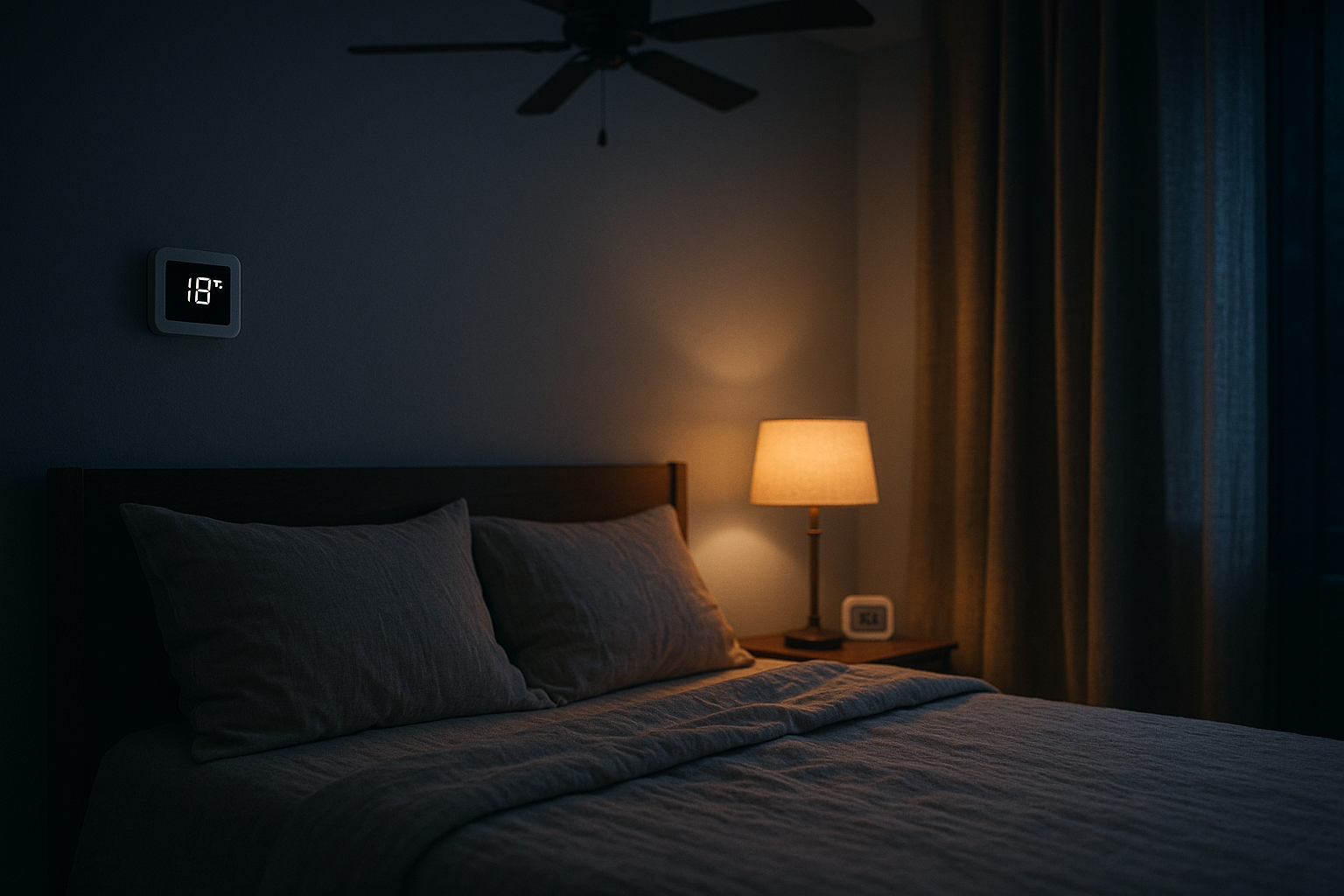
Cool beats warm for most sleepers. For adults, aim for a bedroom around 65°F (18°C) within a typical recommended range of 60–67°F (16–19°C), and keep relative humidity near 30–50%. That cool, slightly dry envelope supports your body’s natural nighttime temperature drop, which helps you fall asleep faster, sleep deeper, and wake up clearer. Below you’ll find nine evidence-based rules—plus practical checklists—for dialing in temperature, humidity, airflow, bedding, and special cases (babies, older adults, hot flashes, CPAP, and heatwaves).
Within a minute or two: the short answer. Cooler (not cold) rooms—about 65°F/18°C with humidity around 40–50%—are the sweet spot for most adults; warm rooms, especially on humid nights, raise wakefulness and fragment sleep. If you remember nothing else: keep the air cool and the covers adjustable.
1. Set 60–67°F (16–19°C) as your target—65°F/18°C is the sweet spot
Most adults sleep best in a cool room; a practical target is 65°F/18°C inside a 60–67°F (16–19°C) range. That range leverages a basic physiology truth: your core temperature drifts lower before and during sleep. A cooler room (paired with adjustable bedding) reduces thermal arousals, shortens sleep onset, and helps preserve deeper stages. If your room stays warmer than ~70°F (21°C), especially on humid nights, expect more awakenings and lighter sleep. On the flip side, overly cold rooms can prompt micro-arousals from shivering or cold extremities. Season and health matter too: in winter, safety guidance for general indoor living recommends keeping occupied spaces ≥18°C (65°F), with slightly warmer rooms for older adults or those with medical conditions. As of August 2025, converging recommendations from sleep and building-health bodies land in this same zone: cool, not frigid.
1.1 Why it matters
Your brain times sleep with circadian cooling. Cooler ambient air reduces the body’s work to shed heat, improving sleep onset and continuity. Excess warmth (notably at night) is linked to shorter sleep and more insufficient-sleep reports, while cool, stable conditions support deeper stages.
1.2 Numbers & guardrails
- Adults: Aim 65°F/18°C, workable 60–67°F (16–19°C).
- Winter safety floor: Keep lived-in rooms ≥18°C/65°F; consider 20–21°C for older adults or those who are frail.
- Don’t overcool: If you’re shivering, you’re too cold—add layers or raise 1–2°F (0.5–1°C).
Mini-checklist
- Set nighttime schedule to 65°F/18°C.
- If you wake sweaty: drop 1–2°F (0.5–1°C).
- If you wake chilly: add a light layer or raise 1–2°F.
- Use a separate duvet/blanket if partners run at different temps.
Close-out: Pick a number inside the range and test it for three nights before tweaking; small changes (1–2°F / 0.5–1°C) are easier to judge.
2. Hold humidity around 30–50% (never above 60%)
Temperature is only half the comfort equation; humidity shapes how hot or cold you feel. The sweet spot for sleeping—and for indoor health—is roughly 30–50% relative humidity, with a hard stop at ≤60% to curb mold and dust mites. Air that’s too humid slows sweat evaporation and traps heat against your skin, making warm nights feel stifling—even if the thermometer number looks mild. Air that’s too dry (common in winter) irritates airways and skin and may worsen snoring. If you’re in a tropical monsoon climate, humidity control can matter more than dialing down temperature alone.
2.1 How to do it
- Measure it: Place a hygrometer on your nightstand (waist height, away from vents).
- Dehumidify summer: Run AC, a dehumidifier, or dry mode to stay ≤50–55%; aim for ≤50% if you’re dust-mite sensitive.
- Humidify winter: Add a cool-mist humidifier to reach 35–45%; clean weekly and use distilled water to avoid mineral dust.
- Seal + ventilate: Fix window leaks; ventilate bathrooms/kitchens; close bedroom during steamy cooking/showers.
2.2 Numbers & guardrails
- Best range: 30–50% RH; many people prefer 40–50% at night.
- Ceiling: Keep <60% to limit mold growth.
- Dry-air fix: Use 35–45% if you get morning dry mouth or static.
Mini-checklist
- Hygrometer reads 65%+? Add dehumidifier or run AC longer.
- Nose/throat dry on winter mornings? Bump to ~40% with cool-mist humidifier.
- Wipe window condensation fast (mold risk), then lower humidity.
Close-out: Hitting the right temperature + humidity combo often solves “my room feels wrong” more than chasing temperature alone.
3. Keep the room cool, but warm your extremities
Counterintuitive but powerful: a cool room plus warm hands/feet speeds sleep onset. Warming distal skin (socks, a brief warm foot soak, or a heating pad set low on feet) opens blood vessels, helping your core shed heat faster—the key physiological cue for falling asleep. This is why many sleepers instinctively stick one foot out. Crucially, warming the whole room is not required (and often backfires); target the extremities while keeping ambient air cool.
3.1 Why it works
- Distal–proximal gradient: When hands/feet are warmer than your torso, you lose heat efficiently, promoting drowsiness.
- Faster sleep onset: Experiments show sock use or distal warming shortens sleep latency.
- Less tossing: With extremities comfortable, you’re less likely to kick off covers and wake hot later.
3.2 Practical ways to do it
- Light socks: Breathable wool or cotton; avoid tight elastic.
- Warm foot soak: 5–10 minutes, 40–42°C (104–108°F), 20–30 minutes before bed.
- Targeted heat: Low-setting heating pad or hot-water bottle at the feet under the covers (never on bare skin; remove before sleep if safety is a concern).
Mini-checklist
- Room at 18°C? Add socks; keep covers moderate.
- Cold feet = long sleep latency; fix extremities, don’t raise the thermostat.
- If you run hot: try room 17–18°C plus very light socks.
Close-out: Cool air + warm extremities is the simplest, most research-backed comfort combo for falling asleep quickly.
4. Adjust for climate, season, and heatwaves (especially humid heat)
Not all 65°F/18°C nights feel equal. Humid heat blunts sweating and makes a modest temperature feel oppressive; dry heat feels easier at the same number. In monsoon or coastal climates, prioritize dehumidification and airflow over raw cooling; in arid regions, evaporative cooling (swamp coolers) works well. During heatwaves, nights can stay above 30°C (86°F)—a level associated with noticeable sleep loss. In those conditions, every bit of moisture removal and airflow helps, and the goal shifts from perfection to damage control.
4.1 Region & season notes
- Humid climates: Make RH ≤50–55% your first milestone. Use AC or a standalone dehumidifier, plus a ceiling or pedestal fan for gentle air movement.
- Dry climates: Evaporative coolers are cost-effective; crack a window for exhaust. Add a bowl of water or humidifier if RH <30% and you’re getting dry eyes/throat.
- Heatwaves: Pre-cool the bedroom late afternoon; close blinds. At bedtime, run AC or dehumidifier + fan. Consider a cool room in the lowest, shadiest part of your home as a “sleep refuge.”
4.2 Tools that punch above their weight
- Reflective/blackout curtains to lower radiant heat.
- Cross-ventilation (opposite windows/doors) when outdoor temps drop at night.
- Bedside fan set to low; oscillation reduces drafts.
- Gel packs (wrapped in a towel) near ankles/calves for 10 minutes before lights out.
Mini-checklist
- If RH >60% at bedtime, prioritize drying the air.
- If outdoor nights fall below indoor temps: window + fan pull cool air in.
- Heatwave plan: cool refuge, sleep earlier, lighter meals, extra hydration.
Close-out: Climate-smart tweaks—especially humidity control—turn “too hot to sleep” into “cool enough to cope,” even when the mercury runs high.
5. Tailor temperature for babies, older adults, menopause, and illness
One-size fits all ends here. Babies don’t regulate heat as well; older adults may feel cold easily and face higher risks from cold rooms; menopause brings night sweats; fever changes comfort and safety. Keep your adult baseline, then apply these population-specific guardrails.
5.1 Babies & toddlers
- Comfort zone: Many pediatric sources cite 68–72°F (20–22°C) as comfortable for infant sleep; UK guidance often suggests 16–20°C with appropriate sleepwear.
- Safety: The American Academy of Pediatrics emphasizes avoiding overheating and using light layers (sleep sacks) rather than blankets.
- Practical tip: Feel baby’s chest/back, not hands/feet, to judge warmth; adjust a layer rather than the whole room.
5.2 Older adults & frail individuals
- Minimums: Aim for ≥18°C/65°F in living/sleeping rooms; consider 20–21°C if mobility is limited or if there are cardiovascular/respiratory issues.
- Layering: Use warmer bed covers and socks; keep ambient air comfortably cool, not cold.
5.3 Menopause/night sweats
- Room strategy: Keep room cool; use light, breathable sheets and layered bedding that’s easy to throw off.
- Before bed: Avoid alcohol/spicy food late; a brief warm shower can trigger subsequent cooling.
- At hand: Keep a spare dry top and a glass of cool water within reach.
5.4 Fever & illness
- Comfort-first: Slightly cool room with light bedding often feels best.
- Hydration & airflow: Gentle fan helps; avoid chilling.
- Seek care: Persistent fever or heat-illness signs require medical attention.
Mini-checklist
- Babies: dress in one more layer than an adult would wear in the same room.
- Older adults: prioritize ≥18°C air temp; add bed insulation as needed.
- Menopause: cool room + breathable layers is the winning combo.
Close-out: Keep the general cool-room principle, then tune for physiology and safety.
6. Manage airflow and radiant heat, not just the thermostat
Two rooms at the same thermostat setting can feel very different because of air movement and mean radiant temperature (heat from walls, windows, and ceilings). Gentle airflow (think low, steady fan) boosts evaporative cooling and lets you tolerate the same temperature more comfortably. High radiant heat—from a sun-baked wall or unshaded window—can make a 68°F room feel stuffy. Your goal: smooth, quiet airflow and cool surfaces.
6.1 How to do it
- Fans: Use a ceiling fan on low or a pedestal fan angled past your face (not directly at it).
- Draft-proofing: Avoid turbulent, noisy jets; oscillation on low is better than a direct blast.
- Shade & insulate: Blackout curtains and insulated shades reduce radiant heat and early-morning warming.
- Bed placement: Keep the head of the bed away from hot walls or west-facing windows.
6.2 Mini-checklist
- If your room feels stuffy at 68°F, add a fan before lowering the setpoint further.
- If one wall radiates heat in summer, use reflective film or an insulating curtain on that wall/window.
- In winter, keep airflow gentle to avoid wind-chill on exposed skin.
Close-out: Airflow and surface temperatures are comfort multipliers—optimize them and you’ll need fewer drastic thermostat changes.
7. Schedule your thermostat like a pro (and save ~10% a year)
Beyond comfort, smart scheduling cuts energy bills. As of August 2025, guidance suggests you can save up to ~10% annually by setting your thermostat 7–10°F (4–6°C) lower (heating season) or higher (cooling) for about 8 hours a day. Nights are a perfect window: program your sleep setpoint (e.g., 65°F/18°C) and align it with bedtime.
7.1 A sample sleeper’s schedule
- 6:30 a.m. Wake: 68–70°F (20–21°C) for comfort while getting ready.
- 8:30 a.m.–5:00 p.m. Away: setback +7–10°F (cooling) / –7–10°F (heating).
- 9:30 p.m. Pre-cool/dehumidify bedroom if needed.
- 10:30 p.m.–6:30 a.m. Sleep: 65°F/18°C, RH ~40–50%.
- Weekends: Similar, but reduce away setbacks.
7.2 Pro tips
- Room sensors: If your thermostat is in a hallway, use remote sensors or a room-level device (smart thermostat ecosystem) to control to bedroom conditions.
- Heat pumps: Avoid extreme setbacks in heating mode; use gentler steps to preserve efficiency.
- Ceiling fan + AC: The combo lets you tolerate a 2–4°F higher AC setpoint with the same perceived coolness.
Mini-checklist
- Program sleep/away blocks; use geofencing if available.
- Verify with a bedside thermometer/hygrometer; don’t trust hallway numbers blindly.
- Track bill and sleep for two weeks, then tweak.
Close-out: Comfort and savings coexist—schedule thoughtfully and let automation hold your targets steady all night.
8. Use breathable bedding and right-weight insulation (tog/clo)
Your bed is a microclimate. Even with ideal room conditions, heavy or non-breathable bedding traps heat and moisture. Choose breathable sheets (cotton percale, linen, Tencel/lyocell) and tune insulation by season using duvet/blanket warmth ratings such as tog (common in the UK) or clo (clothing insulation). As a rule, higher tog/clo = warmer, lower = cooler.
8.1 Practical mapping
- Warm months: 2.5–4.5 tog duvet or a light blanket; thin pajamas or none.
- Shoulder seasons: 7.5–10.5 tog or a medium comforter.
- Cold months: 12–13.5 tog plus socks; keep room ≥18°C for safety.
8.2 Material notes
- Sheets: Crisp cotton percale or linen wick moisture; sateen feels warmer.
- Covers: Duvet + cover lets you vent heat easily; quilts trap less air.
- Mattress feel: Hybrids/innersprings tend to sleep cooler than dense all-foam; a breathable topper can help if you sleep hot.
Mini-checklist
- Wake sweaty with a cool room? Lower tog or switch to linen/percale.
- Cold shoulders at 18°C? Add a light layer before raising room temp.
- Partners mismatch? Try two separate duvets (“Scandinavian method”).
Close-out: Think “cool air, breathable bed.” Tune insulation before touching the thermostat.
9. Troubleshoot with data and simple experiments
If sleep still feels off, run two-week experiments with small changes and measure what matters: sleep onset, awakenings, and how you feel in the morning. Environmental trackers (thermo-hygrometers; even inexpensive sleep apps or wearables) can reveal patterns—like awakenings clustering at 3–4 a.m. when your room warms or humidity creeps up. During very warm nights (>30°C/86°F), expect reduced sleep; that’s normal and measurable. The aim is to reduce the damage: cooler air before bed, dehumidify, fan on low, lighter covers, earlier bedtime.
9.1 A quick method
- Week 1: Fix humidity at 40–50%; keep temp 65°F/18°C.
- Week 2: Adjust ±1–2°F (0.5–1°C) only if needed; change bedding weight before changing air temp.
- Track: Note sleep onset minutes, wake-ups, and morning clarity.
9.2 Signs you’re too warm vs too cold
- Too warm: Damp pillow, frequent tossing, dreams that feel frantic, waking thirsty.
- Too cold: Tight shoulders, curling into a ball, cold feet, morning stiffness.
Mini-checklist
- Use one change at a time; give it 3 nights.
- For hot sleepers: prioritize dehumidification + airflow.
- For cold sleepers: add insulation before raising ambient temp.
Close-out: Small, structured tweaks beat constant fiddling. Let the numbers guide your next step.
FAQs
1) Is a cool or warm bedroom better for sleep?
Cooler is better for most people. A room around 65°F/18°C (within 60–67°F) with 30–50% humidity supports your body’s natural cooling before sleep, helping you fall asleep faster and enter deeper stages. Warm, humid rooms prolong sleep onset and cause more awakenings. The exceptions are safety and special populations (e.g., older adults), who may need a slightly warmer baseline; in winter, keep lived-in spaces ≥18°C/65°F.
2) What’s the ideal bedroom temperature in Celsius?
Aim for 18°C, workable 16–19°C. In practice, people cluster tightly around 18°C if humidity and bedding are right. If you live with older adults or have cardiovascular/respiratory conditions, consider 20–21°C in winter for comfort and safety, then fine-tune bedding weight.
3) My partner runs hot and I run cold—how do we compromise?
Hold the room cool for the hot sleeper and individualize insulation: separate duvets/blankets of different weights, a breathable mattress topper on one side, and light sleepwear for the hot sleeper. This “cool air + personal layers” approach avoids nightly thermostat wars.
4) What humidity should I maintain at night?
Target 30–50% RH (never above 60%). Too much humidity makes warm rooms feel stifling and increases mold/dust mite risk; too little dries airways and skin. A $10–$20 hygrometer on your nightstand is the fastest way to verify and adjust.
5) How can I sleep during a heatwave without great AC?
Dehumidify first (run dry mode or a dehumidifier), use a fan on low for air movement, close blinds by late afternoon, and pre-cool the bedroom before bed. Keep covers light (2.5–4.5 tog). If nights stay above 30°C/86°F, expect some sleep loss; the goal is to reduce it with humidity control, airflow, and earlier bedtime.
6) Is sleeping in a cold room unhealthy?
Not inherently. The risk comes from too cold for too long. Health guidance suggests keeping indoor lived-in spaces ≥18°C/65°F, with warmer rooms for older adults or those with certain conditions. If you’re shivering, raise the setpoint or add insulation. Cold air doesn’t cause colds; viruses do.
7) Does a fan help or hurt at night?
A gentle, steady fan helps most sleepers by boosting evaporation and smoothing temperature. Aim it past your face to avoid dry eyes/throat. In very dry climates, consider a small humidifier to keep RH near 35–45%. For babies, avoid a direct fan blast; use indirect airflow.
8) What temperature should babies sleep in?
Many pediatric sources cite 68–72°F (20–22°C) as comfortable, while UK guidance often recommends 16–20°C with appropriate sleepwear. The American Academy of Pediatrics stresses avoiding overheating, using a sleep sack instead of loose blankets, and checking baby’s chest/back for warmth.
9) I use CPAP. Any temperature/humidity tips?
Keep the room cool and tune your CPAP humidifier to avoid “rainout” (condensation) or dry mouth. If condensation occurs, lower humidifier or tube temperature a notch; if dryness persists, raise humidity gradually. Regular cleaning prevents microbial buildup. Pair with bedroom 40–50% RH.
10) Do warm showers or socks really help me fall asleep?
Yes. A brief warm shower or warm feet increases heat loss afterward, nudging your core temp downward—a reliable sleepiness signal. Combine cool room + warm extremities (light socks, short foot soak) to shorten sleep onset without overheating the room.
Conclusion
The answer to “cool or warm?” is cool—within reason. For most adults, 65°F/18°C inside a 60–67°F (16–19°C) envelope, with 30–50% humidity, delivers the best odds of falling asleep quickly and staying asleep. That baseline works because it partners with biology: your brain expects nighttime cooling. But comfort lives in the details—humidity, airflow, radiant heat, and bedding insulation. Tuning those levers is what makes a 65°F room feel like pure relief instead of “almost right.” Special cases (babies, older adults, menopause, illness) need tailored guardrails, yet the guiding idea remains the same: cool air, breathable layers, and warm extremities.
Your next steps are simple and specific: set a night schedule (65°F/18°C; RH ~40–50%), fix humidity first, add gentle airflow, and adjust bedding weight before changing the thermostat. Run a two-week experiment with 1–2°F (0.5–1°C) tweaks, and let your sleep and morning clarity be the judge. Cooler air, smarter layers, deeper sleep—start tonight.
Call to action: Set your thermostat to 65°F/18°C, place a hygrometer on your nightstand, and swap in breathable sheets—then enjoy the difference within a week.
References
- “The Best Temperature for Sleep,” Sleep Foundation, updated July 11, 2025. https://www.sleepfoundation.org/bedroom-environment/best-temperature-for-sleep
- “Sleep Tips,” National Sleep Foundation (thensf.org), accessed August 2025. https://www.thensf.org/sleep-tips/
- “How to Sleep Better” (PDF), American Academy of Sleep Medicine, 2012. https://aasm.org/resources/pdf/products/howtosleepbetter_web.pdf
- K. Minor et al., “Rising Temperatures Erode Human Sleep Globally,” One Earth, 2022. https://www.cell.com/one-earth/pdf/S2590-3322%2822%2900209-3.pdf
- N. Obradovich et al., “Nighttime Temperature and Human Sleep Loss in a Changing Climate,” PNAS, 2017. https://pubmed.ncbi.nlm.nih.gov/28560320/
- “Care for Your Air: A Guide to Indoor Air Quality,” U.S. Environmental Protection Agency, updated March 31, 2025. https://www.epa.gov/indoor-air-quality-iaq/care-your-air-guide-indoor-air-quality
- “ANSI/ASHRAE Standard 55 – Thermal Environmental Conditions for Human Occupancy,” ASHRAE, accessed August 2025. https://www.ashrae.org/technical-resources/bookstore/standard-55-thermal-environmental-conditions-for-human-occupancy
- “Safer Sleep in Hot Weather,” The Lullaby Trust (UK), accessed August 2025. https://www.lullabytrust.org.uk/baby-safety/travel-and-weather/hot-weather/
- “The Best Room Temperature for a Sleeping Baby,” Sleep Foundation, updated July 15, 2025. https://www.sleepfoundation.org/baby-sleep/best-room-temperature-for-sleeping-baby
- “Programmable Thermostats,” U.S. Department of Energy – Energy Saver, accessed August 2025. https://www.energy.gov/energysaver/programmable-thermostats
- “Minimum Home Temperature Thresholds for Health in Winter,” Public Health England/WHO guidance review, 2018. https://assets.publishing.service.gov.uk/media/5c5986f8ed915d045f3778a9/Min_temp_threshold_for_homes_in_winter.pdf
- K. Kräuchi et al., “Warm Feet Promote the Rapid Onset of Sleep,” Nature, 1999. https://pubmed.ncbi.nlm.nih.gov/10485703/