














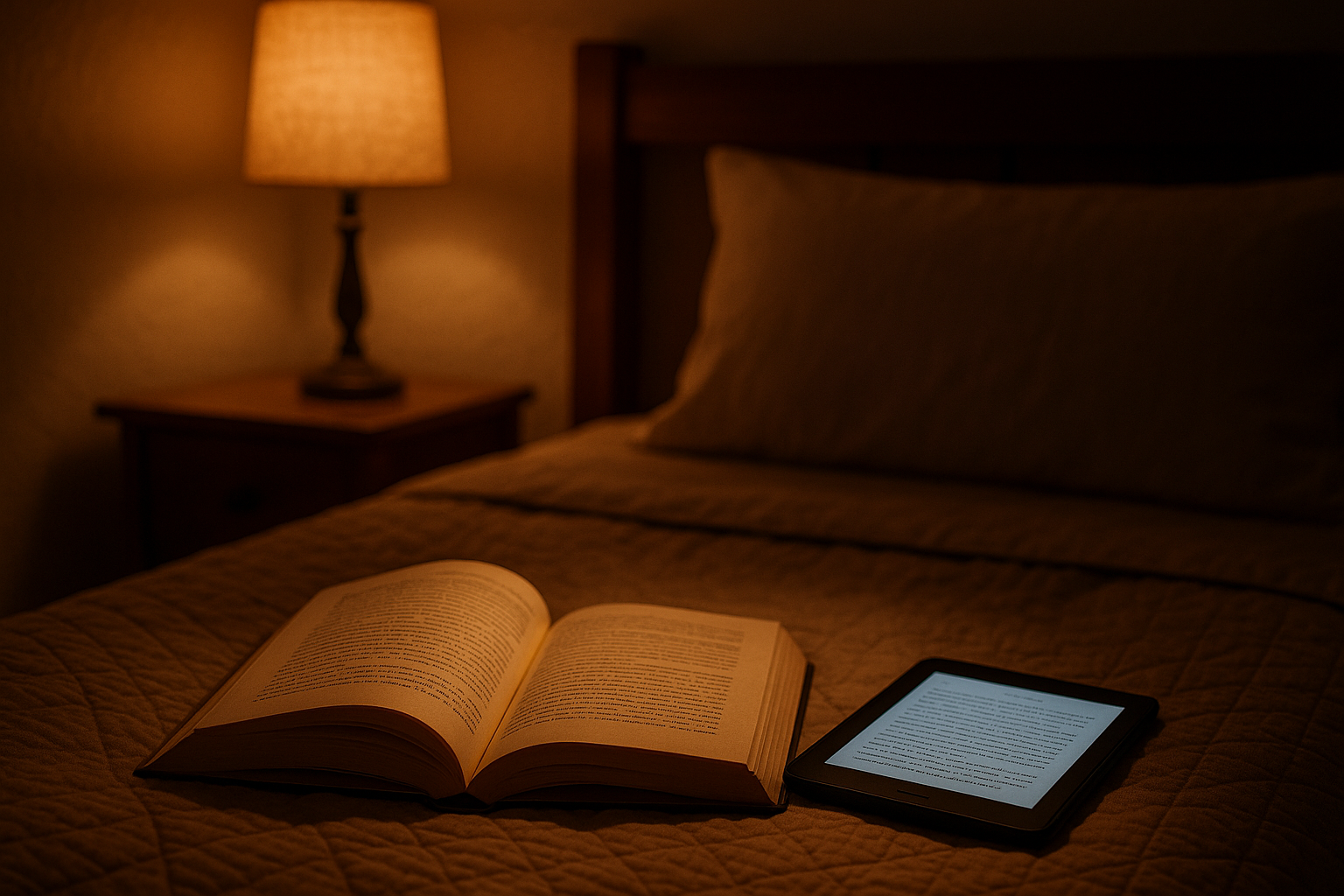
If your goal is better sleep, a paper book is generally the safest default at bedtime, while a dedicated e-ink reader can be nearly as sleep-friendly if you set it up carefully; tablets and phones are the least sleep-friendly. In simple terms: minimize light to your eyes, avoid notifications, and keep your brain in “wind-down” mode. This article explains exactly how to do that, with clear rules you can act on tonight. Brief note: this is general sleep education, not medical advice; if you have persistent insomnia or a diagnosed sleep disorder, consult a clinician.
Quick answer (for the skimmers): Prefer a paper book or a front-lit e-ink reader on the warmest, dimmest setting; keep the device at chest height 30–40 cm from your eyes; airplane mode on; room lighting very low and warm; finish reading at a consistent “lights-out” time.
1. Light and spectrum: what reaches your eyes matters most
Bottom line: The less short-wavelength (“blue-weighted”) light that reaches your eyes in the late evening, the better your odds of falling asleep on time. Paper books add no self-emitted light. Front-lit e-ink readers can be nearly as gentle, because their LEDs shine across the page, not out of it, and many let you warm the light. In contrast, tablets and phones are emissive displays aimed straight at your eyes; even with “Night Shift” or similar, they can still suppress melatonin and delay sleep. The practical goal is not “zero light” but very low, warm light in your environment and at the eye.
As of August 2025, consensus guidance suggests keeping evening melanopic light (a measure of circadian-active light) very low—and near-dark in the sleep environment. Multiple lab and field studies show backlit screens delay melatonin and push bedtimes later; blue light filters help a little but do not eliminate the effect. E-ink’s advantage is reflective optics and much lower luminance at the eye for the same perceived contrast, especially when the front light is dim and amber. Still, any light can matter if it’s bright, cool, or close to your eyes. So treat e-ink as “low-impact,” not “no-impact.”
Why it matters
- Evening light suppresses melatonin and can shift circadian timing; tablets/phones do this reliably in lab conditions. PMC
- “Night Shift”/warm filters reduce but don’t prevent melatonin suppression.
- Expert recommendations cap evening melanopic EDI at ~10 lux for the hours before bed, and ~1 lux in the sleep environment.
Numbers & guardrails
- Target: Evening reading ≤10 melanopic lux at the eye; in-bed environment ~1 melanopic lux. (If you don’t have a meter, use the warmest setting and the lowest readable brightness.)
- Distance: Keep the page/device about 30–40 cm from your eyes; doubling distance quarters illuminance.
- Filters: Warm filters/night modes help but don’t fully solve the problem—don’t rely on them alone.
Mini-checklist:
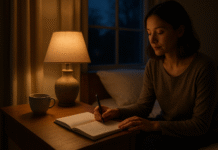
- Paper: use a very dim, warm bedside lamp with a shade.
- E-ink: set warmth to max, brightness just above “too dim,” airplane mode on.
- Tablet/phone: avoid for pre-sleep reading; if unavoidable, dim to near-minimum + warmest filter, and keep farther away.
Synthesis: Paper wins on “no emitted light,” but a carefully tuned e-ink reader can be close; backlit tablets and phones remain the riskiest choice for melatonin-friendly reading.
2. Device class: paper book, e-ink reader, tablet/phone—choose for sleep, not only convenience
Bottom line: For sleep, the hierarchy is clear: paper (best), front-lit e-ink (close second with the right settings), tablet/phone (worst). Paper requires ambient light but emits no light; e-ink adds a low-glare, adjustable front light; tablets/phones are bright emissive displays designed for engagement. If you love the convenience of carrying a library, you can make an e-ink reader behave almost like paper; if you read on a tablet, you’ll need strict guardrails.
E-ink advantages go beyond light: text looks paper-like, there’s no screen “glow,” and most dedicated readers are single-purpose, which reduces the temptation to check messages. Many modern e-ink models include warm LEDs and granular brightness steps; some add auto-brightness that can be turned off and “scheduled warmth” so the light gets amber at night. By contrast, phones and tablets are multi-purpose attention engines. Even if their light were harmless (it isn’t at bedtime), the interaction style—swipes, alerts, links—nudges you to stay awake.
Tools/Examples
- Paper + clip-on amber lamp with a shade: minimal light spill into the room.
- E-ink with max warmth + 1–3 brightness steps: enough contrast without over-lighting your eyes.
- Tablet: if you must, install a distraction blocker, schedule Do Not Disturb, and set a reading timer that closes the book app at “lights out.”
Common mistakes
- Treating “Night Shift” as a free pass on tablets; studies show melatonin suppression persists.
- Using auto-brightness in a dark room; it often overshoots comfort.
- Leaving Wi-Fi on; even e-ink stores may ping with offers when connected.
Synthesis: Pick the device that makes sleep-smart defaults easy. Paper does that by design; e-ink can be tuned to do the same; tablets/phones fight you unless you impose strict limits.
3. Reading comprehension & wind-down: what your brain does with paper vs screens
Bottom line: For informational, time-pressured reading (think articles, study chapters), meta-analyses show a small but reliable comprehension edge for paper; for narrative fiction, differences shrink. At bedtime, the goal is relaxation, not maximal study efficiency—but the same factors (fewer links, no notifications, steadier pacing) make paper and e-ink friendlier to winding down than multi-purpose screens.
Across large samples, paper often yields better calibration (awareness of what you’ve learned) and slightly better comprehension for non-fiction. This isn’t about “good vs bad” screens so much as the behaviors they invite: scrolling, hopping between apps, and reading in a posture that encourages alertness. When you’re trying to shift into sleep mode, predictable, linear reading helps your arousal drop. You can emulate that on e-ink; it’s much harder on a tablet or phone.
Why it matters
- Meta-analyses (2000–2017) show a small paper advantage for comprehension—especially for informational texts and under time pressure.
- Some discipline-specific reviews find minimal differences in certain contexts, but the overall pattern supports paper for deep learning. PMC
How to do it (bedtime edition)
- Prefer fiction or light non-fiction at night; avoid problem-solving or work reading.
- On e-ink, turn off dictionaries/links pop-ups unless you truly need them; micro-interactions nudge wakefulness.
- Use a reading cap (e.g., 15–30 minutes) and a cue (bookmark/closing ritual) so the session ends on time.
Synthesis: For wind-down, choose formats that minimize cognitive switching. Paper does this naturally; e-ink can be configured likewise; tablets/phones tend to re-introduce the very frictions you’re trying to avoid.
4. Notifications, engagement, and “time slip”: why phones feel worst at night
Bottom line: Cognitive arousal (what you do with the device) often hurts sleep more than light alone. Phones are built for interaction and notifications; that keeps your brain in task mode and displaces sleep (“just one more post”). Surveys and intervention studies link bedtime phone use and overnight alerts with poorer sleep quality, greater sleep disturbance, and insomnia symptoms.
Even if you max out warm filters and dim your phone, the timeline, replies, and push alerts stimulate social, emotional, and reward networks that counteract sleep pressure. Dedicated e-ink readers are mostly immune to this because they rarely push non-reading alerts and aren’t optimized for endless scrolling. Paper is immune by design. If your reading platform can do 50 other things, it will invite you to do some of them—especially at night.
Numbers & guardrails
- Large studies and meta-analyses associate bedtime screen use with worse sleep metrics; restricting pre-bed phone use improves sleep and lowers pre-sleep arousal. JMIRPMC
- Nighttime notifications correlate with sleep problems and daytime sleepiness; turn them off.
- AASM polling shows digital distractions routinely delay bedtimes; Do Not Disturb isn’t optional at night.
Mini-checklist
- Enable Do Not Disturb or Airplane Mode from your reading cue until wake time.
- If reading on a phone, remove social apps from the home screen; open the book directly from a widget/shortcut.
- Use an app timer that auto-closes the reading app at your target lights-out.
Synthesis: Light is physics; engagement is psychology. For sleep, both matter—and phones maximize the engagement that keeps you awake.
5. Room lighting: your lamp may matter more than your device
Bottom line: The ambient light in your bedroom can suppress melatonin even if you’re reading paper. Bright, cool room lighting reduces the sleep-friendliness of any reading medium. Keep the room dim and warm, use a shaded lamp, and position light so it hits the page—not your eyes.
Studies show that ordinary indoor light in the hour before bed can suppress melatonin; individual sensitivity varies widely. That means a bright bedside lamp can undo the advantage of paper or e-ink. The fix is straightforward: warmer bulbs (≤2700 K), shades that block direct view of LEDs, and placement that lights the book more than your face. If you need to share a room, a clip-on amber lamp or a very dim e-ink front light can localize light to your side of the bed.
Numbers & guardrails
- Evening guideline: keep melanopic EDI ≤10 lux; in bed aim for ≈1 lux.
- Regular room light in the evening can suppress melatonin compared to dim light; it’s not just screens.
- Sensitivity varies: some people show strong suppression at very low levels, so err on the dimmer, warmer side.
How to set it up
- Use warm (≤2700 K) bulbs in shaded lamps; avoid downlights.
- Place the lamp behind/above your shoulder, not in your sightline.
- If you need a lot of light to read: prefer paper + shaded lamp over a tablet; or e-ink with warm front light at the lowest readable setting.
Synthesis: Make the room sleep-friendly first; then any reading medium you choose will be more forgiving.
6. Eye comfort and fatigue: e-ink vs LCD vs paper for long sessions
Bottom line: For prolonged reading, LCD tablets tend to increase visual fatigue compared with e-ink and paper, while e-ink and paper are often similar on subjective fatigue. That doesn’t mean LCD is “bad” in all cases, but for bedtime wind-down—when you want less strain and fewer stimuli—e-ink or paper makes sense.
A well-controlled study comparing Kindle Fire HD (LCD), Kindle Paperwhite (e-ink), and paper found higher visual fatigue and altered blink patterns on the LCD device over ~70-minute sessions; e-ink and paper were closer to each other. Other research finds mixed or smaller differences depending on fonts, brightness, and tasks, but the broad pattern holds: LCD’s higher luminance and glare can increase subjective strain over longer sessions.
Why it matters
- PLOS ONE (2013): LCD reading triggered higher visual fatigue than e-ink or paper under matched text conditions.
- Earlier work sometimes found small differences between e-ink and LCD, but often under shorter tasks; results vary by setup. PubMed
Mini-checklist
- If your eyes feel “sandy” at night, switch to paper or e-ink and lower luminance.
- Increase font size (1–2 steps up at night).
- Keep the page/device below eye level to reduce exposed ocular surface (less dryness).
Synthesis: For comfort in dim rooms, e-ink behaves more like paper; LCD can be fine in daytime, but it’s not your best friend for bedtime.
7. Ritual and conditioning: building a reliable “sleep cue”
Bottom line: The best bedtime medium is the one you can repeat every night without drifting later or getting pulled into other activities. Paper books and single-purpose e-ink readers make it easier to create a cue-routine-sleep loop. Phones and tablets are weaker cues because they’re associated with many behaviors (work, messaging, entertainment).
Repeated behaviors before bed can become conditioned sleep cues: you see the bookmark, crack the spine, read a chapter, close the book, lights out—your brain predicts sleep. E-ink can support the same habit when it’s used only for books, in airplane mode, with the same light and typography every night. Tablets/phones, by contrast, are inconsistent cues; the same object is also your news feed, inbox, and casual game. You can fight that with settings, but the default associations work against sleep.
How to do it
- Choose a consistent book slot (e.g., 15–30 minutes) and set a soft alarm that reminds you to stop.
- Use the same device + settings nightly (lamp, warmth, font), so your body recognizes the pattern.
- Keep a bedside stack or a dedicated e-ink shelf page—avoid browsing stores at night.
Common mistakes
- Sampling multiple books/apps each night (decision fatigue).
- Browsing the e-book store “for a minute” (time slip into shopping).
- Letting a thrilling cliff-hanger push bedtime—pick calmer genres at night.
Synthesis: The medium isn’t just optics; it’s a habit platform. Paper and e-ink make it easy to build a repeatable, sleepy ritual.
8. Practicalities: portability, cost, sharing a bed, and living with other people
Bottom line: Real life matters: travel, partners, kids, and budget all shape what “works.” Paper wins on zero emissions and simplicity; e-ink wins on portability and localized light (good when sharing a room); tablets win on multimedia but lose on sleep-friendliness. Pick the trade-offs that keep you reading without delaying lights-out.
If you share a bed, a shaded lamp and paper may still splash light toward your partner, whereas an e-ink reader at very low, warm brightness can keep light mostly on the screen. Travelers often prefer e-ink to avoid packing multiple books. Budget-wise, a used e-ink reader may cost less than a few new hardbacks; public libraries lend both print books and e-books, so your “sleep-smart” setup can be affordable either way.
Mini-checklist
- Sharing a room: prefer e-ink at low warmth/brightness or a clip-on amber lamp for paper.
- Libraries: check if your library loans e-books compatible with your device and paper for home pickup—set daytime hours to choose titles.
- Kids/teens: model a no-tablet bedtime; paper or e-ink only in the last hour before lights out.
Region-specific note
- If evening electrical supply is variable (e.g., load-shedding), keep a charged e-ink reader and a battery clip-on lamp as backup for paper; both are low-power options.
Synthesis: Choose the medium that fits your household logistics while keeping light low, warmth high, and schedules consistent.
9. Putting it all together: a simple decision tree for tonight
Bottom line: If you can change nothing else, read a paper book under a dim, warm lamp and turn lights out at a fixed time. If you want convenience and the least trade-offs, use a front-lit e-ink reader on the warmest, dimmest setting, airplane mode, and set a reading timer. Avoid tablets/phones in bed unless they’re your only option—and add strict limits when they are.
Here’s a pragmatic way to decide:
How to do it (decision steps)
- Can you read on paper tonight?
- Yes → Use a shaded, warm lamp; stop at a set time.
- No → Go to step 2.
- Do you have an e-ink reader?
- Yes → Max warmth, minimal brightness, airplane mode, timer.
- No → Go to step 3.
- Only a phone/tablet?
- Use Do Not Disturb, warmest filter, lowest readable brightness, hold farther away, timer, and no other apps.
- Make a plan to get a paper option (library) or entry-level e-ink for future nights.
Numbers & guardrails (one-page recap)
- Evening melanopic EDI ≤10 lux; in bed ~1 lux.
- Avoid relying on Night Shift to “fix” tablet light.
- Remember that room light can suppress melatonin even with paper.
Synthesis: Sleep-smart reading is a stack: dim, warm environment → low-impact medium (paper or tuned e-ink) → distraction control → consistent lights-out. Stack those, and you’ll feel the difference.
FAQs
1) Is e-ink completely safe for sleep?
No device is “completely safe” if the light is bright or cool and close to your eyes. E-ink displays are reflective and can be front-lit very dimly with amber LEDs, which makes them much more sleep-friendly than tablets. Treat e-ink as “low-impact” rather than “no-impact,” and keep brightness/warmth conservative.
2) Do blue-light filters (“Night Shift,” “Night Mode”) solve the problem?
They help, but not enough to rely on. Studies show melatonin suppression can persist even with warm filters on tablets. Filters are a seatbelt, not an airbag—use them and lower brightness, increase distance, and limit engagement.
3) What about reading under a bright bedside lamp with a paper book?
Paper emits no light, but ambient light still hits your eyes. Regular room light before bed can suppress melatonin compared to dim light, so use warm, shaded lamps at low levels and aim light at the page, not your face.
4) Is there proof that reading before bed helps sleep?
Yes—an online randomized trial (“The Reading Trial”) found people assigned to read a book in bed for 15–30 minutes reported better sleep quality than those who didn’t read, over one week. Effects were modest but meaningful.
5) Does paper really beat screens for comprehension?
For informational texts and timed reading, multiple meta-analyses show a small paper advantage. For narrative fiction, differences are smaller. At bedtime—where the goal is relaxation—either paper or e-ink works well when distractions are eliminated.
6) Are there objective reasons LCD tablets feel more tiring to read at night?
In a controlled study, LCD e-readers produced higher visual fatigue and altered blink patterns versus e-ink and paper over ~70 minutes. In practice, higher luminance and glare can make LCDs feel harsher in dim rooms.
7) What single setting matters most on an e-ink reader?
Warmth and brightness, together. Max out warmth, then lower brightness to the minimally readable level; keep the device at a comfortable distance. If your model schedules warmth, set it to increase automatically after sunset.
8) Do notifications really hurt sleep, or is that overblown?
Nighttime alerts and compulsive checking are consistently associated with poorer sleep quality and daytime sleepiness. Even if light is low, engagement keeps your brain in “awake mode.” Use Do Not Disturb or airplane mode during bedtime reading. DigitalCommons@URI
9) I only have a phone—can I make it work?
You can make it less bad: warmest filter, near-minimum brightness, increased distance, Do Not Disturb, and a strict 15–30 minute timer. Pick calm content, no links, and close the app when the timer ends. But consider a paper book or low-cost e-ink for a truly sleep-friendly routine.
10) How long should I read before bed?
Aim for 15–30 minutes—enough to relax without displacing sleep. End at a consistent lights-out time. If you routinely read past bedtime, set a gentle alarm and stop mid-chapter; your brain will anticipate the next session and relax more easily.
11) Does warmer room lighting really help?
Yes. Warmer spectra reduce melanopic content compared with cool white at the same brightness, making it easier to keep melanopic lux low before bed. Pair warm bulbs with low intensity and indirect/shaded fixtures.
12) What if I wake in the night and want to read to fall back asleep?
Keep the environment near-dark (~1 melanopic lux). If you must read, prefer paper with a very dim, localized amber light or an e-ink reader at the lowest setting; avoid tablets/phones to limit alertness spikes.
Conclusion
When your priority is sleep, light exposure, engagement, and habit consistency determine whether reading helps you doze off or keeps you up. Paper books are inherently sleep-friendly: no emitted light, no notifications, and strong ritual value. Front-lit e-ink readers—set to warm, dim, and offline—can deliver almost the same benefits with the convenience of a portable library and localized light that won’t disturb a bed partner. Tablets and phones are the least sleep-friendly; even with warm filters, their emissive light and engagement patterns nudge you later. The most effective plan is simple: dim and warm your room, pick a low-impact medium (paper or tuned e-ink), block distractions, and keep a consistent lights-out. Do this for a week and notice not just how quickly you fall asleep, but how much better you feel the next morning.
CTA: Tonight, choose your medium, set a 20-minute reading timer, and make it a cue that ends with lights out.
References
- Chang, A-M., et al. “Evening Use of Light-Emitting eReaders Negatively Affects Sleep, Circadian Timing, and Next-Morning Alertness.” Proceedings of the National Academy of Sciences, Jan 27, 2015. PNAS
- Brown, T. M., et al. “Recommendations for Daytime, Evening, and Night-time Indoor Light Exposure.” Lighting Research & Technology, 2022. (Open-access summary via NIH/PMC). PMC
- Nagare, R., et al. “Does the iPad Night Shift Mode Reduce Melatonin Suppression?” Lighting Research & Technology / Chronobiology reports (open-access on PMC), 2018–2019. PMC
- Gooley, J. J., et al. “Exposure to Room Light before Bedtime Suppresses Melatonin Onset and Shortens Melatonin Duration in Humans.” Journal of Clinical Endocrinology & Metabolism, 2011. Oxford Academic
- Schöllhorn, I., et al. “Melanopic Irradiance Defines the Impact of Evening Display Light on Sleep and Circadian Physiology.” Communications Biology, 2023. Nature
- Delgado, P., et al. “Don’t Throw Away Your Printed Books: A Meta-analysis on Reading Medium and Comprehension.” Learning and Instruction, 2018. (PDF: ) ScienceDirectUniversitat de València
- Clinton, V. “Reading from Paper Compared to Screens: A Systematic Review and Meta-analysis.” Journal of Research in Reading, 2019. Wiley Online Library
- Finucane, E., et al. “Does Reading a Book in Bed Make a Difference to Sleep? The Reading Trial.” BMC Psychology (People’s Trial), 2021. PMC
- Benedetto, S., et al. “E-Readers and Visual Fatigue.” PLOS ONE, 2013. (PMC: ) PLOSPMC
- Gringras, P., et al. “Bigger, Brighter, Bluer—Better? Current Light-Emitting Devices—Adverse Sleep Properties and Preventative Strategies.” Frontiers in Public Health, 2015. PMC
- Cain, S. W., et al. “Evening Home Lighting Adversely Impacts the Circadian System and Sleep.” Scientific Reports, 2020. Nature
- AASM. “Over Three-Fourths of Americans Lose Sleep Due to Digital Distractions.” American Academy of Sleep Medicine, Dec 4, 2023. AASM