


















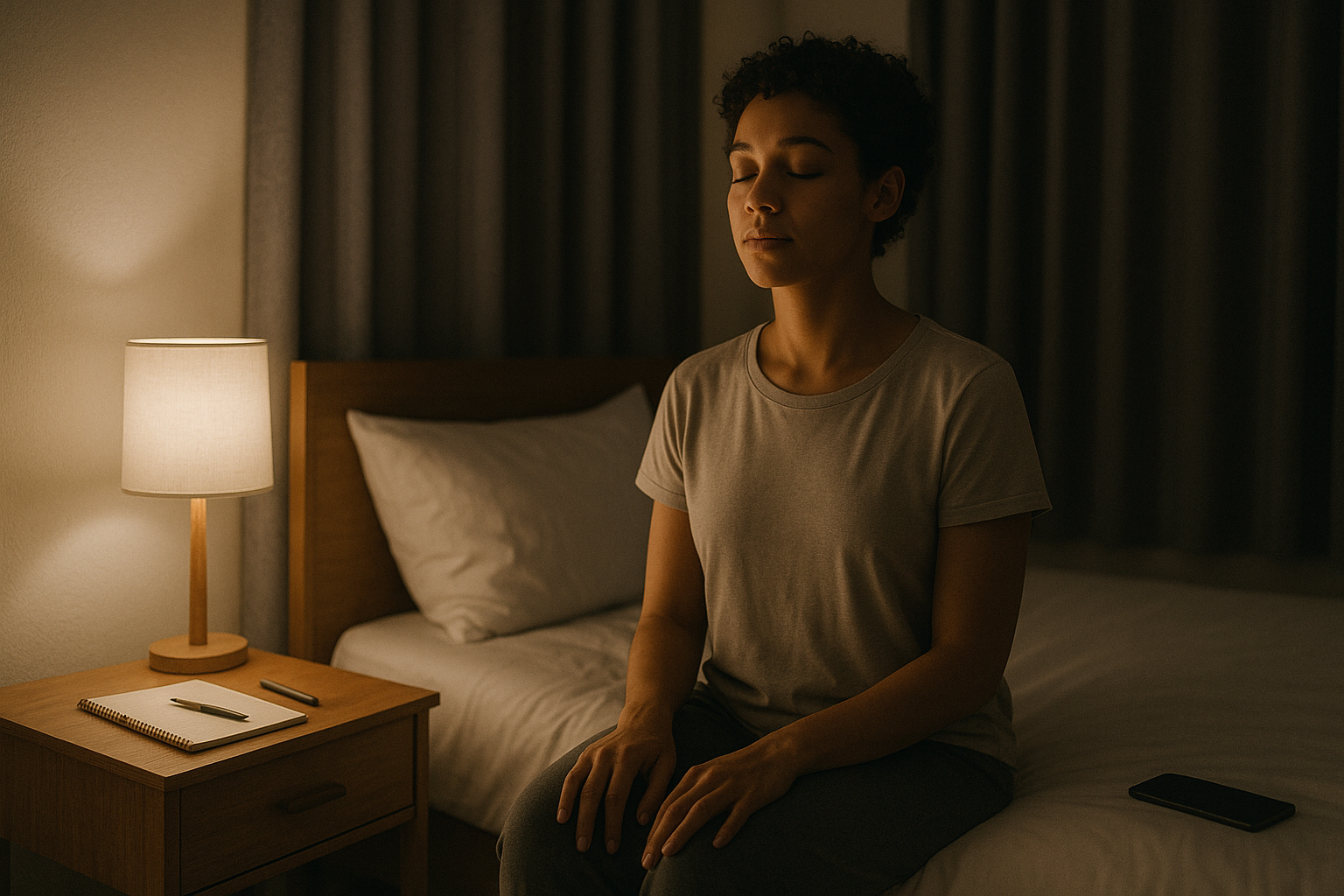
Stress and sleep are tightly linked: when stress spikes, sleep fragments; when sleep crumbles, stress hormones and emotional reactivity climb. This guide turns that cycle around with practical, evidence-based tools you can put to work tonight. You’ll learn how to calm a racing mind, design a wind-down that actually works, and protect your circadian rhythm—without relying on pills. Brief disclaimer: the guidance below is educational, not medical advice; speak with a clinician if you have ongoing insomnia, mental health concerns, or a medical sleep disorder.
Quick definition: “Stress management for healthy sleep habits” means applying behavioral, cognitive, and physiological techniques that lower pre-sleep arousal and support a consistent sleep schedule and environment. In short: reduce mental/physiological “noise,” align with your body clock, and train the bed for sleep.
Fast start (tonight): set a 45–60-minute wind-down, dim lights, park your to-do worries in writing, avoid caffeine after mid-afternoon, keep alcohol out of the last 3–4 hours, and get out of bed if you’re awake >20 minutes.
1. Rewire Bedtime Thoughts with Cognitive Restructuring (CBT-I Core)
Cognitive restructuring directly targets the stress-sleep loop by challenging the catastrophic, perfectionistic, or all-or-nothing thoughts that spike arousal at night. Start by noticing common patterns (“If I don’t sleep 8 hours, tomorrow is ruined,” “I’m broken; I’ll never sleep”). Then evaluate evidence, generate balanced alternatives (“I can function on less; I’ve done it before”), and test the new belief with behavioral experiments. This doesn’t mean “positive thinking”; it’s accurate thinking under pressure. The result is lower pre-sleep anxiety, reduced clock-watching, and fewer adrenaline bursts that keep you awake. As of August 2025, clinical guidelines recommend CBT-I as first-line for chronic insomnia, and its cognitive tools are a big reason why.
1.1 How to do it (5–10 minutes)
- Capture one troubling thought about sleep (use your phone’s notes or a bedside card).
- Ask: What’s the evidence for/against this? What’s a more balanced view?
- Replace with a concise, repeatable line (e.g., “Rest is helpful even if sleep is light.”).
- Pair it with a calming breath set (see section 5) to anchor the new thought.
- Rehearse in the evening wind-down, not just in bed.
1.2 Common mistakes
- Trying to force sleep with thoughts—restructuring reduces worry; it isn’t a “sleep button.”
- Measuring success by instant knockout; track stress reduction and fewer long wakeups.
Synthesis: When your beliefs get less catastrophic, your nervous system follows—creating the calm conditions where sleep can arrive instead of being chased.
2. Use Stimulus Control to Break the Bed–Stress Link
If your bed has become a “thinking chair,” your brain has learned that pillows = problem-solving. Stimulus control retrains that association by pairing bed only with sleep (and intimacy) and by moving wakeful, stressed minutes elsewhere. The core steps are simple but powerful: go to bed when sleepy (not at a fixed time if you’re wide awake), get up at your set wake time daily, and if you can’t sleep after ~20 minutes, leave the bed for a quiet, dim activity until sleepiness returns. Over a couple of weeks, your brain re-labels the mattress from “worry station” to “sleep cue,” lowering arousal and cutting long middle-of-the-night wake periods. Systematic reviews find stimulus control effective on its own and comparable to other active treatments for insomnia.
2.1 Checklist
- Bed = sleep/sex only (no news, email, or planning).
- If awake ~20 minutes, get out of bed; read a paper book under low light.
- Fixed wake time (±15 minutes) every day.
- Nap only before mid-afternoon and cap at 20–30 minutes if needed.
2.2 Mini case
A graduate student with 2–3 a.m. worry sessions moved to a comfy chair whenever wakeful >20 minutes. Within 10 nights, she reported shorter wakeups and felt sleepy faster upon returning to bed.
Synthesis: Stimulus control is the stress breaker: you no longer “practice” arousal in bed—so your body can relearn sleep on cue.
3. Consolidate Sleep with Sleep Restriction (a.k.a. Sleep Scheduling)
Counterintuitive but highly effective, sleep restriction therapy (SRT) reduces time in bed to match your actual sleep, then carefully widens it as efficiency improves. Why it helps stress: when you’re genuinely sleepy at lights-out, rumination loses its grip. Over 1–2 weeks, the homeostatic “sleep drive” builds, your schedule stabilizes, and fragmented nights consolidate. A 2024 network meta-analysis highlights sleep restriction and stimulus control as the most potent CBT-I components. Expect short-term grogginess during the first week; that’s a sign the dose is working (keep driving safety in mind).
3.1 Numbers & guardrails
- Baseline: average your total sleep time (TST) over 7 days.
- Set time in bed (TIB) = TST, but not < 5.5 hours without clinician oversight.
- Fix a wake time; compute bedtime from TIB (e.g., wake 6:30 a.m., TIB 6.5 h → bed 12:00 a.m.).
- When sleep efficiency ≥ 85% for 5–7 nights, add 15–30 minutes to TIB.
3.2 Tools/Examples
- Use a paper log or app to track TST and efficiency; many dCBT-I programs do this automatically (see section 9).
Synthesis: By compressing sleep opportunity to fit real sleep, SRT makes you sleepy enough to out-compete stress—and then gradually restores your preferred schedule.
4. Build a 60-Minute Wind-Down Buffer (Your “Landing Strip”)
One of the most effective stress-management moves is creating a consistent buffer between the day’s demands and lights-out. Think of this as a “physiological landing strip” where stimulation, light, and decisions taper down. Aim for 45–60 minutes. Keep the steps predictable, calm, and low-light: gentle tidy-up, hygiene, stretching, reading, and a brief planning/journaling check (see section 7). Lock in a cue (same soundtrack, lamp, or scent) so your nervous system learns, “Oh—we’re powering down now.” A well-designed wind-down lowers heart rate and cortisol, making pre-sleep arousal less likely to spiral into insomnia. (Guidelines consider relaxation and behavioral routines key elements alongside CBT-I.)
4.1 Mini-checklist
- Start time: ~1 hour before bedtime.
- Lighting: warm/dim; avoid overheads; aim <50 lux.
- No new problems to solve—capture them for tomorrow (section 7).
- Cap screens or use passive, non-interactive content if you keep them (see section 8).
- Finish with a short breath or body scan (section 5–6).
4.2 Common pitfalls
- Treating wind-down like another chore sprint.
- Doomscrolling “for relaxation” (often raises arousal); if you watch, pick familiar, non-stimulating shows.
Synthesis: A repeatable pre-sleep ritual teaches your body to exhale from the day, so sleep has clear airspace to land.
5. Downshift Physiology with Breathing & Progressive Muscle Relaxation
Slow, paced breathing (e.g., 4-7-8 or 0.1 Hz / 6 breaths per minute) and progressive muscle relaxation (PMR) directly dial down sympathetic arousal. They reduce heart rate, ease muscle tension, and shift attention from rumination to sensation. The exact pattern matters less than consistency; combine 3–5 minutes of breathing with a 5–7 minute PMR sweep (tense–release head to toe). Evidence from behavioral sleep guidelines endorses relaxation therapies as components of insomnia care; mechanistically, you’re tapping the vagus nerve and increasing heart-rate variability, which correlates with calm.
5.1 How to do it (6–10 minutes)
- Sit or lie under dim light; inhale 4, hold 7, exhale 8 (or simply 5 seconds in/5 out).
- Scan body part by part: gently tense 3–5 seconds, then release for 10–15 seconds.
- If thoughts intrude, label “thinking”, return to counting the exhale.
5.2 Numbers & guardrails
- Target: 5–10 minutes nightly, plus a 1–2 minute “spot set” if you wake at night.
- Expect a 1–2 week learning curve; consistency beats intensity.
Synthesis: Breathing + PMR give your body a reliable “off switch” you can access anywhere—bedtime, 3 a.m., or pre-meeting.
6. Train Attention with Mindfulness (Body Scan & Noting)
Mindfulness lowers stress by training you to notice thoughts and sensations without automatically reacting. In bed, that means a worry thought doesn’t have to become a 40-minute spiral. A simple body scan (moving attention slowly from toes to head) or “noting” practice (label sensations and thoughts briefly, then release) is plenty. Randomized trials show mindfulness programs improve sleep quality and daytime impairment compared with sleep hygiene education; meta-analyses suggest benefits for insomnia symptoms. Consider 10–20 minutes in the evening or late afternoon; many prefer a short body scan during wind-down. PMC
6.1 Tools/Examples
- Try free guided scans from reputable universities/clinics or mindfulness apps with a “sleep” track.
- Pair with dim light and warm beverage (non-caffeinated) to reinforce the habit.
6.2 Common mistakes
- Forcing relaxation; success is showing up, not “knocking out.”
- Judging sessions by sleepiness; look for reduced stress and fewer long wakeups over 2–4 weeks.
Synthesis: Mindfulness won’t “make” you sleep, but it quiets the mental amplifiers of stress so sleep can emerge naturally.
7. Offload Worries with a 5-Minute “To-Do” Write-Down
When stress is task-based (deadlines, errands, unfinished loops), writing a to-do list before bed speeds sleep onset by “parking” intentions for tomorrow. In a Baylor University study using overnight polysomnography, participants who wrote to-do items fell asleep faster than those who wrote about tasks completed. Keep it short, specific, and time-boxed to five minutes; if your mind pipes up in bed, remind it: “Already captured.” This structured offload reduces late-night planning and cuts the urge to grab your phone. PubMedBaylor News
7.1 Mini-checklist
- Use a small notebook; write 5–10 bullet tasks for tomorrow.
- Add one “first next step” to each.
- Close the notebook and place it out of reach.
7.2 Example
Instead of “finish report,” write “outline sections A–C from 9:30–10:15 a.m.; draft intro 10:20–10:50.”
Synthesis: A tiny dose of planning, done before bed, unhooks your brain from problem-solving when you need rest.
8. Protect Your Body Clock with Light: Bright Mornings, Dim Evenings
Light is your strongest circadian cue. For better sleep and lower evening stress, get bright morning light (ideally outdoors) and dim evening light. At night, blue-rich light suppresses melatonin more than longer wavelengths and can shift your internal clock later; recent work also shows evening bright light can delay melatonin. Practically, dim lamps after sunset, use “night shift” filters, and keep screens passive if you choose to watch (familiar shows, not interactive content). In the morning, 10–30 minutes of outdoor light anchors your rhythm and mood.
8.1 Numbers & guardrails
- Morning: 10–30 min outside within an hour of waking; more on overcast days.
- Evening: keep light low and warm; avoid bright task lighting in the last 2–3 hours.
8.2 If you must screen
- Lower brightness, enable warm filters, keep content low-arousal (no emails/news).
- Hold devices at least 30–40 cm (12–16 in) away to reduce retinal illuminance.
Synthesis: Treat light like a drug: correct dose and timing strengthen your clock—and make nights feel calmer.
9. Consider Digital CBT-I (When Access or Time Is Tight)
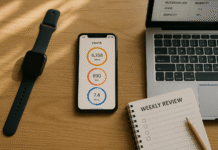
If you can’t see a CBT-I clinician soon, digital CBT-I (dCBT-I) delivers the core program via a structured app or website. In the UK, NICE recommends Sleepio as a cost-saving, effective option in primary care; in the U.S., Somryst is an FDA-authorized prescription digital therapeutic for chronic insomnia. AASM highlights dCBT-I as a pragmatic bridge when in-person access is limited. These programs automate sleep diaries, stimulus control prompts, and sleep scheduling, and many layer in cognitive tools. Expect 6–7 modules over about 6 weeks; results often persist months later.
9.1 When to choose it
- Wait-lists for therapists; need a structured plan now.
- You like dashboards, week-by-week goals, and reminders.
9.2 Guardrails
- If you snore loudly, stop breathing in sleep, or feel excessively sleepy in the day, screen for sleep apnea before starting any insomnia program.
Synthesis: dCBT-I blends proven methods with convenience—letting you reduce stress and retrain sleep with step-by-step guidance.
10. Time Stimulants & Sedatives: Caffeine, Alcohol, Nicotine
Caffeine blocks adenosine receptors and can linger; even 6 hours before bed, it reduces total sleep time and efficiency for many people. As of 2025, newer analyses suggest 100 mg may be tolerable up to 4 hours pre-bed for some, while 400 mg within 12 hours can disrupt sleep—so individualize but err on the early side. Alcohol may help you nod off, but it suppresses REM and fragments the second half of the night; nicotine is stimulating and withdrawal can wake you early. Practical policy: last caffeine 8–10 hours before bed, avoid alcohol within 3–4 hours, and keep nicotine out of the evening. Oxford Academic
10.1 Mini-checklist
- Cap daily caffeine ≤ 400 mg (FDA adult guidance); earlier cutoffs if sensitive.
- If you drink, do so with food and finish ≥ 3–4 hours before bed.
- Swap evening nicotine with patches/gum timed to taper earlier in the day.
10.2 Example swaps
- After-lunch coffee → decaf or herbal tea.
- Evening drink → non-alcoholic bitter or sparkling water with citrus.
Synthesis: Smart timing turns stimulants and sedatives from sleep saboteurs into neutral background factors. The Washington Post
11. Move Your Body (and Pick the Right Time)
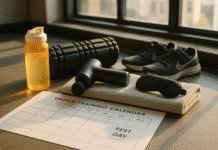
Regular physical activity lowers baseline stress, improves mood, and enhances sleep quality. Aerobic, strength, and mind-body exercise all help; choose what you’ll keep doing. Timing matters for some: high-intensity workouts in the last 1–2 hours can keep you wired, while afternoon sessions often produce the best nighttime sleepiness. Systematic reviews and network meta-analyses continue to support exercise for sleep quality across ages, with dose–response benefits. ScienceDirect
11.1 Numbers & guardrails
- Aim for 150+ minutes/week moderate aerobic or 75 minutes vigorous, plus 2 days of resistance work.
- Keep late-evening sessions light (stretching/yoga) if you’re sensitive to arousal.
11.2 Mini case
A desk worker shifted HIIT from 8:30 p.m. to 6:00 p.m. and added a 10-minute walk at lunch; within 2 weeks, sleep onset shortened and fewer 3 a.m. wakeups occurred.
Synthesis: Consistent movement acts like a pressure valve for stress—and, timed well, it boosts sleep pressure when you need it.
12. Engineer a Calm, Cool, Dark, and Quiet Bedroom
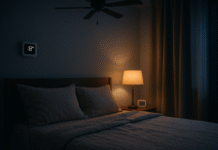
Your environment either lowers stress or pokes it. Keep your bedroom cool (roughly 18–20°C / 65–68°F for many), dark (blackout curtains, mask), quiet (earplugs or white noise), and uncluttered. Warmer nights are linked to poorer sleep globally; thermoregulation is tightly tied to sleep onset. If heat is an issue, pre-cool the room, use breathable bedding (cotton/linen), and consider a fan or active cooling topper. Keep your phone on Do Not Disturb and face down; if you need it as an alarm, airplane mode reduces notifications.
12.1 Mini-checklist
- Temperature: set thermostat or use a fan to reach 18–20°C (65–68°F).
- Darkness: block light leaks; use a low-watt amber nightlight if needed for safety.
- Sound: white noise at ~40–50 dB can mask disruptions.
12.2 Add a cue
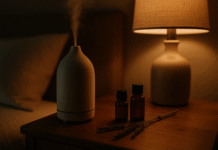
- A consistent scent (lavender/cedar), the same low-light lamp, or a soft playlist can become calming “context cues” that signal bedtime.
Synthesis: A bedroom that speaks calm lowers baseline arousal so your brain never needs to fight the room to fall—and stay—asleep.
FAQs
1) What’s the fastest way to calm a racing mind at bedtime?
Pair a brief to-do list dump (5 minutes, concrete next steps) with paced breathing (3–5 minutes at ~6 breaths/minute). The list parks tomorrow’s concerns; the breathing quiets your nervous system. If you’re still alert after ~20 minutes in bed, get up, read something bland under dim light, and return when sleepy. These moves reduce arousal without pressuring sleep.
2) How long until these strategies start working?
Many people feel relief in 7–14 days—especially from stimulus control and wind-down habits. Full benefits of CBT-I-style scheduling often unfold over 4–6 weeks. Expect a “harder first week” with sleep restriction as your schedule consolidates; stick with your fixed wake time and the curve usually turns.
3) Is screen time always bad before bed?
Blue-rich bright light can delay melatonin and push your clock later; however, dim, passive screen use affects people differently. If screens are soothing for you, keep them warm-tinted, low-brightness, and choose familiar, non-interactive content. Still, dimming the whole room and winding down offline remains the most reliable route.
4) Do I need a sleep app or can I DIY?
You can absolutely DIY with a paper log and the steps above. If you prefer structure or can’t access a clinician, digital CBT-I (e.g., Sleepio; Somryst by prescription in the U.S.) is evidence-based and convenient. Programs typically run 6 weeks with diaries, schedules, and cognitive tools built in.
5) What if I wake at 3 a.m. and can’t get back to sleep?
Use a gentle rule: if you’re not drifting after ~20 minutes, leave the bed. Sit somewhere dim, read a few pages of a paper book, or do a short body scan. When sleepiness returns, go back to bed. This prevents your bed from becoming a stress zone and shortens future wakeups. PubMed
6) How late is too late for caffeine?
Sensitivity varies, but studies show disruption even 6 hours pre-bed for many. A pragmatic rule is 8–10 hours before your target bedtime; the more you’re prone to anxiety or insomnia, the earlier your cutoff should be. Track changes for two weeks to find your personal edge.
7) Does alcohol help or hurt sleep?
It can shorten sleep onset but hurts overall quality by suppressing REM and fragmenting the second half of the night. If you drink, finish at least 3–4 hours before bed and hydrate. If you’re chasing stress relief, substitute an evening walk, shower, or breath work most nights. PMC
8) Can exercise close to bedtime ruin sleep?
Late-night high-intensity sessions can keep some people wired; others are fine. Safest bet: schedule vigorous workouts earlier and keep late-evening movement gentle (stretch/yoga). Overall, consistent weekly activity improves sleep across modalities and ages.
9) What bedroom temperature should I aim for?
Most sleep experts recommend 18–20°C (65–68°F). Warmer nights are linked with poorer sleep, and cooler environments assist your body’s natural temperature drop at sleep onset. Use fans, breathable sheets, and blackout curtains to help.
10) I’ve tried everything—when should I see a clinician?
If insomnia lasts ≥3 months (trouble ≥3 nights/week) or you have symptoms like loud snoring, choking/gasping, or extreme daytime sleepiness, seek an evaluation. A sleep professional can screen for apnea, restless legs, circadian disorders, or mood/anxiety conditions and guide CBT-I or other treatments.
Conclusion
When stress hijacks your nights, the way back isn’t force or perfection—it’s process. You calm the mind with cognitive restructuring, you lower physiology with breathing and PMR, and you retrain your bed and schedule with stimulus control and sleep restriction. You protect your clock with morning light and dim evenings, offload tomorrow with a five-minute list, time caffeine and alcohol wisely, move your body, and make the room a sanctuary. Choose two strategies to start this week (for many, it’s wind-down + stimulus control), then layer others every few days. Track two outcomes: fewer long wakeups and less dread at bedtime. As your nervous system learns safety at night, sleep follows—steadier, deeper, more restorative.
CTA: Pick your first two strategies now, set a start time tonight, and give the plan seven days—your calmer nights begin with tonight’s wind-down.
References
- Behavioral and psychological treatments for chronic insomnia disorder in adults: an AASM clinical practice guideline, Journal of Clinical Sleep Medicine, American Academy of Sleep Medicine, Feb 2021. Journal of Clinical Sleep Medicine
- Cognitive Behavioral Therapy for Insomnia (CBT-I): A Primer, Psychiatry (Edgmont) (review on PMC), 2022. PMC
- Stimulus control for insomnia: A systematic review and meta-analysis, Journal of Sleep Research, 2024. Wiley Online Library
- Network meta-analysis examining efficacy of components of CBT-I, Clinical Psychology Review, 2024. ScienceDirect
- The Effects of Bedtime Writing on Difficulty Falling Asleep: A Polysomnographic Study, Journal of Experimental Psychology: General, 2018 (Baylor University). PMC
- Mindfulness meditation and improvement in sleep quality among older adults with sleep disturbances: a randomized clinical trial, JAMA Internal Medicine, 2015. (PMC version: ) JAMA NetworkPMC
- Blue light has a dark side (summary of melatonin suppression findings), Harvard Health Publishing, updated July 2024. Harvard Health
- Afternoon–evening bright light exposure reduces evening melatonin: circadian impact, npj Biological Timing and Sleep, 2025. Nature
- Caffeine effects on sleep taken 0, 3, or 6 hours before bedtime, Sleep, 2013. PMC
- The effect of caffeine on subsequent sleep: systematic review, Sleep Medicine Reviews, 2023. ScienceDirect
- Alcohol and the sleeping brain: effects on sleep architecture, Alcohol Research: Current Reviews, 2014. PMC
- Effect of physical activity on sleep quality: systematic review, International Journal of Environmental Research and Public Health, 2023. PMC
- Sleepio to treat insomnia and insomnia symptoms (NICE MTG70 Guidance), National Institute for Health and Care Excellence, May 2022. NICE
- Digital treatment for insomnia receives FDA clearance (Somryst), American Academy of Sleep Medicine news, Mar 2020. AASM
- Bedroom temperatures and bedding choices affect sleep (expert guidance summary), Sleep Foundation, Nov 2023. Sleep Foundation
- A systematic review of ambient heat and sleep worldwide, Sleep Medicine Reviews, 2024. ScienceDirect
- Digital CBT-I platforms and characteristics (member resource), American Academy of Sleep Medicine, 2024. AASM
- Mobile HRV biofeedback improves subjective sleep quality in young adults (pilot RCT), International Journal of Psychophysiology, 2022 (PMC). PMC
- Effects of thermal environment on sleep and circadian rhythm (review), Journal of Physiological Anthropology, 2012 (foundational thermoregulation–sleep link). PMC
- The best approaches and doses of exercise for improving sleep (network meta-analysis), BMC Public Health, 2025. BioMed Central