

























Quick answer
Camping trips do not require a structured workout plan to keep you moving. Setting up camp, walking uneven trails, and simple daily chores already provide meaningful physical activity, and a five to ten minute equipment-free routine on rest mornings is enough to cover the gap. The goal for a holiday week is steady, low-pressure movement, not a training block.
By Priya Nandakumar
Who This Matters Most For
This guide is written for people who already have some kind of regular movement habit, whether that is a gym routine, daily walks, a running schedule, or home workouts, and who worry that a week or more of camping will erase that progress. It is also useful for families trying to keep kids active outdoors without turning a trip into a fitness camp, and for anyone returning to camping after a long break who wants a realistic, low-stress way to stay in motion. It is not a training plan for athletes preparing for a specific event, and it is not medical guidance for people managing an injury or a diagnosed health condition, both of whom should get individualized advice before changing their activity level outdoors.
Why Activity Habits Often Lapse During Travel and Camping Trips
Most exercise habits are not really decisions people make fresh every day. They are tied to a specific place, time, and set of cues: the alarm that goes off before a morning run, the gym bag by the door, the route past the park on the way to work. Behavioral researchers describe this as context-dependent habit performance, meaning the behavior is triggered less by willpower and more by a stable environment repeating the same cues day after day. A camping trip removes almost every one of those cues at once. There is no usual alarm, no gym, no familiar route, and often no clear boundary between “activity time” and everything else, since the whole day is unstructured by design.
That disruption is a big part of why people come home from any kind of trip feeling like they fell off track, even when they were far from sedentary. It is also why so many people abandon structured exercise on vacation entirely rather than trying to adapt it: without the familiar cue, the behavior simply does not get triggered. The good news from habit-formation research is that this kind of short interruption is rarely as damaging as it feels. In research on how habits form, led by Phillippa Lally and colleagues at University College London, participants who missed a single opportunity to perform a new habit did not see it meaningfully derail their progress; what mattered more was whether they were consistent overall once they resumed the behavior. A week of altered routine while camping is very unlikely to erase a habit that was built over months, but the return home matters, and having a plan for the trip itself makes that return easier.
The other reason activity habits lapse on a camping trip specifically, as opposed to a beach resort or a city trip, is that people often assume the trip itself will not involve much movement, so they either try to force in a workout that feels out of place or they give up on activity altogether for the week. Both reactions miss what is actually happening physically at a campsite, which is usually far more movement than a typical day at a desk, just not movement that looks like a gym session.
The Natural Activity Opportunities Camping Already Provides
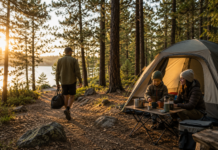
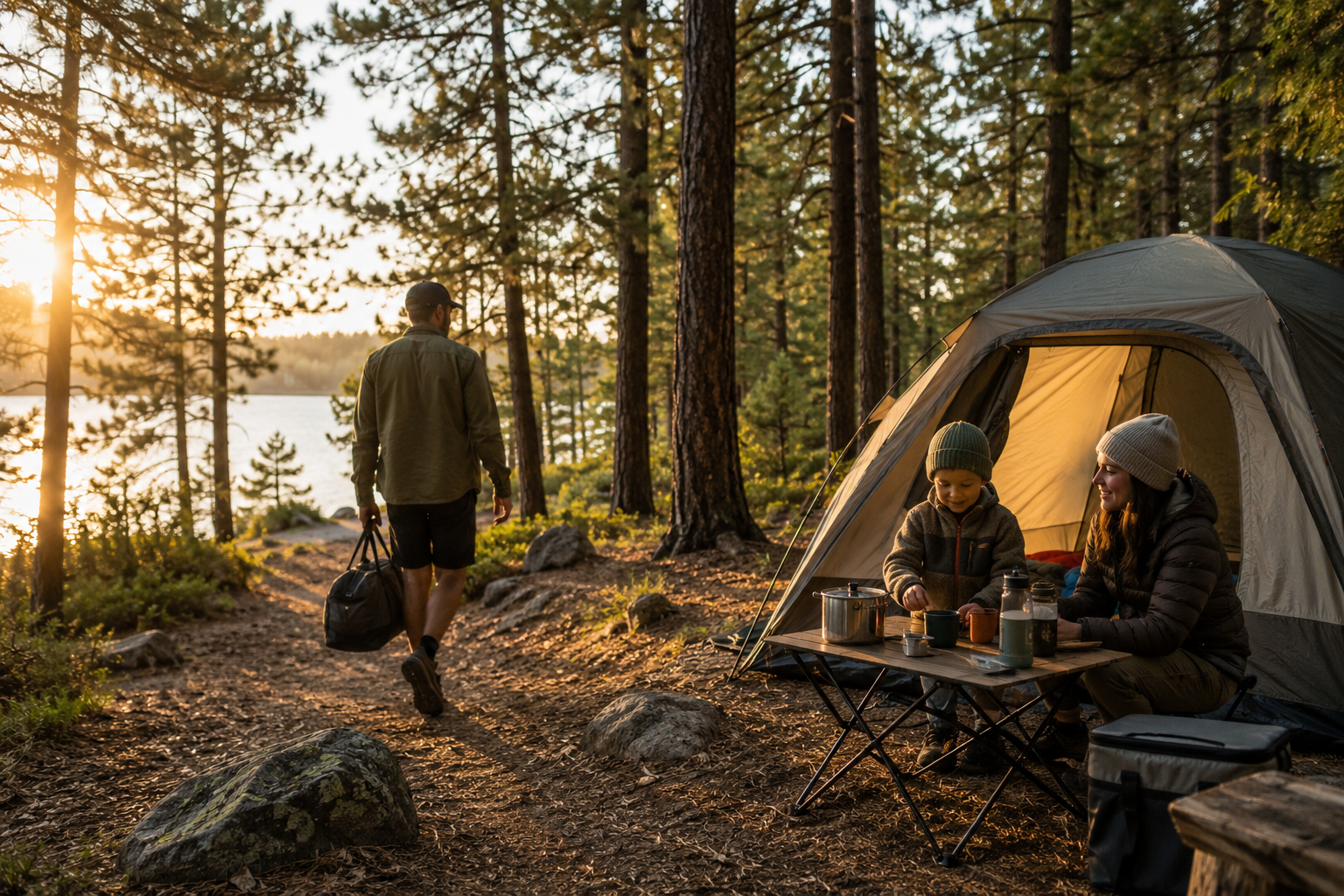
A typical day of camping is built around physical tasks that a typical day at home is not. Pitching and breaking down a tent, gathering and stacking firewood, hauling water or gear from a vehicle to a site, cooking over a camp stove or fire, and walking to a bathhouse, trailhead, or lake all add up to a day with far more incidental movement than most routines at home or in an office. According to the U.S. Centers for Disease Control and Prevention, adults need at least 150 minutes of moderate-intensity activity a week, such as brisk walking, plus two days of muscle-strengthening activity, and the agency is explicit that any amount of physical activity carries some health benefit even below that threshold. Camp chores clear that bar without anyone treating them as exercise.
Harvard Health Publishing’s widely referenced calorie chart gives a useful sense of scale. Cross-country hiking burns roughly 170 to 252 calories per 30 minutes depending on body weight, and carrying and stacking wood, a near-identical motion to what happens at almost every campsite, burns roughly 142 to 210 calories in the same window. Walking at a brisk 3.5 to 4 miles per hour, the pace most people naturally settle into on a trail or a walk to the camp store, burns 107 to 189 calories per 30 minutes. None of that requires scheduling a workout; it is simply what a camping day looks like.
Trail walking adds something a treadmill or sidewalk cannot: constantly changing footing. Every step on packed dirt, roots, rock, or sand asks the ankles, knees, and hips to make small adjustments that flat, predictable ground does not require. Trainers and physical therapists commonly point to this as a reason trail walking feels more demanding than the distance alone would suggest, since stabilizer muscles around the ankle and hip stay engaged throughout the walk instead of coasting on a flat surface. The National Park Service also notes that hiking carries health benefits tied specifically to being outdoors in nature, alongside the physical activity itself, and that introducing children to hiking helps build a lasting connection to the outdoors that can support activity habits well beyond a single trip.
Put together, a typical camping day already includes: fifteen to forty-five minutes of hiking or walking, ten to twenty minutes of physical setup or breakdown labor, repeated short walks around the site and to shared facilities, and often some water-based activity like swimming, paddling, or wading. Recognizing this is often more useful than any workout plan, because it reframes the week from “how do I fit exercise into camping” to “how do I not undercut the activity camping is already giving me.”
Camp Day Movement, By The Numbers
A Simple Equipment-Free Routine For A Campsite
On days with less walking built in, such as a rest day or a rainy morning under the rainfly, a short bodyweight circuit fills the gap without needing any gear. The routine below uses a picnic table, a log, or flat open ground and takes ten to fifteen minutes. It is meant to be a supplement to the activity camping already provides, not a replacement for it, so it stays short and low-pressure by design.
This whole sequence takes roughly ten to fifteen minutes including brief rests between sets, fits the CDC’s guidance to include muscle-strengthening work at least twice a week, and needs nothing beyond what is already at most developed campsites. Doing it three or four mornings across a week-long trip, on top of the walking and camp labor already happening, comfortably covers both the aerobic and strength components of general activity guidelines.
Balancing Rest And Recovery With Staying Active
A holiday week is not supposed to feel like a training camp, and treating it that way tends to backfire. The point of a trip is at least partly to step back from routine and let the body and mind recover, and stacking a rigid workout schedule on top of hiking, setup labor, and irregular sleep can leave people more depleted than refreshed. The goal is not to maximize activity during a camping trip; it is to avoid the two extremes of over-scheduling structured exercise and going fully sedentary because “it’s vacation.”
A useful way to think about it is that camping itself already supplies the aerobic and low-intensity movement most guidelines call for, so the equipment-free routine above is optional rather than mandatory, best used on a rest day, a rainy morning, or simply when someone wants the structure. On the days built around a long hike, a paddle, or a lot of setup and breakdown work, skipping the extra circuit entirely and prioritizing sleep, hydration, and food is the better call. Recovery is not the opposite of staying active; it is part of what makes the activity sustainable across the whole trip and easier to pick back up once everyone is home.
A No-Equipment Campsite Workout At A Glance
Copy-Ready Checklist: Staying Active Without Over-Scheduling It
- Let camp setup and breakdown count as real activity instead of adding a workout on top of them.
- Plan one to two trail walks or hikes over the trip and treat them as the week’s main aerobic activity.
- Keep the equipment-free circuit to rest days or slow mornings only, not every day.
- Involve the whole group in physical chores, gathering wood, hauling water, so movement is shared rather than solo.
- Carry enough water and drink regularly during any hiking or labor-heavy stretch, especially in heat.
- Check trail conditions, weather, and terrain difficulty before setting an activity plan for the day.
- Prioritize sleep and food over squeezing in extra exercise; recovery keeps the rest of the trip sustainable.
- Skip the structured routine entirely on any day that already included a long hike or heavy labor.
- Plan one easy, low-key day back home before resuming a full workout schedule.
A Worked Example: The Fernandez Family’s Week At The Lake
The Fernandez family, two adults and two kids ages nine and twelve, spends a week at a lakeside campground each summer. In past years they packed resistance bands and a jump rope, planned a workout for every morning, and ended up abandoning the plan by day three because it competed with breakfast, fishing, and getting the kids out the door. This year they tried a different approach. Arrival day was setup only: pitching two tents, arranging the site, and a short walk to register at the camp office, no added exercise. Two mornings were built around an actual hike, one a two-mile loop to a viewpoint and one a shorter trail along the lake, both of which left everyone tired in a good way by early afternoon.
On the two mornings without a hike planned, the parents did the equipment-free circuit at the picnic table while the kids did their own version, turning step-ups on a fallen log and standing marches into a game rather than a workout. One afternoon brought rain, so the family stretched and did a short plank-and-march sequence just inside the vestibule of the tent rather than skipping activity altogether. On breakdown day, loading the car and folding tents was treated as the day’s movement, with no extra routine attempted. By the end of the week, the family had hit roughly four hours of combined hiking and walking, done the short circuit three times, and never once felt like the trip revolved around exercise. That balance, activity built around what the trip already offered rather than forced into it, is what made the plan stick.
Common Mistakes To Avoid
What Behavior-Change Researchers Say
The most directly relevant research here comes from work on how habits form and how resilient they are to short interruptions. In the widely cited study led by Phillippa Lally and colleagues at University College London, participants built a new daily habit over an average of 66 days, though the range across individuals was wide. A key finding for anyone worried about a camping trip: missing a single opportunity to perform the behavior did not meaningfully damage the habit-forming process. What mattered more was consistency once the behavior resumed, not perfect, unbroken streaks. Applied to a week away from a normal routine, this suggests that an established activity habit is unlikely to be undone by a camping trip, provided the person picks it back up in a reasonably consistent way once home rather than treating the interruption as a reset.
This lines up with the broader idea in habit research that behavior is often triggered by stable environmental cues rather than conscious daily choice. Removing those cues, as travel does, does not erase the underlying habit; it just removes the automatic trigger for a while. The practical takeaway for a camping trip is to not judge the week by whether it matched a normal routine, and instead focus on re-establishing familiar cues, the same walk, the same time of day, promptly after returning home.
Safety And Scope Notes
This article is general educational information about staying active during a camping trip and is not medical advice. It does not account for individual injuries, chronic conditions, pregnancy, or other circumstances that change what activity is appropriate; anyone with a specific health concern should check with a qualified healthcare provider before changing their activity level, especially before an unfamiliar hike or strenuous outdoor labor. When active outdoors while camping, pay attention to terrain difficulty and footing, current and forecast weather, and hydration needs, all of which can change quickly in an outdoor setting in ways a home workout does not have to account for. Turn back or scale down plans if conditions, energy, or daylight do not support the original plan.
Key Takeaways
- Camp setup, breakdown, and daily chores already provide meaningful physical activity without any planning.
- Trail walking and hiking cover most or all of the CDC’s weekly moderate-activity guideline in just a day or two.
- A ten to fifteen minute equipment-free circuit on rest days covers the muscle-strengthening component many camping days miss.
- Habit research suggests a week of disrupted routine rarely undoes an established activity habit if it is picked back up consistently at home.
- The goal is balance: avoid both over-scheduling structured workouts and going fully sedentary for the whole trip.
Frequently Asked Questions
Do I need to bring workout equipment on a camping trip to stay active?
No. Hiking, camp setup and breakdown, and short bodyweight moves using a picnic table, log, or open ground cover both the aerobic and strength sides of general activity guidelines without any packed gear.
Will a week of camping undo my regular workout routine?
Research on habit formation, including the widely cited Lally et al. study from University College London, suggests a single missed stretch does not meaningfully damage an established habit. What matters more is returning to a reasonably consistent routine once the trip ends.
How much walking does a typical camping day actually involve?
It varies a lot by campsite and plans, but between trips to shared facilities, setting up camp, and any trail time, many camping days easily include well over the CDC’s recommended amount of brisk walking, even without a dedicated hike.
Should I plan a structured workout every day of the trip?
No. Daily structured workouts on top of hiking and camp labor often lead to burnout or abandonment by the second or third day. Save the equipment-free circuit for rest days or slow mornings and let hiking and chores cover the rest.
What should I watch for when hiking or being active at a campsite?
Uneven terrain, changing weather, and hydration needs all deserve more attention outdoors than during an indoor workout. Check trail conditions and forecasts before heading out, and carry and drink water on a regular schedule rather than waiting until you feel thirsty.
How do I keep kids active on a camping trip without making it feel forced?
Turn chores and circuit moves into shared tasks or games, such as racing to stack firewood or turning step-ups into a log-hopping game, and let trail time double as exploration rather than framing it as exercise.
Is it okay to take full rest days with no added exercise while camping?
Yes. Rest and recovery are part of what makes a holiday useful, and a day built around lower activity, especially after a long hike or heavy labor, supports the rest of the trip rather than undermining it.
What is the easiest way to get back into my normal routine after the trip?
Rebuild the familiar cues as soon as possible: the same walk, gym time, or workout slot that triggered the habit before the trip. Habit research suggests the cue matters more for restarting the behavior than trying to make up for missed days.
References
- Centers for Disease Control and Prevention. “Physical Activity Guidelines for Adults.” cdc.gov/physical-activity-basics/guidelines
- Centers for Disease Control and Prevention. “Benefits of Physical Activity.” cdc.gov/physical-activity-basics/benefits
- Centers for Disease Control and Prevention. “Adding Physical Activity as an Adult.” cdc.gov/physical-activity-basics/adding-adults
- Harvard Health Publishing. “Calories Burned in 30 Minutes for People of Three Different Weights.” Updated March 2021. health.harvard.edu
- University College London. “How Long Does It Take To Form A Habit?” Summary of Lally, P. et al., research on habit formation. ucl.ac.uk/news
- National Park Service. “Trails.” nps.gov/subjects/trails