


























By Charlotte Evans
You land, your legs feel like they belong to someone else, your body thinks it is a different time of day than the clock on the wall says, and tomorrow you are doing it all again. Back-to-back travel days, two or three flights strung together with short layovers, a red-eye followed by a morning connection, a work trip that hands you a new city every 48 hours, put a specific kind of strain on the body that a single vacation flight does not. The sitting compounds. The circadian confusion stacks. The sleep debt does not get a chance to clear before the next wheels-up.
This guide is built for people who train, lift, run, or simply want to move well and feel normal again after stringing together multiple travel days in a row. It walks through what is actually happening inside your body during a travel stretch, a step-by-step recovery process you can start before you even leave home, a minimal-equipment movement routine you can do in an airport corner or a hotel room, and a realistic plan for easing back into your regular training schedule once you are home.
What Back-to-Back Travel Days Actually Do to Your Body
Three separate stressors pile up during a multi-leg trip, and they do not resolve on the same timeline. Understanding each one separately makes the recovery plan below make a lot more sense.
Your internal clock falls out of sync
Jet lag is what happens when your circadian rhythm, the roughly 24-hour internal clock that governs sleep, hunger, alertness, and hormone release, stays set to your departure time zone while the sun, meals, and meetings around you are already running on local time. According to the Sleep Foundation, this misalignment typically shows up after crossing three or more time zones and can last anywhere from a few days to a few weeks before your body fully catches up. A commonly used estimate is roughly one day of adjustment for every time zone crossed, though that is a rough average rather than a fixed rule, and direction of travel changes the math considerably.
Research modeling from the University of Maryland, described by sleep researchers, found that a 9-hour eastward shift actually requires more recovery time than a 12-hour shift in either direction, making it the single most taxing pattern for the body’s clock to handle. The Sleep Foundation also reports that roughly 75 percent of travelers find eastbound jet lag worse, compared with 25 percent who struggle more heading west. The likely reason is biological: the human circadian cycle naturally runs slightly longer than 24 hours, so it is easier for your body to stretch a day out (as westward travel requires) than to compress one (as eastward travel demands).
Cabin air pulls moisture out of you faster than you think
Aircraft cabins are dry. A 2020 review published in the journal Nutrients notes that cabin relative humidity typically sits between 10 and 20 percent, far below the comfort range most bodies are used to. The same review cites data showing that resting water loss through breathing and skin can climb from about 160 mL per hour to 360 mL per hour as humidity drops from 60 percent down to 12 percent, meaning a long flight can pull noticeably more fluid out of you than an equivalent stretch on the ground. In simulated long-haul flight conditions, researchers measured plasma volume decreases of 6 to 9 percent over 10 hours, and the same paper notes that explosive movements such as jump performance dropped 7 to 10 percent immediately after arrival. That is a meaningful, measurable dip in physical readiness, not just a subjective feeling of sluggishness.
“A long flight can leave you several percentage points down on plasma volume and explosive power before you have even left the airport, and that deficit does not fix itself with one bottle of water at baggage claim.”
Sitting for hours does more than make you stiff
The Centers for Disease Control and Prevention (CDC) notes that more than 300 million people take long-distance flights, generally defined as over four hours, every year, and that the longer a person stays immobile during travel, the greater their risk of developing a blood clot. This applies to plane, car, bus, and train travel alike. The CDC’s specific recommendation is to get up and move around every one to two hours, and when you cannot walk, to actively exercise your calf muscles in your seat, for example by pulling each knee toward your chest and holding it for about 15 seconds, repeated up to 10 times.
The Jet-Lag Adjustment Timeline: Light Exposure by Direction
Light is the strongest signal your body uses to reset its internal clock, and the timing of that light exposure matters more than the amount. Sleep researchers Roach and Sargent, writing in Frontiers in Physiology, describe the mechanism around a reference point called the circadian body temperature minimum (CBTmin), the daily low point in your core temperature that usually falls during the final stretch of your normal sleep period, not long before your typical wake-up time. Light exposure in the hours before that low point pushes your clock later (helpful for westward travel). Light exposure in the hours after that low point pushes your clock earlier (helpful for eastward travel). Seeking bright light at the wrong time can actually work against you and slow adaptation down.
Jet-Lag Light Exposure Timeline
Based on circadian phase-shifting principles described by Roach and Sargent (2019, Frontiers in Physiology).
Traveling East (clock needs to move earlier)
- Seek bright light soon after your normal wake time and through the morning at your destination.
- Avoid bright light in the evening for the first several nights; sunglasses outdoors after dark-adapted hours can help.
- This is the direction sleep researchers flag as hardest on the body, since it asks your rhythm to compress rather than stretch.
Traveling West (clock needs to move later)
- Seek bright light in the afternoon and evening at your destination.
- Limit very early-morning light exposure for the first few days so your clock does not get pulled back the wrong way.
- This direction generally lines up better with your body’s natural tendency to run slightly long, so it is usually the gentler adjustment.
Rough adaptation windows by shift size (Roach & Sargent, 2019):
| Time zone shift | Approximate days for partial adaptation |
|---|---|
| 3 hours | 1 to 2 days |
| 6 hours | 2 to 3 days |
| 9 hours | 3 to 5 days |
| 12 hours | 6 to 7 days |
Full adaptation, where every part of your rhythm has caught up, typically takes a few days longer than the partial-adaptation window shown above.
If you use melatonin to support the shift, timing again matters more than dose size. The Frontiers review notes that a 3.0 mg dose produced more reliable phase shifts than a 0.5 mg dose in the studies examined, with the largest effect on advancing your clock (useful for eastward travel) occurring when melatonin is taken roughly 11.5 hours before your target bedtime, and the largest effect on delaying your clock (useful for westward travel) occurring about 4 hours after your normal wake time. Talk with a healthcare provider before starting melatonin, especially if you are combining back-to-back travel with training that requires sharp reaction time.
Step-by-Step: Recovering From Back-to-Back Travel Days
Step 1: Set your hydration baseline before you ever board
Do not wait until you feel thirsty in the air; by the time cabin dryness registers as thirst, you are already behind. Drink water steadily in the hours before your first flight, and skip or limit alcohol and heavy caffeine the night before a multi-leg trip since both increase fluid loss on top of what the cabin air is already pulling from you. A simple, practical target used by many travel-health resources is roughly 200 to 250 mL of water for every hour you are airborne, adjusted up if you are sweating from a rushed connection or down slightly if you are also drinking electrolyte fluids.
Step 2: Move on a fixed schedule during every flight and layover
Set a recurring reminder, or simply commit to standing up every time a full hour passes. Following the CDC’s guidance, walk the aisle when the seatbelt sign is off, and when you cannot get up, run through calf pumps, ankle circles, and the seated knee-to-chest hold described earlier. On multi-leg days, use layovers as a gift rather than dead time: a 20-minute layover is enough for a brisk walk to the next gate; a 90-minute layover is enough for the full movement routine in the box below.
Step 3: Anchor your light exposure the moment you land
Use the timeline box above to figure out whether you need morning or evening light at your destination, then act on it immediately rather than waiting until you feel adjusted enough to bother. If you are traveling east, get outside in the morning even if you are tired; if you are traveling west, save your outdoor time for the afternoon and evening. Sunglasses become a tool here, not just an accessory, since blocking light at the wrong time is as useful as seeking it at the right time.
Step 4: Protect one full sleep window before your next travel leg
Sleep researchers describe a well-documented “first-night effect,” where people sleep worse in an unfamiliar environment during the first night, likely tied to part of the brain staying semi-alert in a new setting. On a back-to-back trip you often do not get a second night in the same bed to make up for it, which is exactly why the following habits matter more than they would on a single relaxed vacation: keep the room cool and dark, bring a physical sleep aid such as an eye mask or earplugs since hotel rooms vary wildly in light and noise control, and avoid heavy meals or a lot of alcohol close to bedtime. The Sleep Foundation notes that alcohol’s effects are worsened at altitude and after long travel days, making it a poor sleep aid even though it can feel like one in the moment.
It also helps to remember that circadian disruption and simple schedule disruption are not identical problems. The Sleep Foundation points out that going to bed three hours later than your normal time causes sleep problems similar in scale to crossing three time zones, even with no flight involved at all. On a trip with early meetings, late dinners, and shifting bedtimes, you can be fighting two separate battles: the clock change itself, and the fact that your schedule keeps moving regardless of time zone.
Step 5: Run a minimal-equipment movement routine on travel days themselves
You do not need a gym to keep your body from seizing up between flights. The routine below takes about 12 to 15 minutes, needs no equipment, and works in a hotel room, an airport corner, or a quiet gate area.
Travel-Day Movement Routine (No Equipment)
- Ankle pumps and calf raises, seated or standing, 20 to 30 reps, to keep lower-leg circulation moving.
- Seated or standing spinal twist, 30 seconds each direction, to release the lower back from prolonged sitting.
- Standing march in place for 2 minutes, lifting the knees higher than a normal walk, during any wait longer than 10 minutes.
- Shoulder rolls and neck side-stretch, 30 seconds per side, to counter hunching over a phone or laptop.
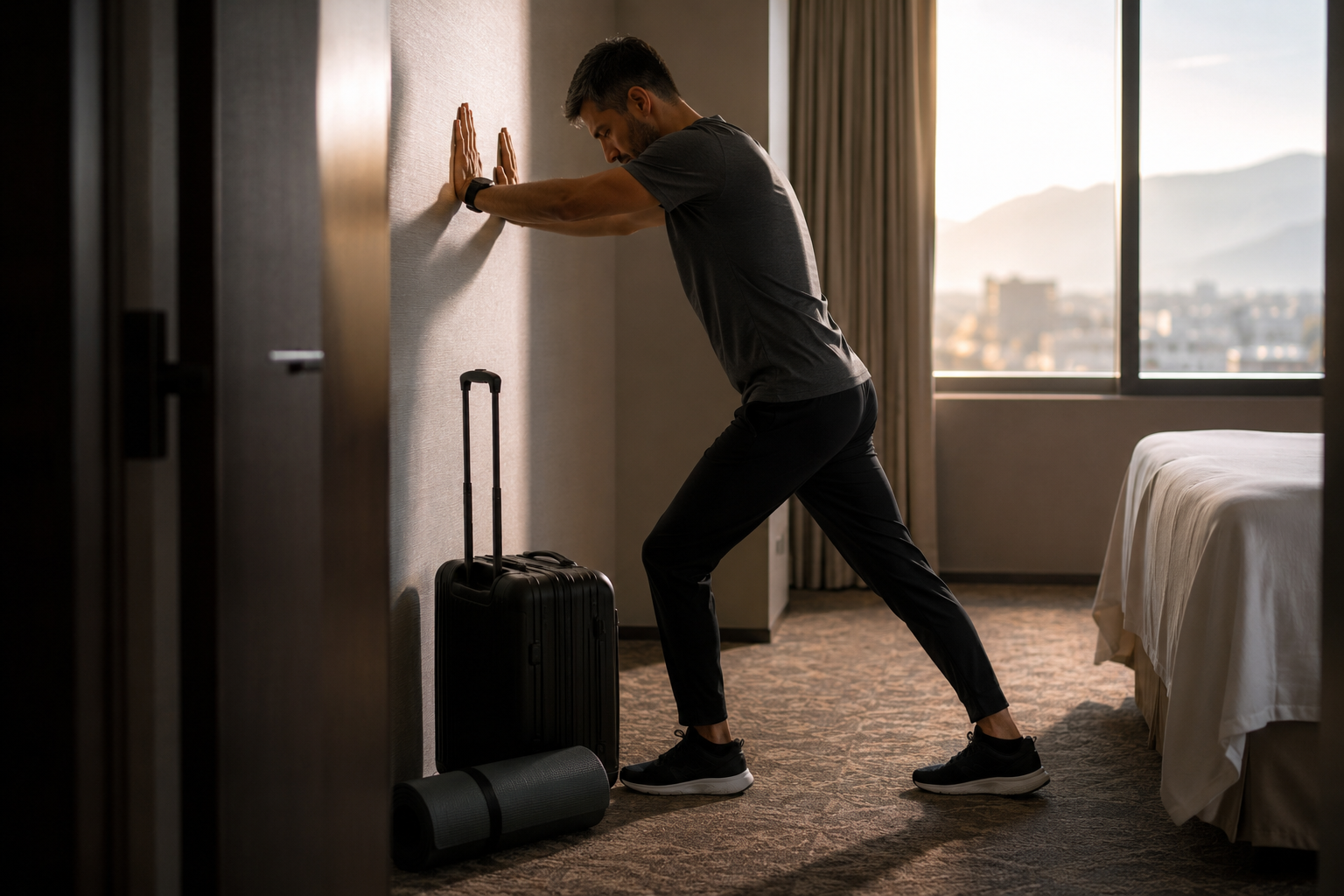
- Standing hamstring and calf stretch against a wall or gate-area railing, 1 minute per leg.
- Bodyweight squats, 12 to 15 reps, done during a longer layover to reintroduce a real strength stimulus without any equipment.
Do the full sequence once every one to two hours of travel, matching the CDC’s movement-frequency guidance for reducing blood clot risk on long trips.
Step 6: Rebuild your normal training schedule gradually, not all at once
The instinct after a rough travel stretch is to either skip training entirely for a week or to jump straight back into your heaviest session to “prove” you are fine. Both tend to backfire. A more reliable approach: on your first day back, do a light session focused on movement quality and blood flow rather than a personal record attempt, since the dehydration and power deficits described earlier in this guide can take a day or two to fully resolve even after you feel mentally normal again. By day two or three, reintroduce your normal training intensity, and use your sleep quality as the signal for full readiness rather than the calendar alone; if you are still waking up in the middle of the night at the wrong hour, your circadian system has not finished catching up yet, and pushing your hardest session on top of that is when injuries and burnout tend to show up.
When Every Leg Is a Different Time Zone
Multi-city work trips and connecting itineraries create a harder version of this problem: you might cross three time zones on Monday, two more on Wednesday, and fly home crossing all five in reverse by Friday. In that situation, chasing a full adaptation to every stop is usually not realistic, and trying to do so can leave you more exhausted than if you had picked a simpler strategy from the start.
A few adjustments help when the itinerary itself will not sit still. First, decide in advance whether each stop is long enough to be worth adapting to; as a rough guide, stays under roughly two days rarely justify a full shift, since your body will barely finish adjusting before it is time to move again. For those short stops, keep your sleep and meal timing as close to your home schedule as the itinerary allows, and treat the trip more like an extended single travel day than a series of separate destinations. Second, for any stop long enough to matter, three days or more, apply the light-exposure timeline from earlier based on that specific leg’s direction, not the trip’s overall direction, since a west-then-east multi-city loop asks two very different things of your circadian system in the same week. Third, protect your hydration and movement habits identically on every leg regardless of how “short” a flight feels; a one-hour hop after two long-haul legs still adds to the same fatigue total, and the CDC’s movement guidance does not have an exception for short connecting flights.
Finally, build in at least one lower-intensity day somewhere in a demanding multi-city stretch, even if it means shifting a workout rather than skipping the trip. Athletes and frequent business travelers who treat every single day of a back-to-back itinerary as a normal training or work day tend to accumulate the sleep and hydration deficits described earlier in this guide until a minor illness or a noticeably weak workout forces the rest anyway. One deliberately lighter day, chosen in advance, is a smaller cost than an unplanned one forced by an immune system or a nervous system that has quietly run out of reserve.
Packing and Hydration Checklist
Before You Fly
- ☐ Empty reusable water bottle (fill after security)
- ☐ Electrolyte packets or tablets, especially for flights over 4 hours
- ☐ Eye mask and earplugs or noise-canceling headphones
- ☐ Compression socks if you are prone to leg swelling or have any clotting risk factors
- ☐ Comfortable shoes that make it easy to walk the aisle or terminal
- ☐ A resistance band or set of light bodyweight moves you already know by heart
- ☐ A note on your phone with your destination’s expected wake and sleep times
During Travel
- ☐ Water target of roughly 200 to 250 mL per hour in the air
- ☐ Stand and move every 1 to 2 hours, even on short hops
- ☐ Limit alcohol and heavy caffeine, particularly on overnight legs
- ☐ Use sunglasses strategically based on your light-exposure direction
On Arrival
- ☐ Get outside for light exposure at the correct time of day for your travel direction
- ☐ Eat a normal-sized meal aligned with local mealtimes, not departure-city mealtimes
- ☐ Protect at least one full sleep window before the next travel leg if possible
- ☐ Keep training light and technical for the first session back
Common Mistakes That Slow Recovery Down
A few patterns show up again and again on multi-leg trips. The first is treating water and sleep as things you will catch up on “later,” which rarely happens when the next flight is already on the calendar. The second is chasing bright light indiscriminately, stepping outside whenever the sun is out without checking whether that timing actually helps your specific direction of travel; as the light-exposure timeline above shows, light at the wrong hour can slow your adjustment rather than speed it up. The third is skipping movement on short flights because “it’s only two hours,” even though the CDC’s one-to-two-hour movement window applies regardless of total trip length once several short legs are stacked together. The fourth is going all-in on the first training session home, which tends to produce a worse workout and more soreness than a deliberately lighter first day would.
“Recovery from back-to-back travel is rarely one big fix. It is a handful of small, correctly timed decisions repeated across every leg of the trip.”
Frequently Asked Questions
How long does jet lag actually last?
It varies with the number of time zones crossed and the direction of travel. The Sleep Foundation describes jet lag as lasting from a few days up to a few weeks, with a commonly cited rough guide of about one day of adjustment per time zone crossed. Research on light-based interventions suggests partial adaptation to a 6-hour shift takes roughly 2 to 3 days, while a 9-hour shift takes closer to 3 to 5 days.
Is it better to shift to the new time zone immediately or stay on home time for a short trip?
For very short trips, some travelers deliberately stay on their home schedule rather than chasing a full adjustment that will just have to reverse in a day or two. For longer stays or trips involving training and competition, actively shifting using the light-exposure timing described above tends to produce better results, since a body stuck between two time zones performs worse in both.
Can I prevent flight dehydration just by drinking more water?
Water helps, but timing and electrolytes matter too. Research reviewed in Nutrients found that low cabin humidity (typically 10 to 20 percent) increases water loss substantially, and that many travelers drink far less than they think during a flight, with one cited study finding roughly half of travelers consumed less than half a liter of water on long-haul flights. Starting the flight already well hydrated, drinking steadily rather than in one large dose, and including electrolytes on longer flights all help more than water alone taken at the end.
What is the single most effective habit for reducing jet lag?
Correctly timed light exposure is consistently identified in circadian research as the strongest lever, more influential than melatonin, caffeine timing, or diet changes alone. Getting the direction and timing wrong, however, can work against you, which is why matching your light exposure to whether you traveled east or west matters as much as simply “getting outside.”
How soon after landing should I resume my normal training schedule?
A light, technique-focused session on day one is usually reasonable, with a return to full intensity by day two or three once sleep has stabilized somewhat. Because measurable drops in explosive power and hydration status have been recorded immediately after long flights, treating the first session back as a recovery session rather than a test of fitness tends to produce better long-term results.
Does napping on arrival day help or hurt jet lag recovery?
A short nap, generally kept under 30 minutes and taken earlier in the day rather than close to your new local bedtime, can help with acute sleepiness without significantly delaying adjustment to the new schedule. A long, late nap tends to work against adjustment by reducing the sleep pressure your body needs to fall asleep at the correct local time that night.
References
- Centers for Disease Control and Prevention. “Understanding Your Risk for Blood Clots with Travel.” https://www.cdc.gov/blood-clots/risk-factors/travel.html
- Roach, G. D., & Sargent, C. (2019). Interventions to Minimize Jet Lag After Westward and Eastward Flight. Frontiers in Physiology, 10:927. https://doi.org/10.3389/fphys.2019.00927
- Zubac, D., Buoite Stella, A., & Morrison, S. A. (2020). Up in the Air: Evidence of Dehydration Risk and Long-Haul Flight on Athletic Performance. Nutrients, 12(9), 2574. https://doi.org/10.3390/nu12092574
- Sleep Foundation. “Travel and Sleep.” https://www.sleepfoundation.org/travel-and-sleep
- Sleep Doctor. “Is Jet Lag Worse Going East or West?” https://sleepdoctor.com/pages/health/is-jet-lag-worse-traveling-east-to-west