


























By Mateo Rivera
If you live above someone else, or someone lives above you, “cardio” comes with an asterisk. Burpees, jump squats, and high-knee drills that feel great in a gym turn into a diplomatic incident in a second-floor walk-up. The good news is that raising your heart rate and jumping are not the same thing. You can build a genuinely demanding cardio session without your downstairs neighbor ever knowing you worked out.
This guide walks through what actually counts as effective cardio, how to gauge intensity without any impact at all, which specific exercises and tools work best in a shared building, and how to put them together into routines you can repeat. It also covers the gear worth owning, the mistakes that quietly stall progress, and when it makes sense to check in with a doctor before starting.
What “No Jumping” Actually Rules Out (and What It Doesn’t)
Impact and intensity are two different variables, and mixing them up is the root of most “low-impact cardio doesn’t work” complaints. Impact refers to the force your body absorbs when a foot strikes the ground, usually after leaving it. Intensity refers to how hard your cardiovascular system is working, measured by heart rate, breathing rate, or perceived effort. You can have high intensity with low impact, and plenty of people do it every day on a stationary bike or in a pool.
Katie Lawton, an exercise physiologist at Cleveland Clinic, put it plainly: low-impact training “is not about effort. You’re still going to be able to push your body.” The distinguishing factor is that low-impact activities don’t put as much stress on the joints, not that they’re automatically easier.
What jumping-based cardio contributes is a category of movement, plyometrics, that trains explosive power and requires both feet to leave the ground. Losing plyometrics from your routine means losing a specific power-training stimulus. It does not mean losing the ability to raise your heart rate into the same zones a jump-rope session would reach. Marching drills, resistance-band intervals, stair climbing at a controlled pace, and shadowboxing can all push you into a vigorous heart-rate zone without a single landing.
How Hard Should You Actually Be Working?
Since you’re trading away the jump rope’s built-in intensity cue (you either keep skipping or you trip), you need another way to know you’re training hard enough. Three simple methods, all endorsed by major health bodies, work well at home with no equipment.
The Talk Test
The CDC frames intensity in plain conversational terms: during moderate-intensity activity, you can talk but not sing. During vigorous activity, you can only get a few words out before needing to catch your breath. If you can comfortably chat through an entire set, you’re likely in a light or moderate zone and have room to push harder.
Perceived Exertion (0–10 Scale)
The CDC also describes a simple 0-to-10 self-rating scale, where 0 is sitting still and 10 is maximal effort. Moderate-intensity activity sits around 5 to 6 on that scale, and vigorous activity starts around 7 to 8. This is useful precisely because it requires no device, just an honest read on how hard the current interval feels.
Heart Rate Zones
If you want a number, the American Heart Association’s standard formula estimates maximum heart rate as roughly 220 minus your age. Moderate-intensity effort generally falls between 50 and 70 percent of that maximum, and vigorous effort falls between 70 and 85 percent. For a 40-year-old, that means a maximum heart rate near 180 beats per minute, with a moderate zone around 90 to 126 bpm and a vigorous zone around 126 to 153 bpm. A basic wrist monitor or chest strap makes tracking this effortless, though it isn’t required to train effectively.
Quick Reference: Reading Your Own Intensity
| Zone | Talk Test | RPE (0–10) | % of Max Heart Rate |
|---|---|---|---|
| Light | Can sing | 2–4 | Under 50% |
| Moderate | Can talk, not sing | 5–6 | 50–70% |
| Vigorous | A few words at a time | 7–8 | 70–85% |
Based on CDC intensity guidance and American Heart Association target heart rate ranges.
The Best Low-Impact Cardio Options for a Shared Building
Cleveland Clinic lists swimming, cycling, rowing, elliptical training, vertical climbers, walking, and hiking among the standard low-impact cardio exercises, noting that swimming is close to zero-impact and that walking places far less stress on joints than running. Not all of those translate directly to a small apartment, so here’s how they and their at-home equivalents stack up for noise, space, and equipment needs.
Low-Impact Cardio Options Compared
| Option | Noise Level | Space Needed | Equipment |
|---|---|---|---|
| Marching / step-touch intervals | Very low | 6×6 ft | None |
| Shadowboxing | Very low | 6×6 ft | None (optional light gloves) |
| Resistance band cardio circuits | Very low | 6×6 ft | Long resistance band, door anchor |
| Sliders (mountain climbers, lunges) | Low | 4×6 ft | Fabric or paper-plate sliders |
| Controlled step-ups | Low–moderate | 4×4 ft | Sturdy low step or platform |
| Mini stepper machine | Low | 2×2 ft | Mini stepper |
| Stationary bike | Low | 3×5 ft | Bike (upright or recumbent) |
| Compact rowing machine | Low–moderate | 3×7 ft | Rower |
Marching and Step-Touch Intervals
High-knee marches, step-touches, and side-to-side shuffles can be pushed into a genuinely vigorous zone just by increasing arm drive and cadence. Add a torso twist or a low front kick and you’ve built a full circuit that never requires a foot to leave the floor by more than an inch or two. This is the closest low-impact substitute for jump-rope cardio, and it needs zero equipment or space beyond what it takes to stand and swing your arms.
Shadowboxing
Three-minute rounds of shadowboxing (jabs, crosses, hooks, slips, and footwork shuffles) are a staple of boxing conditioning precisely because they’re demanding without a single jump. Keep your feet low and quick rather than bouncing on your toes, and the noise stays minimal while the heart-rate response climbs quickly.
Resistance Band Cardio Circuits
A long loop or handle-style resistance band turns squats, rows, presses, and lateral walks into a circuit that combines strength and cardio demand. Moving through 30 to 45 seconds of continuous band work per exercise, with minimal rest between movements, keeps your heart rate elevated the way a bodyweight jump circuit would, without any landing force.
Sliders
Fabric sliders (or paper plates on carpet, folded towels on hardwood) let you perform mountain climbers, reverse lunges, and lateral slides with a smooth gliding motion instead of an impact. The constant tension and balance demand raises heart rate similarly to plyometric versions of the same moves, and the motion is close to silent.
Controlled Step-Ups
A sturdy low step, a stair, or a stable platform lets you build a step-up and step-down circuit that mimics the leg-drive demand of jump squats. The key is control: step up and down deliberately rather than bounding, which keeps this in low-impact territory while still challenging your legs and lungs.
Compact Machines: Mini Steppers, Stationary Bikes, and Rowers
If you have the floor space and budget, a piece of low-impact cardio equipment removes the guesswork entirely. Cleveland Clinic includes cycling, rowing, and elliptical-style movement among its standard low-impact recommendations, noting that these keep weight off the feet and reduce stress on the lower joints. A compact under-desk stepper, a foldable stationary bike, or a magnetic rowing machine can deliver a full cardio session in a footprint smaller than a yoga mat, and modern versions are designed to run quietly on hard floors.
Turning Favorite Jump-Based Moves Into No-Jump Versions
If you already have a routine built around jump squats, burpees, high knees, and jumping jacks, you don’t have to throw it out. Most jump-based exercises have a close low-impact cousin that trains the same muscles through the same range of motion, minus the landing.
Swap Chart: Jump Move to No-Jump Equivalent
| Jump-Based Move | No-Jump Substitute |
|---|---|
| Jump squats | Squat pulses, or slow squat with a controlled calf raise at the top |
| Burpees | Step-back burpees: step (don’t jump) the feet back to plank and step them back in |
| Jumping jacks | Step jacks: step one foot out at a time while raising the arms overhead |
| High knees | Marching high knees at a fast, driving cadence |
| Jump lunges | Alternating reverse lunges, controlled tempo |
| Skater jumps | Lateral step-and-reach, sliding or stepping side to side |
The pattern across every swap is the same: keep the range of motion and the tempo, remove the airborne phase. A step-back burpee performed briskly, for instance, still hits the shoulders, core, and legs in sequence and still spikes the heart rate. It just never asks the floor below you to absorb a landing.
Building a Low-Impact Cardio Routine That Still Challenges You
The CDC and NHS both recommend at least 150 minutes of moderate-intensity aerobic activity a week, or 75 minutes of vigorous-intensity activity, plus muscle-strengthening work on at least two days. You don’t need jumping to hit either target. What matters more is structure: alternating harder and easier intervals, keeping rest periods short, and progressing gradually.
A simple interval framework that works well with any of the exercises above is 40 seconds of work followed by 20 seconds of rest, repeated for 20 to 30 minutes. Because there’s no landing force to manage, you can string these intervals together for longer stretches than a plyometric circuit would typically allow before fatigue and injury risk climb.
Sample 30-Minute No-Jump Cardio Circuit
- 0:00–5:00 — Warm-up: slow marching, arm circles, hip openers, gradually increasing pace
- 5:00–9:00 — Round 1: High-knee marches (40s work / 20s rest x 4)
- 9:00–13:00 — Round 2: Shadowboxing combinations (40s work / 20s rest x 4)
- 13:00–17:00 — Round 3: Resistance band squat-to-row (40s work / 20s rest x 4)
- 17:00–21:00 — Round 4: Controlled step-ups, alternating lead leg (40s work / 20s rest x 4)
- 21:00–25:00 — Round 5: Slider mountain climbers or reverse lunges (40s work / 20s rest x 4)
- 25:00–30:00 — Cool-down: slow walking in place, deep breathing, light stretching
Aim for a “few words at a time” talk-test intensity during work intervals, and full sentences during rest.
Two or three sessions like this a week, combined with everyday walking, comfortably covers the moderate-to-vigorous activity range that both the CDC and NHS describe, without a single jump.
Sample Weekly Layout
A full week doesn’t need to be complicated. A workable starting layout for someone new to structured cardio might look like three dedicated circuit sessions, two shorter walks, and a rest day, adjusted up or down based on how recovered you feel.
- Monday: 30-minute no-jump circuit (as outlined above)
- Tuesday: 20 to 30-minute brisk walk, indoors or out
- Wednesday: Rest, or light stretching and mobility work
- Thursday: 30-minute no-jump circuit, swapping in different exercises from the options list
- Friday: 20 to 30-minute brisk walk
- Saturday: 30-minute no-jump circuit or stationary bike session
- Sunday: Rest
That layout lands close to 150 minutes of moderate-to-vigorous activity across the week, which lines up with both the CDC and NHS recommendations, while leaving built-in recovery days. Swap circuit days for the compact-machine options (bike, rower, mini stepper) whenever you want variety or need a lower-noise alternative for early mornings and late evenings.
Gear That Helps (and Gear You Can Skip)
You don’t need much to make this work, but a few inexpensive items make a real difference in both effectiveness and neighbor relations.
Worth Owning
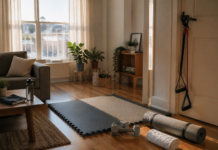
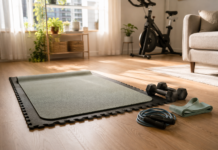
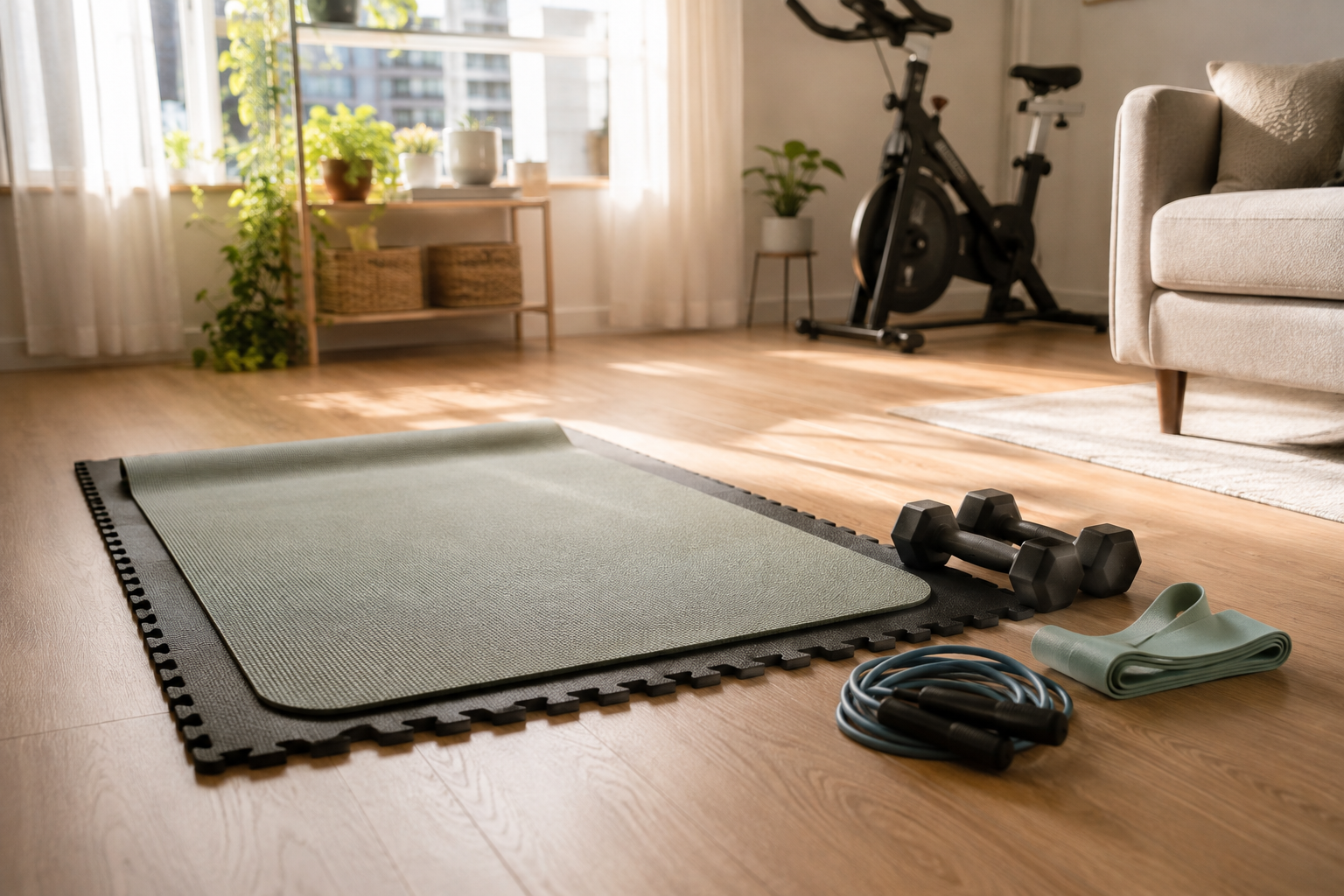
- A thick exercise mat or interlocking foam tiles to dampen vibration through the floor, especially over hardwood or laminate.
- A long resistance band with door anchor for squat-to-row and press-based circuits.
- Fabric or gliding disc sliders for low-noise lunges and mountain climbers.
- Supportive, cushioned indoor shoes rather than bare feet or socks, which absorb more shock through step-based movements.
Optional but Useful
- A compact stationary bike or mini stepper if floor space allows.
- A heart rate monitor or fitness watch to track zones without relying purely on perceived exertion.
- Light dumbbells (2 to 8 lbs) to add resistance to marching and step patterns.
Skip For Now
Jump ropes, plyo boxes, and weighted vests built for jump training aren’t useful here and, in a shared building, tend to create exactly the kind of noise this whole approach is designed to avoid. Save them for a gym or ground-floor space where impact isn’t a concern.
Protecting Neighbor Relations While You Train
Impact-based noise is really a mix of two things: the force of a landing and how directly that force transfers into the structure below. A thick mat over a rug, working in a corner near load-bearing walls rather than the center of a floor, and choosing softer-soled shoes over hard-bottomed sneakers all reduce transmitted vibration, even for the low-impact movements described here. Training earlier in the evening rather than late at night, and giving new neighbors a heads-up about your routine, tends to prevent most friction before it starts.
Placement matters more than people expect. Working out directly above a bedroom is a common source of complaints even at low intensities, simply because sound carries more easily into a quiet room used for sleeping. If your layout allows it, shift your mat toward a hallway, kitchen, or entryway footprint instead, where the room on the other side of the floor is less likely to be someone’s bedroom. Rolling out a second layer of padding, such as interlocking foam tiles under a standard yoga mat, adds another buffer without much cost.
Footwear is worth a second mention here because it’s the detail people skip most often. Bare feet and thin socks transmit more shock through the heel and ball of the foot than a cushioned training shoe does, even during movements that never leave the ground. A supportive pair of indoor-only training shoes, kept just for home workouts, is a small investment that pays off in both joint comfort and quieter footfalls.
Common Mistakes That Undercut Results
A few patterns show up often enough to call out directly. None of them are complicated to fix once you notice them, but they’re easy to slide into when there’s no jump rope or plyo box forcing a certain pace.
Treating “Low Impact” as “Low Effort”
The biggest mistake is slowing everything down until the workout stops raising your heart rate at all. Low-impact only removes the landing force, not the intensity. Use the talk test or RPE scale from earlier to check that you’re genuinely working, not just moving.
Skipping the Strength Component
Both the CDC and NHS guidelines pair aerobic minutes with muscle-strengthening work on at least two days a week. Resistance band circuits and step-ups double as both, but if your routine is purely cardio, add a couple of dedicated strength sessions too.
Ignoring Warm-Up and Cool-Down
Skipping the warm-up is a common shortcut when a session feels “easy” because there’s no jumping involved. Joints and connective tissue still need a gradual ramp-up, particularly around the knees and hips during step-based and lunge-based movements.
Not Progressing the Circuit
Without jump height or landing force as a natural progression marker, it’s easy to plateau. Progress instead by shortening rest periods, adding resistance (bands, light dumbbells), increasing range of motion in step-ups, or extending the total session length.
When to Check With a Doctor First
This guide describes general low-impact cardio approaches and isn’t a substitute for individualized medical advice. If you have a heart condition, joint problems, are pregnant, are recovering from an injury or surgery, take medication that affects heart rate, or haven’t exercised regularly in a while, talk with a doctor before starting a new routine. The American Heart Association specifically notes that some medications can lower your maximum heart rate and target zones, which changes how those numbers should be interpreted for your own training.
Frequently Asked Questions
Is low-impact cardio actually as effective as jumping-based cardio?
It can raise your heart rate into the same moderate or vigorous zones, using the talk test, perceived exertion, or heart-rate percentages as your guide. What you lose is the plyometric, explosive-power stimulus that jumping trains specifically. For general cardiovascular fitness and calorie expenditure, low-impact work at a matched intensity delivers comparable benefit.
How long before I see results from a no-jump routine?
This varies by individual and depends on consistency, starting fitness level, and diet, so it isn’t possible to give a universal timeline. Following the CDC and NHS target of 150 minutes of moderate (or 75 minutes of vigorous) activity weekly, done consistently over several weeks, is the benchmark both agencies associate with measurable health benefits.
Will my downstairs neighbor still hear anything?
Some structure-borne sound is unavoidable in any shared building, but marching, shadowboxing, resistance band work, and slider exercises produce far less impact noise than jumping-based moves. A thick mat, supportive shoes, and training away from late-night hours further reduce what travels through the floor.
Do I need any equipment to get started?
No. Marching intervals and shadowboxing require nothing but floor space. A resistance band and a set of sliders are inexpensive additions that expand your options considerably if you want more variety.
Can I combine low-impact cardio with strength training on the same day?
Yes, and the resistance band and step-up circuits described above already blend the two. Pairing cardio intervals with strength moves in the same session is an efficient way to meet both the aerobic and muscle-strengthening components of the CDC and NHS guidelines.
What if I have knee or joint pain?
Low-impact cardio is generally the recommended starting point for people managing joint pain, since it minimizes landing force. That said, persistent or worsening joint pain during exercise is a reason to stop and consult a doctor or physical therapist rather than push through it, since the right modification depends on the specific cause of the pain.
References
- Centers for Disease Control and Prevention, Physical Activity Guidelines for Adults
- Centers for Disease Control and Prevention, Measuring Physical Activity Intensity
- NHS, Physical Activity Guidelines for Adults Aged 19 to 64
- Cleveland Clinic Health Essentials, Low-Impact Cardio: What It Is and Why It Works
- American Heart Association, Target Heart Rates Chart
- Mayo Clinic, Aerobic Exercise: Top 10 Reasons to Get Physical