





















Fitness · Step-by-Step Guide
How to Build an Outdoor Circuit Using Park Equipment
A practical, station-by-station plan for turning a public park’s pull-up bars, parallel bars, benches, steps, and fitness-trail stations into a real workout, without a gym membership, a home rack, or a single dumbbell.
By Ellie Brooks
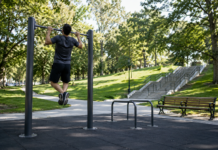
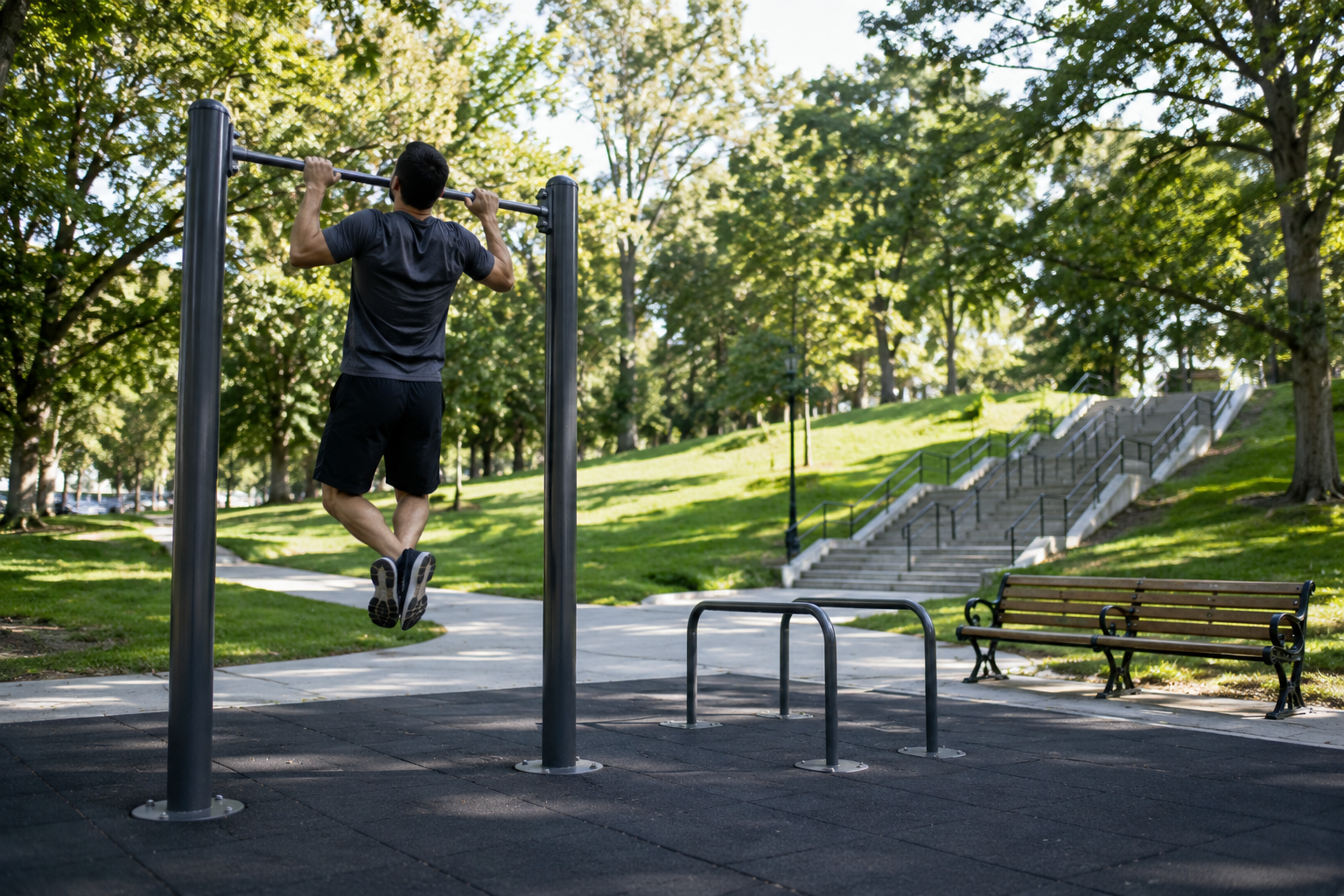
Most “outdoor workout” articles quietly mean two different things at once: bodyweight calisthenics you could do on any patch of grass, or a gym circuit dragged outside for fresh air. This guide is neither. It is built around the specific, physical hardware you find bolted into public parks: pull-up bars, dip or parallel bars, sturdy benches, staircases, monkey bars, and the metal fitness-trail stations (air walkers, leg presses, ski machines, waist twisters) that cities have been installing in growing numbers. If your neighborhood park has any three or four of these, you have enough equipment to build a real, repeatable circuit, and this guide walks through exactly how to scout it, sequence it, and use it safely.
What this guide covers: scouting a park for usable equipment, checking stations for safety before you trust your bodyweight to them, sequencing a circuit so it flows, sample beginner-to-advanced circuits with a comparison table, a real step-by-step walkthrough, weather and surface judgment calls, and a short FAQ.
Why Park Equipment Is Its Own Category of Training
Bodyweight calisthenics needs nothing but floor space. A home workout needs nothing but a living room. A public park fitness circuit needs something in between: fixed, purpose-built hardware that is already installed, free to use, and shared with other people. That changes the planning. You are not choosing exercises in a vacuum, you are working around whatever equipment your specific park happens to have, its layout, its surface, and the people already using it.
This distinction matters because the growth of outdoor fitness equipment (often shortened to OFE in research literature) has been rapid enough that it now has its own body of study. A 2018 study published in PLOS ONE measured the actual metabolic cost of using park fitness-trail devices among older adults, and found meaningful differences between stations: an air walker and a ski-machine-style station reached moderate intensity (roughly 3 to 4 METs depending on pace), while a waist twister and a double-arm stretch station stayed at light intensity, measurably lower than brisk walking (). That single finding is the practical argument for this whole guide: not every piece of park equipment works your body the same way, so a circuit needs deliberate sequencing, not just moving from one shiny station to the next.
Step 1 Through 8: The Full Walkthrough
Below is the complete process, from the first scouting trip to your first logged session. Each step includes what to actually do and why it matters for a circuit built entirely from public equipment.
Scout Your Park and Map Three to Five Stations
Walk the park once with no workout in mind, just an inventory. Note every piece of fixed equipment: pull-up bars, dip/parallel bars, a bench with a stable frame, a staircase or set of terraced steps, monkey bars, and any labeled fitness-trail machines. Pace off the distance between stations, because that walking or jogging gap becomes your built-in transition and light cardio. Three to five usable stations within a two-to-five-minute walk of each other is enough for a full circuit; you do not need a dedicated “fitness zone” if the park has scattered equipment.
Inspect Each Station Before You Trust It
Before adding any station to your rotation, physically check it. Grip the bar and pull sideways and downward to feel for looseness at the mounting point. Look for rust that has eaten into the metal rather than just surface discoloration, cracked welds, splintered wood on benches, or a base that has come loose from its concrete footing. Check the ground under and around the station for holes, exposed roots, broken glass, or standing water. A station that fails any of these checks gets skipped, no matter how good it looks for your planned exercise.
Group Stations by Movement Pattern
Sort what you found into rough categories: pull (pull-up bars, monkey bars), push (parallel/dip bars, a sturdy bench for incline push-ups), legs (steps, a bench for step-ups, a fitness-trail leg press station), and core or balance (waist twister, low bars for hanging leg raises, a bench for planks). A usable circuit needs at least one station from three of these four categories. If your park is missing a pull station entirely, that is fine; the sample circuits later in this guide show how to substitute.
Sequence the Circuit: Push, Pull, Legs, Core
Order your chosen stations so you never hit the same muscle group twice in a row. A simple, reliable order is push, pull, legs, core, repeat. This spreads fatigue across your body instead of burning out your grip on back-to-back pulling stations, and it keeps the circuit moving at a steady pace rather than stalling because one muscle group is cooked.
Set Your Work and Rest Intervals
Match intervals to your fitness level rather than copying someone else’s circuit. A workable starting template is 30 to 40 seconds of work followed by 30 to 40 seconds of rest or walking to the next station, for two to four total rounds. Beginners can lengthen rest to a full minute; more advanced exercisers can shorten rest to 15 to 20 seconds or add a round. Use the talk test as your intensity check throughout: per the CDC, if you can talk but not sing, you are in the moderate range; if you can only get out a few words at a time, you have moved into vigorous territory ().
Warm Up on the Walk Between Stations
Skip a separate warm-up block and instead use your first lap of the park as the warm-up: a brisk five-to-eight-minute walk that visits each planned station without working it, just to confirm footing, check the equipment one more time, and raise your heart rate. Add a few arm circles, bodyweight squats, and ankle rolls at the last station before you start the real circuit.
Run the Circuit for Two to Four Rounds
Work each station for your set interval, then walk or light-jog to the next one during the rest period rather than standing still; this keeps your heart rate from dropping too far between stations. Complete the full sequence, then repeat for your planned number of rounds. If a station is occupied when you arrive, do not wait idly: perform a bodyweight filler movement (squats, lunges, or a plank on the grass) until it frees up, or swap in a nearby alternative you scouted in Step 1.
Cool Down, Log, and Plan Your Next Session
Finish with three to five minutes of easy walking and light stretching for the muscle groups you used, focusing on shoulders, forearms, hips, and calves. Write down which stations you used, how many rounds, and how it felt (easy, moderate, hard). That log is what lets you progress deliberately instead of guessing week to week.
A Station-by-Station Look at What Parks Actually Offer
Not every park has the same layout, but most public fitness spaces draw from a fairly consistent set of hardware. Here is what each type is good for, and what tends to trip people up.
| Station | Primary Category | Common Moves | Watch For |
|---|---|---|---|
| Pull-up bar | Pull | Dead hangs, negatives, chin-ups, hanging knee raises | Bar diameter and grip texture; loose upright posts |
| Parallel or dip bars | Push | Dips, L-sits, tricep push-ups, step-throughs | Bar spacing versus your shoulder width; slick surfaces after rain |
| Sturdy park bench | Push / Legs | Incline push-ups, step-ups, tricep dips, split squats | Wobble in the frame; wet or icy seat surface |
| Steps or stairs | Legs / Cardio | Step-ups, stair sprints, lateral step-overs | Uneven or crumbling edges; foot traffic in shared stairwells |
| Monkey bars | Pull / Grip | Bar traverses, hanging holds, skip-a-bar crossings | Height and landing surface; often shares space with children |
| Fitness-trail stations (air walker, ski machine, waist twister) | Cardio / Core | Timed cadence work at each machine per the label | Intensity varies a lot by machine; treat low-intensity stations as active recovery, not the main event |
Research note: A 2018 metabolic study measured four common fitness-trail devices among adults averaging 70 years old. The air walker and ski-machine-style station reached moderate intensity (roughly 2.8 to 4.1 METs depending on pace), while the waist twister measured around 2.0 METs and a double-arm stretch station around 1.6 METs, both classified as light intensity and lower than brisk walking. In other words, the machine-based stations are not interchangeable in effort, so treat the labeled devices as a supplement to your bench, bar, and step work rather than the backbone of the circuit.
Source:
Three Sample Circuits, Beginner to Advanced
Use these as starting templates, then swap in whatever your specific park actually has. Each one assumes a park with a pull-up bar, dip bars, a bench, and a set of steps, which is a common combination.
| Level | Stations and Work | Work / Rest | Rounds |
|---|---|---|---|
| Beginner | Bench incline push-ups, bar dead hang, step-ups, standing march or waist-twister station | 30s work / 45-60s rest | 2 |
| Intermediate | Dip bar push-ups or dips, bar negatives or chin-ups, stair sprints, hanging knee raises | 35-40s work / 30-35s rest | 3 |
| Advanced | Full dip bar dips, weighted-vest or slow-tempo pull-ups, monkey bar traverses, bench split-squat jumps, stair sprints | 40-45s work / 15-20s rest | 4 |
Quick Pre-Session Checklist
- Route mapped and stations confirmed still standing
- Weather checked (temperature, rain, wind)
- Water bottle, phone, and ID with you
- Footwear suited to grass, gravel, or wet pavement
- Circuit order and rounds written down or saved on your phone
- A backup station picked for anything that’s occupied or unsafe
Safety Around Shared, Fixed Equipment
Public equipment is not maintained on your schedule, and you are sharing it with strangers, children, dogs, and cyclists. A few habits keep the risk low without turning the workout into a chore.
- Test load-bearing points with your hands before committing your full weight, especially after storms, freezes, or long dry spells that can affect wood and metal differently.
- Give playground-adjacent equipment, especially monkey bars, priority to children when the park is busy with families; look for an adult-oriented fitness zone or a quieter time of day instead.
- Keep a mental note of the nearest exit path and, if you exercise alone, let someone know your route and expected return time.
- Stop the movement immediately if you feel sharp or sudden pain, as opposed to normal muscular fatigue; sharp pain is a stop signal, not something to push through.
- Bring your own grip aid (chalk or gloves) rather than relying on the bar’s surface, which is exposed to weather and gets worn smooth over time.
“The evidence indicates that outdoor fitness equipment intervention effectively improves physical activity, physical fitness, psychological health, and health-related issues,” including measurable gains in balance and cardiorespiratory fitness across the studies reviewed.
— Tang et al., systematic review and meta-analysis, Frontiers in Public Health, 2026
When to consult a professional: This guide offers general fitness information, not medical advice. If you have a pre-existing joint, back, or cardiovascular condition, are returning from an injury, are pregnant, or are new to structured exercise after a long inactive period, check with a physician or physical therapist before starting a circuit that includes hanging, dipping, or stair-sprint work. Persistent pain, dizziness, chest discomfort, or joint instability during or after a session warrants a medical evaluation rather than continued training.
Weather and Surface Judgment Calls
Because this circuit lives outdoors on fixed equipment, conditions change what is safe to use on a given day, and that is a genuine planning variable, not a minor inconvenience.
Wet or Icy Conditions
Metal bars and painted steel get slick fast in rain or frost. If a bar feels damp or you can see a sheen on it, either dry it with a cloth before use, switch to a dry alternative station, or skip hanging and gripping movements for that session and substitute step-ups or bodyweight squats on a drier surface.
Heat and Sun Exposure
Metal equipment absorbs and holds heat, sometimes reaching temperatures well above the surrounding air on a sunny day. Touch-test any bar or bench before gripping it in direct summer sun, favor early morning or evening sessions during heat waves, and carry more water than you think you need.
Ground Surface
Grass hides holes and roots; gravel and mulch shift under jumps and lunges; painted concrete can be slippery when wet. Scan the landing zone under and around every station, not just the equipment itself, before adding jumping or dropping movements (like dismounting from bars) to your circuit.
How This Fits Weekly Activity Guidelines
A park-equipment circuit is a convenient way to cover two federal recommendations in one outing. The CDC’s current physical activity guidelines for adults call for at least 150 minutes of moderate-intensity aerobic activity per week (or 75 minutes of vigorous activity, or a combination), plus muscle-strengthening activity that works all major muscle groups, including legs, hips, back, abdomen, chest, shoulders, and arms, on two or more days a week (). A well-sequenced circuit that moves through push, pull, leg, and core stations while walking briskly between them can satisfy both the strength and the cardio side of that recommendation in a single 30-to-45-minute session, twice a week or more.
There is also a growing evidence base specifically on outdoor fitness equipment rather than generic bodyweight training. A 12-week controlled study of older adults using outdoor gym equipment found that a structured, supervised protocol (30-second work intervals at a moderate, metronome-controlled pace, three times a week) produced measurable improvements in functional tests like rising from a chair and walking 10 meters, while even unsupervised, self-directed use of the same equipment improved participants’ quality-of-life scores and weekly activity time (). A broader 2026 systematic review and meta-analysis pooling 14 studies on outdoor fitness equipment interventions found significant improvements across cardiorespiratory fitness, upper and lower limb strength, balance, mental well-being, and quality of life (). The takeaway is not that park equipment is superior to a gym; it is that structured use of it produces real, measured outcomes, which supports building an actual circuit rather than wandering between stations at random.
Progression: What to Do When the Basics Get Easy
Park equipment has a ceiling, but it is higher than most people assume. Once bodyweight dips and dead hangs feel easy, progress by manipulating variables you already control rather than needing new equipment:
- Tempo: Slow the lowering phase of a dip or pull-up to three to five seconds, which increases time under tension without adding load.
- Density: Keep the same work interval but shorten the rest interval, forcing more total reps into the same session length.
- Range of motion: Add a deeper dip, a fuller hanging knee-to-chest raise, or a step-up onto a taller bench or ledge.
- Added rounds: Move from two rounds to three or four before you touch anything else.
- External load: A loaded backpack (books or water bottles) turns bodyweight step-ups, dips, and carries into a genuinely harder session without buying equipment.
4-Week Progress Tracker (example)
| Week | Rounds | Rest per Station | Focus |
|---|---|---|---|
| 1 | 2 | 60s | Learn each station’s setup and form |
| 2 | 2 | 45s | Add a third station to a weaker category |
| 3 | 3 | 35s | Increase total rounds by one |
| 4 | 3 | 25-30s | Shorten rest, hold form steady |
Frequently Asked Questions
My park has no pull-up bar. What do I use instead?
Substitute a low, sturdy horizontal rail or the top of a step railing for inverted rows (feet on the ground, body angled back, pulling your chest to the bar), or use a bench for renegade-row-style bodyweight pulls. If nothing suitable exists, build the circuit around push, legs, and core stations and add resistance-band rows brought from home to cover the pulling pattern.
How long should a park-equipment circuit take?
Most sessions in this guide run 25 to 45 minutes including warm-up and cool-down: roughly five to eight minutes to walk the route and warm up, 15 to 30 minutes for two to four rounds of the circuit, and three to five minutes to cool down and stretch.
Is this safe for a beginner who has never done a pull-up or dip?
Yes, with regressions. Replace dead hangs with brief 5-to-10-second holds, replace full dips with bent-knee dips where your feet stay on the ground, and replace step-ups on a tall bench with a lower step. Build tolerance for two to three weeks before adding full range of motion or extra rounds.
What should I actually bring to a park workout?
Water, a phone, ID, a small towel, and shoes with reasonable traction for grass, gravel, and pavement. Optional but useful additions are a resistance band, workout gloves or chalk for grip, and a mat or towel to sit on for floor-based core work.
How often per week should I run this circuit?
Two to three sessions per week with at least one rest or light-activity day between them is a reasonable starting frequency, and it lines up with CDC guidance to hit muscle-strengthening work on two or more days weekly while leaving room for recovery.
Is it okay to use park fitness equipment right after rain?
Wait until visibly standing water has drained and wipe down bars and benches before use. Painted steel, wet wood, and rubberized matting can all be significantly more slippery right after rain, so this is a reasonable day to shift toward lower-risk stations like steps or a dry section of path instead of hanging or dip work.
Putting It Together
The core idea behind this guide is simple: treat your park as a set of fixed stations rather than open green space for generic bodyweight moves. Scout it once, sort what you find into push, pull, leg, and core categories, sequence a route that alternates those categories, set an interval that matches your fitness level, and log what you did so next week’s session is a deliberate step up rather than a repeat. Do that consistently and a public park becomes a legitimate, repeatable training location, not just a scenic backdrop for a jog.
References and Sources
- Centers for Disease Control and Prevention. Physical Activity Guidelines for Adults. Reviewed December 20, 2023. cdc.gov/physical-activity-basics/guidelines/adults.html
- Centers for Disease Control and Prevention. Measuring Physical Activity Intensity. cdc.gov/physical-activity-basics/measuring/index.html
- Chow, H-W., and Ho, C-H. “Does the use of outdoor fitness equipment by older adults qualify as moderate to vigorous physical activity?” PLOS ONE, 13(4): e0196507, 2018. doi.org/10.1371/journal.pone.0196507
- Barbosa, W.A., et al. “Effects of a 12-week training program in outdoor gym equipment in morphological and functional parameters, quality of life, and physical activity levels in older adults.” Frontiers in Sports and Active Living, 2024. doi.org/10.3389/fspor.2024.1444472
- Tang, Z-Y., et al. “Effectiveness of outdoor fitness equipment intervention on health outcomes: a systematic review and meta-analysis.” Frontiers in Public Health, 2026. doi.org/10.3389/fpubh.2026.1701136