
























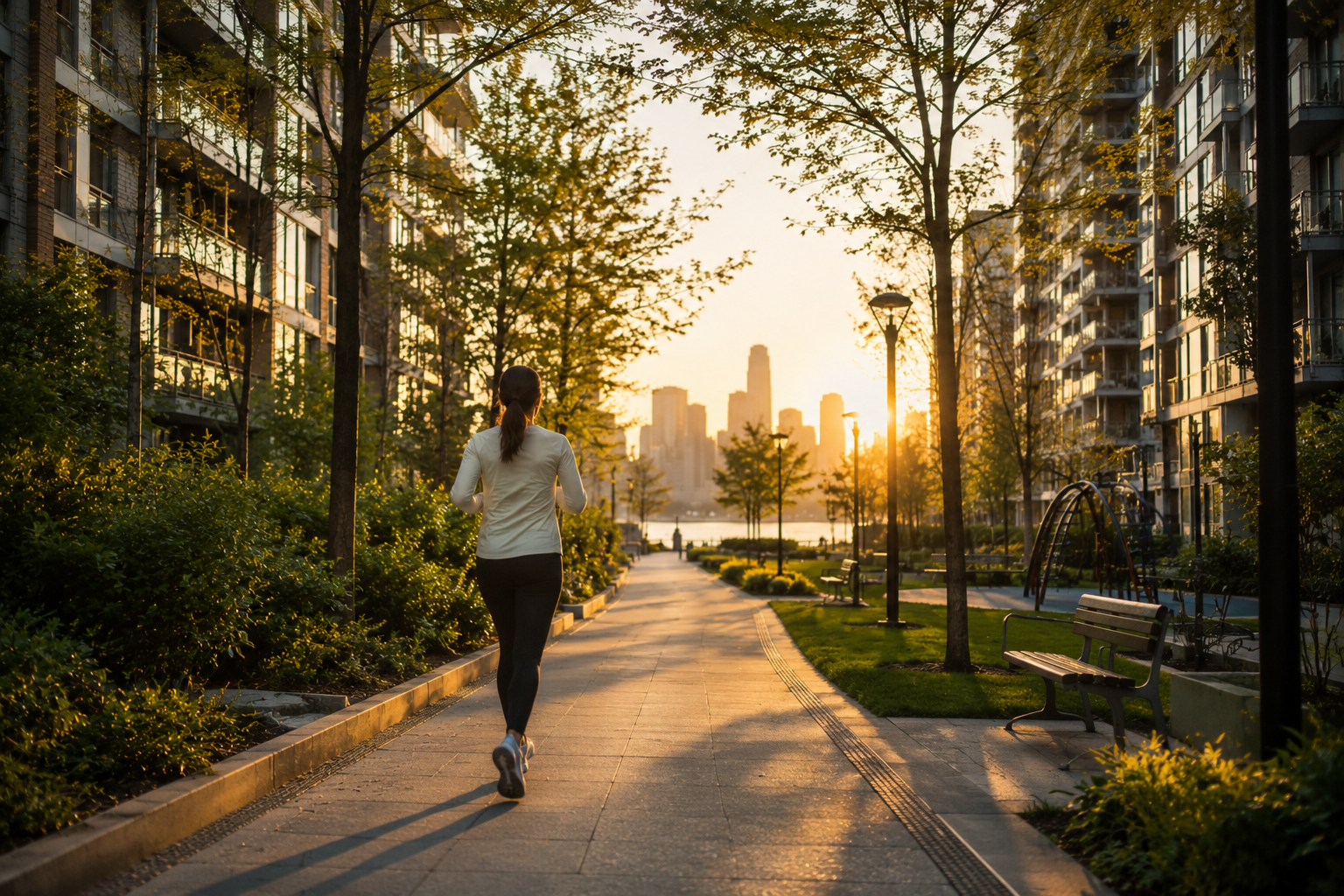
Quick Answer
Building a weekly outdoor habit in a dense city works best when you map two or three realistic, low-friction green or open-air spots within a 10 to 15 minute walk, attach outdoor time to a routine you already do every day (habit stacking), and write a specific if-then plan for when and where you’ll go (an implementation intention). Consistency, not intensity or perfect scenery, is what makes the habit stick.
By Charlotte Evans
Who This Matters Most For
This guide is written for people living in apartments, high-rises, and dense neighborhoods where a backyard, trailhead, or large park is not a five-minute stroll away. If you commute by transit or on foot, work long hours, or have grown discouraged trying to build a nature-based movement habit because “getting outside” always seems to require more planning than it’s worth, the steps below are built around your constraints rather than around an idealized suburban routine.
Why Dense Cities Make Outdoor Habits Harder to Start
Most habit advice about outdoor movement assumes easy access to a trail, a beach, or a big park. In a dense city, the nearest patch of usable green space might be a narrow strip along a road, a rooftop, a plaza with a few trees, or a waterfront path shared with cyclists and delivery scooters. That access gap is not just a feeling. The Trust for Public Land’s 10-Minute Walk campaign, which tracks park proximity across the United States, has found that in many cities more than half of children do not have a park or green space within a 10-minute walk of home. Its 2026 ParkScore ranking of the 100 largest U.S. cities also shows wide variation: the top-ranked city, Washington, D.C., has 99 percent of residents within an easy walk of a park, while lower-ranked cities leave large shares of residents with no nearby option at all.
Distance is only part of the problem. The World Health Organization reports that roughly 31 percent of adults worldwide, about 1.8 billion people, do not meet the recommended 150 minutes of moderate-intensity physical activity per week, and it projects that share could climb toward 35 percent by 2030 if current trends continue. Dense-city living adds specific friction to that already difficult target: irregular schedules, unpredictable weather exposure with no shade or shelter nearby, safety concerns after dark, and the simple fact that “go outside” is a vague intention rather than a concrete plan. The good news is that none of those obstacles require moving to the suburbs to solve. They require a repeatable process.
Dense-city living also changes what “outdoor time” looks like day to day. A person in a low-density suburb might default to a backyard or a quiet cul-de-sac loop without any planning at all. In a dense neighborhood, every outdoor session competes with noise, foot traffic, construction, and the simple logistics of getting from a fourth-floor walk-up to street level and back. None of that makes an outdoor habit impossible; it just means the habit needs a structure that suburban advice usually skips. The protocol below was built specifically around that reality, starting from the assumption that your nearest usable green space might be small, shared, or a short transit ride away rather than a private yard.
The Step-by-Step Protocol
This sequence turns a vague goal (“get outside more”) into a specific, repeatable weekly routine. Work through the steps in order the first time; after that, steps 1 and 2 are one-time setup, and steps 3 through 6 repeat every week.
- Map your realistic radius. Spend fifteen minutes with a map app and mark every outdoor option within a 10 to 15 minute walk or a 10 minute transit ride: parks, plazas, cemeteries with public paths, waterfronts, rooftop gardens, tree-lined streets, school tracks open to the public, and pedestrian bridges. Aim for at least three options so you always have a backup if one is closed or crowded.
- Pick your anchor routine. Choose one daily habit that already happens reliably, such as your morning coffee, a commute, or a lunch break, and decide which outdoor spot pairs naturally with it. This is the core of habit stacking, a method popularized by BJ Fogg’s Tiny Habits work and later by James Clear, which attaches a new behavior to an existing routine so the routine itself becomes the reminder.
- Write one if-then plan per week. Implementation intentions, first studied in depth by psychologist Peter Gollwitzer, take the form “When situation X happens, I will do Y.” For example: “When I finish my Tuesday and Thursday video calls, I will walk the two blocks to the riverside path for 20 minutes.” Specificity about time, place, and trigger is what separates an intention from a habit.
- Set a minimum viable session. Decide the smallest version of the habit you would still count as a win, such as a 10-minute walk around the block. On low-energy days, do only the minimum. This keeps the habit alive on hard weeks instead of breaking the streak entirely.
- Do the session and log it immediately. Use a paper calendar, a habit-tracking app, or a simple notes list. The act of marking completion right after the walk, run, or stretch session reinforces the behavior loop and gives you visible proof of progress.
- Review and adjust weekly. Once a week, look at what worked and what didn’t. If a planned Tuesday slot kept failing, move it. If a specific outdoor spot felt unsafe or overcrowded at your chosen time, swap it for one of your backup options from step 1.
Visualized as a loop, the process looks like this:
Urban Outdoor Options Worth Mapping
You don’t need a forest trail for outdoor movement to count. These categories exist in almost every dense city and each can anchor a weekly habit.
Small, often overlooked green squares tucked between buildings. Good for a 10 to 15 minute reset during a work break.
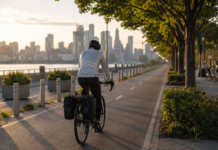
Paved paths along rivers, canals, or harbors, usually flat and well-lit, suitable for brisk walking, jogging, or cycling.
Former rail corridors turned into greenways, tracked by groups such as the Rails-to-Trails Conservancy, often running directly through dense neighborhoods.
Many historic cemeteries and university grounds allow public walking on quiet, tree-lined paths with far less traffic noise.
Apartment and office rooftop terraces or interior courtyards, useful for short stretch or breathing breaks when you can’t leave the block.
Larger parks reachable by transit within 20 to 40 minutes, best saved for longer weekend sessions rather than weekday routines.
Outdoor Options by Time Commitment
Matching the activity to the time you actually have removes the most common excuse for skipping a session.
| Time Available | Good Options | Best Anchor |
|---|---|---|
| 10 minutes | Loop around the block, pocket park bench break, stretching in a courtyard, standing/walking phone calls outside | Right after waking, or a mid-work break |
| 30 minutes | Brisk walk or jog on a waterfront path, bike ride on a rail trail, bodyweight circuit in a plaza or park lawn | Lunch break or immediately after work commute |
| Weekend-length (1.5+ hours) | Regional park hike, long cycling route, group outdoor sport, farmers market walk plus park visit | Saturday or Sunday morning, before other plans fill the day |
Checklist: Building Your Weekly Outdoor Habit
- I have listed at least three outdoor options within a 10 to 15 minute walk or short transit ride.
- I have picked one existing daily routine to attach my outdoor time to.
- I have written a specific if-then plan naming the day, time, trigger, and location.
- I have defined a minimum viable session (10 minutes or less) for low-energy days.
- I have a tracking method, whether an app, calendar, or notebook.
- I have a backup plan for bad weather or a closed location.
- I have set a recurring weekly review, even if it is only two minutes.
- I have told one other person about the plan for light accountability.
Adapting the Habit Across Seasons and Busy Weeks
A weekly outdoor habit that only survives good weather and light schedules is not really a habit yet; it is a preference. Dense cities tend to amplify seasonal friction because pavement and buildings hold heat in summer and funnel wind in winter, and because fewer trees mean less natural shade or windbreak along a typical route. Building in a seasonal adjustment plan from the start prevents the whole routine from collapsing every time the weather turns.
In hot months, shift your anchor session earlier in the morning or later in the evening, and favor waterfront paths or tree-lined streets over open plazas that trap heat. In cold or wet months, shorten the minimum session rather than cancelling it outright, and keep a covered or partially sheltered backup route, such as an arcade, a covered walkway, or a transit-adjacent plaza, in your rotation. During unusually busy work weeks, resist the urge to drop the habit entirely; instead, temporarily reduce every session to the 10-minute minimum until your schedule opens back up. The goal across all of these adjustments is the same: protect the frequency of the habit even when you can’t protect the duration or the ideal setting. Frequency is what builds automaticity; duration and setting are details you can upgrade once the routine is secure.
It also helps to revisit your mapped list of options every few months. Construction fences go up, favorite plazas get renovated, and new pocket parks or trail segments open, particularly in cities actively investing in walkability and green infrastructure. Treat your options list as a living document rather than a one-time decision, and update it during your regular weekly review whenever something changes.
Worked Example: One Month in a Dense City
Maya lives in a one-bedroom apartment on the eighth floor of a mid-rise building in a dense downtown neighborhood. Her nearest large park is a 25-minute bus ride away, but a narrow riverside path and a small plaza are both within an eight-minute walk. Here is how her first month went.
Week 1: Maya spent one evening mapping her radius and found the riverside path, the plaza, and a cemetery with public walking paths as her three anchor spots. She chose her post-work change-of-clothes routine as her habit-stack anchor and wrote the plan: “When I change out of my work clothes, I will walk the riverside path for at least 10 minutes.” She completed four out of five weekday sessions, missing one due to heavy rain with no backup planned yet.
Week 2: After the missed session, Maya added a rainy-day backup: a covered walkway connecting two blocks near her building. She completed all five weekday sessions and added a longer Saturday walk through a farmers market that ended at the cemetery path, roughly 50 minutes total.
Week 3: Motivation dipped mid-week. Instead of skipping entirely, Maya used her minimum viable session rule and did a 10-minute loop around the block twice that week. She still logged both sessions, which kept her streak intact and her tracker showed 12 consecutive days of some outdoor movement.
Week 4: The riverside walk had become close to automatic; Maya reported barely having to think about it before heading out. She extended two weekday sessions to 20 minutes and kept the Saturday market walk as a fixed weekend ritual. By day 28, she was well on her way toward the roughly two-month mark that habit researchers associate with a routine feeling automatic rather than effortful.
By the end of month two, Maya’s tracker showed outdoor movement on 47 of the previous 56 days, including the shortened minimum sessions from harder weeks. She noticed the shift most clearly on a day she genuinely forgot her plan: changing out of her work clothes had become enough of a trigger that she was already at the elevator before she consciously thought about the walk. That is close to the definition researchers use for automaticity, a behavior that no longer requires deliberate decision-making to initiate. Her setting never changed much, the same riverside path, the same plaza, the same handful of backup options, but her relationship to the routine did.
Common Mistakes and How to Avoid Them
| Mistake | Why It Derails the Habit | Better Approach |
|---|---|---|
| Waiting for “ideal” conditions | Perfect weather, a big park, and free time rarely line up together in a busy city schedule | Pre-select a rainy-day and low-energy backup option before you need one |
| Not habit-stacking | A floating “sometime today” plan has no built-in reminder and is easy to forget | Attach the walk or session to a routine that already happens daily, without fail |
| Setting the bar too high | A 60-minute run goal on a packed day gets skipped entirely instead of scaled down | Define a minimum session of 10 minutes that always counts as a win |
| Relying on one single location | Construction, closures, or crowding at your only spot stops the whole habit | Map at least three viable options in your radius from the start |
| Vague intentions instead of if-then plans | “I’ll try to get outside more” has no trigger, so it competes with every other task | Write the specific day, time, cue, and location as one sentence |
What Behavior-Change Researchers Say
The building blocks of this protocol come directly from published behavior-change research rather than general wellness advice. Phillippa Lally and colleagues at University College London tracked participants forming a self-chosen habit and found it took an average of 66 days for the behavior to become automatic, with considerable variation between individuals and behaviors; the study was published in the European Journal of Social Psychology and remains one of the most cited pieces of evidence for how long consistency needs to be sustained before a routine stops feeling like effort.
Psychologist Peter Gollwitzer’s work on implementation intentions, dating back to 1999, showed that intentions alone account for only 20 to 30 percent of the variance in whether people actually follow through on a behavior. Turning a goal into an if-then plan closes much of that gap. In one widely cited example from this line of research, women given an if-then plan for breast self-examination completed the behavior 100 percent of the time compared with 53 percent among those who only stated an intention to do it. Related studies on physical activity, voting, and health screenings have found similar boosts from specific if-then planning compared with vague goal-setting.
Habit stacking, popularized through BJ Fogg’s Tiny Habits research and James Clear’s writing on habit formation, works on a related principle: attaching a new behavior to an existing, reliably occurring routine gives the brain a consistent cue, which is one of the three components (cue, routine, reward) that behavioral scientists generally agree drive habit formation. Combined, mapping realistic options, habit-stacking the routine, and writing an if-then plan address the three biggest points of failure in outdoor-habit attempts: not knowing where to go, not remembering to go, and not having a plan flexible enough to survive a bad week.
Environmental design also matters in ways that dense-city residents can put to direct use. Behavioral researchers studying the cue-routine-reward loop generally find that reducing the number of decisions and steps between “wanting to do something” and “doing it” increases follow-through. Laying out walking shoes by the door, keeping a phone playlist ready, or choosing an anchor routine that happens to end near an exit door all shrink that decision gap. None of these adjustments require new research to justify; they follow directly from decades of findings on how small frictions, not lack of willpower, are usually what stops a planned behavior from happening.
Safety and scope note: This article provides general educational information about building an outdoor movement habit and is not medical advice. If you have a health condition that affects your ability to exercise, talk with a qualified healthcare provider before starting a new routine. When exercising outdoors in a dense urban environment, stay aware of traffic, cross only at marked crossings, use well-lit and populated routes, especially early morning or evening, and adjust your plans during extreme heat, cold, or poor air quality days.
Key Takeaways
- You do not need a large park nearby; pocket parks, waterfronts, rail trails, and even courtyards can anchor a weekly outdoor habit.
- Habit stacking, attaching outdoor time to an existing daily routine, removes the need to rely on memory or motivation.
- Writing a specific if-then plan meaningfully increases the odds you follow through, according to decades of implementation-intention research.
- A minimum viable session of 10 minutes keeps the habit alive through low-energy weeks instead of resetting it to zero.
- Expect roughly two months of consistent repetition before the routine starts to feel automatic rather than effortful.
Frequently Asked Questions
I live in a very small apartment near a busy road with almost no green space. Where do I even start?
Start by mapping anything outdoors within a 10 to 15 minute walk, not just parks. Quiet side streets, a school track open outside class hours, a cemetery, a plaza, or a covered walkway all count. The goal at first is simply consistent outdoor time, not a scenic setting.
How long until this actually feels automatic instead of like a chore?
Research from University College London found an average of 66 days for a new habit to become automatic, though the range varied widely by person and behavior. Expect the first two to three weeks to require the most conscious effort.
What if I miss several days in a row?
Restart with your minimum viable session rather than trying to make up for lost time. A single missed week does not erase the neural groundwork already built; a prolonged gap without any restart plan is what actually breaks a habit.
Is a 10-minute walk really enough to count?
Yes, especially at the start. The World Health Organization’s 150-minutes-per-week target for adults can be reached through several shorter sessions, and consistency in a habit-forming phase matters more than the length of any single outing.
What’s the difference between habit stacking and an implementation intention?
Habit stacking anchors a new behavior to an existing routine (“after I change out of work clothes”). An implementation intention adds the full if-then structure, specifying the exact trigger, time, and action together. Using both at once tends to work better than either alone.
How do I stay safe walking or exercising outdoors in the city, especially in early morning or evening?
Favor well-lit, populated routes over quiet shortcuts, stay alert around intersections and cyclists, and consider carrying a phone with location sharing turned on for a trusted contact. Save less-populated routes for daylight hours.
What if the weather is bad for an entire week?
This is exactly why a backup location and a minimum viable session matter. A short walk under a covered walkway or through a parking structure with outdoor air still preserves the routine until conditions improve.
Do I need special gear to start?
No. Comfortable walking shoes and weather-appropriate layers cover most of the options in this guide. The barrier to starting is planning and consistency, not equipment.
References
- World Health Organization, “Physical Activity” fact sheet, updated June 26, 2024. https://www.who.int/news-room/fact-sheets/detail/physical-activity
- Trust for Public Land, “10-Minute Walk” campaign. https://www.tpl.org/10minutewalk
- Trust for Public Land, “ParkScore Index,” 2026 report. https://www.tpl.org/parkscore
- University College London, “How long does it take to form a habit?” (summary of Lally, van Jaarsveld, Potts & Wardle, European Journal of Social Psychology, 2009). https://www.ucl.ac.uk/news/2009/aug/how-long-does-it-take-form-habit
- Wikipedia, “Implementation intention,” summarizing Gollwitzer (1999) and related studies including Gollwitzer & Oettingen (1998), Luszczynska et al. (2007), Nickerson & Rogers (2010), and Milkman et al. (2011). https://en.wikipedia.org/wiki/Implementation_intention
- James Clear, “Habit Stacking: How to Build New Habits by Taking Advantage of Old Ones,” referencing BJ Fogg’s Tiny Habits method, 2014. https://jamesclear.com/habit-stacking
- Rails-to-Trails Conservancy, TrailBlog, 2026 coverage of urban rail-trail projects. https://www.railstotrails.org/trailblog/