

























By Priya Nandakumar
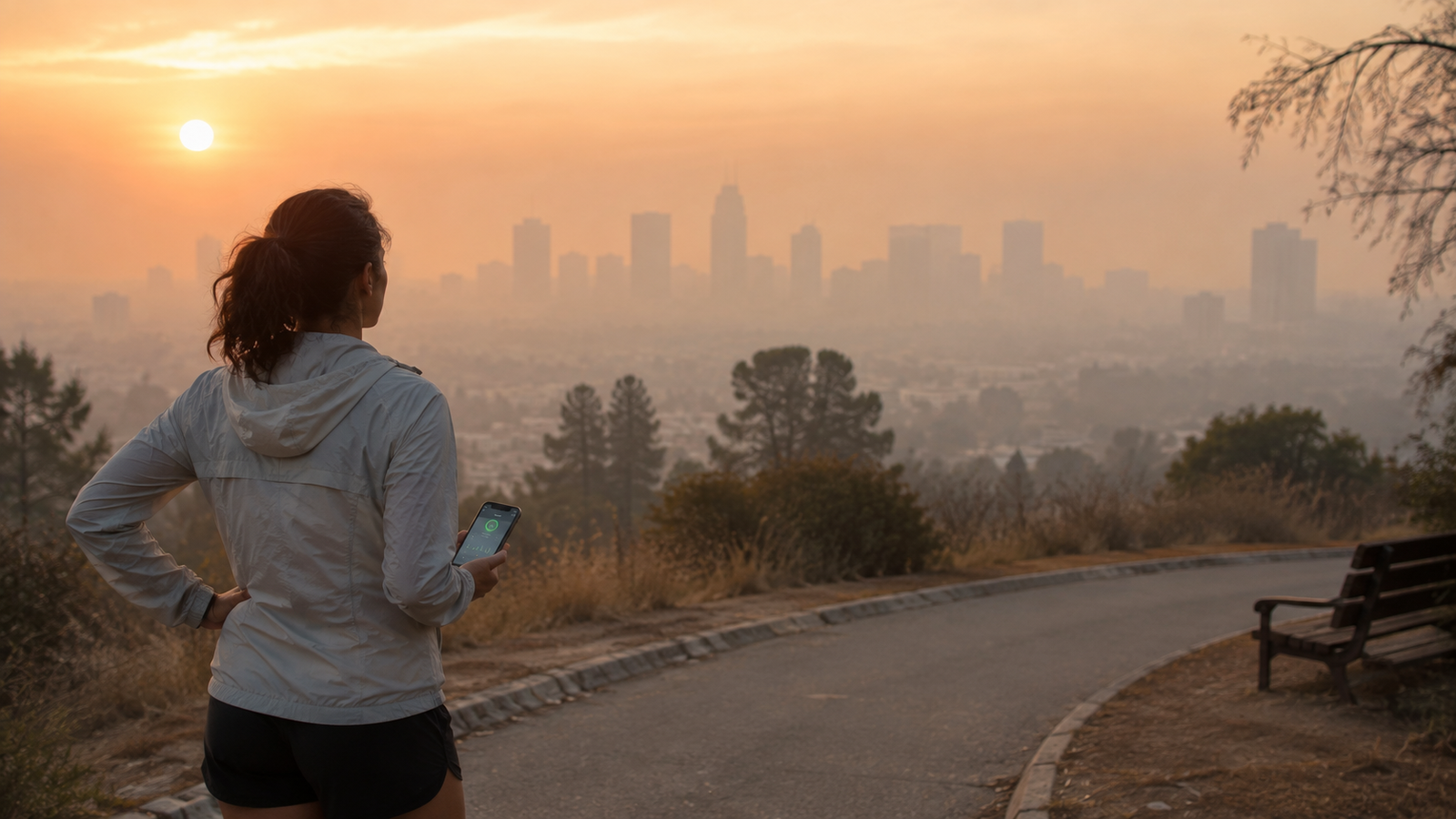
You lace up, step outside, and the air looks fine. But “looks fine” and “is fine” are not the same thing where air pollution is concerned. Ground-level ozone and wildfire smoke are often invisible until concentrations are already high enough to affect how your lungs work, and the effort you put into a hard run or a cycling interval session pulls more of that air, and more of whatever is in it, deep into your chest. Knowing how to read the Air Quality Index before you train is not an optional extra for people with breathing problems. It is a basic piece of exercise planning for anyone who trains outdoors regularly, the same way checking the weather forecast is.
This guide walks through what the AQI actually measures, how fine particulate matter (PM2.5) and ozone behave differently across a single day, who faces the highest risk from outdoor exertion in polluted air, and where the practical lines sit between “still fine for an easy walk” and “time to move the whole session indoors.” It also covers what N95 masks can and cannot do once your breathing rate climbs, and what a sensible indoor backup plan looks like when the sky turns hazy.
What the Air Quality Index Actually Measures
The AQI is a standardized 0-to-500 scale that the U.S. Environmental Protection Agency uses to translate raw pollutant concentrations into a single number the public can act on quickly. It tracks five criteria pollutants: ground-level ozone, particle pollution (PM2.5 and PM10), carbon monoxide, sulfur dioxide, and nitrogen dioxide. On any given day, the AQI you see reported is the highest of the sub-index values for whichever pollutant is worst in your area, according to AirNow.gov’s AQI Basics page.
For outdoor training, two pollutants matter most: PM2.5, fine particulate matter roughly 30 times smaller than a human hair that is the dominant concern during wildfire smoke events, and ground-level ozone, a gas formed when vehicle exhaust and industrial emissions react with sunlight, which tends to build through the day and peak in the afternoon. Both can reach the deepest parts of the lungs, and both behave worse the harder you breathe.
The AQI Scale and What It Means for Outdoor Effort
The table below uses the AQI’s six official categories and colors as defined by AirNow, cross-referenced with activity guidance from the American Lung Association’s exercise and air quality guidance. Treat this as a planning tool, not a rigid rulebook. Your personal threshold may sit lower if you have asthma, COPD, heart disease, or another chronic condition.
| AQI Range | Category | Easy Effort (walk, easy spin) | Hard Effort (tempo, intervals, long run) |
|---|---|---|---|
| 0–50 | Good | Train outdoors as planned. | Train outdoors as planned. |
| 51–100 | Moderate | Fine for most people. | Fine for most; unusually sensitive individuals may notice mild throat or chest symptoms. |
| 101–150 | Unhealthy for Sensitive Groups | Generally okay for healthy adults; sensitive groups should shorten or move indoors. | Sensitive groups should skip hard outdoor efforts; healthy adults should shorten duration and watch for symptoms. |
| 151–200 | Unhealthy | Sensitive groups move indoors; others shorten and slow down. | Move hard efforts indoors for everyone. This is the general line for switching your session. |
| 201–300 | Very Unhealthy | Move indoors. Sensitive groups avoid outdoor exertion entirely. | Move indoors. Everyone should avoid prolonged or heavy outdoor exertion. |
| 301+ | Hazardous | Stay indoors. Everyone should avoid outdoor physical activity. | Stay indoors. Everyone should avoid outdoor physical activity. |
Category ranges and colors reflect the official EPA/AirNow AQI scale. Activity guidance is a general synthesis, not a substitute for local health department advisories or your own doctor’s recommendation.
“The dose of a pollutant you actually receive depends on concentration, how hard you’re breathing, and how long you stay out there. A short easy walk at AQI 140 and a 90-minute tempo run at AQI 140 are not the same exposure at all.”
How Exercise Changes Your Personal Dose
It helps to think about air pollution exposure the way you’d think about a medication dose: total effect depends on concentration, how much you take in per minute, and how long the exposure lasts. The EPA’s own framework for ozone puts it plainly, describing exposure as roughly a product of ambient concentration, level of exertion, and duration of exposure. That means a hard, sustained outdoor effort delivers a meaningfully larger effective dose of whatever is in the air than the same air breathed while sitting on a porch.
The EPA illustrates this with a concrete example: an average young adult playing an outdoor sport like soccer or basketball for two hours can experience small to moderate lung function and symptom effects at an ozone concentration around 120 parts per billion. The same person sitting at rest would need exposure of roughly 300 to 400 parts per billion to see a similar effect. In other words, the “safe” concentration is not a fixed number independent of what you’re doing; it shifts substantially with exertion. This is exactly why a hard tempo run or interval session deserves a stricter personal AQI cutoff than a slow recovery walk, even on the same day, at the same location, breathing the same outdoor air.
This dose relationship is also why duration matters as much as intensity. A 20-minute easy jog and a 2-hour long run at the same AQI reading are not equivalent exposures. If you have a long outdoor session planned and the AQI is sitting in the Moderate-to-Unhealthy-for-Sensitive-Groups range, shortening the run, not just slowing it down, is a legitimate way to reduce total exposure while still getting meaningful training in.
PM2.5 and Ozone Behave Differently Across the Day
Because the AQI reports whichever pollutant is worst, it is worth understanding the two most common ones separately, since they follow very different daily patterns.
Ground-level ozone: an afternoon problem
Ozone forms when sunlight reacts with pollutants from vehicles and industry, so it typically builds through the morning and peaks in mid-to-late afternoon on hot, sunny, stagnant-air days. According to the EPA’s overview of ozone’s health effects, exercise changes how much ozone reaches your lungs: during physical activity you breathe more deeply and more often through the mouth, which shifts ozone uptake from the upper airways into the deeper, more sensitive parts of the respiratory tract. The EPA frames dose as roughly concentration multiplied by exertion level multiplied by duration, meaning a hard 2-hour outdoor session at a given ozone level delivers a meaningfully larger effective dose than the same air breathed at rest. On days when ozone is the main pollutant driving the AQI, scheduling harder outdoor sessions for the morning, before ozone accumulates, is a reasonable and evidence-aligned adjustment.
Wildfire smoke and PM2.5: it doesn’t wait for afternoon
Wildfire smoke is mostly fine particulate matter, and unlike ozone it doesn’t follow a predictable daily curve. Smoke can settle overnight in valleys, arrive on a shift in wind at any hour, and linger for days regardless of sunlight. PM2.5 is small enough to bypass much of the body’s natural filtering and travel deep into lung tissue, and some fraction can pass into the bloodstream. During a smoke event, checking the AQI first thing and again before an afternoon or evening session matters more than sticking to a fixed morning-versus-afternoon rule, because conditions can shift within hours.
Who Is Most at Risk
The following groups experience health effects at lower AQI levels than the general population, and should generally treat the “Unhealthy for Sensitive Groups” (101–150) threshold as their personal line for skipping or moving hard outdoor efforts indoors:
- People with asthma or other chronic respiratory disease, who should follow their asthma action plan during smoke or high-ozone days.
- People with COPD, who face elevated risk of flare-ups and should discuss a wildfire-season plan with their healthcare provider in advance.
- People with heart disease, since fine particulate exposure is linked to cardiovascular strain; watch for chest discomfort, palpitations, or unusual fatigue.
- Pregnant people, as research has examined associations between prenatal PM2.5 exposure and pregnancy outcomes, supporting a cautious approach to outdoor exertion on poor air days.
- Children and teens, who breathe more air relative to body size, spend more time outdoors, and, notably, show ozone-related lung function changes similar to young adults even when they don’t report feeling unwell.
- Older adults, especially those with pre-existing lung or heart conditions.
- Outdoor workers and anyone training at high exertion for long durations, per the EPA’s dose framework above.
The CDC’s guidance on wildfire smoke and chronic conditions is direct about this: people with asthma, COPD, heart disease, or diabetes should talk with a healthcare provider before wildfire season to build a personal protection plan, follow air quality reports closely, and pay attention to “sensitive groups” guidance rather than the general-public thresholds. If you fall into one of these categories and you’re unsure whether it’s safe to train outdoors on a given day, that conversation with your doctor is the right next step, not a guess.
Setting Practical Thresholds for Easy vs. Hard Efforts
A useful mental model is to separate your decision by both AQI band and workout intensity, rather than applying one blanket cutoff to every session:
Easy efforts (walking, easy cycling, mobility work, recovery jogs)
These sessions involve lower ventilation rates, so you generally have more room before pollution becomes a meaningful factor. Most healthy adults can continue easy outdoor movement up through AQI 100, and often into the AQI 101–150 range for shorter durations, provided you’re not in an at-risk group and you stop if you notice throat irritation, coughing, or unusual shortness of breath.
Hard efforts (tempo runs, intervals, races, long endurance sessions)
Because higher ventilation pulls in more pollutant per minute, hard efforts deserve a stricter line. Treat AQI 101–150 as a caution zone: healthy adults can often still train, but should shorten the session and drop intensity, while sensitive groups should move it indoors. Once AQI crosses into the 151–200 “Unhealthy” band, the general and evidence-aligned move is to take hard outdoor efforts indoors entirely, regardless of fitness level.
A simple rule of thumb
If the AQI is orange (101–150) or worse and you belong to a sensitive group, or if it’s red (151+) for anyone, that’s your signal to restructure the session rather than push through it. Checking a live reading from AirNow or a similar local monitoring source before you head out takes under a minute and is far more reliable than judging by eye, since smoke haze and ozone are not always visually obvious.
Do N95 Masks Actually Help During Exercise?
N95 respirators are genuinely effective at filtering particulate matter under laboratory conditions, with studies cited in a rapid evidence review from the National Collaborating Centre for Environmental Health showing reductions of more than 94 percent for particles across a range of sizes when the mask achieves a proper seal, as detailed in its review of mask effectiveness against wildfire smoke. That is a genuinely strong number, but it comes with three caveats that matter specifically for exercise.
First, that filtration efficiency depends on a tight seal with no edge leakage, the kind achieved in fit-testing labs rather than during a sweaty outdoor run. Heavy breathing increases the pressure differential across the mask and around its edges, and the same review notes that poorly fitted respirators can see filtration drop to around 60 percent in real-world conditions. Second, wildfire smoke particles skew toward the ultrafine range, below 0.1 micrometers, where N95 filtration performs less well than the standard 0.3-micrometer test particle the NIOSH rating is built around; the review’s authors caution this may mean N95 masks are somewhat less protective against combustion smoke than headline filtration numbers suggest. Third, and most relevant to training specifically, an N95 adds breathing resistance. At rest that resistance is barely noticeable; at a hard aerobic effort it can meaningfully increase the work of breathing, which for most people makes an N95 impractical to wear during vigorous outdoor exercise even before considering filtration performance.
The practical takeaway: an N95 is a reasonable tool for short periods of light activity outdoors during smoke events, such as walking to your car or checking on a garden, if you make sure it fits snugly with no gaps. It is not a substitute for moving a genuinely hard workout indoors when the AQI calls for it, and it should not be treated as a “training pass” that lets you push through air the AQI is telling you to avoid.
What to Do Instead: Indoor Alternatives
When the AQI pushes your session indoors, you don’t have to lose the workout, just relocate it. A few reliable swaps:
- Treadmill or stationary bike intervals in place of an outdoor tempo run or hard ride, matched to the same duration and effort structure.
- Gym-based strength training as a full substitute on smoke days, since lifting sessions don’t rely on sustained high ventilation outdoors.
- Indoor cardio classes, stair climbers, or rowing machines for variety if a treadmill feels monotonous.
- Bodyweight circuits or mobility and stretching work at home on days when gym access isn’t an option and outdoor air is unsafe even for a walk.
- A genuine rest or active-recovery day, which is always a legitimate choice; one skipped or swapped session on a bad-air day will not undo a training block.
If you exercise indoors during a smoke event, keep windows closed and, where possible, run an air purifier with a HEPA filter or a well-maintained HVAC system, since outdoor PM2.5 can still infiltrate indoor spaces without filtration.
Tools for Checking the AQI Before You Train
Reading the number correctly starts with reading it consistently, from a source that reflects your actual location rather than a citywide average that might be miles from your specific route. A few practical options:
- AirNow.gov and the AirNow mobile app pull data directly from EPA and partner monitoring stations and display the current AQI category with its official color, plus a forecast for the next one to two days.
- Low-cost sensor networks like PurpleAir can offer more hyperlocal readings, which is useful if you live near a specific pollution source such as a highway corridor or an area prone to smoke settling overnight, though these sensors can run slightly higher than regulatory-grade monitors during smoke events.
- Local news and health department alerts often issue specific advisories during wildfire smoke events or ozone action days, sometimes with guidance tailored to schools and outdoor youth sports.
- Built-in weather app widgets on many phones now surface a simplified AQI reading alongside the standard forecast, which is a reasonable quick check even if it lacks the detail of a dedicated tool.
Whichever source you use, check both the current reading and the short-term trend before you commit to a workout plan for the day, especially during wildfire season when conditions can shift within a few hours rather than gradually over a week.
After a Poor-Air Workout: What to Watch For
If you trained outdoors on a day when the AQI turned out worse than expected, or you got caught outside as smoke rolled in, pay attention to how you feel over the following hours, not just during the session itself. Coughing, a scratchy or sore throat, chest tightness, unusual fatigue, or a headache that develops after exertion in smoky or high-ozone air are all reasonable signals that your body took in more pollution than it could comfortably handle. For most healthy people, these symptoms settle within a day once you’re back in cleaner air, with rest and hydration. For anyone with asthma, COPD, or heart disease, persistent or worsening symptoms after an outdoor session on a poor-air day warrant a call to a healthcare provider rather than waiting to see if they pass on their own, particularly if you notice chest pain, palpitations, or genuine difficulty breathing, which are reasons to seek urgent care.
Building a Personal Decision Habit
The simplest system is also the most durable one: check the AQI at the same time you check the weather, before you plan the day’s session, not after you’re already outside and starting to feel it. Free tools like AirNow’s map and mobile alerts, or your phone’s built-in weather app in many regions, report near-real-time readings for your location. If you train at a consistent time each day, it’s worth glancing at both the current reading and the forecast trend, since ozone in particular tends to worsen through a hot afternoon.
“Treat a poor-air day the way you’d treat an ice storm: not a personal failure, just a day where the smart move is to change the plan, not push through it.”
It also helps to notice your own early warning signs rather than relying purely on the number. A scratchy throat, a tight chest, unusual fatigue, or a cough that starts partway through an outdoor session is your body flagging exposure in real time, and it’s worth stopping and moving indoors even if the AQI reading you checked that morning looked acceptable, since local conditions can shift.
When to Talk to a Doctor Before Training Outdoors
If you have asthma, COPD, heart disease, or another chronic respiratory or cardiovascular condition, don’t rely on general guidance alone to decide your personal AQI cutoffs. A healthcare provider can help you build a specific plan, including medication adjustments for high-pollution days, a realistic activity ceiling based on your condition, and warning signs that mean you should stop and seek care. This is especially worth doing before wildfire season arrives in your region rather than during an active smoke event, so you already have a plan in hand. Pregnant individuals with existing respiratory or cardiovascular conditions should have a similar conversation with their obstetric provider. None of the thresholds in this guide are a diagnosis or a personalized medical recommendation; they’re a starting point for a conversation with a professional who knows your health history.
Frequently Asked Questions
What AQI is too high to exercise outdoors?
For most healthy adults, an AQI above 150 (the “Unhealthy” category) is a reasonable general line for moving hard outdoor efforts indoors. People in sensitive groups, including those with asthma, COPD, heart disease, or who are pregnant, older, or very young, should generally treat AQI 101 and above as their signal to shorten or relocate outdoor exercise.
Is it safe to run in Moderate (AQI 51–100) air quality?
Yes, for most people. The Moderate category is generally acceptable for outdoor training, though unusually sensitive individuals may notice mild symptoms and could choose to ease off intensity or duration as a precaution.
Does wearing an N95 mask make it safe to work out hard in smoky air?
Not reliably. N95 respirators filter particulate matter well under lab conditions with a tight seal, but real-world fit during heavy breathing, ultrafine smoke particles, and the added breathing resistance at high effort all reduce their practical value during vigorous exercise. Masks are better suited to brief, low-intensity outdoor tasks during smoke events than to hard training sessions.
Why does ozone matter more in the afternoon?
Ground-level ozone forms when sunlight reacts with pollutants from vehicles and industry, so concentrations typically build through the day and peak in mid-to-late afternoon on hot, sunny, low-wind days. Scheduling harder outdoor sessions earlier in the day can reduce ozone exposure on days when ozone, rather than particulate matter, is the primary driver of the AQI.
Is wildfire smoke worse than everyday urban air pollution?
Wildfire smoke is overwhelmingly composed of fine particulate matter (PM2.5) and can push AQI readings into Unhealthy or Hazardous territory quickly, well beyond typical day-to-day urban pollution levels. It also doesn’t follow a predictable daily pattern the way ozone does, so it needs more frequent AQI checks rather than a fixed morning-versus-afternoon rule.
Should children skip outdoor sports practice on high-AQI days?
Children and teens are considered a sensitive group because they breathe more air relative to their body size, are often more active outdoors, and can experience ozone-related lung function changes without necessarily reporting symptoms. Coaches and parents should follow “sensitive groups” thresholds, generally moving or shortening practice once AQI passes 100, and consulting school or league air quality policies where available.
References
- AirNow.gov, U.S. EPA, “AQI Basics”: https://www.airnow.gov/aqi/aqi-basics/
- American Lung Association, “Air Quality Index”: https://www.lung.org/clean-air/outdoors/air-quality-index
- American Lung Association, “Four Things to Know About Air Quality and Exercise”: https://www.lung.org/blog/four-things-to-know-about-air-quality-and-exercise
- U.S. EPA, “Health Effects of Ozone in the General Population”: https://www.epa.gov/ozone-pollution-and-your-patients-health/health-effects-ozone-general-population
- National Collaborating Centre for Environmental Health, “Rapid Review: Evaluating the Effectiveness of Masks and Respirators Against Wildfire Smoke”: https://ncceh.ca/resources/evidence-reviews/rapid-review-evaluating-effectiveness-masks-and-respirators-against
- CDC, “Wildfire Smoke and People with Chronic Conditions”: https://www.cdc.gov/wildfires/risk-factors/wildfire-smoke-and-people-with-chronic-conditions.html
- IQAir, “New WHO Air Quality Guidelines Will Save Lives” (summary of WHO 2021 Global Air Quality Guidelines): https://www.iqair.com/us/newsroom/2021-who-air-quality-guidelines