























This is the final article in our 28-part series on recovery science and deloading. If you’ve followed along, you already know most of what follows. This piece exists to tie it together.
By Grace Watson
Over the course of this series we have taken apart nearly every recovery tool and technique a curious athlete or weekend gym-goer might encounter: cold plunges, compression boots, percussive massage guns, infrared saunas, heart rate variability wearables, contrast baths, deload weeks, sleep tracking, and more. Twenty-seven articles, one running question underneath all of them: does this actually help, and how much?
The honest answer, after reviewing the trial data article by article, is that most commercial recovery tools produce real but small effects, while the unglamorous basics, sleep duration, adequate calories and protein, sensibly managed training load, and some handle on chronic stress, produce effects that are larger, more consistent, and far more likely to matter for how you actually feel and perform. That is not a marketing-skeptic’s hunch. It is what shows up, trial after trial, when researchers measure recovery outcomes with anything more rigorous than a subjective soreness scale.
This closing piece is not a takedown of recovery gadgets. Several of them have genuine, measurable value in the right context, and we will size that value honestly rather than dismiss it. The goal is calibration: helping you understand roughly how much benefit sits where, so a limited budget of money, time, and attention goes to the things most likely to move the needle.
What “recovery” actually means
Recovery is the process by which the body restores itself after a training stress: muscle protein resynthesis, glycogen replenishment, nervous system normalization, hormonal rebalancing, and the psychological recuperation that lets you want to train again tomorrow. It is not a single switch. It is a collection of overlapping physiological processes running on different timelines, some finishing within hours, others taking days.
Recovery tools generally act on one narrow slice of that process, often the sensation of soreness or a single biomarker like creatine kinase. Recovery fundamentals act on nearly all of it at once, because sleep, food, and training load are the inputs that the entire recovery system is built around. That structural difference is the reason a good night’s sleep tends to outperform a fifteen-minute session with any single device: one is upstream of the whole system, the other is a downstream patch on one part of it.
It also explains why comparing a recovery tool to a recovery fundamental in a single trial can be misleading if you are not careful about what was actually measured. A cold plunge trial might track soreness on a 10-point scale over 48 hours. A sleep trial might track next-day cortisol, reaction time, glycogen resynthesis, and injury incidence over weeks or months. Different outcome windows, different biological systems, different practical stakes. When this series has looked at recovery modalities one at a time, the natural focus on a single outcome sometimes made a small, narrow effect look more central than it is once placed next to the broader inputs it sits downstream of.
The evidence, sized honestly
Effect size is the statistic that lets us compare interventions that were never tested against each other head to head. A small effect (roughly 0.2 on a standardized scale such as Cohen’s d or Hedges’ g) is real but modest, easily lost in day-to-day noise. A moderate effect (around 0.5) is noticeable. A large effect (0.8 and above) is hard to miss. Most recovery-tool trials land in the small-to-moderate range; several sleep and load-management findings land considerably higher, especially for outcomes like injury risk and next-day performance rather than momentary soreness.
A few concrete numbers from the trial literature, gathered across this series and cross-checked again for this closing piece:
- Cold water immersion measurably reduces delayed-onset muscle soreness in the first 24 hours after exercise (mean difference around 0.9 to 1.1 points on standard soreness scales), but that advantage narrows and loses statistical significance by 48 hours, and it does not reliably restore jump performance (Wu et al., 2026, doi.org/10.3389/fspor.2026.1819396; Liu and Ma, 2026, doi.org/10.1097/md.0000000000046781).
- Compression garments produce a small but real effect on post-exercise strength and power recovery (Hedges’ g of roughly 0.21 to 0.23 across 27 studies), most pronounced in already-trained athletes (Li et al., 2025, doi.org/10.3390/life15030438).
- A 2026 randomized trial on percussive massage guns found the device reduced perceived muscle edema on ultrasound but did not produce a statistically clean strength or pain advantage over passive recovery in the days that followed (da Rosa Castilho et al., 2026, doi.org/10.1002/pri.70246).
- Post-exercise sauna and hot water immersion show promising signals for training adaptation over weeks, but a systematic review of 14 controlled trials found the acute recovery benefit for next-session performance is inconsistent, and one trial recorded a measurable cortisol spike after a single infrared sauna session that only faded with repeated exposure (Ahokas et al., 2025, doi.org/10.1186/s40798-025-00910-0; infrared sauna cortisol trial, 2025, doi.org/10.1080/23328940.2025.2493460).
- A network meta-analysis of 17 different post-match recovery strategies in elite soccer players found no single modality dominant across outcomes: different tools ranked best for different measures (jump height, creatine kinase, soreness, sprint speed), and several widely marketed tools, including simple cold compression, ranked well only on subjective soreness rather than objective performance return (2026, doi.org/10.3389/fphys.2026.1760392).
- By contrast, a 14-day sleep hygiene intervention in university soccer players significantly increased sleep duration, cut sleep latency, and produced measurable improvements in aerobic performance alongside a drop in anticipatory cortisol, using nothing more expensive than a behavior change protocol (Broodryk and Broodryk, 2026, doi.org/10.3390/sports14050179).
- Poor sleep quality shows a strong, dose-dependent association with injury risk in youth athletes, with the relationship growing steeper precisely among the highest-risk athletes, the population recovery tools are most often marketed to (Li et al., 2026, doi.org/10.3389/fpubh.2026.1799229).
- Targeted supplementation shows moderate, reliable effects when the underlying diet is inadequate: a 2026 network meta-analysis found creatine produced a moderate strength effect (SMD 0.46), protein a smaller but real endurance effect (SMD 0.28), and omega-3 supplementation a moderate recovery effect (SMD 0.40) across 35 trials, gains that only apply on top of, not instead of, sufficient total protein and calories (Wang et al., 2026, doi.org/10.3390/nu18060909).
None of this means cold plunges or massage guns “don’t work.” It means they work on a narrow slice of the recovery picture, at a magnitude that is easy to overstate once a product is involved. Nothing in the tool category comes close to the size and breadth of effect that sleep restoration or correcting a caloric or protein deficit produces across the whole system.
The tools compete for a narrow slice of the recovery process. Sleep, food, and training load are the process itself.
Sleep: the biggest lever most people underuse
Of every recovery input this series has covered, sleep has the most consistent evidence trail and the most people leaving it on the table. Adults who train seriously typically need seven to nine hours; many athletes and gym-goers get six or less on a regular basis. That shortfall is not neutral. It shows up as slower reaction time, reduced glycogen storage, elevated next-day cortisol, and, in the youth football data referenced above, an injury risk that climbs sharply as sleep quality drops, an effect most pronounced in the athletes already at highest risk (Li et al., 2026).
A behavioral sleep hygiene intervention, essentially a consistent bedtime, a wind-down routine, and reduced evening stimulant use, measurably improved aerobic performance and lowered stress hormone output in as little as two weeks in a controlled trial (Broodryk and Broodryk, 2026). No purchase required. That is a larger, faster, cheaper effect than most of the devices sold specifically to improve recovery.
Nutrition: calories and protein before supplements
The supplement industry sells the idea that recovery nutrition is complicated. For most people it is not. The floor is adequate total calories and roughly 1.6 to 2.2 grams of protein per kilogram of body weight for anyone training with any regularity, distributed across the day. Below that floor, no recovery gadget compensates. Above that floor, targeted additions like creatine can add a genuine, moderate strength benefit (SMD 0.46 in the network meta-analysis cited above), and omega-3 supplementation shows a similarly moderate recovery benefit. But these are additions on top of an adequate diet, not substitutes for one, and the athletes who benefit most from correcting a deficit are, unsurprisingly, the ones who started furthest below the line, including athletes with low energy availability, a pattern this series has documented as under-recognized even among competitive athletes (Sundresh et al., 2026, doi.org/10.7759/cureus.109312).
Training load: the recovery need you can prevent
The most overlooked recovery strategy is not a recovery strategy at all: managing how much load you take on relative to what your body has adapted to. Spikes in training volume or intensity relative to your recent baseline are consistently associated with elevated injury risk across sports, from cricket fast bowling workloads to team-sport running volumes (Chelladurai et al., 2026, doi.org/10.7759/cureus.104847). A well-placed deload week, the kind this series has covered in depth elsewhere, does more to reduce the total recovery burden than any amount of downstream intervention applied after the damage is done. Preventing the need for recovery is cheaper and more reliable than trying to accelerate it after the fact.
Stress: the fundamental that is easiest to ignore
Training stress does not exist in isolation from life stress. A prospective study of Para athletes tracking daily stress, sleep, fatigue, and soreness found these factors were meaningfully associated with injury and time lost from sport over a 50-week period, underscoring that psychological load stacks directly on top of physical load rather than sitting in a separate category (Madaleno et al., 2026, doi.org/10.1136/bmjsem-2025-002950). No cold plunge addresses a work deadline or a poor relationship with training itself; basic stress management, adequate down time, and realistic expectations do more to protect the nervous system than any device strapped to it.
Where recovery tools genuinely help
None of this is an argument to throw out the foam roller. Recovery tools earn a real, if modest, place once the fundamentals are handled.
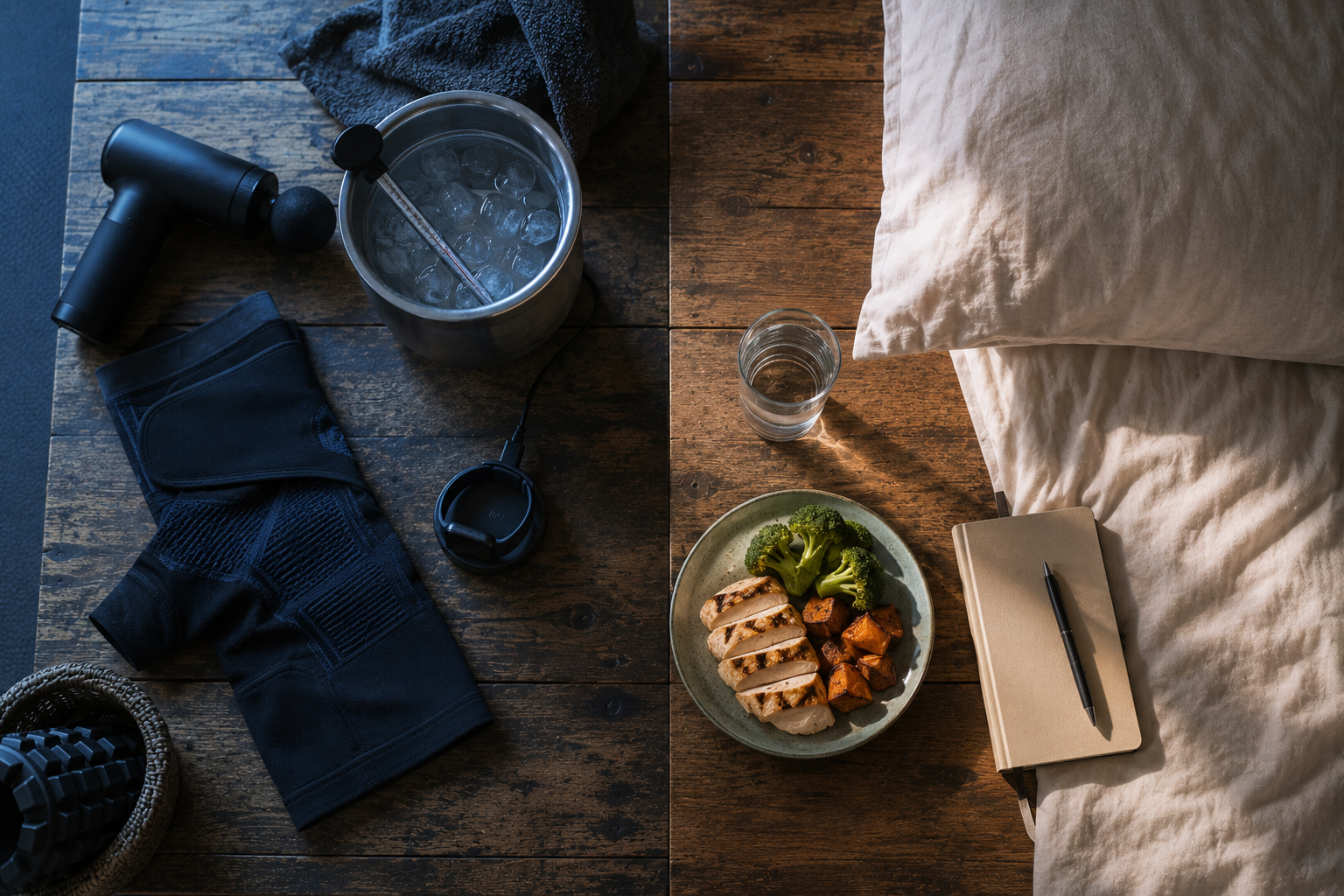
- Cold water immersion has a genuine, time-limited effect on perceived soreness in the first 24 hours, useful before a same-week competition when feeling fresher matters more than long-term adaptation.
- Compression garments offer a small, low-cost, low-risk boost to strength and power recovery, particularly for trained athletes doing repeated-effort sessions close together.
- Massage guns feel good and may reduce localized swelling; treat them as a comfort and mobility tool, not a performance-restoring one.
- Sauna and heat exposure show more promise as a long-term training adaptation tool used consistently over weeks than as a same-day recovery fix, and the cortisol response to a first session is worth knowing about before assuming more heat is automatically better.
- HRV wearables are not recovery interventions at all. They are measurement tools. Their value lies in surfacing patterns, a week of declining readiness alongside declining sleep, for example, that prompt a fundamentals check rather than a shopping trip.
Used this way, tools become a fine-tuning layer on a system that is already working, not a repair kit for one that is not.
Why the tools feel bigger than the data says they are
Three ordinary psychological forces inflate the perceived value of recovery gadgets. First, novelty and ritual: stepping into cold water or strapping on a device is a deliberate act that itself signals care, and that signal produces a real, if partly placebo-driven, sense of improvement. Second, marketing narrows attention to the moment of use rather than the accumulated weeks of sleep debt sitting underneath it. Third, sunk cost: once money has been spent on a device, there is a motivated incentive to believe it works, and to notice sessions where soreness happened to improve rather than the sessions where it did not.
None of that makes the psychological benefit fake. Feeling cared for and in control of your recovery has real value, including for adherence to training in general. It just means the size of that value should not be confused with the size of the physiological effect measured in a controlled trial.
There is also a simpler explanation worth naming: tools are legible in a way that habits are not. A massage gun produces an immediate sensation you can point to. A consistent bedtime produces a benefit that accumulates quietly over weeks and is easy to attribute to something else, a good training block, a lighter work week, better weather. Human attention is drawn to the vivid and immediate over the slow and cumulative, even when the slow and cumulative input is doing more of the actual work. Recognizing that bias is most of what it takes to correct for it.
A practical priority order
If you are deciding where to put limited time, money, and attention, the evidence across this series points to a consistent order. Fix the base of the pyramid before adding to the top.
The order is not arbitrary. Tiers one through three have the largest and broadest evidence base and, not coincidentally, are also free or low cost. Tier four is often skipped because it is harder to quantify, but the injury and performance data treat it as load, not an afterthought. Tier five is a diagnostic layer: useful for noticing when tiers one through four are slipping, not a substitute for fixing them. Tier six is where most of the marketing budget in this space is spent and where, per session, the evidence supports the smallest individual return.
Buy the sleep first. Everything else is optimization on top of a system that either works or doesn’t.
A simple way to check your own priorities
Before adding another recovery tool to your routine, it is worth running a short honest audit. Are you consistently getting seven or more hours of sleep on most nights? Are you eating enough total food and enough protein to support your training volume? Has your training load increased sharply in the last two to three weeks without a corresponding easier week? Do you have any deliberate practice for managing stress outside of training? If the answer to any of these is no, that gap is very likely worth more than the next device on your wish list, and closing it costs nothing beyond attention and consistency.
This is not a call for austerity. If a massage gun makes your Tuesday feel better and you can afford it, use it. The point of sizing the evidence honestly is not to shame anyone out of a cold plunge; it is to stop the fundamentals from quietly losing the competition for attention against tools that are easier to buy than habits are to build.
A note on individual variation
Nothing here should be read as a universal rule that applies identically to every body. Some people respond more strongly to heat exposure than others; some notice a real subjective difference from compression garments during multi-day tournaments that a group-level average effect size does not fully capture; some athletes genuinely train better with a wearable nudging them toward earlier bedtimes than they would otherwise choose. Effect sizes describe averages across groups of study participants, not guarantees for any one person. The practical use of this priority order is not to override your own observed response to a given tool, it is to make sure the fundamentals are not being skipped in favor of it. If sleep and nutrition are already solid and a particular modality reliably helps you, that is a legitimate reason to keep using it, regardless of where it ranks in a meta-analysis.
Frequently asked questions
Do recovery tools like cold plunges or massage guns actually do anything?
Yes, but the effects are generally small and narrow. Cold water immersion measurably reduces soreness in the first 24 hours; compression garments produce a small strength and power recovery benefit; massage guns may reduce local swelling and improve comfort. None of these match the size or breadth of effect from correcting a sleep, nutrition, or training load deficit.
What matters most for recovery if I can only fix one thing?
Sleep. It has the most consistent evidence across performance, hormonal, and injury-risk outcomes of anything covered in this series, and a two-week behavioral sleep hygiene intervention has been shown to produce measurable performance gains with no equipment involved.
Is it a waste of money to buy recovery gadgets?
Not necessarily, but sequencing matters. Recovery tools deliver their advertised benefit most reliably once sleep, nutrition, and training load are already well managed. Buying a device to compensate for chronic under-sleeping or under-eating is unlikely to close that gap.
Are HRV wearables worth using?
They are measurement tools, not treatments. Their usefulness lies in flagging trends, a stretch of declining readiness scores, for example, that prompt you to check sleep, load, and stress rather than in producing recovery on their own.
How much protein do I actually need for recovery?
Roughly 1.6 to 2.2 grams per kilogram of body weight per day for most people training regularly, spread across meals. Supplements like creatine and omega-3s can add a further, moderate benefit, but only on top of an already adequate diet.
Does a deload week count as a recovery tool?
It is better thought of as prevention rather than a tool. Managing training load, including planned lighter weeks, reduces the accumulated damage that recovery modalities are then asked to fix after the fact, and the injury-risk evidence around workload spikes supports treating it as a priority rather than an optional extra.
Why do recovery tools feel more effective than the research suggests?
Novelty, ritual, and the ordinary psychology of having spent money on something all inflate perceived benefit. That subjective boost is real and not meaningless, but it should not be confused with the physiological effect size measured in controlled trials.
In this series
This wraps up our 28-part look at recovery science and deloading. Along the way we covered how training load monitoring and the acute:chronic workload ratio relate to injury risk, why sleep architecture and consistency shape next-day performance more than most people assume, and how the evidence behind popular recovery modalities, from cold immersion to compression to heat exposure, holds up under closer inspection. If there is one thread running through all 28 articles, it is this: recovery is mostly built, not bought. Thank you for following along.
References
- Wu J, Wang A, Hu H, Zhang H. Impact of different cryotherapy interventions on post-exercise acute delayed-onset muscle soreness, athletic performance, and inflammatory biomarkers: a systematic review and network meta-analysis. Front Sports Act Living. 2026. doi.org/10.3389/fspor.2026.1819396
- Liu S, Ma Y. Effects of cold water immersion vs body cryotherapy on delayed onset muscle soreness and jump performance following acute strenuous exercise. Medicine (Baltimore). 2026. doi.org/10.1097/md.0000000000046781
- Li X, Su H, Du L, Li G, Lv Y, Liu X, Feng L, Yu L. Effects of Compression Garments on Muscle Strength and Power Recovery Post-Exercise: A Systematic Review and Meta-Analysis. Life (Basel). 2025. doi.org/10.3390/life15030438
- da Rosa Castilho A, Aguiar AF, Ribeiro AS, Cônsolo IF, Quirino FSP, de Oliveira RF, Andraus RAC. Acute Effect of Percussive Massage on Cross-Section Area, Muscle Strength, and Late Muscle Pain of the Quadriceps Muscle Following a Fatigue Protocol. Physiother Res Int. 2026. doi.org/10.1002/pri.70246
- Ahokas EK, Hennessy RS, Hanstock HG, Kyröläinen H, Ihalainen JK. Effects of Post-Exercise Heat Exposure on Acute Recovery and Training-Induced Performance Adaptations: A Systematic Review. Sports Med Open. 2025. doi.org/10.1186/s40798-025-00910-0
- Salivary cortisol response to post-exercise infrared sauna declines over time. Temperature (Austin). 2025. doi.org/10.1080/23328940.2025.2493460
- Liu J, Li Q, Han Y. Efficacy of post-exercise recovery strategies for elite soccer players: a network meta-analysis. Front Physiol. 2026. doi.org/10.3389/fphys.2026.1760392
- Broodryk A, Broodryk R. A 14-Day Sleep Hygiene Intervention Improves Aerobic Performance and Reduces Anticipatory Cortisol in University Soccer Players. Sports (Basel). 2026. doi.org/10.3390/sports14050179
- Li N, Quan Z, Pang D, Jin D. Sleep quality and injury risk in adolescent football players: an amplified effect for high-risk athletes revealed by quantile regression. Front Public Health. 2026. doi.org/10.3389/fpubh.2026.1799229
- Wang Z, Qin G, Kim BM. Comparative Effects of Dietary Protein, Creatine, and Omega-3 Supplementation on Muscle Strength, Endurance, and Recovery in Trained Athletes: A Systematic Review and Network Meta-Analysis. Nutrients. 2026. doi.org/10.3390/nu18060909
- Chelladurai A, Raman SA, Kirthen H, Nandana A, Thiruvengadam G, S S N, K A T, Sivaraman A. Quantifying Workload and Injury Risk Among Cricket Fast Bowlers: A Systematic Review and Meta-Analysis. Cureus. 2026. doi.org/10.7759/cureus.104847
- Madaleno F, Ocarino J, Verhagen E, Pinheiro L, Wezenbeek E, Witvrouw E, Albieiro Gonçalves D, Moraes LS, de Mello MT, Silva A, Resende R. Daily stress, sleep, fatigue and muscle soreness and their associations with injury and time loss in Para athletes: a 50-week prospective study. BMJ Open Sport Exerc Med. 2026. doi.org/10.1136/bmjsem-2025-002950
- Sundresh N, Premkumar SVD, Raman SA, K R R, Keddin Alwar T, Sivaraman A, Baig S, Ethirajan P. Low Energy Availability in Male Indian Athletes: A Cross-Sectional Study. Cureus. 2026. doi.org/10.7759/cureus.109312