




















By Noah Sato
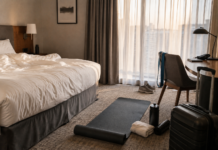
A cramped room, a suitcase that ate your sneakers, and a schedule that has you back at a conference table by 8 a.m. This is the reality most travelers face when they think about staying active on the road, and it’s exactly why so many people just skip exercise entirely during trips. The good news is that a hotel room is a perfectly functional gym if you know which moves actually pull their weight and which ones are just filler you saw in a magazine once.
This guide sorts through the noise. It covers the hotel workouts backed by real exercise science, the ones you can do in the square footage between the bed and the window, and how to structure them so a 20-minute session on a Tuesday morning in a Marriott actually counts toward your fitness, not just your step count for the day.
Why Hotel Room Workouts Are Worth Taking Seriously
It’s tempting to write off a hotel session as a token gesture, something to make you feel less guilty about the minibar. But bodyweight training, done with intent, is a legitimate form of resistance exercise. The World Health Organization and the U.S. Centers for Disease Control and Prevention (CDC) both frame the weekly target the same way: adults should get at least 150 minutes of moderate-intensity aerobic activity (or 75 minutes of vigorous activity) plus muscle-strengthening work that hits the major muscle groups at least two days a week. Neither agency requires a barbell to meet that second part. The CDC’s guidance explicitly lists push-ups and sit-ups as valid muscle-strengthening activities, right alongside resistance bands and weight machines.
That matters for travelers because a hotel room, a hallway, or a stairwell gives you everything needed to satisfy that strength-training requirement without ever touching a piece of equipment. The obstacle isn’t capability, it’s usually motivation and structure, which is what the rest of this piece is built to fix.
“Muscle-strengthening activities should work all major muscle groups, including the legs, hips, back, abdomen, chest, shoulders, and arms, at least two days a week.”
— CDC Physical Activity Guidelines for Adults
There’s also a broader public-health backdrop worth understanding. According to the World Health Organization, roughly 31% of adults worldwide do not meet recommended physical activity levels, a figure that rose about five percentage points between 2010 and 2022. Travel is one of the more common reasons routines fall apart: gym access disappears, schedules compress, and it feels easier to just wait until you’re home. WHO data also links insufficient activity to a 20% to 30% higher risk of death compared with people who are active enough, which is a strong argument for treating even a short in-room session as worth doing rather than skipping it entirely.
What Actually Makes a Hotel Workout “Worth Doing”
Not every in-room exercise pulls equal weight. Before getting into specific routines, it helps to know the criteria that separate a workout worth your 20 minutes from one that’s mostly motion.
- It loads a major muscle group hard enough to matter. Slow, controlled bodyweight squats or push-ups to near-fatigue can create meaningful strength stimulus, especially for anyone who isn’t already advanced. Twenty half-hearted jumping jacks do not.
- It fits genuinely small spaces. Most hotel rooms give you roughly a 6-by-6-foot clear patch of floor once the furniture is pushed aside. A move that needs a full-length lunge walk across the room isn’t realistic in a standard room.
- It doesn’t require gear you didn’t pack. Bodyweight, a resistance band, or furniture that can safely bear weight (a sturdy chair, the edge of the bed frame) should be the only “equipment.”
- It’s quiet enough for the guest below you. Burpees and jump squats on a hard floor at 6 a.m. are a fast way to get a call from the front desk.
- It can scale to your actual fitness level and time. A workout worth doing on a rushed morning is one you’ll actually finish, not an ambitious plan you abandon halfway through.
The Core Hotel Room Exercise List
Below are the movements that meet the criteria above, organized by what they train. These are the foundation for the full routines later in this article.
Lower Body
- Bodyweight squats: quads, glutes, hamstrings
- Reverse lunges (stationary, so they don’t need much floor length): quads, glutes, balance
- Glute bridges: glutes, hamstrings, lower back
- Calf raises off a stair or the edge of a phone book/thick towel roll: calves
- Wall sits: quads, isometric endurance
Upper Body
- Push-ups (standard, incline on the bed frame, or knee-modified): chest, shoulders, triceps
- Chair or bed-frame dips: triceps, shoulders
- Pike push-ups: shoulders
- Doorway rows with a towel looped around a sturdy door handle (use caution and test the door’s stability first): back, biceps
Core
- Plank holds (front and side): full core, stability
- Dead bugs: deep core, spinal control
- Bicycle crunches: obliques, rectus abdominis
- Mountain climbers (low-impact pace for quiet execution): core plus light cardio
Cardio / Conditioning
- Step-ups onto a sturdy chair or the end of the bed frame
- Shadow boxing: quiet, effective, needs almost no space
- Stair climbing in the hotel stairwell: one of the most underused resources in most hotels
- High knees in place, done at a controlled pace to keep noise down
Three Routines, Sorted by Time and Goal
Structure beats a random exercise list every time. Here are three routines built around realistic travel constraints: the pre-meeting quickie, the standard session, and the strength-focused version for longer stays.
12-Minute Express Circuit (No Equipment)
For the morning you have exactly one alarm snooze to spare. Perform each move for 40 seconds, rest 20 seconds, and go through the full circuit twice.
- Bodyweight squats
- Push-ups (any variation)
- Reverse lunges (alternating legs)
- Plank hold
- High knees (controlled pace)
- Glute bridges
Total time: about 12 minutes including transitions. This kind of short, higher-effort interval work is worth knowing about beyond convenience: research summarized by Harvard Health notes that after a stretch of interval-style training, metabolism can stay elevated for up to a full day, an effect often called excess post-exercise oxygen consumption, or EPOC.
25-Minute Full-Body Session
The standard option for a normal travel morning. Three rounds, 45 seconds of work per move, 15 seconds to transition, 60 seconds of rest between rounds.
- Push-ups
- Bodyweight squats
- Doorway rows (towel method) or chair rows
- Reverse lunges
- Pike push-ups
- Bicycle crunches
- Wall sit
- Mountain climbers (low-impact pace)
35-Minute Strength-Focused Session (Longer Stays)
Best for extended trips where you want to actually build strength rather than just maintain it. Slower tempo, more focus on control, fewer but harder reps. Aim for 4 sets of 8-12 controlled reps per move, resting 60-90 seconds between sets.
- Slow-tempo push-ups (3 seconds down, 1 second up)
- Single-leg glute bridges
- Chair or bed-frame dips
- Bulgarian split squats using the bed or a chair for the rear foot
- Pike push-ups
- Side plank with hip dips (each side)
Comparing the Three Approaches
Here’s a side-by-side look at when each routine actually makes sense, so you’re not guessing on a groggy morning.
Don’t Skip the Stairwell
Of everything covered here, the hotel stairwell is probably the most underrated tool available, and it’s one most travelers walk past every day without a second thought. Climbing stairs is a legitimate cardio and lower-body strength activity that requires zero setup and works in essentially every hotel with more than two floors. A few flights up and down, repeated for 10-15 minutes, delivers a genuine cardiovascular workout, and it satisfies the “vigorous intensity” category the CDC and NHS both reference when they note that shorter bouts of harder effort can substitute for longer moderate sessions. If your hotel has 10 or more floors, “stairwell repeats” (walk or jog up, walk down to recover, repeat) is worth building into your trip alongside or instead of an in-room circuit.
Common Mistakes That Waste Your Time
A lot of travelers do attempt some version of a hotel workout and still get little out of it. Usually the problem isn’t effort, it’s one of these habits creeping in.
Treating Every Move as a Warm-Up
Ten easy push-ups followed by ten easy squats followed by a light plank isn’t a workout, it’s a warm-up for a workout that never happens. The exercises on the list above are only useful when they’re pushed close to the point where good form starts to break down. If you can easily do another five reps after “finishing” a set, the set wasn’t hard enough to drive adaptation.
Skipping Lower Body Work
Upper body moves like push-ups feel more familiar to a lot of people, so squats, lunges, and glute bridges quietly get dropped from the routine. That’s a mistake: the legs and hips are the largest muscle groups in the body, and neglecting them leaves a real gap in a “full body” claim.
Rushing Through Reps
Fast, bouncy reps rely on momentum rather than muscle, which lowers the actual training effect even if the exercise looks the same from across the room. Slowing down, especially on the lowering portion of a push-up or squat, keeps tension on the working muscle for longer and tends to make bodyweight exercises noticeably harder without changing the movement itself.
Only Working Out on “Good” Days
Waiting for a day with a wide-open schedule means most trips end up with zero workouts, because that day rarely shows up. The 12-minute circuit exists specifically so a packed day still gets something rather than nothing. Consistency across short sessions beats an occasional long one.
Tracking Progress Without a Gym Logbook
One reason home or hotel training feels less “real” to some people is that there’s no machine stack telling you the number went up. That doesn’t mean progress can’t be tracked, it just needs a slightly different approach.
- Reps at the same tempo. If you did 15 slow push-ups last week and can now do 20 at the same controlled pace, that’s genuine progress.
- Time under tension. Holding a plank or wall sit longer than your last trip, even by 15-20 seconds, reflects real endurance gains.
- Rest needed between rounds. Needing less recovery time between circuit rounds is a sign your conditioning is improving, independent of the exercises themselves.
- How the routine feels subjectively. A workout that used to leave you wiped out and now feels merely challenging is data, even without a number attached to it.
Keeping a simple note on your phone (exercises, reps, how it felt) after each hotel session takes under a minute and turns a string of one-off workouts into something you can actually compare over time.
Sample Step-by-Step Warm-Up (Do This First, Every Time)
Skipping a warm-up in a hotel room is a common mistake, mostly because people are rushing. Two to three minutes fixes this. It matters more when you’re stiff from a flight or a long day of sitting in meetings.
3-Minute Pre-Workout Warm-Up Checklist
- ☐ 20 arm circles (each direction)
- ☐ 10 bodyweight squats, slow and controlled
- ☐ 10 walking lunges in place (alternating)
- ☐ 15 torso twists
- ☐ 20 seconds of light marching in place
Making It Fit Your Actual Trip
If You Have Almost No Time
Pick three moves from the exercise list, one from each category (lower body, upper body, core), and do 3 rounds of 30-45 seconds each. That’s a functional 8-minute session, and it still counts toward the muscle-strengthening target the CDC and NHS both cite.
If You’re Sharing a Room
Stick to quiet movements: planks, wall sits, glute bridges, pike push-ups, dead bugs. Skip jumping variations and mountain climbers at a fast pace.
If You’re Dealing With Jet Lag
Timing matters here. Research summarized by the Sleep Foundation notes that moderate to vigorous exercise can reduce the time it takes to fall asleep and cut down on time spent awake during the night, which is useful when your internal clock is scrambled. That said, the same research flags that vigorous workouts within about an hour of bedtime can reduce sleep efficiency for some people, so save the harder circuits for morning or midday and lean on gentler stretching or a short walk if you’re exercising close to lights-out.
If You Actually Want to Build Strength, Not Just Maintain It
Progression is still possible without weights. Slow the tempo down (a 3-4 second lowering phase on push-ups and squats), add single-limb variations (single-leg glute bridges, Bulgarian split squats, one-arm-supported planks), or extend time under tension by holding the hardest position of a move for a few extra seconds. These are the standard ways trainers make bodyweight work harder once basic reps stop feeling challenging.
Safety Notes Worth Actually Reading
A hotel room is not a gym floor, and a few practical precautions go a long way:
- Check that any furniture you’re using for step-ups, dips, or rows is stable before putting weight on it. Hotel furniture varies a lot in build quality.
- Clear the immediate area of glass, lamps, and low furniture before doing anything with a wide range of motion, like lunges or mountain climbers.
- If you’re jet-lagged, dehydrated from a flight, or simply exhausted, scale the intensity down. A short mobility-focused session beats pushing through a hard circuit on no sleep.
- If you have any existing joint issues, cardiovascular conditions, or are new to exercise altogether, it’s worth talking to a doctor before starting a new routine, including a bodyweight one. This is standard advice from public health bodies for anyone beginning a new activity program, and it applies just as much to a hotel room as it does to a gym.
- Stop and reassess if you feel sharp pain, dizziness, or chest discomfort. That’s not a “push through it” situation under any circumstances.
What to Pack So the Routine Actually Happens
None of this requires much, but a couple of small items make a real difference in whether the workout happens at all:
- A resistance band or two: light and heavy tension. These pack flat and open up rows, presses, and lateral work that bodyweight alone can’t replicate as easily.
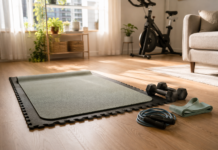
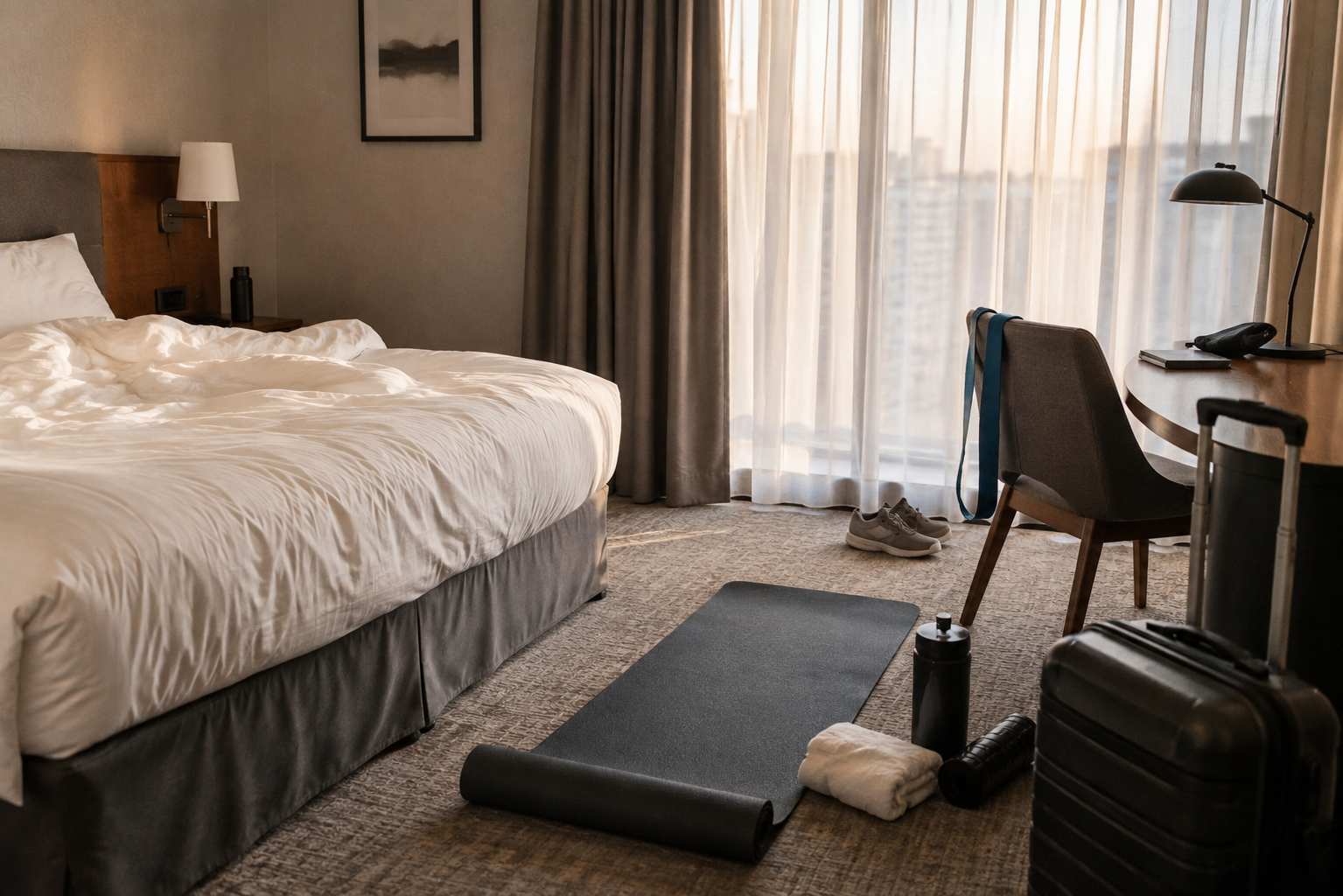
- A yoga mat or thin travel mat: hotel carpet is not always clean or cushioned enough for planks and floor work, and a hard bathroom tile floor is uncomfortable without one.
- Real shoes, not just dress shoes or sandals: even one pair of trainers changes what’s possible, especially for stairwell work.
- A phone timer or basic interval app: removes the guesswork on rest periods and keeps the session moving.
Frequently Asked Questions
Can a hotel room workout actually replace a gym session?
For most people traveling for a few days to a couple of weeks, yes, at least as a maintenance strategy. Bodyweight training with proper intensity (near-fatigue reps, controlled tempo, minimal rest) can meet the muscle-strengthening component of national activity guidelines, which don’t specify equipment, only that the major muscle groups get worked at least twice a week. It won’t fully replace heavy barbell training for someone chasing serious strength gains over months, but for the length of a typical trip, it’s a legitimate substitute, not a consolation prize.
How long should a hotel room workout be to actually count?
There’s no strict minimum, but somewhere between 10 and 30 minutes of focused work, done with real effort, is enough to be meaningful. The CDC’s guidance allows for activity to be broken into smaller chunks throughout the day rather than one long session, so even two 10-minute bouts can add up.
Is it okay to do a hard workout the day I land after a long flight?
It depends on how you feel. Light to moderate movement, like the warm-up sequence or a short walk, is generally fine and can help with circulation after sitting for hours. A maximum-effort circuit on very little sleep is a judgment call; scaling down the intensity is usually the smarter move, and if you have any underlying health conditions, checking with a doctor before undertaking a strenuous travel routine is a reasonable precaution.
What if my hotel room genuinely has no floor space?
Isometric holds (wall sits, planks against the bed) and standing exercises (calf raises, standing pike variations against the wall, step-ups on a bathroom step) need almost no clear floor area. Doorway rows and chair-based moves are also space-efficient options.
Do I need a resistance band, or is bodyweight enough?
Bodyweight alone is enough to satisfy general strength-training guidelines, especially for beginners to intermediate exercisers. A band is a nice-to-have that adds variety and makes pulling movements (rows) more effective, since bodyweight training is naturally push-dominant. It’s optional, not required.
How do I keep a hotel workout quiet enough not to disturb other guests?
Favor controlled, low-impact versions of moves: step in place instead of jumping, slow mountain climbers instead of fast ones, and skip anything involving jumping jacks or box jumps on a hard floor. A mat under your feet also helps absorb noise and protects the flooring.
The Bottom Line
A hotel room won’t replace a fully equipped gym, and it’s not supposed to. What it offers is a way to keep a strength habit intact instead of hitting pause every time you travel. Pick a routine that matches the time you actually have, treat the effort seriously rather than going through the motions, and use the stairwell when you get the chance. Do that consistently across a handful of trips a year and it adds up to a real difference, not just a box checked on a to-do list.
The bigger pattern worth noticing is how travel fitness connects to the rest of your routine. Someone who trains three or four times a week at home but goes completely dormant for every business trip is, over a year of regular travel, losing a meaningful chunk of their total training days. Treating hotel sessions as a real part of the plan, not an afterthought squeezed in only when everything else lines up, is what actually closes that gap. None of the routines above require talent or a special background, just a willingness to use the floor space you already have.
References
- CDC: Physical Activity Guidelines for Adults
- World Health Organization: Physical Activity Fact Sheet
- NHS: Physical Activity Guidelines for Adults Aged 19 to 64
- Harvard Health Publishing: The Truth About Metabolism
- Sleep Foundation: Exercise and Sleep
- American College of Sports Medicine: Physical Activity Guidelines