
























By Olivia Bennett
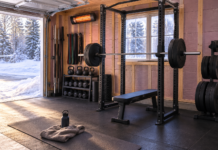
A spare bedroom corner. The gap beside a couch. A patch of hallway barely wide enough to stretch your arms out. That is roughly two square metres, and it is genuinely enough room to build a strength and conditioning setup you can use every single day without moving furniture around first. You don’t need a converted garage or a rack of chrome plates to get stronger, move better, and keep a consistent habit going. You need a plan, a short list of the right equipment, and a system for keeping it tidy enough that you’ll actually use it.
This guide walks through exactly how to measure, equip, and organize a home gym that fits inside roughly 2 square metres (about 21.5 square feet), plus how to structure workouts that make full use of that small footprint. It’s written for renters, apartment dwellers, and anyone who has decided that “I don’t have space” is no longer a reason to skip strength training.
Why a Two-Square-Metre Gym Is Enough
Global health data makes the case for doing something, even something small, better than most marketing copy ever could. The World Health Organization estimates that 31% of adults worldwide, roughly 1.8 billion people, do not meet recommended physical activity levels, a figure that has climbed 5 percentage points since 2010 and is projected to reach 35% by 2030 if current trends continue. Inactivity rises sharply after age 60, and women are consistently about 5 percentage points less active than men across most regions tracked.
Against that backdrop, the amount of equipment required to meet baseline strength guidelines is smaller than most people assume. The U.S. Centers for Disease Control and Prevention recommends that adults get muscle-strengthening activity that works all major muscle groups (legs, hips, back, abdomen, chest, shoulders, and arms) at least 2 days per week, alongside 150 minutes of moderate-intensity aerobic activity or 75 minutes of vigorous activity weekly. The NHS gives the same baseline: strength exercises “at least twice a week.” Neither guideline mentions a squat rack, a cable machine, or a dedicated room. A pair of adjustable dumbbells, a band, your own bodyweight, and roughly the floor space of a yoga mat cover every muscle group on that list.
Mayo Clinic’s strength training guidance adds useful specifics for beginners: a single set of 12 to 15 repetitions performed with proper form and enough resistance to fatigue the muscle can build strength efficiently, done at least twice weekly with a full rest day between sessions targeting the same muscle group. That’s a realistic, low-volume starting point, and it’s exactly the kind of training a compact space handles well, since you’re not chasing heavy barbell lifts that need a full range of motion and spotter clearance.
Before You Start: Measuring, Flooring, and Safety Basics
Before buying anything, walk your space with a tape measure. Two square metres can be a 1.4 x 1.4 metre square, a 1 x 2 metre rectangle, or an irregular L-shaped nook, so the actual dimensions matter more than the total area. You need enough clearance to fully extend your arms overhead and to lie down for floor work without your feet or head touching a wall or door.
Checklist before you buy anything
- Ceiling height of at least 2.2 metres if you plan to do any overhead pressing or jump rope
- A hard, level floor, or a floor you can protect with interlocking mats
- A wall you can safely mount a hook, shelf, or slim rack on (check for studs if the wall is drywall)
- Reasonable ventilation, since a small enclosed space heats up fast once you’re moving
- A nearby power outlet if you plan to use a phone, speaker, or fan during workouts
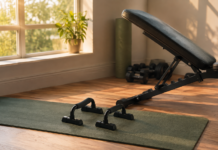
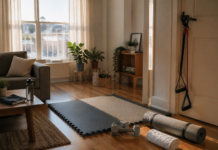
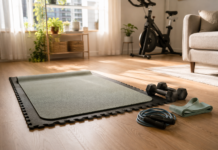
Flooring is the one purchase worth prioritizing over everything else. Interlocking rubber or foam tiles protect both your joints and your floor, muffle noise for anyone below or beside you, and visually mark out your training zone so the “gym” stays contained to its footprint rather than creeping across the room. A 2×2 metre set of tiles, trimmed to fit an odd-shaped corner if needed, is usually enough.
Before starting any new exercise program, especially if you have an existing health condition, joint issue, or haven’t trained in a while, it’s worth checking with a doctor or physical therapist first. Mayo Clinic’s guidance is direct on this: if an exercise causes pain, stop. Building strength should feel challenging, not sharp or joint-painful.
“A single set of 12 to 15 repetitions with the proper weight can build muscle efficiently.” That one line from Mayo Clinic’s strength training guidance is the entire argument for a small home gym: you don’t need volume, variety, or a warehouse of equipment to see real results. You need consistency and a handful of tools you’ll actually reach for.
The Core Equipment List: What Fits in Two Square Metres
Every item below has to earn its place through two tests: does it fold, stack, or hang out of the way when not in use, and does it let you train a genuine range of muscle groups. Here’s how the main options compare.
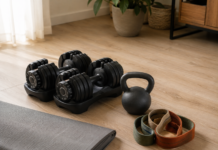
You don’t need every row in that table. A realistic starter setup is adjustable dumbbells or a resistance band set, a mat, and either a pull-up bar or a kettlebell, depending on whether you have a suitable door frame. That combination alone covers every major muscle group the CDC lists, and it stores inside a single under-bed box or a shallow wall shelf when you’re done.
Adjustable dumbbells versus resistance bands
This is the most common fork in the road for anyone building a micro gym, and the honest answer is that both work, for different reasons. Dumbbells give you a fixed, known resistance that’s easy to track and progress in small increments, which matters for anyone who wants a clear record of getting stronger over time. Bands are lighter, cheaper, quieter, and put less shear stress on joints, since resistance increases through the range of motion rather than staying constant. Harvard Health has noted that resistance training, whether from bands, dumbbells, or your own bodyweight, produces meaningful strength gains as long as the muscle is worked to fatigue with reasonable consistency. If your two square metres includes a lower floor or shared walls, bands are the quieter neighbor-friendly choice. If you want visible, trackable load progression, adjustable dumbbells are worth the extra cost.
Step-by-Step: Building Your Home Gym
Step 1: Measure and mark your footprint
Use painter’s tape or the edges of your mat to define the exact 2 square metre zone. This keeps the space psychologically separate from the rest of the room, which makes it far more likely you’ll actually step into “gym mode” rather than letting the area become general storage.
Step 2: Lay protective flooring
Install interlocking mats or a single thick folding mat across the full footprint. This protects both your joints during floor work and the floor itself from dumbbell drops or kettlebell swings.
Step 3: Choose your primary resistance tool
Pick one main strength tool based on your goals, noise constraints, and budget: adjustable dumbbells for trackable progression, or a resistance band set for a quieter, lower-cost, joint-friendly option. Buy this before anything else on the list.
Step 4: Add a vertical movement option
If your door frame allows it, install a doorway pull-up bar rated for your bodyweight. If not, a single kettlebell or a second, heavier band covers pulling and hinging movements like rows and deadlift patterns instead.
Step 5: Install wall storage
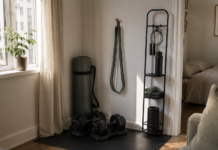
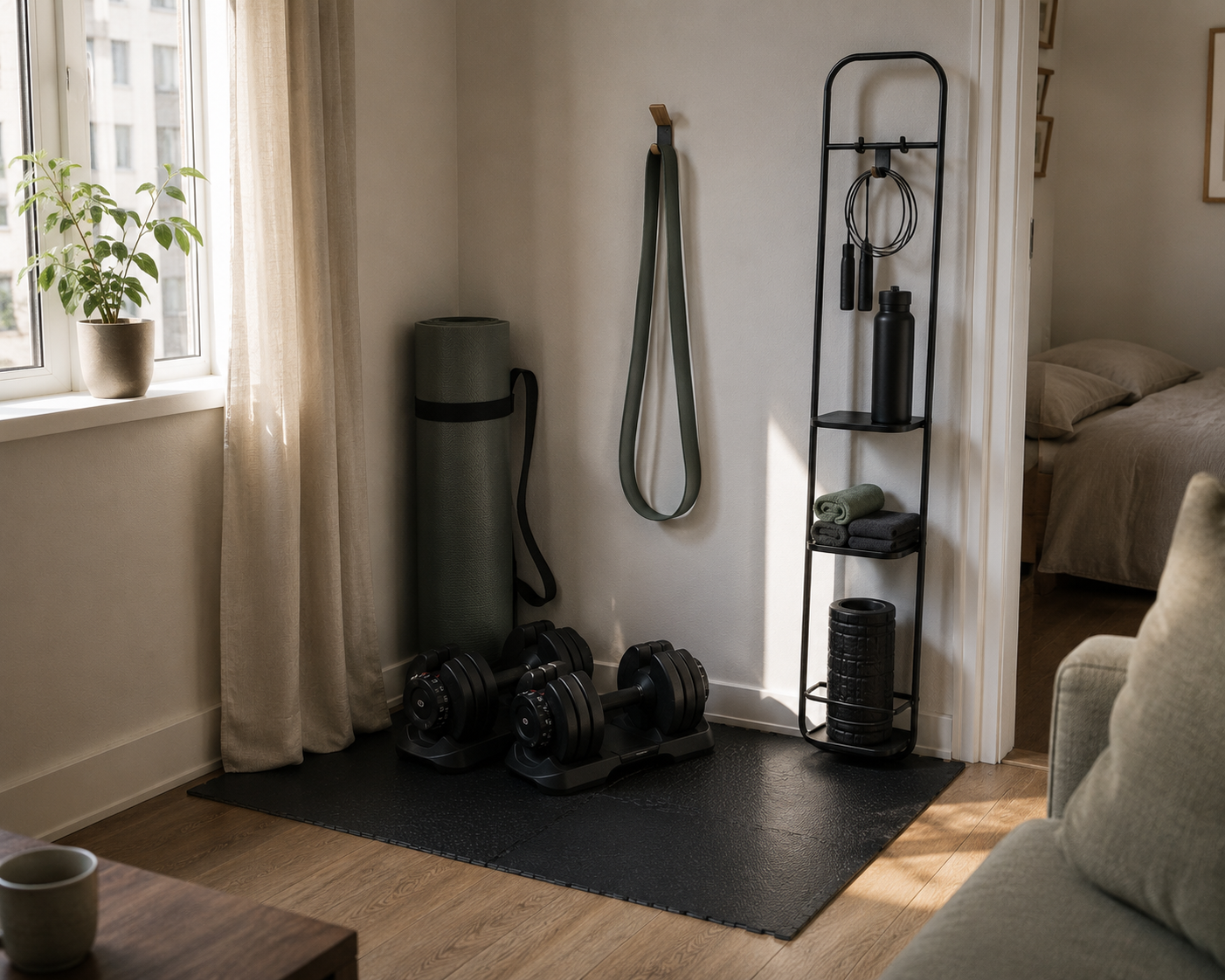
Mount a slim shelf, a set of hooks, or a small over-door organizer to keep bands, a mat, and a water bottle off the floor. Vertical storage is what keeps a 2 square metre gym from visually swallowing the room it sits in.
Step 6: Set up light and airflow
Position the space near a window if possible, or add a small clip-on fan. A stuffy corner gets skipped far more often than one with decent airflow, especially once a session pushes your heart rate up.
Step 7: Build your first weekly session plan
Write out (physically, on paper taped to the wall, or in a notes app) a simple two or three day per week split before your first workout. Knowing exactly what you’re doing when you step onto the mat removes the biggest barrier to consistency: decision fatigue.
Build-Out Timeline Checklist
- ☐ Day 1: Measure space, mark footprint with tape, order flooring
- ☐ Day 2–3: Install mats or interlocking tiles
- ☐ Day 4: Order primary resistance tool (dumbbells or bands)
- ☐ Day 5: Mount doorway bar or place kettlebell in a fixed spot
- ☐ Day 6: Install wall shelf or hooks for storage
- ☐ Day 7: Write your first weekly training split and do session one
A Sample Weekly Training Split for a Micro Home Gym
Following the CDC’s baseline of muscle-strengthening work at least twice a week and the NHS recommendation of the same, a simple two-day full-body split is a reasonable starting point for most healthy adults new to strength training. Mayo Clinic’s guidance of one set of 12 to 15 reps per exercise, with a full rest day between sessions hitting the same muscles, fits naturally into a small-space routine where you’re not juggling multiple stations.
Day A: Push and legs
- Goblet squats (dumbbell or kettlebell): 1–2 sets, 12–15 reps
- Standing shoulder press (dumbbell or band): 1–2 sets, 12–15 reps
- Wall or floor push-ups: 1–2 sets, to near fatigue
- Calf raises: 1–2 sets, 15 reps
Day B: Pull and core
- Bent-over rows (dumbbell or band): 1–2 sets, 12–15 reps
- Assisted or negative pull-ups (bar) or band pull-aparts: 1–2 sets
- Kettlebell or dumbbell deadlifts: 1–2 sets, 12–15 reps
- Plank or dead bug: 1–2 sets, 20–40 seconds
Add a third day of light mobility work, walking, or band-based cardio intervals if your goals lean toward the 150 minutes of moderate aerobic activity the CDC and WHO both reference. A jump rope, which stores in a coat pocket, is one of the few genuinely space-neutral cardio tools and pairs naturally with a strength-focused micro gym.
Budget Tiers: Three Ways to Build This Setup
Cost is often the real barrier, not space, so here’s what building this out looks like at three different budget levels.
Starter tier (roughly $60–$100)
One resistance band set, a folding mat, and a doorway pull-up bar. Covers every major muscle group at minimal cost and near-silent operation.
Mid tier (roughly $200–$350)
A single adjustable kettlebell, a quality mat, a band set for variety and warm-ups, and a wall shelf for storage.
Full tier (roughly $400–$600)
Adjustable dumbbells with a wide weight range, a doorway pull-up bar, a premium interlocking mat set, and proper wall-mounted storage for everything.
None of these tiers require anything close to a full square metre of permanently visible equipment. Everything above stores flat, on a hook, or inside a shoebox-sized footprint.
Common Mistakes in Small Home Gyms
Buying too much, too soon
The single biggest space killer is buying five pieces of equipment in the first week. Start with one primary resistance tool and a mat, use them consistently for a month, and only then decide what’s missing.
Skipping the floor protection
Dropped dumbbells and kettlebell swings damage floors and joints fast. A $30 set of interlocking tiles is cheaper than either a flooring repair or a knee injury.
No dedicated storage plan
Equipment left on the floor “just for now” is the fastest way for a 2 square metre gym to turn into 2 square metres of clutter that nobody wants to train in. Wall storage isn’t optional, it’s part of what makes the space usable long-term.
Ignoring ceiling height and clearance
Overhead presses and jump rope both need real vertical clearance. Test this before buying a barbell, an ambitious kettlebell swing plan, or a jump rope, not after.
Training in isolation with no plan for progression
Consistency runs out fast without a way to measure progress. Even a basic log of weights, reps, or band resistance level keeps sessions from becoming vague and directionless.
Adapting the Setup for Different Goals
Not everyone building a 2 square metre gym wants the same outcome, and the equipment list above flexes depending on what you’re actually training for.
If your goal is general strength and muscle
Prioritize adjustable dumbbells over bands. The ability to add small, specific weight increments (often as little as 1 to 2 kilograms per side) makes it far easier to track progressive overload over months, which is the main driver of long-term strength and muscle gains. Pair this with a simple written log so you know exactly what weight and rep count you used last session.
If your goal is weight management
Lean toward a mix that supports both strength and elevated heart rate: a jump rope, a kettlebell for swings and squats, and a resistance band for supersets between strength movements. Combining the CDC’s two weekly strength sessions with additional aerobic minutes, even short 10-minute bursts of jump rope or band-based circuits, adds up toward the 150-minute weekly aerobic target without needing separate cardio equipment.
If your goal is mobility or rehabilitation
A mat and a light resistance band set are usually sufficient, and in many cases preferable to heavier equipment. Bands allow controlled, low-load movement through a full range of motion, which is often exactly what a physical therapist recommends during recovery from an injury or for maintaining joint health as you age. Anyone training around an existing injury should still get individualized guidance from a physical therapist or doctor rather than relying on general equipment advice.
If your goal is general health maintenance
A minimal setup, one resistance band set plus a mat, genuinely covers the CDC and NHS baseline of twice-weekly strength work across all major muscle groups. There’s no requirement to buy more just because more exists. Matching your equipment to your actual goal, rather than to what looks impressive, is what keeps a small space useful rather than cluttered.
Choosing Which Corner of Your Home to Use
Not every corner that measures 2 square metres makes a good training spot. A few practical factors separate a corner you’ll use daily from one you’ll avoid.
- Proximity to daily paths: A space you walk past often (near a bedroom door, beside a home office) gets used more than one tucked in a rarely visited spare room.
- Noise tolerance: Ground-floor rooms or spaces away from shared walls give you more freedom for kettlebell swings or jump rope without disturbing neighbors.
- Temperature: Corners near exterior walls or poorly insulated windows can be uncomfortably cold or hot depending on season, which matters more than it seems once you’re training there several times a week.
- Visual clutter nearby: A gym corner next to a messy closet or overflowing laundry pile is psychologically less inviting than one that’s visually clear, even if the two square metres themselves are tidy.
Test a candidate corner for a week before committing to permanent flooring or wall mounts. Stand in it at the time of day you actually plan to train, since a corner that looks fine at noon can be dim, cold, or noisy in the early morning or late evening.
Maintaining Your Micro Gym Long-Term
A small footprint needs a little more discipline than a large one, mostly because there’s no room for equipment you’ve stopped using. Every few months, walk through your setup and ask honestly whether each item is still earning its space. Wipe down mats and equipment regularly, especially rubber and foam surfaces that trap sweat and odor in a small enclosed area. Rotate resistance bands out when they show cracking or thinning, since a snapped band at full stretch is a genuine injury risk in close quarters.
If your goals shift, for example toward more cardio-based training, swap out a piece of strength equipment for a jump rope or a set of ankle weights rather than trying to add more items to an already tight space. The discipline of a one-in, one-out policy is what keeps a 2 square metre gym functional five years in, not just five weeks in.
Frequently Asked Questions
Is 2 square metres really enough space for a full workout?
Yes, for the kind of strength and bodyweight training most health guidelines recommend. The CDC and NHS both call for muscle-strengthening work covering major muscle groups at least twice weekly, and that can be done with dumbbells, bands, and your own bodyweight in a footprint roughly the size of a large yoga mat plus a bit of clearance for arm and leg extension.
Do I need a doorway pull-up bar, or can I skip it?
You can skip it. Rows using a resistance band or a dumbbell cover similar pulling muscles (back, biceps, rear shoulders) without needing a suitable door frame. A pull-up bar is a useful addition, not a requirement.
What’s the minimum equipment I need to start?
A resistance band set and a mat is a genuinely complete starting point. Both cost under $100 combined, store in a small drawer, and let you train every major muscle group listed in CDC and NHS strength guidelines.
How often should I train in a small home gym?
Following CDC and NHS guidance, aim for at least two sessions per week covering all major muscle groups, with Mayo Clinic’s recommendation of a full rest day between sessions that target the same muscles. Three sessions a week, alternating push-focused and pull-focused days, works well for most beginners.
Will a small space limit my long-term strength gains?
Space is rarely the limiting factor for most people’s first one to two years of consistent training. Load, form, and consistency matter more than room size at the beginner and intermediate stages. Adjustable dumbbells with a wide weight range can carry a lot of that progression before space becomes a real constraint.
Is it safe to do strength training at home without supervision?
For most healthy adults using dumbbells, bands, and bodyweight movements, yes, as long as form is learned carefully (video tutorials or a session or two with a trainer can help) and any pain, not normal muscle fatigue, is treated as a stop signal. Anyone with an existing health condition, injury history, or who hasn’t exercised in a long time should check with a doctor before starting a new program.
References
- Centers for Disease Control and Prevention, “Physical Activity Guidelines for Adults” — cdc.gov/physical-activity-basics/guidelines/adults.html
- NHS, “Strength Exercises” — nhs.uk/live-well/exercise/strength-exercises
- World Health Organization, “Physical Activity Fact Sheet” — who.int/news-room/fact-sheets/detail/physical-activity
- Mayo Clinic, “Strength Training: Get Stronger, Leaner, Healthier” — mayoclinic.org/healthy-lifestyle/fitness/in-depth/strength-training/art-20046670
- Harvard Health Publishing, on resistance training and muscle fatigue for strength gains — health.harvard.edu/exercise-and-fitness