

























By Grace Watson
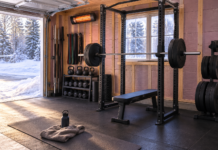
A garage rarely gets designed with January in mind. It gets a coat of epoxy, a rack, a bench, and a rubber mat, and for about eight months of the year that setup works fine. Then the first real cold snap hits, the temperature inside drops to somewhere close to the temperature outside, and every plan to train before work quietly falls apart. Builders in Minnesota, Alberta, the Dakotas, and anywhere else winter actually means something learn this the hard way: a garage gym is a building project first and an equipment purchase second.
This guide walks through what actually matters when you’re setting up a garage gym somewhere the mercury regularly drops below freezing: the building envelope, heating choices, flooring and equipment behavior in the cold, safety considerations that get skipped too often, and a realistic budget and build order. None of it requires turning your garage into a finished basement. It requires making a few deliberate choices before you bolt anything to the wall.
Why Cold Climates Change the Garage Gym Equation
Most garages are built to store cars and lawn equipment, not to hold a stable indoor temperature. They typically have little to no wall insulation, a single-pane or uninsulated overhead door, a concrete slab that sits directly on cold ground, and minimal air sealing around the door frame. None of that matters much for parking a car. All of it matters when you’re trying to do a strength session at 6 a.m. in February.
The Centers for Disease Control and Prevention notes that cold stress risk climbs “when temperatures drop below normal and as wind speed increases,” and that in regions not used to harsh winters, even near-freezing temperatures can be enough to create a real cold stress factor for the body. A garage that sits at 35°F is a different training environment than one held at 60°F, even though both would feel “cold” to someone walking in from outside. Cold air is denser, joints move less freely, grip strength drops, and the body burns extra energy just maintaining core temperature before a single rep happens.
None of this means a cold garage gym is unusable. It means the build has to account for three things: keeping heat in (insulation and air sealing), adding heat back (a heating strategy sized to the space), and protecting both the people and the equipment from the temperature swings a garage sees over a winter.
Start With the Building Envelope, Not the Equipment
It’s tempting to spend the whole budget on a rack and a barbell and figure out the heating later. Do it in the other order. A well-insulated, well-sealed garage holds heat efficiently enough that a modest heater keeps it comfortable; a leaky, uninsulated one will fight any heater to a draw, burning money without ever getting warm.
Air Sealing Comes Before Insulation
Before adding any insulation, seal the obvious gaps: weatherstripping around the service door, a sweep at the bottom of the overhead door, foam gaskets behind outlet and switch covers, and caulk around any pipe or wire penetrations. Air leaks let warm air escape and cold air in far faster than a poorly insulated but well-sealed wall does. This step costs relatively little and makes a noticeable difference before any insulation goes in.
Insulating Walls, Ceiling, and the Garage Door
The U.S. Department of Energy’s home insulation guidance explains that insulation works by slowing conductive and convective heat flow, and that its effectiveness is measured by R-value: the higher the number, the better the material resists heat transfer. Recommended R-values scale with climate zone, and a garage in a genuinely cold region should be treated more like the “colder zone” end of the chart than a mild one.
DOE-Recommended Insulation R-Values by Climate Zone
CI = continuous insulation applied as an external layer. Source: U.S. Department of Energy insulation guidance. Check your local building code for your specific zone before buying materials.
In practice, most garage gym builders use rigid foam board on the walls (it resists moisture better than fiberglass batts in a space that sees temperature swings and occasional condensation), and an insulated garage door kit or a full door replacement with a built-in foam core. The garage door is often the single biggest heat-loss point in the whole structure, so it’s worth prioritizing even if the walls stay bare a little longer.
Don’t Ignore the Slab
A bare concrete floor sitting on cold ground pulls heat out of the room (and out of your feet) constantly. Interlocking rubber gym tiles or foam mats add a thin insulating layer, but for a genuinely cold climate, a proper subfloor (plywood or insulated deck tile over a vapor barrier, topped with rubber flooring) makes a bigger difference than most people expect walking into the space for the first time.
Choosing a Heat Source That Fits a Garage Gym
Once the envelope is sealed and insulated, heating stops being an uphill battle. The right choice depends on your garage’s size, your electrical setup, and whether the space is attached to your house.
“More than 400 Americans die from unintentional carbon monoxide poisoning not linked to fires every year, with over 100,000 emergency department visits and more than 14,000 hospitalizations annually.” (CDC)
That single fact should shape every heating decision in a garage gym. Fuel-burning heaters (propane, natural gas, kerosene) produce carbon monoxide, and a garage, even an insulated one, is not automatically well ventilated. If you use any fuel-burning heater:
- Install a battery-operated or plug-in carbon monoxide detector in the space, and check it seasonally.
- Never run a generator inside the garage. The CDC recommends operating generators outdoors, more than 20 feet from any window, door, or vent.
- Follow the manufacturer’s clearance requirements around anything combustible, including exercise mats and wood platforms.
- Replace CO detectors roughly every five years, per manufacturer guidance.
Electric options sidestep the carbon monoxide question entirely and are the most common choice for garage gyms:
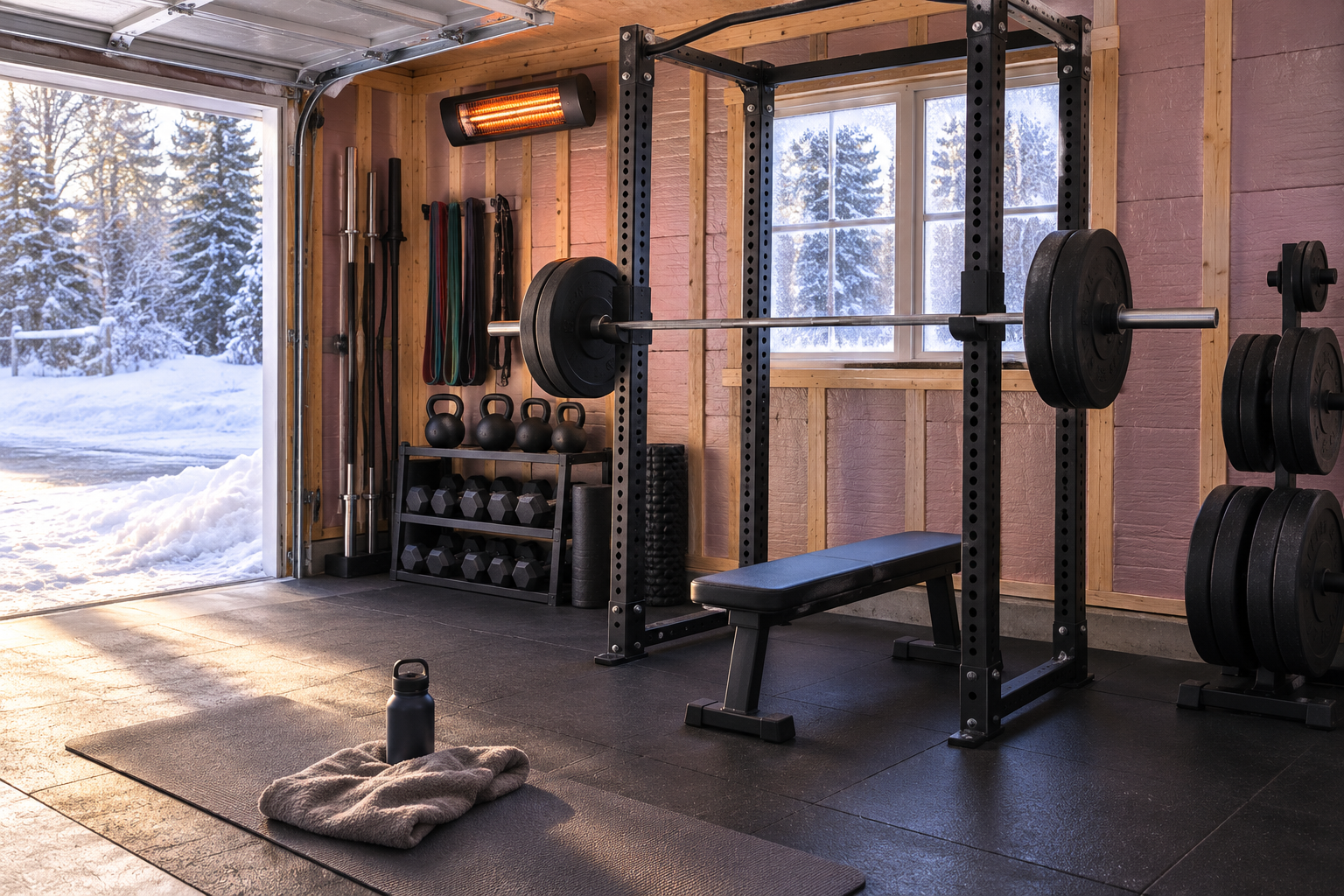
- Radiant (infrared) heaters warm people and objects directly rather than heating all the air in the room first, which suits a garage gym well since you mainly need to feel warm while moving, not maintain a living-room temperature around the clock.
- Forced-air electric heaters heat the whole volume of air faster but typically draw more power and cost more to run continuously.
- Mini-split heat pumps cost more upfront but heat (and cool, in summer) efficiently and quietly, and many garage gym owners who train year-round eventually land here.
Whichever option you choose, the National Fire Protection Association notes that home heating fires peak in December, January, and February, the exact months a garage gym gets used most for indoor training. Keep space heaters on a hard, level surface, at least three feet from mats, wood, and stored gear, and never left running unattended overnight.
How Cold Affects Your Body, and What to Do About It
Even a well-heated garage gym can dip in temperature near the floor or by the door, and plenty of people still train in a garage that’s cool rather than warm. Cold air makes muscles and connective tissue less pliable, which is part of why a proper warm-up matters more here than it does in a climate-controlled commercial gym.
Extend Your Warm-Up, Don’t Skip It
A five-minute warm-up that works fine in a 70°F gym is often not enough in a 50°F garage. Give yourself extra time for light cardio (rowing, cycling, jump rope, or brisk walking) to raise your core temperature before stretching or loading a barbell. Layer clothing so you can shed pieces as you warm up rather than starting a session already sweating through a heavy jacket.
Know the Warning Signs of Cold-Related Illness
This part isn’t meant to be alarming, just practical: a garage gym in a genuinely cold climate carries a small but real cold-exposure risk, particularly if the heating fails or you’re training very early or very late when temperatures are lowest. According to the Mayo Clinic, hypothermia sets in when core body temperature drops below 95°F (35°C), compared with a normal baseline around 98.6°F. Early signs include shivering, slurred speech, clumsiness, and unusual drowsiness or confusion. People experiencing hypothermia often aren’t aware of their own condition, which is exactly why it’s worth knowing the signs before you need them, rather than during a workout.
Frostbite is a separate but related risk, most likely to affect fingers, toes, ears, the nose, and cheeks, per Mayo Clinic guidance. It starts as a cold feeling followed by numbness and can progress to hard, waxy-looking skin. If it happens, the general first-aid guidance is to get out of the cold, avoid rubbing the area, rewarm gradually with warm (not hot) water for about 30 minutes, and seek medical care for anything beyond mild frostnip. Direct heat sources like heating pads or heat lamps are specifically discouraged on affected skin because compromised tissue burns easily.
The Mayo Clinic’s “COLD” Rule for Staying Warm
- C (Cover): Wear a hat and gloves; a lot of body heat escapes through the head and hands.
- O (Overexertion): Avoid working so hard you sweat heavily, since damp clothing loses insulating value fast.
- L (Layers): Wear loose, layered clothing. Wool and synthetic fabrics hold heat better than cotton.
- D (Dry): Change out of wet clothing (from sweat or melted snow) as soon as possible.
None of this is medical advice specific to your situation, and if you have a heart condition, Raynaud’s phenomenon, asthma that’s triggered by cold air, or another condition affected by temperature extremes, it’s worth talking to a doctor before training regularly in a cold garage.
Flooring and Equipment: What Cold Does to Your Gear
Cold temperatures don’t just affect comfort, they affect the equipment itself over a full winter of use.
Rubber Flooring
Standard rubber gym flooring gets stiffer and more brittle in cold conditions. Cheaper mats can develop small cracks at the edges over a few winters if the garage regularly swings from freezing to warm. Thicker mats (three-quarter inch or more) and higher-quality closed-cell rubber tend to hold up better than thin, budget interlocking tiles.
Barbells and Metal Equipment
Bare steel bars can develop condensation when a cold garage warms up quickly (say, when the heater kicks on before a session), and that moisture left sitting is what leads to rust, not the cold itself. Wiping bars down after use and choosing a coated finish (black oxide, zinc, or cerakote) instead of bare steel reduces maintenance in a garage that sees temperature and humidity swings.
Chalk, Bands, and Accessories
Resistance bands and anything rubber-based (jump ropes, floor guards) get less pliable in the cold and are more prone to cracking if stretched hard while stiff. Letting the space warm up for 20 to 30 minutes before a session that involves heavy band work isn’t a bad habit to build.
Ventilation and Moisture Control
A sealed, insulated, heated garage traps more moisture than an open, drafty one. Snow melting off boots, breath during a hard set, and the temperature swing between a cold morning and a heated afternoon all add humidity to the air. Left unmanaged, that moisture shows up as condensation on windows, rust on uncoated metal, or, over a longer stretch, mildew on drywall or wood framing. A small exhaust fan vented outside, or simply cracking a window for ten minutes after a heavy session, helps the space dry out between workouts. If you notice a musty smell or visible moisture on the ceiling, it’s worth checking the insulation for gaps before it becomes a bigger repair.
Lighting and Electrical Considerations
Cold weather is harder on electronics and older wiring than most people expect. If your garage gym relies on a space heater, a sound system, and lighting all running from the same circuit, an overloaded breaker becomes a real possibility during the exact months you’re using the space most. Have an electrician confirm the garage circuit can handle a heater plus your other equipment before you commit to a specific unit, and consider a dedicated circuit if the heater draws significant power. LED lighting also tends to perform more reliably in cold, unheated spaces than older fluorescent fixtures, which can flicker or dim at low temperatures.
A Practical Build Order for a Cold-Climate Garage Gym
Building in the wrong order is the most common (and most expensive) mistake. Here’s a sequence that avoids redoing work later.
Cold-Climate Garage Gym Build Checklist
- Air seal first. Weatherstrip doors, seal outlet gaps, add a bottom sweep to the overhead door.
- Insulate the garage door and walls. Prioritize the door; it’s usually the biggest single source of heat loss.
- Address the slab. Add a subfloor or thick rubber flooring system rated for the space you have.
- Install ventilation and a CO detector before any fuel-burning heater goes in, no exceptions.
- Add your heat source, sized to the square footage and insulation level you actually have, not a guess.
- Bring in equipment once the space holds a stable temperature, protecting anything electronic (like a phone or speaker) from being left in freezing temps overnight.
- Set a seasonal maintenance routine: wipe down metal after humid days, check flooring for cracking each spring, and test the CO detector monthly.
Budgeting Realistically
Costs vary enormously by region, garage size, and how much you do yourself, but a rough order of magnitude helps with planning. Air sealing and DIY rigid foam board insulation for a two-car garage is usually the smallest line item. An insulated garage door replacement or retrofit kit is a mid-size expense, often the single biggest one in the envelope phase. A quality electric radiant or forced-air heater sized correctly for the space is a moderate cost, while a mini-split system costs more upfront but tends to pay that back over several winters through lower running costs and dual-season use. Flooring and equipment costs are the same as they’d be in any climate, though it’s worth budgeting slightly more for thicker, cold-tolerant rubber if you’re skipping a subfloor.
A staged approach works well: seal and insulate one winter, add heating and flooring the next, and upgrade equipment as the space proves itself out. A garage gym that’s warm and dry with basic equipment gets used far more consistently than one with premium equipment sitting in a space nobody wants to walk into at 6 a.m. in January.
Common Mistakes to Avoid
A few patterns show up again and again in cold-climate garage gym builds:
- Insulating before air sealing. Gaps around doors and outlets undercut even good insulation.
- Oversizing a space heater and skipping ventilation planning. Bigger isn’t automatically safer or more efficient, and any fuel-burning unit needs a CO detector installed first.
- Ignoring the garage door. It’s easy to forget the door counts as a wall, and often the least insulated one.
- Skipping the extended warm-up. Cold muscles and joints need more preparation time, not less, before loading up.
- Leaving bare steel wet. Condensation from a fast temperature swing causes more rust damage over a winter than the cold itself.
- Treating the whole project as an equipment purchase. The building envelope determines whether any of the equipment gets used consistently through the winter.
Frequently Asked Questions
What temperature is actually too cold to train in a garage gym?
There’s no single universal cutoff, since tolerance depends on clothing, warm-up length, and individual health factors. As a practical guideline, most people find sustained training uncomfortable and higher-risk for strains below roughly 40–45°F, and grip strength and joint mobility both noticeably decline as temperatures drop further. If you’re shivering at rest before you’ve even started warming up, that’s a signal to add heat or clothing rather than push through.
Do I need to insulate the garage, or is a strong heater enough?
A powerful heater in an uninsulated, unsealed garage will run constantly and still struggle to hold a stable temperature, especially overnight or when the overhead door opens. Insulation and air sealing reduce how hard (and how expensive) the heater has to work, so they’re worth doing first even on a tight budget.
Is it safe to use a propane or kerosene heater in a garage gym?
Fuel-burning heaters can be used, but they produce carbon monoxide, and a garage isn’t automatically ventilated well enough to disperse it safely. A carbon monoxide detector is non-negotiable if you go this route, and manufacturer clearance and ventilation instructions should be followed exactly. Many garage gym owners find electric radiant or forced-air heaters simpler and safer for a space they’re standing in at 6 a.m. half-awake.
Will cold temperatures ruin my barbell or weight plates?
The cold itself doesn’t damage steel, but the condensation that forms when a cold garage warms up quickly can lead to rust if bars aren’t wiped down. Coated bars (black oxide, zinc, or cerakote) and a quick wipe-down habit after sessions go a long way toward preventing this.
How much warm-up time should I add for cold-weather training?
There’s no exact formula, but many coaches suggest roughly doubling a typical warm-up in a genuinely cold space, aiming for enough light cardio and dynamic movement to feel warm and slightly out of breath before you touch a loaded bar. Layering clothing so you can remove pieces as you warm up works better than starting a session bundled up and overheating halfway through.
What’s the single highest-priority upgrade for a cold garage gym on a limited budget?
Air sealing and insulating the garage door tend to deliver the most noticeable comfort improvement per dollar, since the door is usually the largest, least insulated surface in the room. A basic electric radiant heater paired with that sealed, insulated envelope will outperform an expensive heater fighting a leaky garage every time.
References
- Centers for Disease Control and Prevention, NIOSH: Cold Stress
- Mayo Clinic: Hypothermia: Symptoms and Causes
- Mayo Clinic: First Aid: Frostbite
- U.S. Department of Energy: Insulation
- Centers for Disease Control and Prevention: About Carbon Monoxide Poisoning
- National Fire Protection Association: Home Heating Safety
- Centers for Disease Control and Prevention: Winter Weather Safety
This article is for general informational purposes and does not replace individualized medical or professional advice. Consult a doctor before starting a new exercise program, especially if you have a heart condition or a cold-sensitivity disorder, and consult a licensed electrician or HVAC professional before installing heating or electrical equipment.