

























By Priya Nandakumar
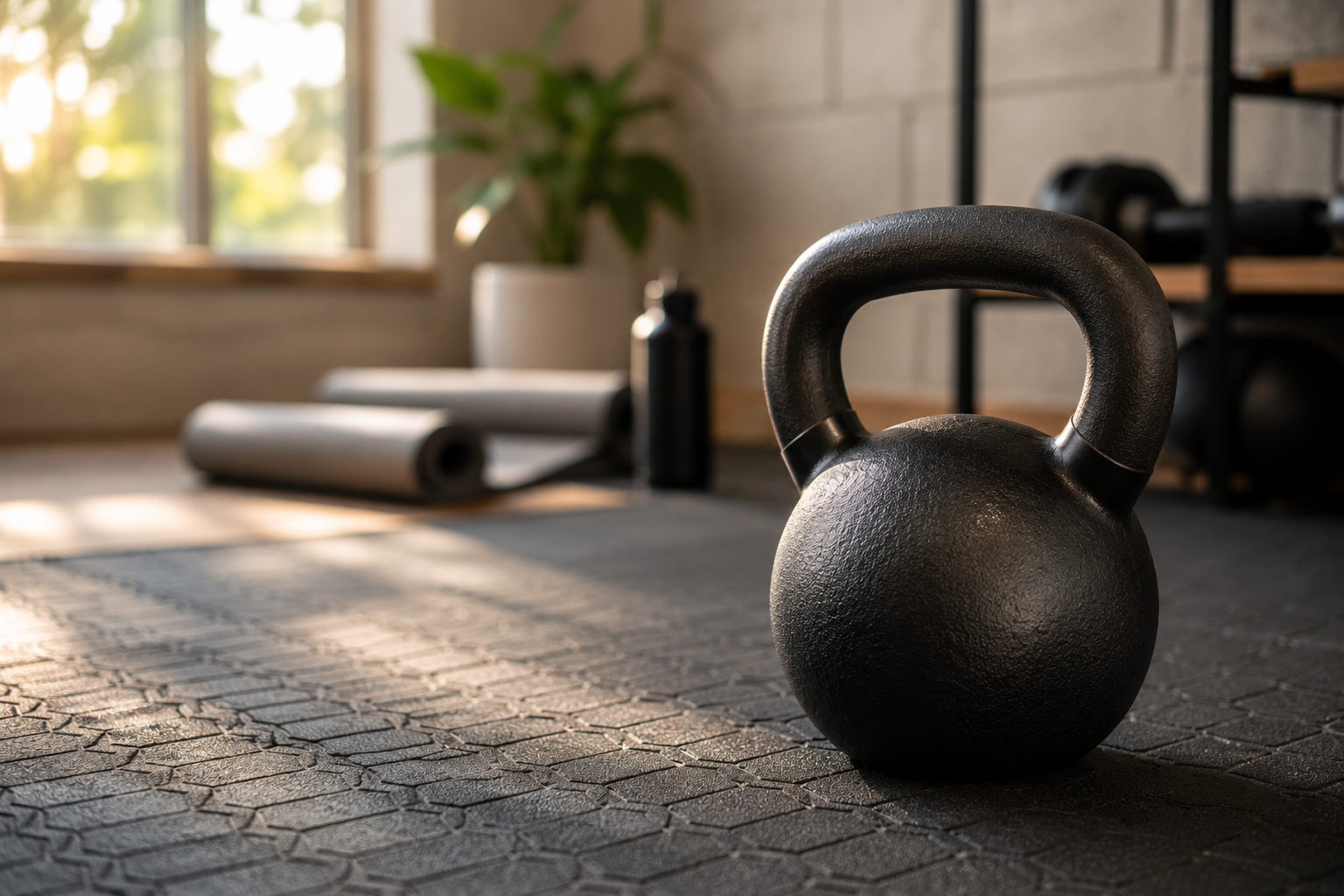
A kettlebell looks deceptively simple: a cannonball with a handle. But that handle changes everything. Because the weight hangs below and away from your grip instead of sitting evenly in your palm like a dumbbell, a kettlebell forces your hips, core, and shoulders to work together instead of in isolation. That’s the whole appeal, and it’s also why so many people buy one, watch a few minutes of video, swing it around their living room, and end up more sore in their lower back than anywhere useful.
You don’t need a rack of them to get real value from this tool. Five movements, practiced well, cover almost every pattern your body needs: hinging, squatting, pressing, carrying tension overhead, and getting up off the floor under load. This guide walks through each one, explains why it earns its place in a beginner’s routine, and gives you the cues and common mistakes that matter most. It also covers dosage, safety, and how to build these five moves into a week you can actually stick to.
As with any new resistance-training program, check with a doctor first if you have a heart condition, joint problems, are pregnant, or are returning from injury. The Mayo Clinic notes that working with a qualified trainer to learn proper form when you’re starting a strength program helps prevent injuries and get better results, and that’s especially true for kettlebell technique, where the ballistic hip-hinge movements reward precision (see References below for the source).
Why Kettlebells Earn a Spot in a Beginner’s Routine
The kettlebell’s off-center load is the whole story. A dumbbell keeps weight centered in your hand, so most dumbbell exercises isolate one joint at a time: a curl works the elbow, a lateral raise works the shoulder. A kettlebell’s handle sits above the bulk of the weight, so the bell wants to swing, rotate, and pull you off balance. Bracing against that instability recruits your core and stabilizer muscles almost automatically, even during a “simple” swing or squat.
That single design detail is why kettlebell training tends to blend strength work and conditioning in the same session. Movements like the swing are performed for higher reps at a faster tempo than a typical barbell lift, which raises heart rate while still loading the hips and posterior chain. It’s resistance training and interval-style cardio work overlapping, rather than two separate workouts bolted together.
None of this replaces the two pillars public health guidance already asks for. The CDC recommends adults get at least 150 minutes of moderate-intensity aerobic activity a week (or 75 minutes of vigorous activity, or a combination), plus muscle-strengthening activity that works all the major muscle groups on at least two days a week. A well-built kettlebell routine can satisfy that strength-training requirement on its own, and depending on pace and rep scheme, it can contribute toward the aerobic target too. The NHS gives the same two-day-a-week minimum for strength work and points out that these sessions improve everyday mobility, not just gym numbers, like the ability to stand from a chair or carry groceries without strain.
The short version: five kettlebell movements, done with attention to form, can cover a hip hinge, a squat, a press, an overhead carry pattern, and a full-body floor-to-standing transition. That’s most of what a general strength program needs to hit, in one piece of equipment that fits in a closet.
Choosing Your First Kettlebell
Weight selection matters more with kettlebells than with most gym equipment because a bell that’s too heavy doesn’t just limit your reps, it changes your movement pattern in ways that can strain your lower back, especially on the swing. Kettlebells are commonly sold in kilogram increments, and Wikipedia’s overview of competition-style kettlebells notes a standard color-coded progression from 8 kg (about 17.6 lb) up to 48 kg (about 106 lb) in 2 kg steps, with intermediate weights marked by a colored band. You don’t need a competition set, but that increment system is a useful reference when you’re shopping.
General starting points that most coaches converge on:
If in doubt, go lighter. You can always add weight once the pattern is automatic. You cannot un-tweak a lower back mid-set.
The Five Movements
Each of these targets a different fundamental pattern. Together they build a base that supports almost any goal, from general conditioning to sport preparation to simply moving through daily life with less effort.
1. The Kettlebell Swing (The Hip Hinge)
The swing is the signature kettlebell movement and, for most beginners, the hardest one to get right on the first try, mostly because it looks like a squat but isn’t one. The power comes from snapping your hips forward, not from bending and straightening your knees.
- Setup: Stand with feet slightly wider than shoulder width, kettlebell on the floor a short distance in front of you.
- The hinge: Push your hips back (not down) until you feel tension in your hamstrings, keeping your shins close to vertical. Grab the handle with both hands, arms straight.
- The drive: Snap your hips forward hard, squeezing your glutes at the top. The bell floats up to roughly chest height, driven by hip extension, not by your arms lifting it.
- The float and reset: Let the bell fall back naturally, hinge at the hips to absorb it, and let momentum carry it back between your legs for the next rep.
Common mistake: squatting the swing, which turns it into a front raise for your shoulders and a squat for your legs, defeating the hip-hinge purpose entirely and putting unwanted stress on the lower back when the bell swings past knee height with a rounded spine.
2. The Goblet Squat (The Squat Pattern)
Holding the kettlebell at chest height, close to your body, is one of the easiest ways to teach a beginner a clean squat, because the counterbalance in front naturally encourages an upright torso and a deeper, more controlled descent than most people manage with an empty-handed squat.
- Setup: Hold the kettlebell by the “horns” (the sides of the handle) at chest height, elbows pointing down.
- The descent: Feet just outside shoulder width, sit down and back between your heels, letting your elbows brush the inside of your knees near the bottom.
- The bottom position: Aim for thighs at or below parallel if your hips and ankles allow it comfortably, chest tall, weight through the whole foot.
- The drive up: Push the floor away through your heels and mid-foot, exhaling as you stand.
The goblet squat doubles as a mobility screen. If your heels lift or your lower back rounds sharply at the bottom, that’s useful information about ankle or hip mobility worth addressing before adding heavier squat variations later.
3. The Kettlebell Clean (Loading the Rack Position)
The clean moves the bell from the floor or from a swing into the “racked” position, resting against your forearm and the outside of your wrist, near your shoulder. It’s less about brute strength and more about timing and getting your hand through the bell’s rotation without banging your wrist.
- The pull: From a hinge, pull the bell up close to your body, elbow bending as it rises, similar to starting a swing but steeper.
- The turnover: As the bell reaches chest height, rotate your elbow forward and slightly down so your hand punches through the handle rather than the bell flipping around your wrist.
- The catch: The bell settles against your forearm, upper arm close to your ribs, wrist straight, like you’re holding a suitcase against your chest.
Most beginners clean too far from the body, so the bell crashes into the wrist and forearm on the way up. Keeping the bell traveling close to your torso, almost brushing your shirt, solves this almost every time.
4. The Kettlebell Press (Overhead Pressing Strength)
From the rack position, pressing the bell overhead builds shoulder strength and, because the load is offset rather than centered like a barbell, real core and lat stability at the same time. It’s a strict, controlled movement: no leg drive, no momentum.
- Setup: Start racked, wrist straight, forearm roughly vertical, feet hip-width and grounded.
- The press: Push the bell straight up, letting your head move slightly back and then through as your arm passes your ear, so the bell finishes stacked directly over your shoulder.
- Bracing: Keep your ribs down and glutes lightly engaged throughout. Avoid arching your lower back to help the bell up.
- The descent: Lower with control back to the rack rather than dropping it.
If your shoulder mobility doesn’t let the bell travel in a straight vertical line without your lower back arching to compensate, that’s a sign to work on thoracic and shoulder mobility separately, or press at a lighter weight while that mobility improves.
5. The Turkish Get-Up (Full-Body Integration)
The get-up is the slowest, most technical of the five, and arguably the most valuable for a beginner precisely because it can’t be rushed. It takes you from lying on the floor to standing, kettlebell held overhead the entire time, then reverses back down. Wikipedia’s kettlebell overview describes it as moving “from lying supine on the floor to standing, and back again” while keeping the arm extended vertically throughout, which is a fair summary of a movement that’s genuinely easier to learn from a coach or a slow video than from text alone.
Turkish Get-Up, Broken Into Checkpoints
- Lie on your back, kettlebell in one hand pressed straight up over your shoulder, same-side knee bent, foot flat.
- Press through the opposite heel and roll onto your free elbow, eyes staying on the bell.
- Push up onto your free hand, then lift your hips off the floor.
- Sweep your straight leg back and under you into a kneeling lunge position.
- Drive up to standing, bell still stacked overhead.
- Reverse each checkpoint in order to return to the floor with control.
Practice this one without weight, or with just your fist in the air, until every checkpoint feels stable. Add a light kettlebell only after the bodyweight pattern is smooth.
“Improper form can be harmful to anyone who has shoulder or back issues or a weak core, but when done correctly, kettlebell exercises have a lot of health benefits. High-repetition training should start out slowly to build muscle endurance, support the joints, and prevent injury.”
— summarized safety guidance on kettlebell technique
Comparing the Five: What Each One Actually Builds
Common Mistakes That Slow Beginners Down
Most technique problems with kettlebells trace back to one of a handful of habits, and recognizing them early saves weeks of frustration.
- Muscling the swing with your arms. The bell should be a passenger driven by hip extension. If your shoulders are doing the lifting, you’ll feel it in your traps the next day instead of your glutes and hamstrings, and you’ll cap your weight progression far below what your hips could actually handle.
- Squatting instead of hinging. Bending your knees heavily and dropping your hips straight down turns the swing into an awkward front squat with a weight swinging through it. Practice the hip hinge against a wall or a doorframe first: push your hips back until they touch, without your knees traveling forward.
- Holding your breath through a whole set. Kettlebell sets tend to run longer than a typical barbell set, so breathing needs a rhythm. A common pattern is a sharp exhale on the effort phase (the hip snap, the press, the stand from a get-up) and a natural inhale on the return.
- Chasing rep count over position. A get-up done in perfect sequence at half speed teaches your nervous system more than five sloppy ones. Especially in the first month, prioritize the checkpoint quality over how many reps you can grind out.
- Skipping the light-bell phase entirely. It’s tempting to buy one moderately heavy kettlebell and use it for everything. A second, lighter bell for pressing and get-up work lets you train those patterns properly instead of using a swing-weight bell that’s too heavy to press with good form.
Equipment, Space, and Footwear
Kettlebell training doesn’t demand much of a setup, but a few details make sessions safer and more comfortable. A flat, non-slip surface with a few feet of clearance in every direction is enough space for all five movements; you don’t need a full home gym. Flat-soled shoes, or bare feet on a suitable surface, generally work better than cushioned running shoes, since a stable, unyielding base under your heels matters for the hip drive in the swing and the leg drive in the squat and get-up.
Chalk or a simple grip aid can help once you start swinging a heavier bell for higher reps, since the handle can slip in sweaty hands well before your hips or legs fatigue. That grip demand is itself one of the underrated benefits of this kind of training: swings, cleans, and get-ups all load the forearms and hands isometrically in ways that a lot of standard gym routines skip entirely, and grip strength carries over directly into everyday tasks like carrying bags, opening jars, and holding onto a handrail.
Building a Simple Weekly Routine
You don’t need five separate workouts. These movements combine well into two or three sessions a week, which lines up with the CDC’s and NHS’s shared recommendation of at least two strength sessions weekly.
A Beginner-Friendly Two-Day Split
Day A — Hinge and Push
- Turkish get-up: 3–5 slow reps per side (technique focus)
- Kettlebell swing: 5 sets of 10–15 reps
- Kettlebell press: 3 sets of 5–8 reps per arm
Day B — Squat and Carry
- Goblet squat: 4 sets of 8–12 reps
- Kettlebell clean: 3 sets of 5 reps per arm (light load, technique focus)
- Swing: 4 sets of 12–15 reps at a brisker pace
Rest a day between sessions when you’re starting out. Warm up with a few minutes of easy movement, light hip hinges, bodyweight squats, and some shoulder circles, before picking up the bell, mirroring the general advice to precede strength work with a brief aerobic warm-up.
Safety Notes Worth Taking Seriously
- Start lighter than you think you need. Technique breaks down under load faster with a kettlebell than with most other tools because the weight is offset from your hand.
- The swing is a hip movement, not a squat or a shoulder raise. If your lower back rounds under the bell, stop, lighten the load, and rebuild the hinge pattern.
- Protect your wrist during cleans. Bruised forearms are a sign the bell is traveling too far from your body on the way up, not a badge of honor.
- Learn the get-up slowly. Practice it without weight until each checkpoint is stable before adding a kettlebell.
- Stop if something hurts, as opposed to normal muscle fatigue. Sharp or joint-level pain is a signal to stop the set, not push through it.
- Get medical clearance first if you have a cardiovascular condition, a back or joint injury, or are newly postpartum or pregnant, before starting any new resistance-training program.
Frequently Asked Questions
How often should a beginner train with kettlebells?
Two to three sessions a week, with at least one rest day between them, is a solid starting cadence. This also satisfies general public health guidance calling for muscle-strengthening activity at least twice weekly.
Can kettlebell training replace cardio?
It can contribute meaningfully, especially higher-rep swing work that elevates heart rate, but it shouldn’t be your only source of aerobic activity. The CDC’s baseline of 150 minutes of moderate-intensity activity weekly is easiest to hit with a mix of activities, not one tool alone.
What size kettlebell should I buy first?
Most coaches suggest roughly 8–12 kg (18–26 lb) for women and 12–16 kg (26–35 lb) for men who are new to resistance training, with a second, lighter bell useful for presses and get-ups. Go lighter if you’re unsure; you can always progress once the pattern feels automatic.
Is the kettlebell swing bad for your back?
A properly executed swing, driven by the hips with a neutral spine, is not inherently harmful and is widely used in strength and conditioning programs. Problems arise when the movement turns into a squat with the arms lifting the bell, or when the load is too heavy for the lifter’s current hip-hinge technique. Learning the pattern with a light bell first, ideally with feedback from a coach or careful video review, reduces that risk substantially.
Do I need all five movements, or can I just do swings?
Swings alone build hip power and conditioning, but they don’t cover pressing strength, squat depth, or the full-body control trained by the get-up. Using all five gives you a genuinely balanced program rather than one dominant pattern.
How long before I see results?
Technique typically improves within the first few sessions as the hip hinge and rack position become familiar. Strength and conditioning changes generally follow the same broad timeline as other resistance-training programs, with noticeable improvements over several weeks of consistent, twice-weekly (or more) training, though individual timelines vary with starting fitness, consistency, sleep, and nutrition.
Bringing It Together
A kettlebell earns its keep because five movements, trained consistently, touch nearly every pattern a general fitness program needs to cover: a hip hinge, a squat, a pull into a loaded position, a press, and a full-body transition from the floor to standing. None of them require a gym membership or a rack of equipment. What they do require is patience with the early technical learning curve, especially on the swing and the get-up, and a willingness to start lighter than your ego wants.
Build the pattern first. Add weight second. That order, more than anything else, determines whether kettlebell training becomes a durable habit or a source of a tweaked lower back and an unused piece of iron in the closet.
References
- Centers for Disease Control and Prevention. “Physical Activity Guidelines for Adults.” https://www.cdc.gov/physical-activity-basics/guidelines/adults.html
- NHS. “Strength Exercises.” https://www.nhs.uk/live-well/exercise/strength-exercises/
- Mayo Clinic. “Strength Training: Get Stronger, Leaner, Healthier.” https://www.mayoclinic.org/healthy-lifestyle/fitness/in-depth/strength-training/art-20046670
- Wikipedia. “Kettlebell.” https://en.wikipedia.org/wiki/Kettlebell
This article is for general educational purposes and is not a substitute for individualized medical or professional fitness advice. Consult a doctor before starting a new exercise program, particularly if you have an existing health condition or injury.