


























By Grace Watson
The workout doesn’t stop just because someone needs a snack, a shoelace tied, or a referee for a dispute over a toy truck. If you’re raising young kids and trying to keep some kind of exercise habit alive, you’ve probably already discovered that the version of fitness shown in most online routines (quiet room, uninterrupted 45 minutes, a playlist nobody skips) doesn’t match your actual house. This guide is built for the real one: the one with a toddler orbiting your feet during squats and a six-year-old narrating your push-ups.
None of what follows requires a babysitter, a gym membership, or a locked door. It’s a practical system for building strength and stamina in the gaps of an ordinary day at home, with your children nearby rather than out of the picture.
Why Training Around Your Kids Beats Waiting for a Clear Window
Plenty of parents put off exercise until conditions are perfect: nap time lines up, both kids are occupied, the house is quiet. That window rarely opens on schedule, and waiting for it is often the reason a fitness habit quietly dies. The good news, according to national guidance, is that the “perfect session” isn’t actually required.
The CDC’s physical activity guidelines for adults call for 150 minutes of moderate-intensity aerobic activity a week (or 75 minutes of vigorous activity), plus muscle-strengthening work on two or more days that covers the major muscle groups: legs, hips, back, abdomen, chest, shoulders, and arms. The UK’s NHS guidance lines up closely, and adds a detail that matters a great deal to parents of small children: activity can be spread across several short sessions, including “several short sessions of very vigorous intensity activity,” and the week’s target doesn’t need to come from one continuous block. The NHS also specifically recommends breaking up long stretches of sitting with movement throughout the day, not just during a dedicated workout slot.
In practice, that means ten minutes of bodyweight strength work before breakfast, eight minutes of a circuit while dinner simmers, and a fifteen-minute walk pushing a stroller around the block all count toward the same weekly total. You don’t need your children out of the room. You need permission to stop measuring your workouts against a version of fitness that assumes you live alone.
“A 150-minute weekly target sounds intimidating until you realize it’s roughly the length of one movie, chopped into pieces you can lose to a diaper change and pick back up ten minutes later.”
— Grace Watson
Setting Up a Child-Safe Training Zone at Home
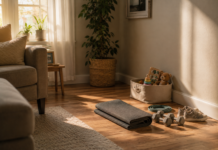
Before any routine matters, the space has to be safe for a curious kid to be near while you’re mid-set. This isn’t about creating a padded gym; it’s about removing the handful of hazards that turn a normal workout into an accident.
Clear the floor first
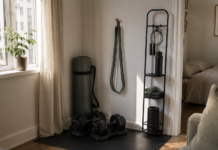
Dumbbells, kettlebells, and resistance bands are the main offenders. A weight left on the floor between sets is a tripping hazard for a toddler moving at full speed and low visibility. Rack or bag your equipment the moment you set it down, and pick a spot along a wall rather than the middle of the room so there’s a clear, obstacle-free lane for foot traffic.
Give heavy or fast movements a wider radius
Anything involving swinging a kettlebell, throwing a medicine ball, or moving explosively (box jumps, broad jumps, battle ropes) needs more clearance than a controlled bicep curl. If your children tend to run up to you mid-exercise for a hug or a question, save those higher-momentum moves for moments when they’re seated with an activity, or skip them in favor of controlled strength work while they’re actively underfoot.
Anchor anything that could tip
Adjustable benches, freestanding pull-up bars, and stacked plates can be pulled over by a climbing toddler. If a piece of equipment isn’t in use, store it against a wall or in a closet rather than leaving it staged in the open.
Keep a visual line of sight
Face the room, not the wall, when you can. Positioning yourself so you can see your child out of the corner of your eye lets you keep counting reps without constantly stopping to check on them, and it means you’ll notice early if they wander toward something they shouldn’t.
Safety note: If you’re returning to exercise after pregnancy, a long break, an injury, or you manage a chronic health condition, check in with your doctor before starting a new home training program. This is general guidance, not a substitute for individualized medical advice.
A Weekly Framework Built for Interruptions
Instead of planning one long session and hoping it survives contact with your household, plan several shorter ones that are individually resilient to interruption. The table below maps common time blocks parents actually have to the CDC and NHS weekly targets described above.
Stack a handful of these across the week and the total climbs past 150 minutes without a single session requiring quiet, uninterrupted time. On days when a session gets cut short by a spill or a meltdown, the remaining minutes simply roll into the next block instead of being lost. That flexibility is the point: consistency across many short sessions beats an all-or-nothing approach built around one long one that rarely happens.
Age by Age: What Your Kids Can Realistically Do Nearby
What “training with children underfoot” looks like changes enormously depending on how old they are. Matching your expectations to their stage saves you frustration and keeps everyone safer.
Infants (not yet mobile)
This is often the easiest window. A baby who isn’t crawling yet can sit in a bouncer, play mat, or carrier while you move through a full strength or cardio circuit nearby. Babywearing itself can double as light resistance for lower-body work like squats and step-ups, as long as your carrier is rated for the movement and your baby is secured appropriately.
Toddlers (roughly 1-3 years)
This is the stage that gives the article its title. Toddlers move unpredictably, want to be close to you, and can’t reliably follow safety instructions yet. Favor slower, controlled strength movements over anything explosive, keep equipment tidy between sets, and treat a toddler climbing onto your back mid-plank as a possibility to plan for rather than an interruption to fight.
Preschoolers (roughly 3-5 years)
The CDC notes that children in this age range should be physically active throughout the day for healthy growth and development, and that caregivers play a role in encouraging that activity through play: jumping, climbing, riding a tricycle. This is a good age to start inviting kids into your workout directly: they can “race” you through jumping jacks, count your reps out loud, or copy simple movements on their own mat next to yours.
School-age kids (roughly 6-17 years)
CDC guidance recommends at least 60 minutes of moderate-to-vigorous activity daily for this age group, with vigorous activity at least three days a week, plus muscle-strengthening (climbing, push-ups) and bone-strengthening (running, jumping) activities at least three days a week. A shared home workout can contribute meaningfully toward that total for your child, not just yours, which makes training together a genuine two-for-one instead of something you have to work around.
Step-by-Step: A 20-Minute Session You Can Run With Kids in the Room
Here’s a concrete structure you can repeat two to four times a week. It’s designed so that a pause for a spilled cup or a bathroom trip doesn’t derail the whole thing.
The Child-Safe 20-Minute Circuit
- Minute 0-2: Clear and set the zone. Move toys and loose items off your floor space. Place any equipment you’ll use along the wall within reach.
- Minute 2-3: Set expectations out loud. Tell kids what you’re doing and for how long (“Mommy’s going to do her exercises until the timer beeps”). A visible kitchen timer helps toddlers and preschoolers understand the boundary.
- Minute 3-6: Warm-up. March in place, arm circles, bodyweight squats, gentle torso twists, at a pace slow enough that a child bumping into you doesn’t cause a fall.
- Minute 6-16: Main circuit (3 rounds of 4 exercises, about 50 seconds of work with 10 seconds of transition). Choose from squats, push-ups (knee or full), glute bridges, standing rows with a band, reverse lunges, and plank holds. Keep footwork controlled rather than jumping-heavy if a small child is moving through the space.
- Minute 16-18: Cooldown stretch. Hamstring stretch, chest opener, child’s pose (kids often enjoy copying this one specifically).
- Minute 18-20: Debrief and reward. A high-five, a sticker, or simply narrating what you did together (“we did squats and push-ups!”) reinforces that this is a normal, positive part of the day rather than a chore you resent.
If a session gets cut off at minute 12 by something that needs your full attention, that’s still a complete win. Close it out, note where you stopped, and pick the next circuit back up later that day or the next.
Equipment That Actually Works in a House With Kids
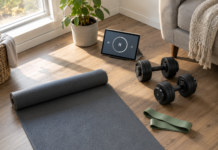
You don’t need much, and less is often safer. A short list of durable, low-hazard tools covers most bodyweight and light-resistance training needs.
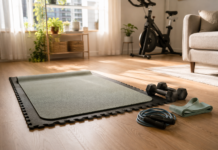
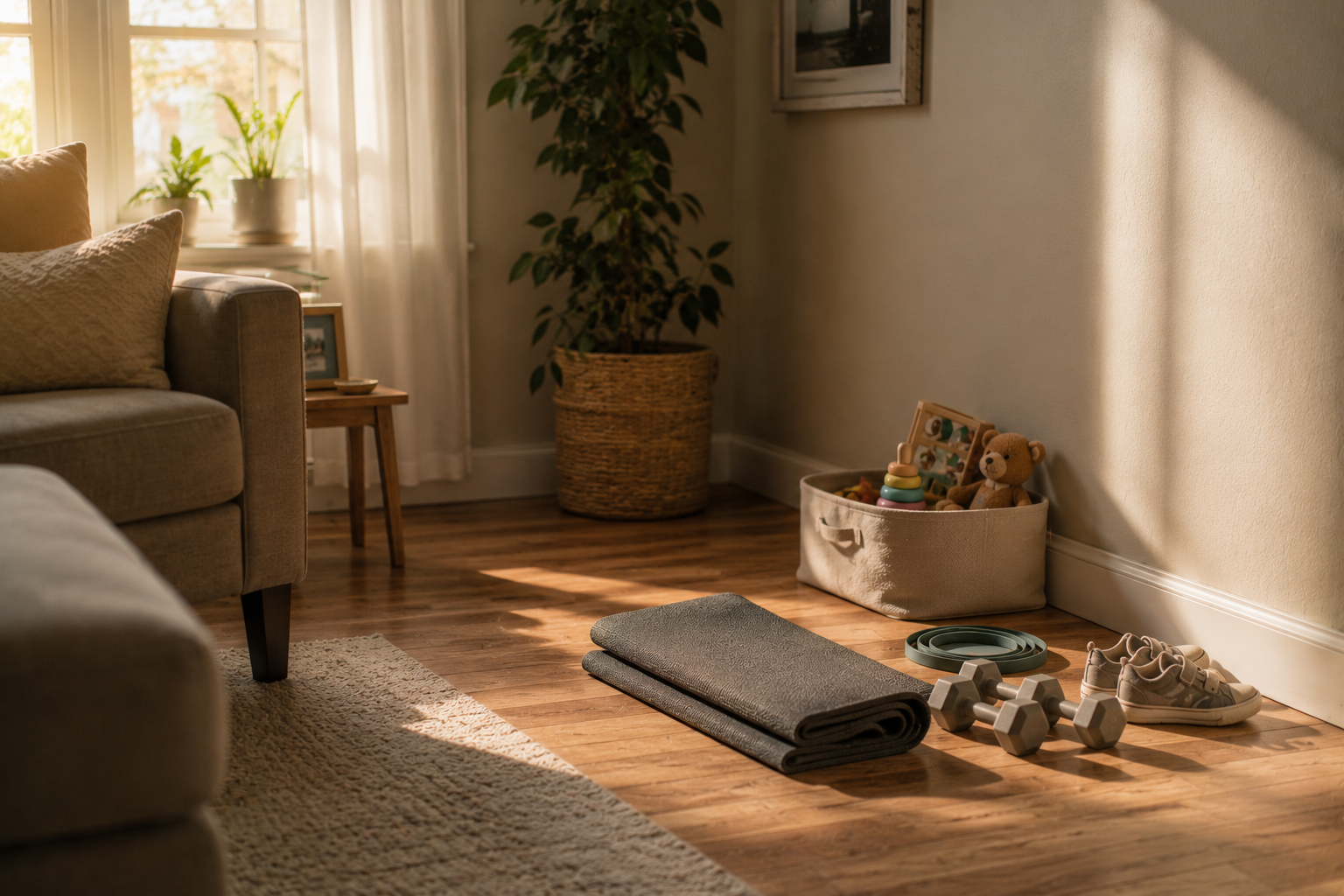
- A single mat. Defines your workout footprint and gives kids a visual “stay off the mat while I’m moving” boundary.
- Resistance bands. Low weight per unit of size, easy to store flat, no loose plates for little hands to grab.
- One pair of adjustable dumbbells. Saves floor space compared to a full rack; store them in a closed bin between sessions.
- A sturdy chair or low step. Doubles for step-ups, tricep dips, and elevated push-ups; no assembly, no tip-over risk.
- A kitchen timer or phone timer. Gives your children a concrete, visible signal for when the workout starts and ends.
Skip anything with small detachable parts (loose collars, clip-on weights, tiny attachments) if you have a child who still mouths objects. Kettlebells and barbells aren’t off-limits as your kids get older and more predictable around you, but they’re not the easiest starting point for the toddler years.
Common Mistakes That Derail a Parent’s Home Routine
Most parents who give up on training at home don’t quit because the workouts don’t work. They quit because the setup around the workouts wasn’t built to survive a real household. A few patterns show up again and again.
Treating any interruption as a failed session
If your mental rule is “it only counts if I finish the whole thing,” a single spilled cup of juice can end your fitness habit for the week. Reframe partial sessions as partial credit toward your weekly total rather than as a loss. Five completed minutes plus five more later in the day is still ten real minutes of movement.
Choosing exercises that need more room than you have
Long jump ropes, wide lateral bounds, and barbell movements that require a clear path in front of and behind you are hard to manage safely in a living room with a toddler underfoot. Swapping in stationary or small-footprint variations, like a jump rope drill done in place, or a landmine press instead of a full overhead barbell press, keeps the same training stimulus in a smaller, safer box.
Scheduling around a “quiet house” that never arrives
Waiting for both kids to nap at the same time, or for a partner to take them out for two hours, sounds efficient on paper. In practice it’s a plan that depends on conditions you don’t control. A framework built around several short, interruption-tolerant sessions throughout the day tends to survive contact with an actual family schedule far better than one long session waiting for permission to happen.
Skipping the warm-up because “there’s no time”
When sessions get compressed into eight or ten minutes, warm-up is often the first thing cut. That’s a mistake, especially for parents managing sleep debt and general fatigue. A two-minute warm-up doesn’t need to be elaborate: a few bodyweight squats, some arm circles, and a short walk around the room is enough to reduce the risk of strain during the main circuit.
Not involving the kids at all
Trying to train in total isolation from your children, even when they’re in the same room, often creates more friction than it solves. Kids sense when they’re being actively excluded from something and tend to escalate for attention. Giving them a small role, counting reps, copying a move, holding the timer, usually reduces interruptions rather than causing more of them.
A Simple 4-Week Ramp-Up
| Week | Focus | Target |
|---|---|---|
| Week 1 | Build the habit | Three 8-10 minute sessions, any time you can grab |
| Week 2 | Add structure | Use the 20-minute circuit above at least twice |
| Week 3 | Add a family session | One walk, bike ride, or active game the kids join fully |
| Week 4 | Reach the weekly target | Combine sessions to approach 150 minutes total |
Turning the Workout Into Their Play
Fighting your children for space often backfires; inviting them into it tends to work better. A few approaches parents use successfully:
- Mirror games. Ask your child to copy your movement. Slower, simpler exercises (squats, arm raises, marching) work best for this.
- Counting duty. Preschoolers and school-age kids love being handed a job. Let them count your reps out loud.
- Their own “workout.” A second small mat or towel next to yours, with an instruction to do “whatever exercise they want,” keeps them occupied and physically active in parallel.
- Timer control. Older kids can hold the phone and tell you when the interval ends, which gives them a sense of involvement without needing your attention.
None of this needs to be elaborate. The goal is simply to make your training time feel like something happening with your kids rather than something you’re protecting from them.
Screens, Gates, and Other Household Logistics
For sessions where you genuinely need your child occupied elsewhere in the room rather than actively involved, a short screen block is a common and reasonable tool many parents use during a workout window. The American Academy of Pediatrics recommends keeping certain zones and times screen-free (meals, homework, the hour before bed) to protect family connection and sleep, so it’s worth choosing a workout slot that doesn’t conflict with those windows rather than treating screen time as a default babysitter for every session.
A baby gate across a doorway can also buy you a contained, hazard-checked space for a workout without needing another adult present. And if your living situation allows it, training in view of a window or backyard where an older child is playing outside lets you supervise while still getting a real session done.
When to Pause, Skip, or Bring in Backup
Not every day works, and it shouldn’t have to. A few honest guidelines:
- If your child is sick, overtired, or in a rough emotional stretch, skip the workout without guilt. It rolls into next week’s total, not into a failure column.
- If a movement requires more focus or momentum than you can safely give while watching a toddler (heavy overhead lifts, fast plyometrics), save it for a nap window, a partner’s watch, or a gym visit instead of forcing it around your kids.
- If you’re pregnant, postpartum, recovering from injury, or managing a chronic condition, get personalized guidance from your doctor or a physical therapist before building a new routine, especially around load and intensity.
- If your child’s behavior around your equipment becomes a repeated safety issue despite the precautions above, it’s worth adjusting your setup (or your timing) rather than pushing through it.
Frequently Asked Questions
Is it actually safe to lift weights while my toddler is in the room?
It can be, with precautions. Keep loads light to moderate, avoid ballistic or overhead movements when a child could wander underneath, and clear the floor of any weight the moment you set it down. If your toddler tends to grab or climb, controlled bodyweight or band work is often the safer starting point.
How much exercise do I actually need each week as a busy parent?
The CDC and NHS both point to the same baseline for adults: about 150 minutes of moderate-intensity activity a week (or 75 minutes vigorous), plus muscle-strengthening work covering the major muscle groups on two or more days. That total can be built from several short sessions rather than one long one.
Can my child’s activity count as part of the family’s exercise time?
For your child specifically, yes. Guidance for kids ages 6-17 calls for at least 60 minutes of moderate-to-vigorous activity daily. A shared circuit or an active game you both do together can contribute to that total for them, separate from your own weekly target.
What if my workout keeps getting interrupted before I finish?
That’s normal, and it’s fine. A session split by a diaper change or a spilled snack still counts for the minutes completed. Pick the circuit back up later in the day if you can, or simply let the next scheduled session cover the difference.
Should I let my toddler use a screen so I can train uninterrupted?
Occasional screen time during a workout window is a reasonable tool many parents use, but it’s worth keeping it outside of the screen-free zones pediatric guidance recommends (mealtimes, the hour before bed). Rotating screen time with active “parallel workout” games for your child can reduce how often you need to rely on it.
At what age can kids start doing real exercises with a parent?
Preschool-age children (roughly 3-5) can usually start copying simple movements like squats, jumping jacks, or marching in place. School-age kids can typically follow a full short circuit alongside you, including basic bodyweight strength moves like push-ups and step-ups.
References
- Centers for Disease Control and Prevention, Physical Activity Guidelines for Adults
- Centers for Disease Control and Prevention, Physical Activity Guidelines for Children and Adolescents
- NHS, Physical Activity Guidelines for Adults Aged 19 to 64
- NHS, Exercise Guidelines Overview
- HealthyChildren.org (American Academy of Pediatrics), How to Make a Family Media Use Plan
This article provides general fitness information and is not a substitute for personalized medical advice. Talk with your doctor before starting a new exercise program, especially if you are pregnant, postpartum, or managing a health condition.