
























By Noah Sato
Open any fitness app and search “20 minute workout” and you’ll get the same answer nine times out of ten: a string of jumping jacks, high knees, and burpees set to a countdown timer. It raises your heart rate, it makes you sweat, and twenty minutes later you’re done. What it doesn’t do is build the strength, bone density, and joint resilience that a body actually needs over the long run.
A twenty-minute home session can do more than that, and it doesn’t require a garage gym or an hour you don’t have. It requires structure: a deliberate mix of warm-up, resistance work, conditioning, and recovery, arranged so each piece earns its place in the clock. This guide walks through exactly how to build that structure, minute by minute, using nothing more than bodyweight and whatever household objects you already own.
Why Twenty Minutes Is Enough Time, If You Structure It Right
The Centers for Disease Control and Prevention recommends adults get at least 150 minutes of moderate-intensity aerobic activity per week, or 75 minutes of vigorous activity, along with muscle-strengthening work on at least two days a week that targets the major muscle groups: legs, hips, back, abdomen, chest, shoulders, and arms. The American College of Sports Medicine frames it similarly: roughly 30 minutes of moderate aerobic activity five days a week, or 20 minutes of vigorous activity three days a week, plus strength training at least twice weekly.
Notice what both of those recommendations have in common. Neither treats cardio and strength as substitutes for one another. They’re separate boxes that both need checking. A cardio-only quick workout, no matter how hard you push it, only ever checks one of those boxes. A well-built twenty-minute session can check both in a single sitting, which matters most on the days when a single sitting is all you’re going to get.
The scale of the problem is worth naming too. The World Health Organization estimates that 31 percent of the global adult population, roughly 1.8 billion people, do not meet recommended activity levels, a figure that rose five percentage points between 2010 and 2022 and is projected to reach 35 percent by 2030 without meaningful intervention. Inactivity climbs further after age 60. None of that is solved by a single article, but it’s the backdrop against which “I only have twenty minutes” becomes a real design constraint rather than an excuse.
The Problem With Cardio-Only Quick Workouts
Pure cardio circuits are popular because they’re easy to program (repeat a handful of jumping movements until the clock runs out) and because they deliver an unmistakable, sweaty sense of effort. That feedback loop is satisfying, but it’s also a little misleading. Feeling wrecked and building strength are not the same thing.
Skipping resistance work regularly means missing out on the muscle-strengthening stimulus that CDC and ACSM both call out separately from aerobic activity. Over months and years, that gap shows up as slower metabolism, weaker bones, and less resilient joints, especially as the body ages. It also means every home session looks the same: high heart rate, low load, nothing for the muscles to adapt to beyond getting slightly better at burpees.
The fix isn’t to abandon cardio. Conditioning work still belongs in a twenty-minute session; it’s genuinely useful for cardiovascular health and it makes the session feel complete. The fix is to stop letting it be the whole session.
The Twenty-Minute Session at a Glance
| Block | Time Window | Duration | Purpose |
|---|---|---|---|
| Warm-up | 0:00 – 3:00 | 3 minutes | Raise heart rate, mobilize joints, prime muscles |
| Strength circuit | 3:00 – 11:00 | 8 minutes | Build and maintain muscle, load major joints safely |
| Conditioning finisher | 11:00 – 17:00 | 6 minutes | Elevate heart rate, add cardiovascular stimulus |
| Cool-down | 17:00 – 20:00 | 3 minutes | Lower heart rate, stretch worked muscles, reset breathing |
The Four Building Blocks of a Complete Session
Every effective twenty-minute session, whatever the specific exercises, rests on the same four blocks. Understanding what each one is for makes it much easier to swap exercises later without breaking the structure.
1. Warm-Up: Prime the System, Don’t Skip It
Mayo Clinic’s guidance on strength training is direct about this: begin with several minutes of brisk walking or light aerobic movement before lifting anything, even bodyweight. A cold muscle and a cold joint are more prone to strain. Three minutes of marching in place, arm circles, hip openers, and a few slow bodyweight squats is enough to raise core temperature and rehearse the movement patterns you’re about to load.
2. Strength Circuit: The Part Cardio-Only Workouts Skip
This is the block that actually satisfies the muscle-strengthening recommendation from CDC and ACSM. Eight minutes, organized as two rounds of four compound movements, is enough to touch every major muscle group: legs, hips, chest, back, shoulders, and core. Compound movements (squats, hinges, presses, rows) are chosen deliberately over isolation moves because they train more muscle in less time, which is exactly the trade-off a twenty-minute window demands.
3. Conditioning Finisher: Where the Cardio Lives
Six minutes of higher-intensity movement, placed after the strength work rather than instead of it, still delivers a real cardiovascular stimulus. Doing it after resistance training rather than before also means you lift with fresher muscles and better form, then finish the session already warm for faster-paced movement.
4. Cool-Down: The Block Most People Cut First
When time runs short, the cool-down is usually the first thing to go, and it’s the wrong one to cut. A few minutes of static stretching for the muscles just worked, paired with slower breathing, helps bring heart rate back down in a controlled way and is a good moment to notice how a joint or muscle actually felt during the session, information worth acting on before the next one.
Step-by-Step: Building Your Own Session
Step 1: Choose One Move Per Major Pattern
Rather than memorizing a fixed list of exercises, pick one movement from each of these four categories: a squat or lunge pattern (legs), a push pattern (chest, shoulders, triceps), a hinge or row pattern (hamstrings, glutes, back), and a core or carry pattern (midsection, grip, stability). Any bodyweight or household-object exercise that fits one of those patterns can be substituted in.
Step 2: Sequence Them Into an 8-Minute Circuit
Work each move for 40 seconds, rest 20 seconds, then move to the next. Four exercises at that pace takes four minutes per round; two rounds fills the eight-minute strength block. Keep the same order both rounds so your body doesn’t have to relearn a sequence mid-session.
Step 3: Pick a Different Energy System for the Finisher
The conditioning block should feel distinctly different from the strength block, faster, lighter on load, more continuous. Bodyweight movements like mountain climbers, lateral shuffles, step-ups onto a stair, or shadow-boxing combinations all work well here because they don’t require recovering from heavy loading first.
Step 4: Build In a Real Cool-Down
Match your stretches to whatever you just trained. If the strength block hit squats and hinges, spend the cool-down on hip flexors, hamstrings, and lower back. Add two or three slow breaths held for a count of four in, four out, to bring your nervous system back down before you walk back into the rest of your day.
A Complete Sample Session (No Equipment Required)
Below is one full twenty-minute session built from the structure above. Swap any movement for an equivalent if it doesn’t suit your joints or current fitness level, and stop any exercise that causes pain rather than pushing through it.
Minute-by-Minute Checklist
- 0:00 to 3:00, Warm-up: 60 sec marching in place, 30 sec arm circles, 30 sec hip openers, 10 slow bodyweight squats, 30 sec ankle bounces
- 3:00 to 7:00, Strength round 1: 40 sec bodyweight squat / 20 sec rest, 40 sec push-up (knees down if needed) / 20 sec rest, 40 sec single-leg hip hinge / 20 sec rest, 40 sec bent-over row with a filled backpack or band / 20 sec rest
- 7:00 to 11:00, Strength round 2: repeat the same four moves in the same order
- 11:00 to 14:00, Conditioning round 1: 40 sec mountain climbers / 20 sec rest, 40 sec lateral shuffles / 20 sec rest, 40 sec step-ups / 20 sec rest
- 14:00 to 17:00, Conditioning round 2: repeat the same three moves
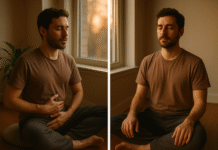
- 17:00 to 20:00, Cool-down: standing forward fold (30 sec), hip flexor stretch each side (30 sec each), chest opener stretch (30 sec), seated or standing box breathing for the remaining time
How to Progress This Session Over Weeks
A structure like this is meant to be reused, not reinvented every session, but it should still change over time or it stops asking anything new of your body. A few reliable ways to progress:
- Add load before adding time. A loaded backpack, filled water jugs, or resistance bands turn bodyweight squats and rows into genuinely challenging strength work without adding a single minute to the clock.
- Slow the tempo. Taking three seconds to lower into a squat or push-up increases difficulty without changing the exercise list at all.
- Rotate the movement pattern, not the structure. Swap a squat for a reverse lunge, or a row for a plank pull-through, every couple of weeks to keep joints moving through varied ranges.
- Track how the last few reps feel. Mayo Clinic’s guidance suggests choosing a resistance level that brings on muscle fatigue by the 12th to 15th repetition; if you’re finishing sets feeling fresh, it’s a signal to add resistance.
Adapting the Session to Your Fitness Level
The four-block structure holds up whether you’re brand new to structured exercise or have been training for years. What changes between fitness levels is the intensity within each block, not the blocks themselves.
If You’re Just Starting Out
Keep every exercise in the strength circuit at the easiest stable version: push-ups from the knees rather than the toes, squats to a chair seat rather than free range, and rows using a light resistance band rather than a heavy backpack. It’s fine to extend rest periods to 30 or even 40 seconds between moves during the first few weeks while you learn the movement patterns. The conditioning finisher can be walked through at a controlled pace rather than performed explosively; the goal in these early sessions is building a habit and learning safe form, not maximizing heart rate. Two sessions a week, spaced with rest days between them, is a sensible starting frequency before adding a third.
If You’ve Been Training for a While
Once bodyweight versions of the strength circuit feel comfortable through 15 reps, start layering in load: a heavier backpack, a pair of household weights, or a resistance band with more tension. You can also shorten rest periods slightly, from 20 seconds toward 10 to 15, to increase the density of work within the same eight minutes. In the conditioning block, add explosiveness to movements like step-ups or mountain climbers, or introduce a fourth exercise into each round instead of three.
If You’re Returning After a Break or an Injury
Rebuild volume gradually rather than picking up where you left off. Start with a single round of the strength circuit instead of two, and treat the conditioning finisher as optional for the first week or two. Pay close attention to any joint that was previously injured, and if a movement causes pain rather than normal training fatigue, substitute a gentler variation or skip it and consult a physical therapist. Consistency at a lower intensity beats an aggressive restart that leads to another setback.
Common Mistakes That Turn a Balanced Session Back Into “Just Cardio”
Rushing the Strength Block to “Save Time” for Cardio
Cutting rest periods short or racing through reps to leave more time for the conditioning finisher undermines the point of the strength block. Form suffers first, and the muscle-building stimulus goes with it.
Choosing Only Upper-Body or Only Lower-Body Moves
CDC guidance specifically calls for strengthening “all major muscle groups,” not just the ones that feel most familiar. A session that’s all push-ups and planks skips the legs, hips, and back entirely.
Never Changing the Resistance
Bodyweight-only training has a ceiling. Once 15 reps of a movement stop being challenging, it’s time to add load, tempo, or a harder variation, or the strength block quietly turns into another form of light cardio.
Treating the Cool-Down as Optional
Ending abruptly after the conditioning block, without stretching or slowing the breath, leaves out a piece of the session that supports recovery and helps you notice minor aches before they become bigger problems.
Safety Notes
Stop any movement that causes sharp or persistent pain and reassess before continuing, as Mayo Clinic’s strength training guidance advises. Warm up properly every time rather than skipping straight to loaded movement, use full range of motion and controlled form over speed, and remember to breathe steadily through each exercise instead of holding your breath under load. If you are new to exercise, pregnant, managing a chronic condition, or returning from an injury, talk with a doctor or physical therapist before starting a new home workout program, and consider working with a qualified trainer for a session or two to check your form on the core movement patterns above.
How to Tell the Structure Is Actually Working
A session can look busy without producing much change. A few practical signs tell you whether the structure above is doing its job over the first month or two.
Watch the strength circuit first. If the same weight or resistance level that felt hard in week one still feels equally hard in week six, with no change in how many clean reps you can complete, the load hasn’t kept pace with your body. That’s a cue to add resistance, slow the tempo, or move to a harder variation of the same pattern, not a sign that the plan has failed. Progress in a bodyweight or household-object program tends to show up as more control and more reps before fatigue, rather than as a number on a barbell plate.
Pay attention to the conditioning block too. Early on, six minutes of intervals might leave you breathing hard for a minute or two after finishing. As your cardiovascular fitness improves, that recovery time should shorten, even if the work itself still feels challenging in the moment. That’s a reasonable, informal way to gauge aerobic progress without any special equipment.
Outside the session itself, notice everyday markers: carrying groceries, climbing stairs, or getting up from the floor feeling less taxing than it did a month earlier. Those changes tend to show up before any visible difference in the mirror, and they’re a more reliable early signal that the structure, not just the sweat, is doing what it’s supposed to do.
Finally, keep a simple log, even a one-line note after each session listing the exercises, the load or resistance level used, and how many clean reps you completed. Reviewing that log every few weeks makes it obvious whether you’re actually progressing the strength circuit or unconsciously repeating the same session on autopilot.
Frequently Asked Questions
Is twenty minutes actually enough to build strength?
Yes, if the time is structured with intention. Mayo Clinic notes that a single well-executed set of 12 to 15 repetitions per exercise, performed at least twice a week for all major muscle groups, is sufficient to build and maintain strength. An eight-minute strength circuit inside a twenty-minute session, done consistently, meets that bar.
Should I do the strength block or the cardio block first?
Strength first is generally the better order for a mixed session. You lift with fresher muscles and cleaner form early on, then move into faster-paced conditioning once you’re already warm, which tends to feel more natural than trying to lift heavy after your heart rate is already elevated.
Do I need equipment to make this effective?
No. Bodyweight movements, a loaded backpack, filled water bottles, or a resistance band are enough to progress a strength circuit for months. Equipment expands your options later, but it isn’t required to get a real training effect now.
How many days a week should I do a session like this?
CDC and ACSM both recommend muscle-strengthening work at least two days a week, with a day of rest between sessions that hit the same muscle groups, according to Mayo Clinic’s guidance. Three sessions a week, on non-consecutive days, is a reasonable target for most people building a home-workout habit.
What if twenty minutes still feels too long some days?
Both the CDC and WHO note that some activity is better than none. On a genuinely short day, keep the warm-up and strength circuit and drop the conditioning finisher, or shorten each block proportionally. A ten-minute version that still includes real resistance work beats a skipped session entirely.
Can this replace a gym-based strength program?
For general health and the CDC’s baseline muscle-strengthening recommendation, a well-structured home session can cover the basics. If your goal is significant muscle or strength gains beyond general fitness, progressive overload eventually calls for heavier external load and more variety than a bodyweight-and-household-object setup can offer long term.
What should I do if I only have ten minutes instead of twenty?
Keep the warm-up short (about one minute), run a single round of the strength circuit instead of two, and skip straight to a two or three minute cool-down. That version still includes real resistance work for every major muscle group, which matters more on a tight day than trying to cram the full conditioning block into a rushed window. A shorter but complete session, done consistently, builds more over a month than an occasional full-length one squeezed in only when the schedule allows.
References
- Centers for Disease Control and Prevention, “Physical Activity Guidelines for Adults”: cdc.gov/physical-activity-basics/guidelines/adults.html
- World Health Organization, “Physical Activity” fact sheet: who.int/news-room/fact-sheets/detail/physical-activity
- American College of Sports Medicine, Physical Activity Guidelines resources: acsm.org/education-resources/trending-topics-resources/physical-activity-guidelines
- Mayo Clinic, “Strength training: Get stronger, leaner, healthier”: mayoclinic.org/healthy-lifestyle/fitness/in-depth/strength-training/art-20046670
This article is for general informational purposes and is not a substitute for individualized medical advice. Consult a doctor or qualified health professional before starting a new exercise program, especially if you have an existing health condition or injury.