


















By Ada L. Wrenford
A note before you start: This article is educational and does not replace individualized medical advice. Joint pain has many causes, and some need specific care from a physician or physical therapist before you increase activity. If you have not had persistent joint pain evaluated, or if you notice swelling, joint locking, or a feeling that a joint might give way, talk to a clinician before starting or changing a cardio routine.
Joint pain does not have to mean giving up cardio. It usually means changing how you do it. Runners with a cranky knee, former athletes with an arthritic hip, and anyone managing osteoarthritis can still build real cardiovascular fitness, and the trick is picking movement patterns that keep the heart rate up while keeping the load on cartilage and connective tissue low. Swimming, cycling, elliptical training, and water walking all fit that description, and each one can be scaled from a five-minute starting point to a full workout over a period of weeks.
This guide walks through a step-by-step way to choose a low-impact cardio option, progress it safely, and recognize the difference between normal exercise discomfort and a signal to back off. It draws on guidance from the American College of Rheumatology, the Arthritis Foundation, and Mayo Clinic, along with published research on aquatic and land-based exercise for arthritis.
Why Low-Impact Cardio Works for Joint Pain
Impact is the repeated force that travels through a joint every time a foot strikes the ground. Running generates roughly two to three times body weight in force at the knee with each stride, largely because only one leg is in contact with the ground at a time and it absorbs the full load. Low-impact cardio modalities reduce or remove that single-leg loading pattern, which is why they are the starting point recommended for people managing joint pain.
The American College of Rheumatology groups exercise for arthritis into four categories: flexibility work, strengthening exercise, aerobic conditioning, and mindful-movement practices such as tai chi or yoga. Aerobic conditioning is where low-impact cardio lives, and the ACR specifically lists walking, swimming, and cycling as suggested aerobic options for people with arthritis. Regular activity in these categories is associated with reduced pain, better joint health, more energy, improved sleep, and less difficulty with daily tasks.
Mayo Clinic’s general physical activity guidance for arthritis points toward a similar target used across public health recommendations: working up to about 150 minutes per week of moderate aerobic activity, along with strength training at least two days a week for the major muscle groups. None of that has to happen through pounding activity. Walking, stationary or recumbent cycling, swimming, water aerobics, and elliptical work are named explicitly as options that are easier on the joints than higher-impact alternatives.
Comparing the Main Low-Impact Cardio Options
Each modality below has a different impact profile, equipment need, and learning curve. Use the table to get oriented, then read the step-by-step progressions further down.
| Option | Joint Impact | Equipment | Good Starting Point For |
|---|---|---|---|
| Swimming | Very low; water largely offsets body weight | Pool access, comfort in water | Hip, knee, or ankle pain; multi-joint arthritis |
| Water Walking / Aqua Aerobics | Very low; buoyancy plus gentle resistance | Pool access; no swimming skill required | Beginners, post-flare recovery, balance concerns |
| Cycling (stationary or road) | Low; no ground impact, seated weight support | Bike, or recumbent/upright stationary bike | Knee osteoarthritis, weight-bearing pain |
| Elliptical Trainer | Low; both feet stay in contact with the pedals | Elliptical machine (gym or home) | People who want a walking- or running-like motion without pounding |
Step 1: Get a Baseline Before You Start
Before increasing cardio volume, it helps to know what you are working with. If joint pain has been present for more than a few weeks, is worsening, or came on after an injury, see a physician or physical therapist first. They can rule out conditions that need specific treatment, such as a meniscus tear, an inflammatory flare, or a stress fracture, before you build a training plan around the assumption that this is manageable osteoarthritis-type pain. A physical therapist can also assess which movement patterns aggravate a particular joint, which is useful because two people with “knee pain” can have very different mechanical issues underneath that label.
Once a clinician has cleared you for activity, a simple baseline test works well: pick one of the low-impact options below and do five to ten minutes at an easy, conversational pace. Note how the joint feels during the session, immediately after, and the next morning. That three-point check, covering during, right after, and the following day, becomes the yardstick for every progression decision from here on.
Step 2: Choose Your Starting Modality
Swimming
Water supports a large portion of body weight, which is why swimming is often the first recommendation for people with pain in multiple joints or significant hip and knee arthritis. A review of 20 randomized controlled trials on water-based exercise for degenerative arthritis found that aquatic exercise relieved pain better than land-based exercise in several comparisons, an effect researchers linked partly to warm pool water relaxing muscles and nerve tissue around the joint. Typical study protocols used sessions of about an hour, two to three times a week, in waist- to chest-high water, for several weeks to three months.
A freestyle or backstroke-focused session is a reasonable starting stroke choice for most joint conditions because it avoids the whip-kick motion in breaststroke, which loads the knee in a way that some people with knee pain find irritating. If a particular stroke aggravates a joint, switch strokes rather than pushing through.
Water Walking and Aqua Aerobics
For people who are not confident swimmers, or who are returning to activity after a flare, walking laps in chest-deep water accomplishes something similar without requiring swim technique. The water’s buoyancy reduces the load through the hips, knees, and ankles while its resistance still raises heart rate. Structured aqua aerobics classes add that resistance through direction changes and light equipment, which builds strength alongside cardio capacity.
Research on aquatic exercise in rheumatoid arthritis and spondyloarthritis backs this up at a larger scale: a review covering nine studies and more than 600 patients found that water-based exercise relieved pain, improved function, and in some cases lowered disease activity, occasionally outperforming land-based programs. The European Alliance of Associations for Rheumatology has also reported that higher-intensity water exercise tends to produce better pain and function outcomes than very light water exercise, which suggests that “easy” and “low-impact” are not the same thing — you can work at a real intensity in water while keeping impact low.
Cycling
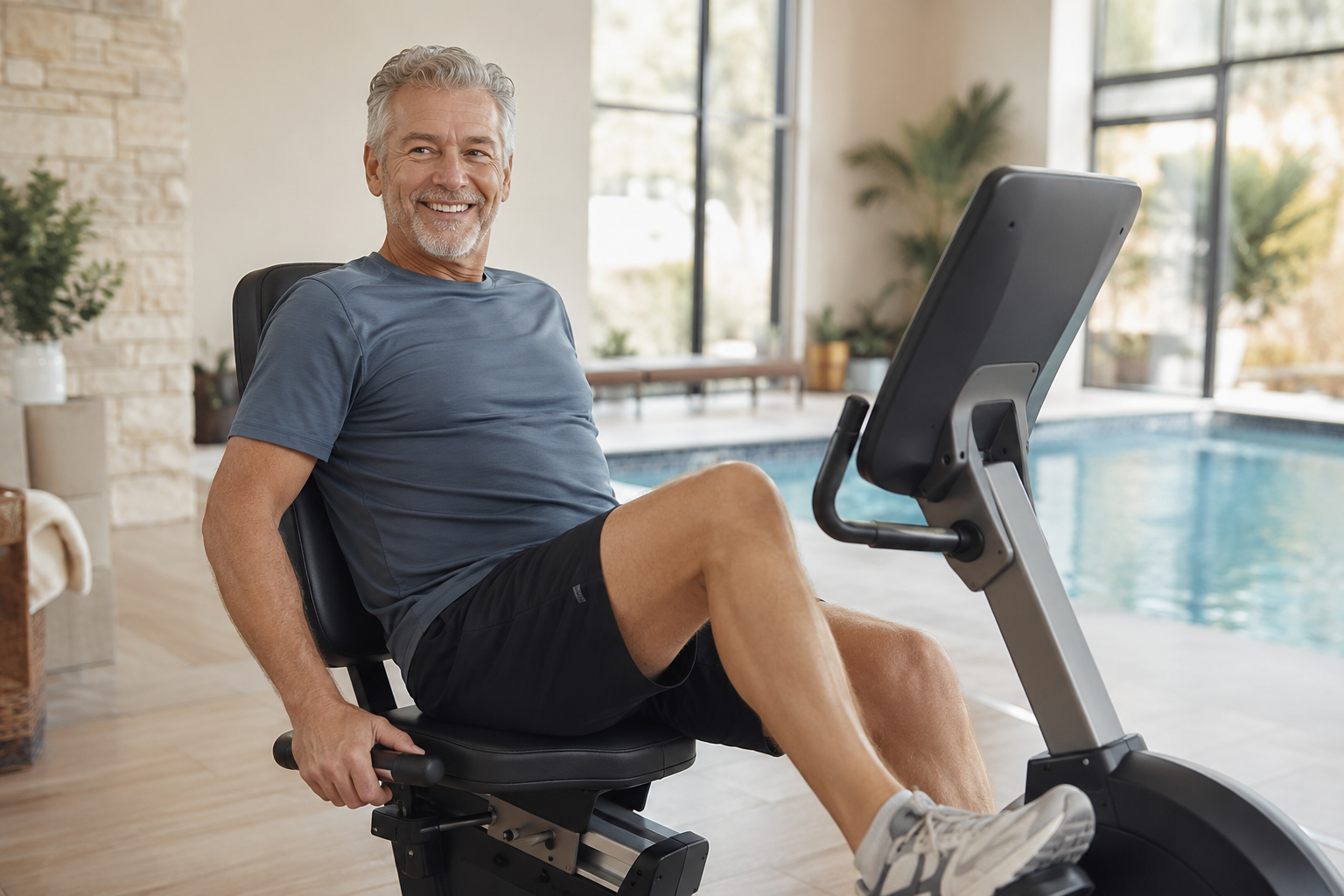
Cycling removes ground-reaction impact entirely because the rider’s weight sits on the seat and pedals rather than transferring through the legs with each stride. This makes it a common recommendation for knee osteoarthritis specifically, since the seated, circular pedaling motion moves the joint through a controlled range without the compressive spike of a footstrike. A recumbent bike, which supports the back and positions the legs more horizontally, further reduces strain on the hips and lower back for people who find an upright bike uncomfortable.
Seat height matters more than most riders expect. If the seat sits too low, the knee stays bent through too much of the pedal stroke and takes on extra strain; if it sits too high, the hips rock side to side to reach the pedals, which can irritate the hip or lower back. A knee that is nearly straight, but not locked, at the bottom of the pedal stroke is a reasonable starting position to adjust from.
Elliptical Training
An elliptical trainer keeps both feet in continuous contact with the pedals, which is the main reason it produces less pounding force than a treadmill. On a treadmill, one leg leaves the ground with every stride and the landing leg absorbs the full weight of the body; on an elliptical, the machine’s arc carries the foot through its path instead. Despite the smoother feel, research comparing elliptical and treadmill sessions at matched intensity has found similar calorie expenditure between the two, so the reduced joint stress does not come at the cost of conditioning benefit.
The Arthritis Foundation’s guidance on elliptical training recommends starting with five to ten minutes and building toward thirty minutes most days, paying attention to posture, using footwear with adequate arch support, and keeping a light rather than white-knuckled grip on the handlebars, since gripping too hard can transfer tension up into the shoulders and neck during a session that should otherwise be low-strain.
Step 3: Build Tolerance Gradually
The most common mistake in returning to cardio with joint pain is not choosing the wrong modality; it is progressing volume or intensity too quickly once a modality starts to feel good. Joints, tendons, and cartilage adapt more slowly than the cardiovascular system does, so a joint that “feels fine” at ten minutes may not yet be ready for thirty. A conservative, staged plan protects that gap.
Sample Progression Plan
- Weeks 1–2: Three sessions a week, 10–15 minutes each, easy conversational effort. Goal is tolerance, not fitness.
- Weeks 3–4: Three to four sessions a week, 15–20 minutes each. Add gentle resistance (water resistance, light bike gear) if the prior stage felt easy and produced no next-day soreness.
- Weeks 5–6: Four sessions a week, 20–25 minutes, moderate effort. Consider introducing a second modality (for example, alternating cycling and water walking) to vary joint loading patterns.
- Weeks 7–8: Four to five sessions a week, 25–30 minutes, working toward the 150-minutes-per-week target. Layer in two short strength sessions for the muscles supporting the affected joint.
- Ongoing: Maintain volume; increase intensity in small steps only after a stage produces no increase in pain, swelling, or stiffness the following day.
Increase only one variable at a time (duration, frequency, or intensity) and hold the others steady while you do. If a joint responds poorly after a change, drop back to the last comfortable stage for a week before trying again. This is slower than most fitness plans, and that is the point: the goal is a routine that can be sustained for years, not a program that produces a flare in month two.
Step 4: Add Strength and Mobility Work Around the Cardio
Cardio alone rarely solves joint pain because the muscles around a joint play a large role in how much load the joint itself absorbs. Strengthening the quadriceps supports the knee; strengthening the hip abductors and glutes supports both the hip and the knee, since weakness there changes how the leg tracks during walking, cycling, or water walking. The ACR and Mayo Clinic both list strengthening as a separate, necessary category alongside aerobic work, generally recommending it on at least two non-consecutive days a week.
Simple, joint-friendly strength options include seated leg extensions with light resistance, bodyweight sit-to-stands from a chair, resistance-band hip abduction, and water-based strengthening moves performed during a pool session. Mobility work, meaning gentle range-of-motion movement for the affected joint done daily and separate from cardio sessions, keeps the joint moving through its available range and can make the cardio sessions themselves feel easier over time.
Step 5: Know When to Modify vs. When to Stop
Some discomfort during a new or increased activity is normal, particularly in the first few sessions of a new modality. The general rule used across arthritis exercise guidance is that mild soreness which settles within a couple of hours, or mild stiffness the next morning that eases with movement, is tolerable and often expected. Pain that is sharp, that is clearly worse than a person’s usual baseline joint pain, or that lingers well into the next day is a signal to modify: reduce the duration, drop the resistance, or switch to a gentler modality such as water walking for a session or two.
A short list of changes that call for reducing or pausing a session:
- Pain during the activity that is sharp rather than a dull ache
- Pain that persists or worsens more than a couple of hours after stopping
- Visible swelling around the joint, or a change in skin color or warmth over the joint
- Stiffness the next morning that lasts longer than usual or does not ease with gentle movement
Red Flags That Warrant a Prompt Medical Evaluation
A smaller set of symptoms goes beyond “modify the workout” and points toward getting evaluated by a physician before continuing any cardio program on that joint:
- New or worsening swelling around a joint that does not settle with rest
- Locking or catching — a joint that suddenly cannot move through its normal range, or that clicks and catches painfully during movement
- A feeling of significant instability — a joint that feels like it might give way or buckle under normal load
- Fever, redness, or warmth around a joint, which can indicate infection or an inflammatory flare rather than mechanical joint pain
- Pain that wakes you from sleep or is present at rest, not only with movement
None of these symptoms should be diagnosed or managed through an exercise progression alone. They are reasons to contact a physician or physical therapist promptly rather than pushing forward with a cardio plan.
Step 6: Track Progress and Adjust the Plan
A simple log makes the difference between guessing and adjusting deliberately. After each session, note the modality, duration, effort level, and how the joint felt during, immediately after, and the next morning. Over a few weeks, patterns tend to show up on their own: a particular stroke in swimming that consistently bothers a shoulder, a bike seat height that needs another adjustment, or a day of the week when fatigue makes form harder to maintain and pain more likely.
Reassess the plan every two to four weeks. If a stage has produced no pain flares, minimal next-day stiffness, and the sessions feel sustainable, it is reasonable to progress to the next stage. If a stage keeps producing setbacks even after modification, that is useful information for a follow-up conversation with a physical therapist, who can look at movement mechanics that a written plan cannot account for.
A basic log does not need to be complicated. A notes app entry with the date, modality, duration, resistance or intensity level, and a one-line comment on how the joint felt is enough to spot trends. Some people prefer a simple 0-to-10 pain scale recorded before, during, and the morning after each session, since a consistent number is easier to compare across weeks than a memory of “it felt about the same.” Whatever format is used, the goal is the same: turn a vague sense of “my knee has been off lately” into a specific pattern that a clinician or physical therapist can act on, such as pain that consistently rises after breaststroke sets, or stiffness that only shows up after sessions longer than twenty-five minutes. That level of detail speeds up appointments and makes any adjustments to the plan more targeted.
Warming Up and Cooling Down
A short warm-up matters more for joint pain than it does for general fitness. Five minutes of the same modality at a very easy effort, before working up to the planned intensity, gives synovial fluid time to circulate and warms the surrounding muscle and tendon tissue. Skipping straight into a moderate-effort set is one of the more common reasons a session that should have felt fine ends up feeling sharp in the first few minutes.
A cool-down of a few minutes at reduced effort, followed by gentle stretching for the muscles around the affected joint, helps the transition out of a session go more smoothly as well. Neither step needs to be long. The point is a gradual on-ramp and off-ramp around the working portion of the session, rather than starting and stopping at full intensity.
Putting It Together
Low-impact cardio is not a lesser version of “real” exercise; it is the version that lets people with joint pain build cardiovascular fitness without paying for it in flares and setbacks. Swimming and water walking offer the lowest impact and are a strong starting point for multi-joint pain. Cycling and elliptical training offer a more land-based feel while still avoiding the pounding of running or high-impact classes. A staged progression, paired with strength work and honest tracking of how joints respond, turns any of these into a routine that can be maintained for years rather than abandoned after a flare.
Joint pain that is new, worsening, or accompanied by swelling, locking, or instability deserves a proper evaluation before an exercise plan is built around it. For everyone else, the options above give several practical ways to get the heart rate up while keeping the joints out of the equation as much as possible.
Frequently Asked Questions
Is walking considered a low-impact cardio option for joint pain?
Walking is lower impact than running, but it is not impact-free since each step still involves a single-leg landing. Many people with mild joint pain tolerate walking well, especially on soft, even surfaces with supportive footwear. For more significant pain or multi-joint involvement, swimming, cycling, water walking, and elliptical training generally place less load on the joints than walking does.
How long before low-impact cardio starts to reduce joint pain?
Timelines vary by individual and by the underlying cause of the joint pain, and this is a question worth discussing with a physician or physical therapist who knows the specific diagnosis. In general, published exercise studies for arthritis have used programs lasting several weeks to a few months before measuring changes in pain and function, which suggests that consistency over weeks matters more than any single session.
Can I do low-impact cardio every day?
Many people tolerate daily low-impact cardio once they have built up tolerance, particularly if sessions are moderate in length and intensity. The progression plan above builds toward four to five sessions a week rather than seven, partly to leave room for strength work and rest, and partly because joints and connective tissue benefit from some recovery time even when the activity itself is gentle.
Do I need a pool to manage joint pain with cardio?
No. Pool access helps because it offers the lowest-impact options, but cycling and elliptical training deliver similar low-impact cardiovascular benefits without water. Choose the option that matches what is available and what a clinician has approved for the specific joint involved.
What is the difference between normal exercise soreness and a joint pain red flag?
Normal soreness is typically mild, affects the muscles more than the joint itself, and settles within a day. A red flag looks different: sharp pain during movement, swelling that does not go down with rest, a joint that locks or catches, or a feeling of instability. The red flag list in this article covers the specific symptoms that call for a prompt medical evaluation rather than a workout adjustment.
Should I stop all cardio during a joint pain flare?
Not necessarily, but the type and intensity usually need to change. Guidance for inflammatory arthritis flares generally points toward scaling back to gentle range-of-motion movement or light water-based activity rather than stopping activity altogether, though this depends on the specific condition and severity. A physician or physical therapist can advise on what is appropriate during an active flare.
References
- American College of Rheumatology. Exercise and Arthritis
- Arthritis Foundation. Benefits of Aquatic Exercise for Arthritis
- Arthritis Foundation. Elliptical Machines Go Easy on Your Joints
- Mayo Clinic. Exercise Helps Ease Arthritis Pain and Stiffness
- Wang J, et al. The Critical Role of Physical Activity and Weight Management in Knee and Hip Osteoarthritis: A Narrative Review. Journal of Rheumatology.