



























Quick answer
A workable cycling commute rests on three things: a bike that actually fits your body, a route chosen for safety rather than pure distance, and a pacing and packing plan that gets you to work clean, not drenched. Riders who commute by bike show meaningfully lower rates of cardiovascular disease and all-cause mortality in long-term population studies, but those benefits only show up when the setup is comfortable enough to repeat, week after week.
By Sophie Taylor
Who This Matters Most For
This guide is written for adults who are considering, or have just started, commuting to work or school by bicycle, typically for trips in the two to twelve mile range. It assumes no racing background and no specialized fitness. It is most directly useful for someone who owns or is about to buy a hybrid, road, or commuter-style bike, rides mostly on streets and shared paths rather than singletrack trails, and wants a repeatable routine rather than a one-off adventure ride. If you are managing a diagnosed cardiovascular or joint condition, are recovering from an injury, or are new to any regular exercise, read this alongside guidance from your own clinician, since individual medical circumstances change what a safe starting point looks like.
What the Research Says About Commuting by Bike
The strongest evidence on active commuting comes from large population studies that track people’s usual travel mode over years and then compare health outcomes. The best-known example followed more than 260,000 adults in the UK Biobank study and matched their self-reported commute type against hospital and mortality records over a median of five years. People who commuted by bicycle, including those who cycled only part of the way, had substantially lower rates of cardiovascular disease, cancer diagnosis, and death from any cause compared with people who drove or took public transit for their whole commute. The researchers, led by Dr. Carlos Celis-Morales and Dr. Jason Gill at the University of Glasgow, reported the difference in hazard ratios: cycle commuters had roughly a 41 percent lower risk of dying during the study period, a 45 percent lower risk of developing cancer, and a 46 percent lower risk of developing cardiovascular disease, relative to non-active commuters, after adjusting for factors such as age, smoking, and existing illness.
Walking commuters in the same study also showed a lower risk of cardiovascular disease, though the effect was smaller than for cycling, most likely because cycling trips tend to cover more distance and sustain a higher heart rate for longer. The study’s authors pointed to the built-in nature of the exercise as the mechanism: a bike commute converts unavoidable daily travel time into moderate-to-vigorous physical activity without requiring a separate gym visit, which may explain why the association held up even among people who reported no other structured exercise.
This lines up with general physical activity guidance. The World Health Organization recommends that adults get at least 150 minutes of moderate-intensity activity per week, and it names walking and cycling as core forms of “active transport” that public health policy should make easier and safer to choose. The U.S. Centers for Disease Control and Prevention makes a similar point: reaching that 150-minute weekly target is linked to lower risk of heart disease, stroke, type 2 diabetes, and several cancers, and the agency notes that activity does not need to happen in one continuous block to count. A 20-minute ride each way, five days a week, clears that bar on its own.
Active commuting, by the numbers
Sources: Celis-Morales et al., BMJ 2017 (357:j1456); University of Glasgow; WHO Physical Activity fact sheet; CDC Bicycle Safety and Physical Activity Basics pages. Full citations in References below.
Bike Fit and Equipment Setup Essentials
A bike that does not fit is the single fastest way to quit commuting by bike. Knee pain, numb hands, a sore lower back, or a saddle that hurts within ten minutes are almost always fit problems, not fitness problems, and they are usually fixable with simple adjustments rather than a new bike.
Start with saddle height. Sit on the bike with a wall or a friend to steady you, put your heel on the pedal at the bottom of the pedal stroke, and adjust the saddle until your leg is fully straight in that position. When you clip in or place the ball of your foot on the pedal normally, that same bottom position should leave a slight bend in the knee, roughly the angle you’d get standing with your knees relaxed and just slightly bent. A saddle that is too low forces the knees to overwork and is a common cause of anterior knee pain; a saddle that is too high causes hips to rock side to side and can irritate the lower back.
Next, check reach: the distance from saddle to handlebar. You want a comfortable, slight forward lean with elbows softly bent, not locked straight and not so short that your knees bump the handlebar on each pedal stroke. Most commuter and hybrid bikes are built with a more upright position than road racing bikes specifically to reduce strain on the neck, wrists, and lower back during everyday riding, which is part of why they tend to suit new commuters better than a borrowed road bike. If your wrists go numb or your neck aches after ten minutes, a shorter stem or raised handlebar is usually a low-cost fix at a bike shop.
Tire pressure and gearing round out the basics. Under-inflated tires increase rolling resistance and raise flat-tire risk; check the sidewall for the recommended pressure range (usually printed in PSI or bar) and inflate toward the higher end for pavement riding. Learn your gearing before your first real commute: shift to an easier gear before you reach a hill or a stop, not once you’re already grinding to a halt, since that habit alone prevents a lot of the early-week frustration that makes people abandon the idea.
Route Selection and Safety
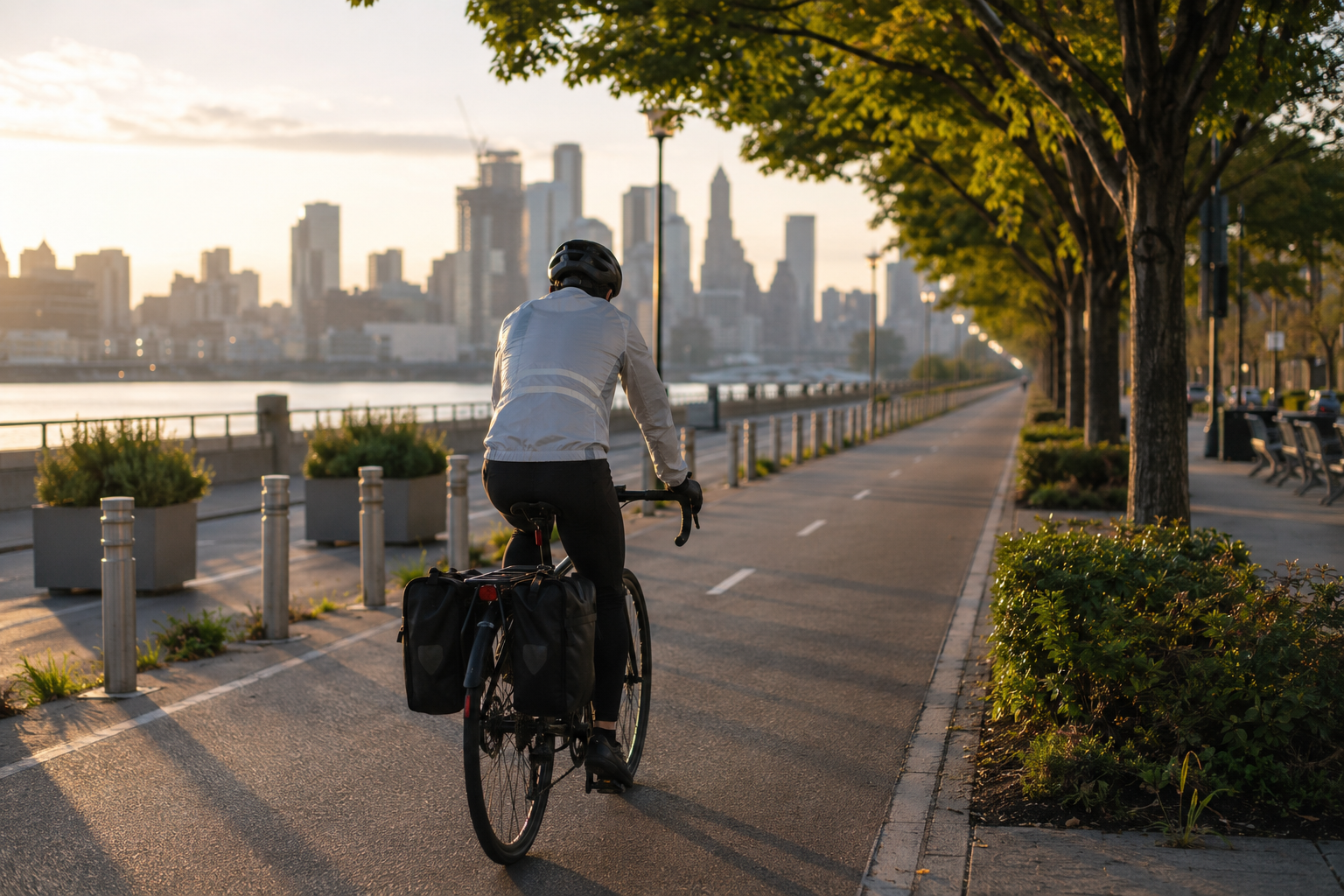
The fastest route on a car GPS is rarely the best cycling route. Distance matters less than the type of road you’re on and how exposed you are to fast-moving traffic. The CDC’s bicycle safety data shows that the majority of fatal bicycle crashes happen away from intersections, on road segments where vehicle speeds are higher, and involve urban roads rather than rural ones. That points to a clear planning principle: favor protected bike lanes, quiet residential streets, and multi-use paths over arterial roads with high speed limits, even if it adds a few minutes.
Before committing to a route for daily use, ride it once on a weekend when the stakes are lower. Note where you’ll cross busy intersections, where parked cars create a “door zone” you need to ride around, and whether lighting is adequate if part of your commute happens before sunrise or after sunset. Many cities now publish dedicated cycling maps that flag protected lanes and known trouble spots; a few extra minutes with one of these before your first ride can save a lot of stress later.
Both the CDC and the National Highway Traffic Safety Administration are direct about the fundamentals: ride in the same direction as traffic, obey the same signals and signs a car would, signal your turns, and assume that any given driver has not seen you until you have clear eye contact or another confirmation. NHTSA also recommends a front white light and rear red light any time visibility is reduced, not only after full dark, since dawn, dusk, and heavy rain all reduce how easily a driver can pick out a cyclist.
Recovery and Logistics: Arriving Without Being Wrecked
The part of cycling commuting that trips people up is rarely the ride itself; it’s arriving at work sweaty, late, or too tired to focus for the first hour. Pacing solves most of this. Ride the first ten minutes noticeably easier than feels necessary. Heart rate and body temperature both climb faster than they feel like they are climbing, and a hard opening five minutes is the most common reason people show up overheated even on short commutes. A steady, conversational effort for most of the ride, with a slightly easier final stretch to let your heart rate come down, gets you there in close to the same time with far less sweat.
Plan your arrival routine before your first real commute, not during it. If a shower is available at work, use it on longer or hotter rides. If it isn’t, a small towel, unscented wipes, and a change of shirt handle most of what a shower would on rides under 20 to 25 minutes at an easy pace. Keeping a spare set of work clothes, deodorant, and a hairbrush at your desk means you’re not carrying that weight in your bag every single day.
Build up gradually if you are new to regular cycling. A common and avoidable mistake is treating week one like a fitness test: riding the full distance at full effort on day one, waking up sore, and quitting by Wednesday. A better pattern is to ride part of the distance for the first week (for example, ride to a transit stop partway and finish the trip by bus or train), then extend as your legs and your route confidence both build. Muscle soreness that lingers for more than two or three days, sharp joint pain, or persistent breathlessness are signs to scale back and, if they continue, to check in with a doctor.
Weather deserves its own plan rather than a day-of decision. Layer for temperature (a base layer plus a wind or rain shell packs down small and handles a wide range of conditions), keep a pair of light gloves in your bag once temperatures start dropping, and decide your rain threshold in advance: many riders draw the line at lightning or genuinely hazardous downpours and treat ordinary rain as something a shell jacket and fenders handle fine.
Setting Up Your Commute: A Copy-Ready Checklist
- Get a professional or careful DIY fit check: saddle height, reach, and handlebar height.
- Test-ride your planned route on a low-stakes day (weekend, no time pressure).
- Install front white light and rear red light, even if you plan to ride only in daylight at first.
- Buy or confirm a properly fitted helmet, adjusted so it sits level and doesn’t rock.
- Pack a spare tube, tire levers, and a mini pump; learn to change a flat before you need to.
- Choose a lock rated for your neighborhood’s theft risk (U-lock or heavy chain over a thin cable).
- Stage a change of shirt, wipes or towel, and deodorant at your desk or in your bag.
- Decide your rain and cold-weather thresholds before the first storm shows up.
- Plan a backup (bus, train, rideshare) for days you’re not up for the ride.
- Start with a distance that feels easy, and extend it over two to four weeks.
A Worked Example: Building the Habit Over Six Weeks
Consider a composite case based on a typical new commuter: a 34-year-old office worker, three miles from her workplace, who has not ridden regularly since college. Her goal isn’t speed; it’s a sustainable routine three days a week.
Week 1. She gets a bike shop to check her saddle height and confirms tire pressure. She rides the route once on a Saturday morning with no schedule pressure, discovers one intersection she wants to avoid, and maps a slightly longer but calmer alternative. She commutes twice that week, at an easy pace, and drives the rest of the days.
Weeks 2 to 3. She adds a third weekly ride and starts keeping a spare shirt and wipes in her desk drawer. Her legs are mildly sore after week one but not painful by week three, which she treats as a sign she’s adapting rather than overdoing it. She installs a rear light after one ride home in fading evening light felt less comfortable than expected.
Weeks 4 to 5. She’s riding four days a week and has stopped thinking about the route consciously; it’s become routine. She adjusts her morning pace after noticing she arrives overheated when she pushes the first hill too hard, and finds that easing off for the first few minutes fixes it entirely.
Week 6. A rainstorm tests her weather plan for the first time. Because she’d already decided her threshold (ride through steady rain, skip if there’s lightning or flooding), she doesn’t have to make that call under pressure, and her shell jacket and fenders keep her presentable at the office. By this point the commute has stopped being a special event and become an ordinary part of her week, which is the actual marker of a setup that works.
Common Mistakes
What Active-Transportation Researchers Say
Researchers who study active transportation tend to frame cycling commutes less as a workout and more as “incidental” activity: exercise that happens as a side effect of getting somewhere you already needed to go. Dr. Carlos Celis-Morales, who led the UK Biobank commuting analysis, and his co-author Dr. Jason Gill described the appeal of this design in the study’s public commentary: because the activity is built into an existing daily trip, it doesn’t compete with time the way a gym session does, which may be part of why the health associations held up so strongly across a large, varied population.
Public health bodies echo the same framing. The WHO’s global guidance on physical activity explicitly recommends that governments invest in infrastructure that “ensures access to walking, cycling and non-motorized transport,” treating safe route availability as a public health lever, not just a transportation planning detail. The CDC’s road safety data adds an important counterpoint that researchers are careful not to skip past: cyclist fatalities remain concentrated on roads with higher vehicle speeds and away from intersections, which is why the same researchers who champion active commuting for its health effects also champion protected infrastructure and lower urban speed limits as the intervention that makes those health effects safely reachable for more people.
Safety and scope notes
This article is general educational information, not medical or individualized safety advice. Wear a properly fitted helmet on every ride, follow local traffic laws, and build up distance and intensity gradually if you’re new to regular cycling. If you have a heart condition, joint problems, or another medical concern, talk with a doctor before starting a new commuting routine, and treat any chest pain, severe joint pain, or unusual shortness of breath during riding as a reason to stop and seek medical attention.
Key Takeaways
- Large cohort research links cycle commuting to markedly lower rates of cardiovascular disease, cancer incidence, and all-cause mortality compared with non-active commuting.
- Bike fit (saddle height, reach, handlebar position) is the single biggest factor in whether a commute stays comfortable enough to repeat.
- Route choice should prioritize protected lanes, paths, and quiet streets over the shortest distance; most fatal crashes happen on faster roads away from intersections.
- Pacing the first minutes of a ride, and having a plan for clothes and cleanup, prevents the “sweaty and late” problem that ends most commuting attempts.
- Build distance and frequency gradually over a few weeks rather than starting at full intensity.
Frequently Asked Questions
How far is reasonable for a first bike commute?
Most new commuters do well starting somewhere between two and six miles each way. Distances in that range are usually manageable in 15 to 30 minutes at an easy pace and are short enough that a shower isn’t strictly necessary. You can extend the distance once your fitness and route confidence build.
Do I need a road bike, or is a hybrid fine?
A hybrid or dedicated commuter bike is usually a better starting point than a road bike. Its more upright riding position reduces strain on the wrists, neck, and lower back, and the wider tires handle potholes and rough pavement more comfortably.
How do I avoid showing up to work sweaty?
Ride the first ten minutes noticeably easier than feels necessary, since heart rate and body temperature climb faster than they seem to. Pair that with a light layering strategy, a short cool-down stretch before you go inside, and a towel or wipes and a change of shirt for anything longer than about 20 minutes.
What is the single most important safety item?
A properly fitted helmet, worn on every ride, is the item with the clearest evidence behind it for reducing head and brain injury severity in a crash. Front and rear lights come next, since visibility failures are a major factor in crashes involving cyclists.
Should I ride on the sidewalk to stay away from traffic?
Sidewalk riding is generally discouraged by traffic safety agencies for adult cyclists, since it increases the risk of a crash at driveways and intersections where drivers aren’t looking for a cyclist moving at bike speed. A protected bike lane, multi-use path, or quiet street is a better option where one is available; check your local traffic laws, since sidewalk cycling rules vary by city.
What if my workplace has no shower?
For most commutes under 20 to 25 minutes ridden at an easy pace, a small towel, unscented wipes, and a fresh shirt handle the cleanup adequately. Keeping a spare set of essentials (deodorant, a hairbrush, a shirt) at your desk removes the need to carry them daily.
How often should I ride to see health benefits?
Public health guidance targets 150 minutes of moderate activity per week. A commute of around 20 to 30 minutes each way, ridden five days a week, reaches or exceeds that target on its own; even two or three days a week contributes meaningfully and is a reasonable starting frequency.
What should I do about rain and cold weather?
Decide your weather thresholds before the season turns, rather than deciding each morning under time pressure. A wind or rain shell, fenders, and light gloves handle most conditions; many riders draw the line at lightning, ice, or flooding rather than ordinary rain or cold.
References
- Celis-Morales, C.A., Lyall, D.M., Welsh, P., et al. “Association between active commuting and incident cardiovascular disease, cancer, and mortality: prospective cohort study.” BMJ 2017;357:j1456. bmj.com/content/357/bmj.j1456
- University of Glasgow. “Cycling to work linked to lower risk of cancer and heart disease” (2017 research summary). gla.ac.uk/news/archiveofnews/2017/may/headline_522765_en.html
- University of Glasgow Enlighten repository record for the above study. eprints.gla.ac.uk/138376
- World Health Organization. “Physical activity” fact sheet. who.int/news-room/fact-sheets/detail/physical-activity
- Centers for Disease Control and Prevention. “Benefits of Physical Activity.” cdc.gov/physical-activity-basics/benefits/index.html
- Centers for Disease Control and Prevention. “Bicycle Safety.” cdc.gov/transportation-safety/bicycle-safety/index.html
- National Highway Traffic Safety Administration. “Bicycle Safety.” nhtsa.gov/road-safety/bicycle-safety