




























By Ada L. Wrenford
Most people don’t quit a workout routine because it stops working. They quit because it stops fitting into their day. Supersets solve that problem directly: they let you do more training in less time by pairing two exercises back to back with little or no rest in between. Done well, this approach can meaningfully shrink your session length while keeping the training effect largely intact. Done carelessly, it can also wreck your form, spike your heart rate uncomfortably fast, or set you up for a strain.
This guide walks through exactly how to superset safely: which exercises to pair, how much rest to actually cut, how to protect your joints and technique when fatigue builds, and a full step-by-step framework you can apply to almost any workout split. It’s written for people who already have some training experience and want to train smarter under real time pressure, and it includes caveats for anyone newer to strength training or managing a health condition.
What a Superset Actually Is (and What It Isn’t)
A superset means performing two exercises consecutively with minimal rest between them, then resting before repeating the pair. That’s the whole definition, but the details of which two exercises you choose change the workout completely. Strength coaches generally group supersets into a few categories:
- Agonist-antagonist supersets: pairing exercises that work opposing muscle groups, such as a biceps curl with a triceps pushdown, or a chest press with a seated row. Because the muscles involved are different, one can partially recover while the other works.
- Compound sets: pairing two exercises for the same muscle group back to back, like a leg press followed immediately by a leg extension. These are more fatiguing because the same tissue is doing all the work.
- Staggered or non-competing supersets: pairing a main lift with a small, unrelated accessory movement, such as a squat with a plank or calf raise, so the “rest” period between squat sets becomes productive.
People sometimes use “superset” loosely to describe circuit training (several exercises in a row) or drop sets (reducing weight mid-set). Those are related time-efficient techniques but they aren’t the same tool, and they carry different fatigue profiles.
The research in brief: a controlled study by Robbins and colleagues found that when trained lifters supersetted opposing-muscle exercises (lat pulldowns with leg curls, biceps curls with triceps work), they finished their sessions about 36% faster than a group doing traditional straight sets, while strength and muscle-building outcomes stayed comparable. That single data point is a big part of why supersets have become a standard tool for people who lift with a limited calendar rather than a limited work ethic.
Why Supersets Cut Time Without Necessarily Cutting Results
Traditional strength training spends a surprising amount of the clock on rest, not work. A set of eight reps might take 30 to 40 seconds, but the rest period that follows is commonly two to three minutes for compound lifts. Over an hour-long session, rest can account for more total time than the actual lifting.
Supersets attack that inefficiency in two ways:
- They fill “dead” rest time with productive work. While your chest and triceps recover from a pressing movement, your back and biceps haven’t been touched yet, so they can go to work instead of you standing around.
- They shorten total session rest. Instead of resting after every single set, you rest once after completing a full pair, which reduces the number of full rest breaks in the session.
A 2021 review on designing time-efficient resistance training programs describes supersetting as a strategy that can bring total session time down substantially compared with traditional set-and-rest training, while training volume (the total sets and reps performed) is kept the same. That distinction matters: the time savings come from smarter sequencing, not from doing less work.
The Safety Trade-Off Nobody Skips Past Fast Enough
Cutting rest is exactly what makes supersets efficient, and exactly what makes them riskier if you apply the technique carelessly. Fatigue accumulates faster, your heart rate climbs higher and stays elevated longer, and your technique on the second exercise of a pair is being performed by a body that’s already partially gassed from the first. A few specific risks show up repeatedly in coaching guidance:
- Technical breakdown under fatigue. The exercise that comes second in a superset is at higher risk of sloppy form, because stabilizing muscles from the first movement may still be fatigued.
- Overreaching on heavy, technical lifts. Coaches caution against supersetting two highly demanding, technique-sensitive compound lifts, such as barbell squats paired with deadlifts, because the combined fatigue and loss of precision on both increases injury risk without a clear payoff.
- Cardiovascular and gastrointestinal strain. Because supersets keep your heart rate elevated with less recovery, some people report light-headedness or nausea, especially when they jump into aggressive supersetting too quickly rather than easing in.
- Poor exercise selection logistics. If your two exercises require walking across a crowded gym floor, sharing equipment, or a long station change, the “rest” you save on paper gets eaten by set-up time, and you may end up rushing reps to compensate.
None of this means supersets are unsafe as a method. It means they reward good judgment about pairing, load, and pacing, the same way any intensification technique does.
How to Superset Safely: A Step-by-Step Framework
Step-by-Step Checklist
- Warm up properly first. Spend 5-10 minutes on light aerobic movement and dynamic mobility before your first working set. This is standard strength-training guidance and matters more, not less, once you plan to cut rest between sets.
- Pick your pairing style deliberately. Default to agonist-antagonist pairs (opposing muscles) for the safest, most time-efficient combination. Save same-muscle compound sets for when you specifically want extra metabolic fatigue on a smaller, less technical movement.
- Never pair two high-skill, high-load compound lifts. Keep barbell squats, deadlifts, and heavy overhead presses on their own, resting normally. Superset the accessory and single-joint work around them instead.
- Choose a weight you can control fully fatigued. A widely used benchmark is a load that fatigues the working muscle within roughly 12-15 repetitions; if you’re grinding out reps 1 through 4, that’s not the right pairing weight for supersetting.
- Set your rest windows, don’t wing them. A workable starting structure: about 15-30 seconds transitioning between the two exercises in the pair, then 60-120 seconds of full rest after completing both.
- Stage your equipment ahead of time. Choose exercises you can do in the same spot, or grab both sets of equipment (dumbbells, bands) before you start the pair, so you aren’t losing your short rest window to walking across the gym.
- Watch your breathing and stop if you feel lightheaded. If you notice nausea, dizziness, or your heart rate feels uncomfortably high, extend your rest period or drop back to traditional sets for that exercise pair.
- Progress gradually. Introduce one or two supersetted pairs into a session in your first week or two rather than converting an entire workout at once, so your body adapts to the higher cardiovascular demand.
- Track total volume, not just time. The goal is the same sets and reps in less time, not fewer sets and reps. Log your workouts to confirm you’re maintaining volume as you shorten the session.
- Reassess week to week. If recovery, sleep, or joint soreness worsens, dial back the pairing intensity or spacing before it becomes a nagging issue.
Matching Supersets to Your Training Goal
Not every goal calls for the same superset structure. The pairing logic stays the same, but the rest windows, load selection, and pacing shift depending on what you’re actually training for.
Fat loss and general conditioning
If your priority is calorie expenditure and cardiovascular conditioning alongside strength, shorter transition windows (10-20 seconds) and slightly lighter loads keep your heart rate elevated for longer stretches. Circuit-style supersetting across three or four exercises can work here, but keep an eye on technique since fatigue accumulates faster across more movements.
Hypertrophy (muscle building)
For muscle growth, agonist-antagonist supersets are a strong fit because they let you accumulate more total working sets per hour without meaningfully compromising the load or rep quality on either exercise, since the opposing muscle group had a chance to recover. Compound sets (same muscle group back to back) can add extra metabolic stress for a specific area, but they’re best used sparingly, on accessory movements, rather than as your default approach for every muscle group.
Strength maintenance under time pressure
If the goal is simply preserving strength during a busy stretch of life rather than chasing new personal records, supersetting your accessory and single-joint work while keeping your main compound lift (squat, bench press, deadlift, overhead press) on its own traditional rest cycle is a sensible compromise. You protect the lift that most needs full recovery and full technical focus, while still trimming meaningful time off the accessory portion of the session.
Time-crunched general fitness
If you simply have 30-40 minutes and want a complete, balanced session, a full-body superset template (like the sample below) covering push, pull, lower body, and core in three or four pairs is usually the most efficient structure available without sacrificing the range of movement patterns a well-rounded routine should include.
Equipment and Setting: Gym Floor vs. Home Workouts
Where you train changes how practical supersetting is. In a busy commercial gym, the biggest logistical obstacle is usually not fatigue, it’s finding two adjacent, available stations for your pair of exercises. A few adjustments make this easier:
- Favor dumbbells and cables over fixed machines when the gym is crowded, since a pair of dumbbells can usually be carried to one spot and used for both exercises in your pair.
- Scout your pairing before you start the set, rather than mid-rest, so you’re not scrambling to find open equipment while your transition window ticks by.
- Have a backup pairing in mind in case your first-choice equipment is occupied when you get there.
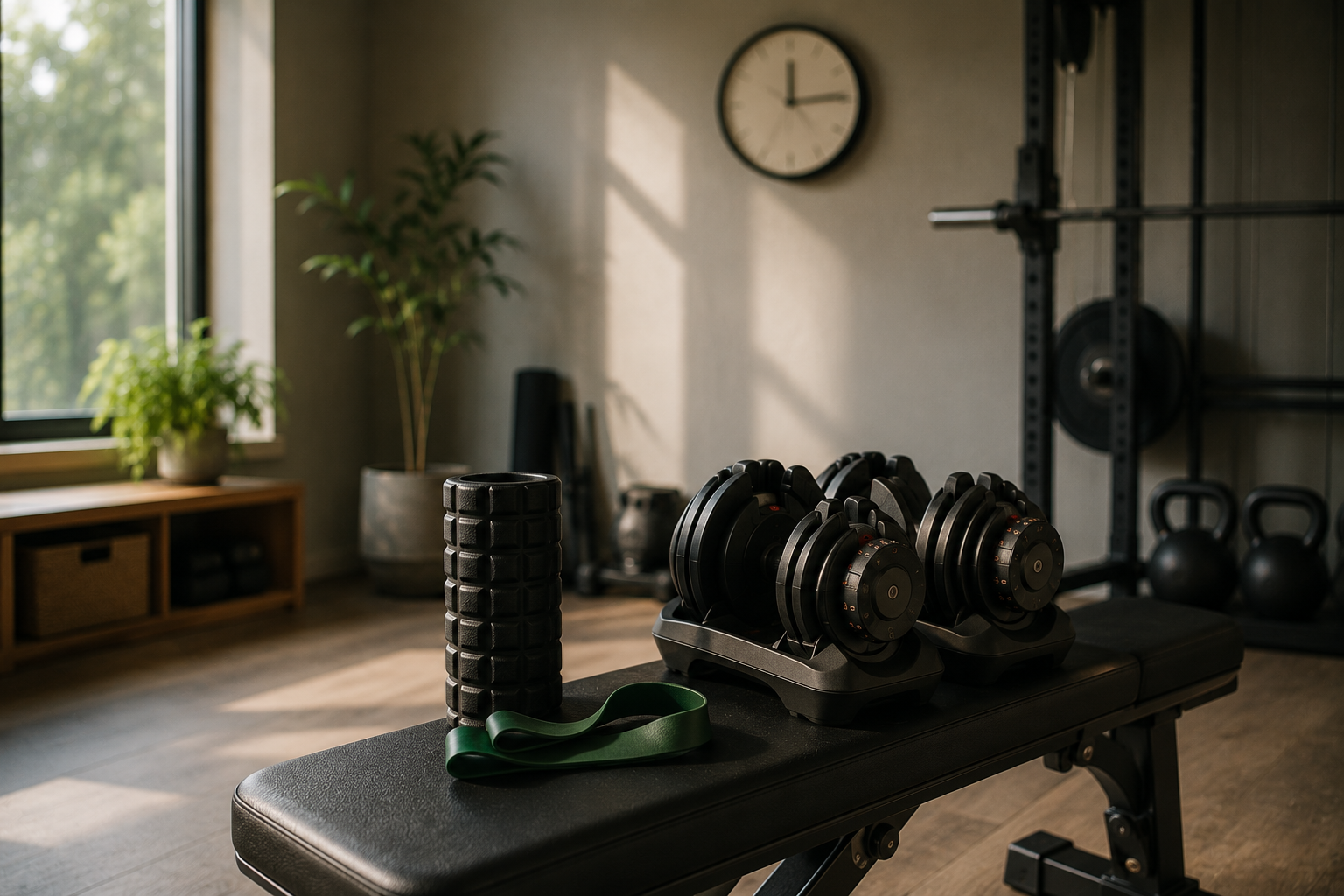
At home, equipment logistics are simpler since everything is usually within a few steps, but space and variety can be more limited. A resistance band, one or two pairs of adjustable dumbbells, and a stable bench or sturdy chair are enough to build almost every pairing described in this guide. The core challenge at home tends to be self-pacing discipline: without a gym clock or a training partner keeping time, it’s easy to let rest periods drift longer or shorter than planned, so a phone timer or fitness watch interval feature is worth using.
Sample Superset Pairings by Body Region
The table below shows practical, lower-risk pairings organized by training goal. These favor opposing muscle groups or a compound lift paired with an unrelated accessory movement, following the same logic described above.
| Focus Area | Exercise A | Exercise B | Why It Works |
|---|---|---|---|
| Upper body push/pull | Dumbbell chest press | Seated cable row | Opposing muscles, similar equipment area, minimal setup change |
| Arms | Biceps curl | Triceps pushdown | Classic antagonist pair used in published superset research |
| Lower body | Leg curl (hamstrings) | Leg extension (quadriceps) | Opposing muscles, low technical demand, machine-based so fatigue is manageable |
| Core with a main lift | Goblet squat | Front plank | Non-competing muscle demand, turns squat rest into core work |
| Shoulders/back | Dumbbell shoulder press | Lat pulldown | Opposing movement pattern, similar equipment area |
| Avoid pairing together | Barbell back squat | Conventional deadlift | Two high-skill, high-fatigue compound lifts; keep these on separate rest cycles |
Building a Full Session Around Supersets
Here’s a full-body template that applies the framework above. It assumes roughly 45 minutes of available time, moderate training experience, and a goal of general strength and muscle maintenance.
Sample 45-Minute Superset Session
- Warm-up (8 minutes): light cardio plus dynamic mobility for hips, shoulders, and ankles.
- Superset 1: Dumbbell chest press x 10-12 reps, then seated cable row x 10-12 reps. Rest 20-30 seconds between exercises, 90 seconds after the pair. Repeat for 3 rounds.
- Superset 2: Goblet squat x 12 reps, then front plank x 30-40 seconds. Rest 30 seconds between, 90 seconds after the pair. Repeat for 3 rounds.
- Superset 3: Biceps curl x 12 reps, then triceps pushdown x 12 reps. Rest 15-20 seconds between, 60 seconds after the pair. Repeat for 3 rounds.
- Cool-down (5 minutes): walking pace plus static stretching for the muscles trained.
Compare that to the same volume performed as traditional straight sets with 2-3 minutes of rest after every set, and the difference in total session length becomes obvious. That’s the practical version of the time-savings effect described in the research above: same sets, same reps, meaningfully less clock time, because the rest periods are doing double duty.
Who Should Be Extra Careful, or Check With a Doctor First
Supersets increase cardiovascular demand and the pace of a session, so a bit more caution is warranted for certain groups. If you’re new to structured resistance training altogether, it’s worth building a foundation with straight sets and correct technique before adding the fatigue-stacking effect of supersets. Anyone with a diagnosed heart condition, uncontrolled blood pressure, a recent injury or surgery, or who is pregnant should talk with a doctor before adopting a higher-intensity training format like this. General public health guidance recommends muscle-strengthening activity on at least two days a week as part of a well-rounded routine, but how you structure the intensity within those sessions should fit your individual health situation.
Common Mistakes That Undermine Safe Supersetting
Chasing speed over quality
The entire point is to preserve training quality while trimming the clock, not to rush through reps sloppily to “beat the timer.” If your form degrades noticeably on the second exercise of a pair, slow down, lighten the load, or lengthen your transition window.
Supersetting two maximal-effort compound lifts
As covered above, pairing two heavy, technical barbell lifts multiplies fatigue and risk without a clear efficiency reward, since both exercises already demand near-full-body stabilization on their own.
Ignoring warm-up because the session feels “shorter”
A shorter total session is not a reason to cut the warm-up. If anything, an elevated-heart-rate format benefits from a properly primed cardiovascular and neuromuscular system going in.
Skipping the last rest period
The rest after completing a full pair is not optional filler. It’s what allows you to hit your next pair with enough quality to keep the reps in a safe, controlled range.
Treating every session like a superset session
Supersetting every single exercise in every single workout, week after week, can leave some lifters running down on recovery, particularly once several muscle groups are being trained at a faster pace with less rest across an entire training week. Mixing in some traditional-set sessions, or reserving supersets for the accessory portion of a workout rather than the entire thing, is a reasonable way to get the time benefit without accumulating fatigue faster than you can recover from it.
Tracking Your Progress as You Transition to Supersets
Because the appeal of supersetting is largely about time, it helps to measure two things side by side once you start: how long your sessions actually take, and whether your working weights and rep counts are holding steady or improving. A simple log, whether on paper or in a fitness app, that records exercise pairs, rest periods used, weight, and reps gives you a clear picture of whether the format is working for you specifically.
If you notice your reps creeping down for the same weight over a few weeks, or your rest periods quietly stretching out because you’re more fatigued than expected, that’s useful information. It might mean you need to lengthen the transition window slightly, drop the load a notch, or swap a demanding compound set back to a traditional straight set for a while. Supersetting is a tool for saving time without giving up results, and the only way to confirm it’s actually doing that for you is to keep an eye on the numbers rather than just the clock.
Frequently Asked Questions
Do supersets really cut workout time in half?
Not always exactly in half, but the time savings can be substantial. A controlled study on agonist-antagonist supersets found sessions finished about 36% faster than traditional straight-set training, and a review of time-efficient training methods describes supersetting as a strategy that can bring total session duration down roughly by half in some program designs, while keeping the same training volume. Your actual time savings depend on how you structure rest, transitions, and equipment setup.
Are supersets good for beginners?
They can be, once you already have reasonably solid technique on the individual exercises involved. If you’re brand new to resistance training, it’s generally safer to first spend a few weeks learning proper form with traditional sets and full rest, then introduce supersets gradually.
Should I superset the same muscle group or opposite muscle groups?
Opposing muscle group pairings (called agonist-antagonist supersets) are generally the safer and more time-efficient default, because one muscle group gets a partial break while the other works. Same-muscle-group pairings (compound sets) are more fatiguing and better reserved for smaller, less technically demanding exercises.
How much rest should I take between exercises in a superset, and between rounds?
A commonly used starting structure is roughly 15-30 seconds transitioning between the two exercises in a pair, then 60-120 seconds of full rest once you’ve completed both. Adjust based on how heavy the exercises are and how you feel; heavier or more technical movements deserve more rest, not less.
Can supersets cause injury?
Any training method can raise injury risk if it’s applied without attention to load, form, and recovery. The main risks specific to supersets are technical breakdown on the second exercise of a pair due to fatigue, and overreaching by pairing two demanding compound lifts together. Choosing sensible pairings, using a controllable weight, and stopping if something feels off (pain, dizziness, or nausea) all reduce that risk substantially.
How often can I use supersets in my training week?
Many lifters use supersets in most or all of their strength sessions once they’re accustomed to the format, since general public health guidance suggests muscle-strengthening activity on at least two days a week as a baseline. That said, if you notice recovery suffering, more joint soreness, or persistent fatigue, it’s reasonable to scale back to traditional sets on some days and reserve supersets for the sessions where time is tightest.
References
- Centers for Disease Control and Prevention, Physical Activity Guidelines for Adults
- Mayo Clinic, Strength training: Get stronger, leaner, healthier
- Stronger by Science, Supersets: An Evidence-Based Overview (summarizing Robbins et al. research on agonist-antagonist superset training and session time)
- PubMed, Search results on superset resistance training and time efficiency, including “Superset Versus Traditional Resistance Training Prescriptions: A Systematic Review and Meta-analysis” and “No Time to Lift? Designing Time-Efficient Training Programs for Strength and Hypertrophy”