



























By Mateo Rivera
You booked the flight, packed the garment bag, and told yourself this trip would be different. Then the meeting ran long, the hotel gym turned out to be two treadmills and a yoga mat, and by the third night you were eating room-service pasta at 9 p.m. wondering if the whole training program you built over the last four months just quietly died in a Marriott.
It didn’t. Strength is more durable than most lifters assume, and a week or two of imperfect training rarely undoes months of consistent work. But repeated travel, the kind where you’re on the road one or two weeks out of every month, is a different problem. It’s not one missed session; it’s a pattern that can slowly erode the habit itself. The goal of this guide isn’t to help you train exactly like you do at home. It’s to help you build a system flexible enough to survive layovers, unfamiliar gyms, jet lag, and 6 a.m. client breakfasts, so the habit stays intact even when the conditions are far from ideal.
Why Work Travel Actually Derails Training (It’s Not Just Willpower)
Frequent travelers tend to blame themselves for skipped workouts, but the barriers are mostly structural. Time zones shift your internal clock. According to the Sleep Foundation, the circadian clock takes roughly 1 to 1.5 days to adjust per time zone crossed, which means a five-hour shift can leave you fighting your own biology for the better part of a week. Add unpredictable meeting schedules, hotel gyms that range from fully equipped to nonexistent, and the simple fact that decision fatigue is higher when you’re managing a client dinner and an unfamiliar city, and it makes sense that training slips first.
None of that means you’re stuck skipping lifting every trip. It means the fix isn’t “try harder,” it’s building a plan that assumes disruption instead of getting derailed by it. The travelers who keep training year after year aren’t the ones with more willpower than everyone else. They’re the ones who stopped expecting a road trip to look like a normal training week and built a separate, simpler system for it instead.
That system is what the rest of this guide walks through: a minimum weekly target grounded in real guidelines, a packing and planning routine you run before every trip, three interchangeable training modes depending on what’s available, and a set of fallback plans for the trips that break every rule you had.
The Minimum Effective Dose for Travel Weeks
The CDC’s physical activity guidelines recommend that adults do muscle-strengthening activities for all major muscle groups at least 2 days a week. Mayo Clinic adds that a single set of 12 to 15 repetitions, taken close to muscular fatigue, is enough stimulus for most people, and that sessions of 20 to 30 minutes are sufficient when you hit that effort level. On the road, this is the number that matters: two focused, honest sessions a week, even short ones, is the threshold that keeps the habit and most of your strength intact. Anything beyond that is a bonus, not a requirement.
Step-by-Step: Building a Travel Lifting System That Actually Survives Real Trips
This is the core framework. Run through it once before your next trip and it becomes a repeatable routine instead of something you have to reinvent at every airport.
Step 1: Audit the hotel before you book it, not after you arrive
Most corporate travel booking tools let you filter by amenities, and most hotel websites list fitness center details on the property page. Before your travel coordinator locks in a hotel, spend two minutes checking for a fitness center with actual strength equipment (not just cardio machines), its operating hours, and whether it requires a key-card time restriction. If you have any input into hotel choice, a property with a real gym, even a small one, removes 80 percent of the friction that causes skipped sessions.
Step 2: Pick one of three training modes for the trip, not five
Decide in advance which mode this trip will use: hotel gym, bodyweight-only, or resistance band. Trying to keep your full at-home program running with substitutions for every exercise is where most travel plans collapse under decision fatigue. Pick one lane before you leave.
Step 3: Pack a kit that fits in a laptop bag
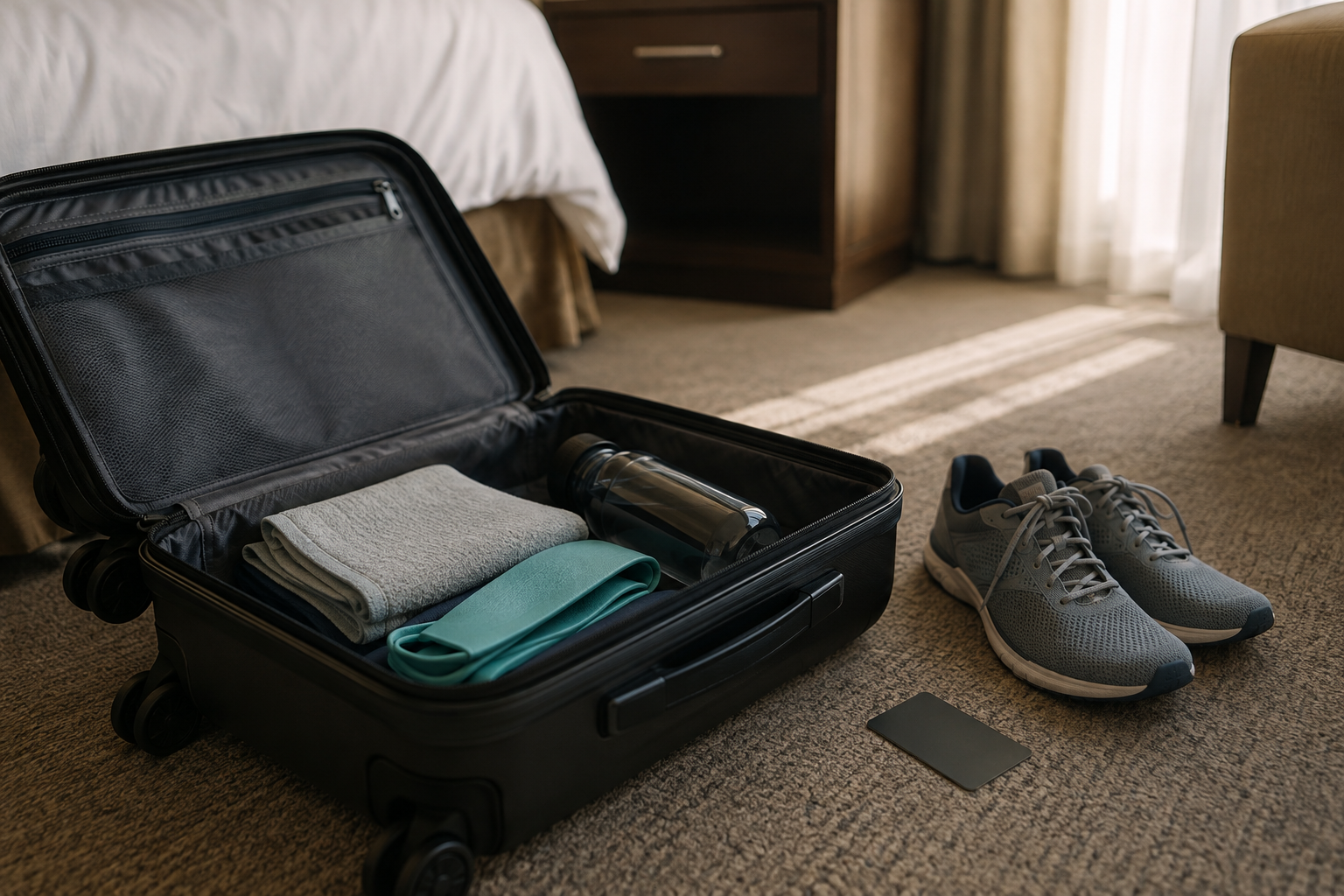
A single long resistance band (or a set of loop bands), a pair of collapsible workout shoes if you have room, and a printed or saved 2-page workout card covering your chosen mode. That’s it. The band is the single highest-value item here: it weighs almost nothing, clears airport security without a second look, and turns almost any hotel room into a strength-training space.
Step 4: Scout the space within an hour of check-in
Walk down to the fitness center (or clear a patch of hotel room floor) as soon as you check in, even if you’re not training that day. Knowing exactly what’s available, whether the gym has dumbbells past 25 pounds, whether there’s a bench, whether the room has enough floor space for a burpee, removes the guesswork that turns “I’ll figure it out later” into “I never went.”
Step 5: Anchor the workout to a fixed point in your schedule, not free time
“Free time” rarely exists on a work trip. Instead, anchor training to something fixed: right after you land and before you unpack, first thing before the day’s meetings start, or immediately after your last call ends. Treating the session like a scheduled meeting with yourself, blocked on your actual calendar, works far better than waiting for a gap to appear.
Step 6: Run the session, adjusting effort rather than skipping it
If jet lag has you at 40 percent, don’t cancel. Cut the volume in half, keep the movement patterns, and treat it as a maintenance dose rather than a training peak. The Sleep Foundation notes that light physical activity outside, timed with daylight exposure, actually helps recalibrate your circadian rhythm after a time zone change, so a lighter session can do double duty as both training and a jet lag countermeasure.
Step 7: Protect sleep and protein before you protect the workout itself
Training on the road matters less if you’re running on four hours of sleep and skipping meals between flights. Prioritize a protein source at each meal, even if it’s just the eggs at the breakfast buffet or a protein bar packed from home, and treat your sleep window as non-negotiable as the client dinner. Recovery capacity, not workout perfection, is usually the real bottleneck when traveling.
Pre-Trip Checklist
- ☐ Checked hotel fitness center hours and equipment list
- ☐ Packed one resistance band or loop set
- ☐ Chosen training mode: hotel gym / bodyweight / bands
- ☐ Saved a 2-page workout card to your phone
- ☐ Blocked two fixed times on your calendar for training
- ☐ Packed a portable protein source for travel days
Hotel Gym vs. Bodyweight vs. Resistance Bands: Which Mode Fits Your Trip
Each mode has a real place depending on what’s available. Here’s how they stack up on the factors that matter most when you’re traveling for work.
Sample Routines for Each Mode
Hotel gym full-body session (30-35 minutes)
Goblet squat or leg press, 3 sets of 8-12; dumbbell row or seated cable row, 3 sets of 10-12; dumbbell bench press or push-up, 3 sets of 8-12; Romanian deadlift with dumbbells, 2 sets of 10; plank, 3 sets of 30-45 seconds. Rest 60-90 seconds between sets. If the gym only has dumbbells up to 30 or 40 pounds, slow the tempo down on the lowering phase to keep the effort high despite the lighter load.
No-equipment bodyweight circuit (10-15 minutes)
ACE Fitness, the American Council on Exercise, built a travel-specific circuit for exactly this situation: clients with no gym access and limited time. The five movements are a table-top bridge, a side plank get-up, a single-leg flextension, a mountain skater, and a dancing squat, performed back-to-back for five to ten minutes as a single nonstop circuit. It’s designed to be a genuinely challenging session using nothing but floor space, which makes it a strong default for red-eye arrivals or cramped rooms.
Resistance band full-body session (20-25 minutes)
Band squat with the band anchored under both feet, 3 sets of 12-15; band row anchored to a door or heavy furniture leg, 3 sets of 12-15; band chest press, 3 sets of 12-15; band Romanian deadlift, 2 sets of 12-15; band pull-apart, 2 sets of 15-20. Keep tension constant through the full range of motion rather than letting the band go slack at the top or bottom of each rep.
“Consistency at 70 percent effort, done twice a week for a year, will always beat a perfect program you only follow when you’re home.” That’s the whole philosophy behind training on the road: protect the minimum, and let the rest flex.
Handling the Trips That Break Every Rule
The one-night turnaround
Land, meet, sleep, fly home. There’s no time for a full session, and that’s fine. A 10-minute band or bodyweight circuit before bed or right after you wake up covers the “something is better than nothing” principle the WHO highlights in its physical activity guidance: any amount of activity counts, and the goal on trips like this is simply not letting the streak break entirely.
Back-to-back time zone changes
When you’re crossing multiple zones in a single trip, don’t try to force your usual training split. Default to full-body sessions so that whatever day you do manage to train, you’re covering the major muscle groups rather than hitting “leg day” on the one day you happen to have energy for it.
Early meetings that eat your morning
Flip to an evening session instead of skipping the day. A short walk outside during a break, paired with your usual light exposure, can also help reset your clock a little faster according to sleep researchers, and it doubles as low-intensity movement on days when a real session isn’t realistic.
No gym, no band, no floor space
Rare, but it happens. Stairwells exist in almost every hotel. A few rounds of stair sprints or step-ups, plus push-ups and a plank hold, will cover the basics until you’re back to a proper setup.
Nutrition and Recovery While You’re on the Road
Training stimulus is only half of the equation. Muscle is maintained and built during recovery, and recovery is usually the first thing to suffer on a work trip. A few practical habits protect the investment you’re making in those short hotel sessions: prioritize a protein-containing food at each meal (eggs, poultry, yogurt, or a packed protein bar), keep a water bottle with you through the airport and in meetings since travel dehydration is common, and treat your sleep window with the same discipline as your calendar commitments. None of this requires perfect meal prep. It requires picking the protein option at the breakfast buffet instead of skipping it, and going to bed on time even when the hotel bar looks tempting.
Making It Stick Across a Year of Travel, Not Just One Trip
A single trip handled well is a nice proof of concept. The real test is whether the system holds up across twenty or thirty trips a year, which is the reality for a lot of consultants, sales reps, and account managers. Three habits separate people who keep lifting through years of travel from people who quietly stop.
First, they track something simple. It doesn’t need to be a spreadsheet with load and volume charts. A note on your phone with the date and “trained, 25 minutes, bands” is enough to see the pattern over a quarter and catch a slide before it becomes a six-week gap. Second, they separate “maintenance trips” from “home training blocks” in their own head, so a lighter travel week doesn’t feel like failure against a program built for a full gym. Third, they rebuild the habit the same way each time they get home: back to the regular program within a day or two of landing, rather than treating the return as another excuse to ease in slowly.
Frequent travelers also benefit from picking a “home base” exercise for each major movement pattern (a squat variation, a hinge, a push, a pull) that they can perform in some version across all three modes: hotel gym, bodyweight, and band. When the pattern stays familiar even as the tool changes, the transition back to a fully loaded gym session is far smoother, and there’s less of that “starting over” feeling that makes people give up on travel training altogether.
Rebuilding after a rough stretch of trips
Some quarters are brutal. A cluster of international trips, a few overnight turnarounds, a stretch where the two-day minimum simply didn’t happen. If that’s where you are right now, the fix isn’t guilt or a punishing “make up for it” week. Go back to your normal program at normal intensity, expect the first session or two to feel a bit rusty, and trust that strength returns quickly once consistent training resumes. Treating a bad travel stretch as a permanent setback is usually what turns a temporary dip into someone quitting lifting altogether.
Nutrition, Hydration, and Recovery Details Worth Getting Right
A few specific habits make the difference between a travel week that supports your training and one that quietly works against it, beyond the general “eat protein and sleep well” advice already covered.
Alcohol and client dinners. Business travel often comes with dinners where declining a drink entirely isn’t realistic. If that’s your situation, treat it as an occasional cost rather than a nightly habit, and prioritize water alongside it. Sleep quality drops noticeably after evening drinking, which compounds the sleep disruption you’re already managing from time zone changes.
Airport and flight nutrition. Packing a protein bar or a bag of nuts for travel days solves the problem of arriving at a destination hungry, tired, and reaching for whatever’s fastest. It’s a small thing that removes one more decision at the point in the day when you have the least willpower left to make good ones.
Hydration on flights. Cabin air is dry, and a long flight without enough water can leave you starting a trip already behind on hydration, which affects both workout performance and general energy for the meetings that are the actual point of the trip. Carrying an empty water bottle through security and filling it at a fountain afterward is a simple habit that solves this without needing to buy bottled water at airport prices.
Sleep environment. Hotel rooms are rarely as dark or quiet as home. An eye mask and a pair of earplugs weigh almost nothing and can meaningfully improve sleep quality, which matters more for recovery from training than almost anything else on this list.
When to Actually Skip a Session Guilt-Free
Not every missed workout needs a workaround. If you’re dealing with real illness, an injury, or a genuinely brutal schedule where sleep itself is already compromised below a healthy minimum, skipping is the right call, not a failure of discipline. The two-day-a-week floor is a target for a normal travel week, not a rule to chase through sickness or exhaustion. Consult a doctor before starting any new exercise program, particularly if you have an existing injury, a chronic health condition, or haven’t trained consistently in a while, and listen to your body’s signals over any article’s checklist, including this one.
Frequently Asked Questions
Will I lose muscle if I only train once or twice during a week-long trip?
Meaningful muscle loss takes considerably longer than a week of reduced training to show up. The CDC’s baseline recommendation of at least 2 days a week of muscle-strengthening activity exists for a reason: it’s a realistic floor, not an ideal. Hitting that floor on a travel week protects both your strength and, just as important, the habit itself.
Is a resistance band actually enough to build or maintain strength?
For maintenance during travel, yes. Bands provide variable resistance through a range of motion, and when you keep the tension high and push sets close to fatigue, they can substitute effectively for short stretches. They’re not a permanent replacement for progressive overload with free weights over months, but as a travel bridge, they work.
What if the hotel gym only has cardio machines?
Default to your bodyweight or band routine instead of trying to force a strength session out of a treadmill. Mixing in a short cardio session is fine for general health, but it’s not a substitute for the muscle-strengthening work your body needs, so keep the two goals separate rather than treating cardio as your lifting session for the week.
How do I deal with jet lag messing up my energy for workouts?
Reduce the ambition of the session rather than cancel it. A lighter version of your planned workout, combined with getting outside for natural light exposure, supports the circadian adjustment process (which the Sleep Foundation notes takes about 1 to 1.5 days per time zone crossed) while still keeping the training habit alive.
Should I try to keep my exact home program while traveling?
Generally no. Trying to replicate a five-day split with specific exercise substitutions for every trip is a common reason travel training plans fail. Pick one simplified full-body mode for the whole trip (hotel gym, bodyweight, or band) and accept that it’s a maintenance phase, not a growth phase.
How many days a week should I actually aim for on a work trip?
Two is the realistic, evidence-aligned target. It matches the CDC’s minimum guidance for muscle-strengthening activity, it’s achievable around most travel schedules, and hitting it consistently across a year of trips matters more than any single “perfect” week.
References
- Centers for Disease Control and Prevention. Physical Activity Guidelines for Adults.
- Mayo Clinic. Strength training: Get stronger, leaner, healthier.
- American Council on Exercise (ACE Fitness). How to Stay Fit While Traveling.
- Sleep Foundation. Jet Lag: Symptoms, Causes, and Recovery Tips.
- World Health Organization. Physical Activity Fact Sheet.