
























By Priya Nandakumar
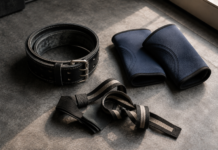
Walk into any gym and you’ll spot them within minutes: the thick leather belt cinched around someone’s midsection during a heavy squat, the fabric loops wrapped around wrists before a deadlift, the neoprene sleeves slid over knees before a warm-up set. For a beginner, this gear can look like a secret club with unwritten rules — wear the wrong thing at the wrong time and you might feel like you’re doing it wrong, or worse, cheating your own progress.
The truth is less mysterious than it looks. Belts, straps and sleeves each solve a specific mechanical problem, and each has a point in a lifter’s development where it starts to make sense — and a point where it doesn’t yet. This guide breaks down what each piece of equipment actually does, what the research says about it, and how to decide, as a beginner, whether you need any of it right now.
Why This Gear Exists in the First Place
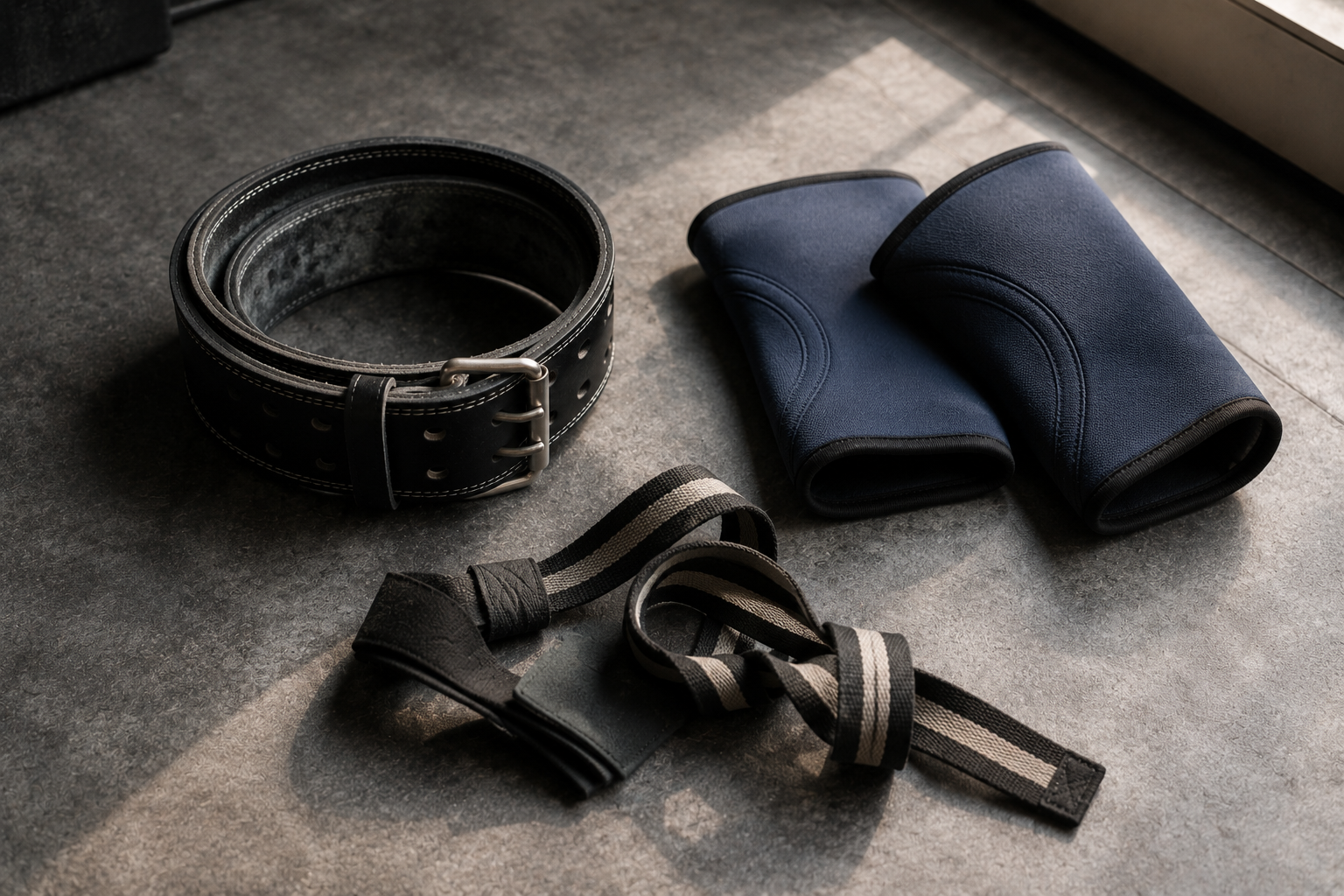
Strength training loads the body in ways daily life rarely does. A heavy squat or deadlift asks the spine to stay rigid under compressive force, asks the hands to hold onto a bar that wants to roll out of your grip, and asks the knee joint to track through a full range of motion while supporting several times your body weight. Belts, straps and sleeves each target one of those three demands: trunk stability, grip security, and joint support and warmth, respectively.
None of them build muscle or technique for you. They remove a specific bottleneck so the muscles you’re actually trying to train can do more work. That distinction matters, because it explains both why experienced lifters use this gear and why it isn’t something a first-time gym-goer needs on day one.
“A belt doesn’t lift the weight for you. It gives your trunk something firmer to brace against, so the muscle you already have can transfer more force into the bar.”
Lifting Belts: What They Do and What They Don’t
The mechanism
A weightlifting belt doesn’t support your spine the way a cast supports a broken arm. It works by giving your abdominal and low-back muscles a surface to push against when you brace, which raises intra-abdominal pressure (IAP) inside your trunk. Higher IAP turns your midsection into a stiffer cylinder, and a stiffer cylinder resists the bending forces that a loaded bar places on your spine during a squat or deadlift.
Research on this mechanism is fairly consistent. Studies measuring IAP during heavy lifts have recorded pressures around 175 mmHg with a belt versus roughly 156 mmHg without one during near-maximal deadlifts, and the effect stacks with the Valsalva maneuver (briefly holding your breath against a closed airway while bracing). That combination appears to improve how efficiently force transfers through the trunk rather than replacing muscular effort.
This is the part that surprises most beginners: electromyography studies looking at abdominal and back muscle activation with and without a belt find very little difference. In other words, a belt does not switch your core muscles off. You’re still doing the bracing work; the belt just gives that bracing something firmer to push against, which is one reason coaches don’t consider belts a shortcut around building core strength.
Does it make you stronger, or just feel safer?
Both, to a modest degree. Controlled studies have found that lifters using a belt during squats moved through the lift measurably faster (one commonly cited trial found around 15% faster bar speed) while holding the same load and form. Belted lifters also tend to report lower perceived exertion on heavy deadlift sets. That’s a real performance effect, not just a psychological one, though the size of the benefit is modest rather than dramatic — belts appear to help core bracing and force transfer more than they change output from the legs, hips, or hamstrings directly.
The injury-prevention myth
This is where the popular understanding of belts gets furthest from the evidence. Decades of workplace research on back-support belts, most notably a large prospective study led by the U.S. National Institute for Occupational Safety and Health (NIOSH) among retail material handlers, found that wearing a back belt was not associated with a reduced rate of back injury claims or reported low back pain, even though lab tests showed belts reduce spinal bending under load. NIOSH’s official position, reaffirmed after that research, was that there was insufficient evidence to recommend back belts as an injury-prevention tool.
That’s occupational research, not a powerlifting meet, but the mechanical principle carries over: a belt changes how force moves through your trunk while you’re wearing it. It does not build durability that persists once you take it off, and it won’t compensate for poor bracing technique or a weight that’s genuinely too heavy for you to control.
When a beginner should actually reach for one
Most coaches don’t recommend a belt on day one, and for a good reason: you need something to brace against before a belt has anything useful to press into. Bracing is a skill (learning to take a breath into your belly, tighten your midsection in all directions, and hold that tension through a rep) and it’s worth training beltless for at least your first few months so that skill actually develops.
A few practical benchmarks that come up repeatedly in coaching guidance:
- You can squat roughly your bodyweight or deadlift around 1.5 times bodyweight with solid technique.
- Your working sets are regularly landing above about 80% of your one-rep max.
- You’ve completed at least one full training block (roughly 8-12 weeks) focusing on bracing and technique without a belt.
Below those thresholds, the loads usually aren’t heavy enough for a belt to add much, and the priority is still building the bracing pattern the belt will eventually reinforce.
Quick Belt Checklist
- Have you trained consistently for at least 2-3 months without one?
- Can you brace your core and feel your midsection push outward against your hands before a rep?
- Is the lift you’re belting for a squat, deadlift, or overhead press variant (the trunk-loaded lifts)?
- Is the working weight at or above roughly 80% of your current max?
- Have you practiced bracing against the belt at lighter weights before taking it into a heavy set?
Lifting Straps: Solving the Grip Problem
What straps actually change
Lifting straps are loops of nylon, cotton, or polyester webbing that wrap around the bar and your wrist, anchoring the bar to your forearm instead of relying entirely on your fingers to hold on. For pulling movements like deadlifts, rows, and shrugs, this matters because your grip often fatigues well before your back, hips, and legs do. Without straps, a strong lifter can find themselves capped not by leg or back strength but by how long their fingers can hold the bar.
A 2021 study examining lifting straps during the deadlift found that straps improved measures like movement velocity and grip security while reducing perceived exertion, compared to lifting without them, particularly as loads got heavier. That lines up with what most experienced lifters report anecdotally: straps let you complete more total reps at a given heavy load because grip failure is no longer the limiting factor.
The “straps will ruin your grip” myth
This is a genuinely common worry, and it’s mostly overstated. Grip strength develops through several types of loading (crush grip, pinch grip, and the sustained “support grip” used in deadlifts), and straps only remove one specific demand: holding on when the bar wants to roll out of your hands. Used strategically, meaning on your heaviest top sets or highest-volume pulling work, while still doing plenty of straight-grip work on lighter sets and accessory movements, straps don’t prevent grip strength from developing elsewhere in your training.
Where the myth has some truth is if straps become the default for every single set of every pulling exercise from day one. Grip is a use-it-or-lose-it adaptation, and a beginner who straps up for every warm-up set will genuinely train less grip capacity than one who saves straps for the sets that actually need them.
When beginners should use them
Early on, most lifters don’t need straps for main deadlift or row work. Grip is one of the faster adaptations in strength training, and beginner-level deadlift weights typically aren’t heavy enough to outpace grip development. Straps tend to earn their place once:
- Grip is failing noticeably before your legs, hips, or back on heavy pulling sets.
- You’re doing high-volume back or pulling work (like rack pulls, heavy rows, or shrugs) where forearm fatigue would otherwise limit the target muscle’s training stimulus.
- You’re recovering from a hand or finger issue and need to keep training pulling patterns without aggravating it.
Knee Sleeves: Support, Warmth, and What the Science Actually Shows
What sleeves are (and are not)
Knee sleeves are neoprene cylinders that slide over the knee joint. Unlike knee wraps, which are long elastic bandages wound tightly around the knee to store elastic energy and provide real mechanical rebound out of a squat, sleeves don’t provide structural support. They work through compression, warmth, and proprioceptive feedback (a better sense of where your knee is in space during a lift), not through storing and releasing elastic energy the way wraps do.
That distinction trips up a lot of beginners who assume sleeves and wraps do the same job with a different look. They don’t. Sleeves are the gentler, more general-purpose option; wraps are a specialized competition tool that meaningfully changes how a heavy squat feels and moves.
What the research shows
Studies comparing tight-fitting compression sleeves to loose placebo sleeves have found a modest squat one-rep-max improvement, on the order of about 3% in trained lifters, along with better subjective ratings of knee comfort and stability during heavy sets. Interestingly, sizing sleeves down for a tighter fit hasn’t been shown to add further performance benefit beyond a properly fitted sleeve, it just makes the sleeve harder to put on and take off.
For people managing knee osteoarthritis or general joint discomfort, sleeves have shown a more clearly useful role: research in that population associates sleeve use with reduced pain severity, improved perceived stability, and greater willingness to keep exercising through joint discomfort.
The caveat worth taking seriously
As with belts, there isn’t solid evidence that knee sleeves prevent injuries. Warmth and compression can make a joint feel more stable and less achy, which is genuinely valuable, but “feels more stable” and “is structurally protected from injury” are different claims, and the research doesn’t support the second one. Sleeves are a comfort and mild-performance tool, not armor.
When a beginner should consider them
Knee sleeves are lower-stakes than belts or straps because they don’t require any particular strength threshold to use well. Reasonable reasons for a beginner to try them include general knee achiness during squats, training in a cold gym where joints feel stiff before warming up, or simply preferring the snug, supported feeling during heavier sets. There’s little downside to trying a pair early, as long as you don’t treat them as a substitute for warming up properly or for addressing a knee issue that’s actually causing pain, which deserves an assessment from a physical therapist or physician rather than a piece of neoprene.
Belts vs. Straps vs. Sleeves, Side by Side
How to Introduce Any of This Gear Without Undermining Your Progress
A Simple Rollout Timeline
Weeks 1-8: Train without belts or straps. Build technique, learn to brace, let grip adapt naturally through progressive loading.
Weeks 8-16: Add knee sleeves anytime for comfort. Try a belt on your single heaviest set of the week to learn how to brace against it, keeping lighter sets beltless.
Month 4 onward: Introduce straps on your heaviest pulling sets or highest-volume back work if grip is genuinely limiting the set, while keeping warm-ups and lighter accessory work strap-free.
Ongoing: Reassess every few months. Gear use should track your loads and goals, not become a fixed habit applied to every single set regardless of weight.
Fit and Buying Basics
Belts
Look for a belt that’s a uniform width around the whole circumference (typically 4 inches, or 10 cm) rather than one that tapers at the front, since a uniform width gives even bracing surface. Leather and heavy-duty nylon versions with a lever or prong buckle both work well; the buckle style is a matter of preference and how quickly you need to adjust it between lifts.
Straps
Cotton straps are inexpensive and grippy but wear out faster; nylon versions last longer and handle more weight. Figure-8 straps loop through themselves for extra security on maximal pulls but take slightly longer to put on and take off between sets than standard lasso-style straps.
Knee sleeves
Sizing charts vary by brand and are usually based on knee circumference, not shoe size or overall height, so measure before ordering. A snug fit that requires some effort to pull on is normal; sleeves that slide on with no resistance likely won’t offer much compression benefit.
Common Mistakes Beginners Make With This Gear
Buying before you need it
It’s tempting to pick up a belt, straps, and knee sleeves in your first week because the gear looks like a signal of seriousness. In practice, the loads most beginners use in month one rarely justify any of it. Spending that money later, once you actually feel the specific problem each item solves, tends to produce a better fit and a clearer sense of why you’re using it.
Wearing a belt too loose or too high
A belt that’s cinched loosely, or sits up around the ribs instead of across the navel and lower back, gives almost nothing to brace against. The belt should sit snug enough that you feel real resistance when you breathe in and push your stomach outward against it. If you can slide two fingers in easily without tightening your brace first, it’s probably too loose to do its job.
Strapping in on every single set
Using straps on warm-up sets and light accessory work removes a training stimulus your grip would otherwise get for free. Save straps for the sets where grip is genuinely the limiting factor, usually your heaviest top sets or highest-volume pulling work, and let lighter sets train your hands the normal way.
Assuming sleeves fix a knee problem
Warmth and compression can make an achy knee feel noticeably better during a session, which sometimes masks an issue that needs actual attention. If knee pain is sharp, persistent, or getting worse over several weeks, a sleeve is not the right tool to solve it. That calls for a proper look from a physical therapist or physician before you keep loading the joint.
Chasing the exact gear a strong lifter uses
A ten-year veteran’s belt thickness, strap material, and sleeve compression level were chosen for a body and a training history that likely looks nothing like yours. Start with modestly priced, well-reviewed versions of each category, and let your own preferences and problems guide any upgrades from there rather than copying someone else’s setup wholesale.
Frequently Asked Questions
Do I need a belt if I’m just trying to get generally fit, not compete in powerlifting?
Probably not right away, and possibly never, depending on the loads you use. If your training stays in moderate weight ranges for general fitness, muscle, or health goals, a belt is unlikely to add much because the loads rarely reach the intensity where the bracing benefit matters most. It becomes more relevant once you’re regularly working near your one-rep max on squats, deadlifts, or overhead presses.
Will wearing a belt weaken my core over time?
The available evidence doesn’t support that. Studies measuring core muscle activation with and without a belt find little difference, which suggests the belt isn’t switching your core off, it’s giving the bracing you’re still doing something firmer to push against. That said, it’s still worth training some sets beltless so your bracing skill keeps developing independent of the equipment.
What’s the difference between lifting straps and wrist wraps?
They solve different problems. Straps anchor the bar to your wrist to help with grip on pulling exercises like deadlifts and rows. Wrist wraps are stiff, adjustable bands wrapped around the wrist joint itself to add support and limit hyperextension during pressing movements like heavy bench press or overhead press. It’s common to eventually use both, just not for the same lift or the same reason.
Are knee sleeves necessary if my knees don’t hurt?
No. If your knees feel fine and you’re not squatting in a particularly cold environment, sleeves are optional. Some lifters like the snug, supported feeling on heavy sets regardless of pain, but there’s no requirement to wear them if you have no discomfort and no preference either way.
Can lifting straps actually improve my deadlift numbers?
For many lifters, yes, specifically on sets where grip would otherwise fail before the target muscles do. Research on strapped versus unstrapped deadlifts has found improvements in movement velocity and grip security along with lower perceived effort at heavier loads. The gains show up mainly on grip-limited sets, not on lighter sets where grip was never the bottleneck.
Is it “cheating” to use this equipment as a beginner?
No. None of this gear lifts the weight for you, and none of it substitutes for technique or consistent training. Used appropriately, at the point where they solve an actual problem you’re running into, belts, straps, and sleeves are tools, the same way a coach might recommend particular shoes or a specific bar. The only misuse worth avoiding is reaching for gear so early that you skip building the underlying strength and skill it’s meant to support.
References
- Barbell Medicine, “What Does a Weightlifting Belt Do and How Do They Work?” — barbellmedicine.com
- Barbell Medicine, “What Do Knee Sleeves Do?” — barbellmedicine.com
- ScienceDirect, “Ergogenic effects of lifting straps on movement velocity, grip strength, perceived exertion and grip security during the deadlift exercise” — sciencedirect.com
- Girls Gone Strong, “When Should You Use a Weightlifting Belt?” — girlsgonestrong.com
- U.S. National Institute for Occupational Safety and Health (NIOSH/CDC), “Workplace Use of Back Belts” (Pub. No. 94-122) — cdc.gov
- CDC/NIOSH, “Summary of NIOSH Back Belt Studies” — cdc.gov (archived)
- Ironbull Strength, “Lifting Grips vs. Straps: Which Tool Delivers Real Training Advantages” — ironbullstrength.com
- Eleiko, “Guide to Knee Sleeves” — eleiko.com