



























By Noah Sato
A percussive massage gun looks simple to use: turn it on, press it against a sore muscle, move it around for a bit. That simplicity is exactly why so many people end up with a purple welt on a shin, a tender bruise over a shoulder blade, or a sore spot that lingers for a week instead of fading in a day. The device itself is not especially dangerous when it is used on the right tissue, at the right pressure, for the right amount of time. The danger comes from treating every part of the body the same way a plush muscle like the glutes or quadriceps can tolerate.
This guide walks through what percussive therapy devices actually do to soft tissue, what current research supports and what it does not, exactly which areas of the body should never be targeted, and how to build a session that reduces soreness risk instead of adding to it. It closes with a plain-language checklist for who should skip massage guns entirely, because for a small group of people, the risk profile changes substantially.
What a Massage Gun Actually Does to Tissue
A percussive device drives a small head into the skin and underlying muscle dozens of times per second, then pulls back, over and over. Most consumer devices operate somewhere in the range of 1,200 to 3,200 percussions per minute, which works out to roughly 20 to 53 strikes every second, with a head travel distance (the “stroke length” or amplitude) usually between 10 and 16 millimeters. That combination of speed and depth is what separates a massage gun from a simple vibrating foam roller: the head is not just buzzing against the skin, it is briefly compressing the tissue underneath with each strike.
Physiologically, that repeated compression does a few things. It increases local blood flow to the treated area for a short window afterward. It appears to stimulate mechanoreceptors in the muscle and connective tissue, which can dull the perception of soreness through the nervous system rather than by changing the tissue itself. It also produces a vibration effect that some researchers argue does more of the therapeutic work than the percussive impact does. A 2025 evidence review on percussion massage usage noted that professionals using these devices in practice tended to favor slow-to-medium settings rather than maximum intensity, and that vibration frequencies in roughly the 30 to 50 Hz range were associated with the circulation benefits that faded within about 30 minutes of treatment.
None of that mechanism is exotic or unique to massage guns. Manual massage, foam rolling, and vibration plates work through overlapping pathways. What a massage gun adds is convenience and a much higher, more concentrated force delivered to a small contact point, which is precisely why technique matters more here than it does with a foam roller spreading force over a wider surface.
What the Evidence Actually Shows
Where percussive therapy seems to help
A 2026 systematic review and meta-analysis published in Chiropractic and Manual Therapies examined percussive therapy dosages and their effect on recovery from acute exercise-induced muscle damage, concluding that dosage (how long and how intensely a muscle group is treated) meaningfully changes recovery outcomes, rather than percussive therapy having one fixed effect regardless of protocol. That dosage-dependent finding matters for anyone assuming “more is better”: the research base does not support that assumption.
A randomized clinical trial published in Physiotherapy Research International in 2026 tested percussive massage on the quadriceps after a fatiguing exercise protocol in physically active men, looking at muscle cross-sectional area, strength, and late-onset muscle pain. Short bouts of percussive massage were associated with measurable acute effects on how the muscle responded to fatigue, adding to a growing body of small trials suggesting a real, if modest, physiological effect rather than a purely placebo one.
Tensiomyography research published in the Journal of Functional Morphology and Kinesiology in 2026 examined how the vastus medialis (part of the quadriceps) responded to different frequency-duration combinations of percussive massage, reinforcing that the specific settings used, not just the act of using the device, changes the muscle’s mechanical response. A separate 2026 trial in the same journal, involving trained male football players, similarly found that percussive massage intensity affected change-of-direction performance and jump kinetics differently depending on the settings and time of day, which again points toward dosage as the variable that matters.
Where the claims outrun the data
A 2025 scoping and critical review of non-pharmacological strategies for delayed-onset muscle soreness (DOMS), published in the Journal of Functional Morphology and Kinesiology, placed percussive massage alongside foam rolling, cold water immersion, and compression garments as an intervention with some supportive evidence but considerable variability between studies, small sample sizes, and inconsistent protocols. That review is a useful corrective to marketing claims that treat massage guns as a settled, proven recovery tool. The honest summary of the current literature is: short-term improvements in perceived soreness and range of motion are plausible and shown in some trials, but the effect sizes are frequently modest, often short-lived (in some trials, improved range of motion faded within about ten minutes, similar to what is seen after light static stretching), and inconsistent across muscle groups and protocols.
One detail from the applied literature is worth repeating because it cuts against a common assumption: a treatment that hurts is not necessarily working better. Trials comparing tolerable-pressure protocols against high-pressure, high-discomfort protocols have found that participants who reported more pain during treatment did not reliably get better soreness or performance outcomes afterward. Pain during the session is not a marker of effectiveness. It is a signal to ease off.
“Discomfort during a session is not proof the treatment is working. In the available trials, people who found the treatment painful did not reliably recover faster or better than those who kept it comfortable.”
The Core Safety Principle: Float, Don’t Force
Nearly every safety mistake with a massage gun comes down to the same error: pressing the device into the body instead of letting the device’s own motion do the work. The head is designed to compress tissue on its own. Adding your own body weight or grip strength on top of that motion multiplies the force delivered to whatever is underneath, whether that is a soft muscle belly or a shin bone sitting just under the skin.
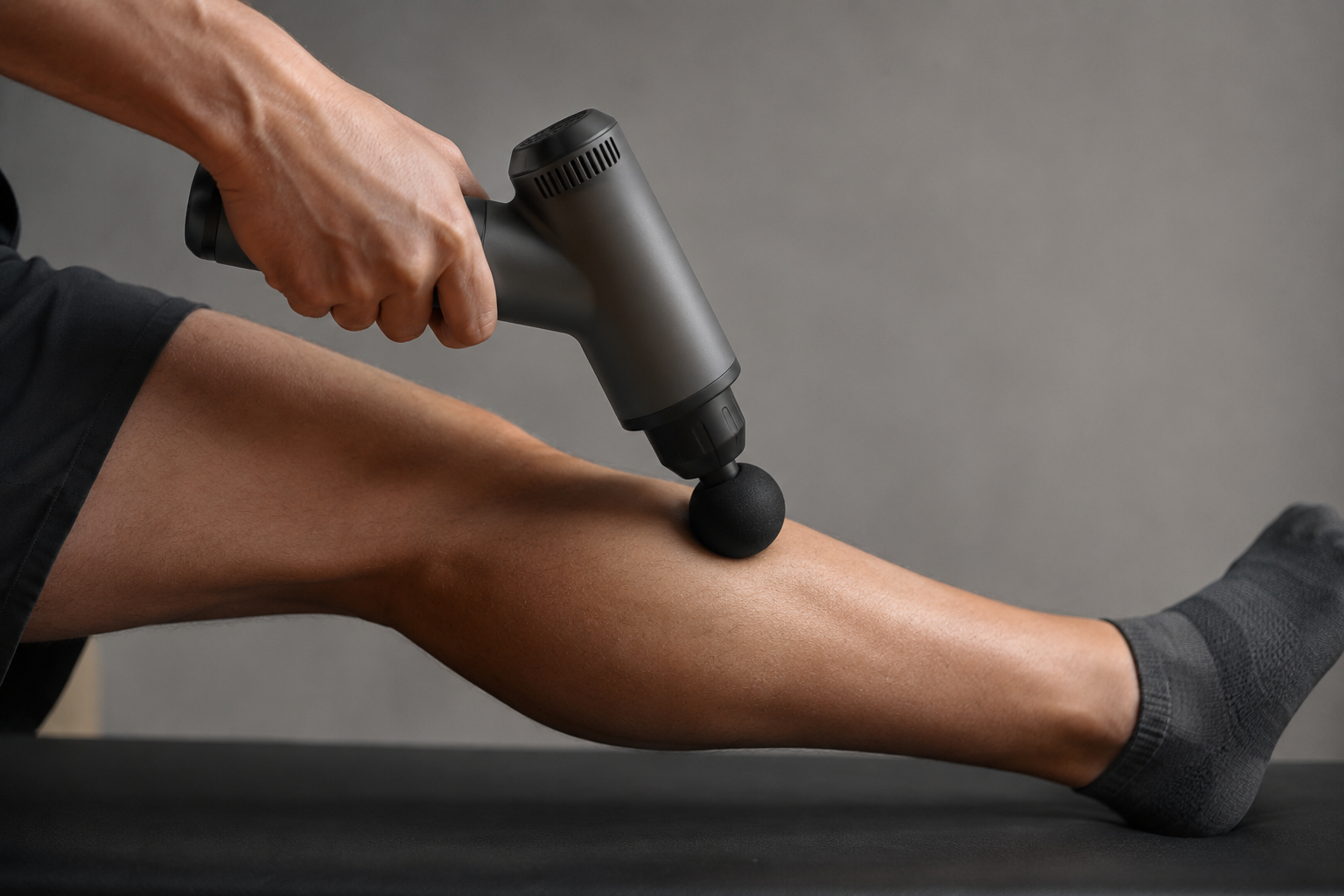
A workable mental model is to imagine the gun “floating” against the muscle: your hand guides direction and keeps the head in contact with the skin, but the arm stays relaxed rather than pushing. If you can feel your knuckles whitening or your shoulder tensing to drive pressure into the tissue, that is a sign to back off the force and, if needed, drop to a lower speed setting instead of compensating with more push.
Keep the head moving. Holding a percussive device stationary over one spot, even a soft one, concentrates thousands of strikes into a single patch of tissue over a short period, which is one of the more common causes of avoidable bruising. A slow, continuous gliding motion, roughly the pace of a slow brushstroke, spreads that force across a larger area of muscle instead of hammering one point.
Areas to Avoid Completely
Some regions of the body should never be targeted with a percussive device, regardless of speed or attachment. The reasons vary: some areas have bone sitting close to the skin with almost no muscle padding, some sit directly over major blood vessels or nerves, and some are simply too structurally delicate to absorb repeated impact safely.
Pressure, Speed, and Duration by Muscle Group
The table below is a starting point, not a rigid prescription. Everyone’s tissue tolerance differs, and the right amount is whatever stays comfortable and continuously tolerable, never sharp or radiating. Treat “max time per spot” as a hard ceiling, not a target to hit every session.
| Muscle Group | Speed | Attachment | Pressure | Max Time | Notes |
|---|---|---|---|---|---|
| Quadriceps (front thigh) | Medium–High | Ball or fork | Light–moderate | up to 2 min total | Keep moving; steer around the kneecap entirely |
| Hamstrings (back thigh) | Medium | Ball | Light–moderate | 1–2 min | Stop well above the back of the knee |
| Calves | Low–Medium | Ball or flat | Light | 1–2 min | Avoid the Achilles tendon and any visible veins |
| Glutes | Medium–High | Ball or flat | Moderate | 1–2 min | Large muscle mass tolerates firmer pressure well |
| Upper back / lats | Medium | Fork or flat | Light–moderate | 1–2 min | Use the fork attachment straddling the spine, never on it |
| Shoulders / traps | Low–Medium | Ball | Light | 1 min | Stay on the muscle belly, well clear of the collarbone |
| Forearms | Low | Small ball | Light | 30–60 sec | Bony and nerve-dense; short bursts only |
| Outer thigh / IT band | Low | Ball | Very light | 30 sec | Fibrous connective tissue, not muscle; go easy |
| Neck | Not recommended at any setting. Use gentle manual stretching or ask a physical therapist for safe alternatives. | ||||
Choosing the Right Speed and Attachment
Most devices offer somewhere between three and six speed settings along with a handful of interchangeable heads. As a starting rule, reserve the highest speed settings for large, well-padded muscles like the glutes and quadriceps, and default to the lowest one or two settings almost everywhere else, including the first time you try a new muscle group. You can always increase intensity in a later session once you know how your tissue responds; you cannot undo a bruise from going too hard on the first try.
Attachment choice matters as much as speed. A rounded ball head spreads force over a broader area and is the safest general-purpose choice for most muscle groups. A flat head is better suited to larger, flatter muscles like the glutes or lats. A fork or “U-shaped” attachment is designed specifically to straddle the spine, applying pressure to the muscle on either side while leaving the vertebrae untouched. A small bullet or pointed head concentrates force into a tiny area and is best reserved for precise trigger-point work by someone experienced with it, not for general use, and never on bony or thin-skinned areas.
A Safer Step-by-Step Routine
- Warm up first. Tissue that is already warm, whether from light movement or a few minutes after exercise, tolerates percussive pressure better than cold tissue does.
- Start on the lowest speed. Turn the device on before it touches skin, then bring it to the muscle. Never press a stationary head into tissue and then power it on.
- Let it float. Guide direction with a relaxed hand; do not lean your body weight into the device.
- Keep it moving. Glide slowly across the muscle rather than parking on one point.
- Limit each area. Follow the per-muscle-group durations above, and stop sooner if the area starts to feel tender rather than simply worked.
- Check in with sensation, not just soreness. Mild pressure and looseness are the goal. Sharp, stinging, or radiating sensations mean stop immediately.
- Skip anything bony, joint-adjacent, or already sore from injury. Refer back to the avoid list above rather than guessing.
- Check the skin afterward. Mild pink coloring that fades within a few minutes is normal. Deep redness, swelling, or a bruise that develops over the following hours is a sign to reduce pressure, duration, or speed next time, and to let that area rest.
Signs You Should Stop Immediately
Stop the session and remove the device from the skin if you notice any of the following: sharp or stabbing pain distinct from ordinary muscle tenderness; numbness, tingling, or a “pins and needles” sensation, which suggests nerve irritation; a sudden headache, dizziness, or visual changes if the device was anywhere near the neck or head, which warrants urgent medical evaluation given documented reports of vascular injury; or a bruise that forms and darkens rapidly rather than a mild, short-lived pink mark. None of these are situations to push through.
Who Should Avoid Massage Guns Entirely
For most healthy adults using sensible pressure on appropriate muscle groups, percussive massage carries a low risk profile. But for a specific set of people, the risk-to-benefit calculation shifts, and avoiding the devices altogether, or only using them after clearing it with a clinician, is the more sensible path. This is not a diagnostic tool and nothing here replaces individualized medical advice; it is a starting checklist for a conversation with your doctor or physical therapist.
- ☐ You take anticoagulant or antiplatelet medication (warfarin, apixaban, rivaroxaban, clopidogrel, daily aspirin therapy, and similar). If this applies to you, consult your doctor before using a massage gun anywhere on your body.
- ☐ You have a diagnosed clotting or bleeding disorder (hemophilia, thrombophilia, von Willebrand disease, or similar).
- ☐ You currently have, or have previously had, a blood clot or deep vein thrombosis.
- ☐ You have varicose veins, spider veins, or notably fragile or thin skin.
- ☐ You have a recent fracture, sprain, strain, or other acute soft-tissue injury that has not been cleared by a clinician.
- ☐ You are pregnant (avoid the abdomen and lower back without guidance from a prenatal care provider).
- ☐ You have numbness, nerve damage, or reduced sensation in the area you want to treat.
- ☐ You have an active skin infection, open wound, or rash in the area.
- ☐ You have a pacemaker or another implanted electronic device (follow the device manufacturer’s specific guidance).
- ☐ You have osteoporosis or significantly reduced bone density.
- ☐ You are currently undergoing cancer treatment (ask your oncology team before using percussive massage near a treatment area).
If any of these apply, that does not automatically mean percussive massage is off-limits forever. It means the decision belongs to you and a clinician who knows your full medical history, not to a product manual or an article like this one.
The reason for this level of caution is not theoretical. Published medical case reports document real harm from improper percussive device use, concentrated almost entirely around the head, neck, and eyes. One 2025 case report in the Journal of Neurosurgery: Case Lessons described a vertebral artery dissection with cerebellar stroke following use of a percussive massage device near the neck. Ophthalmology case reports have documented a traumatic cataract and, separately, bilateral retinal tears after percussion gun use too close to the eyes. These are uncommon events, not a reason to panic about a device used correctly on a quadriceps muscle, but they are exactly why the neck, head, and face sit on the strict avoid list above rather than the “use caution” list.
“The documented harms from percussive massage devices cluster almost entirely around one mistake: using them near the neck, head, or eyes. Keep the device on padded muscle tissue, away from the head and throat, and that entire category of risk disappears.”
Frequently Asked Questions
Can a massage gun cause a blood clot?
A massage gun does not create a blood clot out of nowhere in a healthy person using it correctly. The concern is different: in someone who already has a clotting disorder, an existing clot, or is on blood-thinning medication, applying concentrated impact to soft tissue, especially near deep veins, carries added risk of vessel damage or dislodging material that should not be moving. That is why anyone in those categories should get individual medical clearance first rather than assuming general safety guidance covers their situation.
How long should I use a massage gun on one spot?
Most guidance, and the pattern reflected in the muscle-group table above, points to roughly 30 to 120 seconds per muscle group, with the device kept moving rather than held in place. Parking the head on a single point for an extended period is one of the most common causes of bruising, even on well-padded muscle.
Are more expensive massage guns safer than cheaper ones?
Price is not a reliable safety indicator. What matters more is whether a device offers a genuinely low speed setting, comes with a range of attachments (particularly a rounded ball head and a spine-straddling fork attachment), and whether the person using it follows sound technique. A premium device used aggressively on a shin is still going to bruise a shin.
Can I use a massage gun on my neck?
No. The neck contains the carotid and vertebral arteries along with dense nerve bundles, all close to the surface. Published case reports have linked percussive device use in this area to vertebral artery dissection and stroke. For neck tension, gentle manual stretching, heat, or a session with a physical therapist are safer options.
Should using a massage gun hurt?
No, and research does not support the idea that pain during treatment means it is working better. The target sensation is firm pressure and a sense of the muscle loosening, similar to a deep massage, not sharp or stinging pain. If it hurts, the pressure, speed, or attachment needs to change.
How soon after a workout can I use a massage gun?
Using one shortly after exercise, once you have cooled down slightly, is generally considered reasonable and is the timing used in most of the recovery-focused trials referenced above. There is no evidence requiring a mandatory waiting period for uninjured muscle, though if a specific area feels unusually sore, tight, or painful beyond typical post-exercise fatigue, treat that as a signal to ease off that area rather than work it harder.
The Bottom Line
Percussive massage devices are a reasonable, moderately supported recovery tool when they are used the way the evidence and the anatomy both point: on padded muscle tissue, at a comfortable intensity, kept moving rather than parked in one spot, and never on the neck, joints, bony areas, or already-injured tissue. The research base is still thin in places, and some marketed benefits outpace what trials have actually shown, but the core safety guidance is not complicated. Respect the areas to avoid, respect your own tolerance over the device’s maximum setting, and check with a clinician first if you fall into any of the contraindication categories above.
References
- Zhu Y, Yang L, Liu T, Yao F, Wang Q, Yi Z. Effects of percussive therapy dosages on recovery from acute exercise-induced muscle damage: a systematic review and meta-analysis. Chiropractic and Manual Therapies. 2026. DOI: 10.1186/s12998-026-00657-9
- da Rosa Castilho A, Aguiar AF, Ribeiro AS, Cônsolo IF, Quirino FSP, de Oliveira RF, Andraus RAC. Acute Effect of Percussive Massage on Cross-Section Area, Muscle Strength, and Late Muscle Pain of the Quadriceps Muscle Following a Fatigue Protocol in Physically Active Men: Randomized Clinical Trial. Physiotherapy Research International. 2026;31(3):e70246. DOI: 10.1002/pri.70246
- Di Lorenzo L, Forte AM, Agosti V, Forte F, Lanciano T, Pirraglia N, D’Avanzo C. Advances in Non-Pharmacological Strategies for DOMS: A Scoping and Critical Review of Recent Evidence. Journal of Functional Morphology and Kinesiology. 2025;10(4):452. DOI: 10.3390/jfmk10040452
- Ascic S, Curic M, Sklempe Kokic I. Short-Term Tensiomyography Responses of the Vastus Medialis to Percussive Massage Therapy with Different Frequency-Duration Combinations. Journal of Functional Morphology and Kinesiology. 2026;11(2):163. DOI: 10.3390/jfmk11020163
- Eken Ö, Demiralp İ, Arslanoğlu B, Aslan TV, Eken İ, Yagin B, Aldhahi MI. Acute Effects of Percussive Massage Intensity on Change-of-Direction Performance, Vertical Jump Kinetics, and Neuromuscular Performance Across Morning and Evening Sessions in Trained Male Football Players. Medicina (Kaunas). 2026;62(3):439. DOI: 10.3390/medicina62030439
- Romiyo P, Furst T, George DD, Ellens N, Bender MT, Harrigan MR. Vertebral artery dissection with cerebellar stroke after use of a percussive massage device: illustrative case. Journal of Neurosurgery: Case Lessons. 2025;9(21):CASE24812. DOI: 10.3171/case24812
- Garza Reyes A, Ahmad NU, Field MG, Skiles S, Oetting TA. Traumatic cataract induced by improper use of a percussion massage gun. American Journal of Ophthalmology Case Reports. 2024;33:101995. DOI: 10.1016/j.ajoc.2024.101995
- O’Connell N, Khan A. Bilateral retinal tears and dialysis: a rare complication of percussive massage gun use. BMJ Case Reports. 2026;19(6):e264566. DOI: 10.1136/bcr-2024-264566
- Bartsch K, Slomka G, Baumgart C, Offermann C, Schleip R, Freiwald J, Klingler W, Egner C, Wilke J, Hoppe MW. A survey of sports and rehabilitation professionals on foam rolling applications, contraindications, and adverse events, does the science reach professionals’ perceptions? Frontiers in Physiology. 2025;16:1659081. DOI: 10.3389/fphys.2025.1659081
This article is for general educational purposes and does not replace individualized medical advice. If you take anticoagulant medication or have a bleeding or clotting condition, consult your doctor before using a percussive massage device.