



























By Mateo Rivera
If you have ever sprinted for a shaker bottle the moment you racked your last set, worried that every passing minute was costing you muscle, you were acting on one of the most persistent myths in fitness: the idea that a narrow “anabolic window” slams shut about 30 minutes after training and that missing it wastes the whole workout. It is a compelling story. It is also not what the research actually supports.
This article walks through what exercise and nutrition scientists have actually measured about post-exercise protein timing, why the 30-minute cutoff never had strong evidence behind it, when timing genuinely does matter more, and what to do with a protein shake or meal if you cannot eat within a half hour of finishing your workout.
Where the 30-Minute Anabolic Window Idea Came From
The anabolic window concept grew out of early exercise physiology studies from the 1990s and early 2000s, many of which tested nutrient intake in people who trained in a fasted state and then measured short-term markers of protein synthesis or glycogen resynthesis in the hours immediately afterward. Those studies were not wrong on their own terms — muscle tissue does become more receptive to amino acids and glucose after a training session, partly through increased blood flow and greater insulin sensitivity in the exercised muscle.
The problem was what happened next: a narrow, fasted-state finding got generalized into a blanket rule for every gym-goer, then compressed into a marketable number (“30 minutes!”) that supplement companies could print on a label. The nuance — that most of those original studies involved people who had not eaten for several hours before training — got left behind.
Alan Aragon and Brad Schoenfeld directly addressed this gap in their widely cited 2013 review in the Journal of the International Society of Sports Nutrition, “Nutrient timing revisited: is there a post-exercise anabolic window?” Their conclusion was that the window, if it exists at all as a meaningful practical constraint, is almost certainly much wider than the 30-to-60-minute range popularized in gym culture — especially for anyone who ate a normal meal in the hours before training (Aragon & Schoenfeld, 2013).
Part of why the myth traveled so easily is that it fit neatly into a broader “quick fix” culture around fitness supplements. A 30-minute countdown is easy to print on a tub of powder, easy to repeat in a locker room, and easy to sell as an exclusive trick that separates people who “know what they’re doing” from people who do not. A more accurate but less catchy message — spread your protein across the day and hit your total intake — does not fit on a label nearly as well, so it got far less airtime even as the underlying science moved on.
There is also a kernel of legitimate physiology buried inside the myth, which is part of why it has been so hard to dislodge. Resistance training does increase blood flow to the trained muscle and does appear to improve its sensitivity to insulin and amino acids for a period afterward. Early researchers who noticed this correctly identified a real phenomenon; the mistake came later, when that finding was stretched into a rigid, universal 30-minute rule rather than treated as one input among several that shape a much longer recovery period.
Myth vs. Reality: What the Evidence Actually Shows
Here is the practical contrast between the popularized version of the anabolic window and what the underlying research supports.
The Myth
- Muscle protein synthesis “shuts off” if you miss a strict 30-to-60-minute post-workout window.
- A workout is largely wasted without an immediate shake.
- Precise timing is the single most important lever for muscle growth.
- Everyone, regardless of pre-workout eating habits, faces the same tight window.
The Reality
- If protein was consumed within a few hours pre-workout, elevated amino acids in the blood extend the effective window well past 30 minutes (Aragon & Schoenfeld, 2013).
- A 2013 meta-analysis found that when total daily protein intake was statistically accounted for, the apparent benefit of post-workout protein timing on muscle size and strength was no longer significant (Schoenfeld, Aragon & Krieger, 2013).
- Total daily protein intake and consistent training are the dominant drivers of hypertrophy outcomes across the literature.
- Fasted training and unusual schedules (two-a-day sessions) are the contexts where timing carries more practical weight, as detailed below.
The 2013 Meta-Analysis: Timing’s Effect Mostly Disappears When Total Protein Is Controlled
The single most influential piece of evidence on this topic is the meta-analysis published by Brad Schoenfeld, Alan Aragon, and James Krieger in the Journal of the International Society of Sports Nutrition, “The effect of protein timing on muscle strength and hypertrophy: a meta-analysis.” The authors pooled data from resistance-training studies that compared protein consumed near a workout against protein consumed at other times of day.
Taken at face value, the pooled data showed a modest advantage for peri-workout protein timing on muscle hypertrophy. But when the researchers ran a meta-regression that controlled for total daily protein intake, that timing effect lost statistical significance. In plain language: studies that showed a timing benefit tended to also be studies where the timed-protein group simply ended up eating more protein overall across the day. Once that confound was accounted for, precise timing stopped looking like an independent driver of muscle growth (Schoenfeld, Aragon & Krieger, 2013).
That is not the same as saying timing is completely irrelevant. It is saying that, for most people training in typical conditions, hitting your total daily protein target reliably matters far more than which hour you eat it in.
Total Daily Protein: The Variable That Actually Moves the Needle
Daily Protein Priority Checklist
Before worrying about a shaker-bottle stopwatch, get these fundamentals in place first:
- Hit your total daily protein target. Sports nutrition position stands describe protein intakes in roughly the 1.4–2.0 g per kilogram of body weight per day range as generally sufficient to support resistance-training adaptations (Jäger et al., 2017).
- Spread protein across multiple meals. Distributing protein into roughly 3–4 servings through the day, each containing enough to meaningfully stimulate muscle protein synthesis, is a more evidence-aligned strategy than concentrating it all immediately post-workout (Jäger et al., 2017).
- Train consistently and progressively. No nutrient-timing strategy compensates for inconsistent training or a lack of progressive overload.
- Then, if you want to optimize further, consider timing. Once the above are handled, refining when you eat around training is a smaller, secondary lever.
Protein “Pulsing” and How Often You Should Eat It
A frequently cited study by José Areta and colleagues, published in The Journal of Physiology in 2013, offers useful detail on distribution. The researchers gave resistance-trained participants the same total amount of protein (80 grams) after a bout of leg exercise, but split into three different patterns over a 12-hour recovery period: a small number of large boluses, a moderate number of intermediate-sized servings, or a larger number of smaller “pulsed” servings. The pulsed pattern, with protein spread more evenly across the recovery window, produced the highest rate of myofibrillar protein synthesis over that 12-hour period compared with the other two distribution patterns (Areta et al., 2013).
The takeaway from that study is not that you need a kitchen timer buzzing every 90 minutes. It is that spreading protein across several meals in a day, rather than loading nearly all of it into one sitting, appears to be a more effective distribution strategy than either extreme — and it lines up with the broader position-stand guidance to consume roughly 0.4 grams of protein per kilogram of body weight per meal, several times a day (Jäger et al., 2017).
When Does Timing Actually Matter More?
None of this means timing is irrelevant in every circumstance. There are specific scenarios where paying closer attention to when you eat around training has a more defensible rationale, largely because they change how much time your muscles spend without circulating amino acids or fuel.
| Scenario | Why Timing Matters More | Practical Adjustment |
|---|---|---|
| Fasted training (e.g., early-morning sessions with no prior meal) | No recent amino acids circulating means the “extended window” logic from a pre-workout meal does not apply; the body starts recovery from a lower amino-acid baseline. | Prioritize eating a protein-containing meal or shake reasonably soon after finishing, rather than delaying for hours. |
| Multiple training sessions per day (e.g., two-a-days for athletes) | Less total recovery time between bouts means nutrient availability needs to catch up faster to support the next session. | Eat a balanced protein-and-carbohydrate meal or snack promptly after each session, especially before the next one. |
| Very long gaps between meals (e.g., training, then not eating again for 5+ hours) | Extended post-training fasting delays the meal that would otherwise support recovery, regardless of what “window” framework you use. | Aim to eat a normal meal within a reasonable timeframe rather than skipping the next meal entirely. |
| Aggressive caloric restriction (cutting phases, contest prep) | Lower overall energy and protein availability makes efficient distribution of what you do eat comparatively more important. | Spread protein evenly across scheduled meals rather than skewing intake toward one large end-of-day meal. |
| Typical single daily session, normal eating pattern | A pre-workout meal within a few hours of training already keeps amino acids elevated through and beyond the session. | Relax about exact minutes; focus on hitting total daily protein and eating your next meal at a normal time. |
The common thread across the higher-priority scenarios is a longer-than-usual gap since the last meal, not the workout itself. That is consistent with the broader position-stand view that nutrient timing recommendations should flex around an individual’s training schedule, meal frequency, and specific goals rather than a single fixed rule for everyone (Kerksick et al., 2017).
What Actually Happens If You Skip the Shake for a Few Hours
For someone who ate a normal meal two to three hours before training and then trains for 45 to 75 minutes, delaying a post-workout meal by another hour or two while they shower, commute, or run errands is very unlikely to meaningfully change their muscle-building outcomes over weeks and months, provided they still hit their total daily protein target. The elevated amino acids from the pre-workout meal, combined with the muscle’s continued sensitivity to protein for hours after resistance exercise, cover that gap (Aragon & Schoenfeld, 2013).
Where people run into trouble is not a missed 30-minute window — it is chronically under-eating protein across the whole day, or going long stretches (skipping breakfast and lunch, for example) with no protein intake at all before or after a workout. That is a total-intake and meal-frequency problem, not a stopwatch problem.
Building a Realistic Day of Eating Around Training
It helps to see how this plays out across an ordinary training day rather than as an abstract rule. Consider someone who trains in the early evening, after work. A workable pattern, grounded in the “spread protein across the day” principle rather than a post-workout countdown, might look like a protein-containing breakfast mid-morning, a protein-containing lunch around midday, a moderate pre-workout snack a couple of hours before training, and dinner within a normal window after the session ends — whether that is 20 minutes or 90 minutes later. Total protein across those four eating occasions matters far more than the exact clock time attached to any single one of them.
Someone who trains fasted first thing in the morning is working with a different starting point. Because there is no recent meal keeping amino acids elevated, it makes more sense for that person to prioritize eating relatively soon after finishing, simply because they are starting the post-exercise period from a lower baseline rather than an elevated one. That is a legitimate, evidence-consistent reason to care more about timing — it just is not the same reason (or the same 30-minute cutoff) that gym folklore usually cites.
Athletes training twice in a single day face a related but distinct situation. The gap between session one and session two is often only a few hours, which is a much shorter runway for restoring glycogen and amino acid availability than the 16 or more hours between a normal evening workout and the next day’s training. In that context, eating a balanced meal or snack promptly after the first session is less about a rigid anabolic window and more about simple logistics: there is not much time before the next bout of exercise, so refueling needs to happen efficiently.
Why “I Missed My Window” Anxiety Is Usually Misplaced
One underappreciated cost of the 30-minute myth is psychological rather than physiological. Framing a missed post-workout shake as a “wasted workout” creates a level of food anxiety that is out of proportion to the actual stakes. People have skipped meetings, gotten stuck in traffic, or simply forgotten a shaker bottle and then spent the rest of the day feeling like the session did not count. That framing is not supported by the research summarized above, and it can quietly erode the habit of training consistently in the first place, since a rule that feels punishing is harder to sustain than one that flexes with real life.
A more accurate mental model treats the day, not the 30 minutes after a set of squats, as the relevant unit of nutrition. Training builds the stimulus; adequate total protein and calories across that day and the days that follow supply the raw materials; consistency over weeks and months determines the outcome. None of that requires sprinting to a blender.
Practical Takeaways
- Stop stressing over minutes. If you ate protein within a few hours before training, there is no strong evidence that eating your next protein source at 35 minutes versus 90 minutes post-workout makes a meaningful difference.
- Make total daily protein the priority. Position-stand guidance points to roughly 1.4–2.0 g/kg/day for most people doing resistance training, adjusted for individual goals (Jäger et al., 2017).
- Spread protein across 3–4 meals. This lines up with both the position-stand recommendations and the pulsed-feeding research showing more even distribution outperforms one or two very large servings (Areta et al., 2013).
- Tighten timing specifically around fasted training or multiple daily sessions. Those are the contexts where the underlying rationale for faster refueling actually holds up.
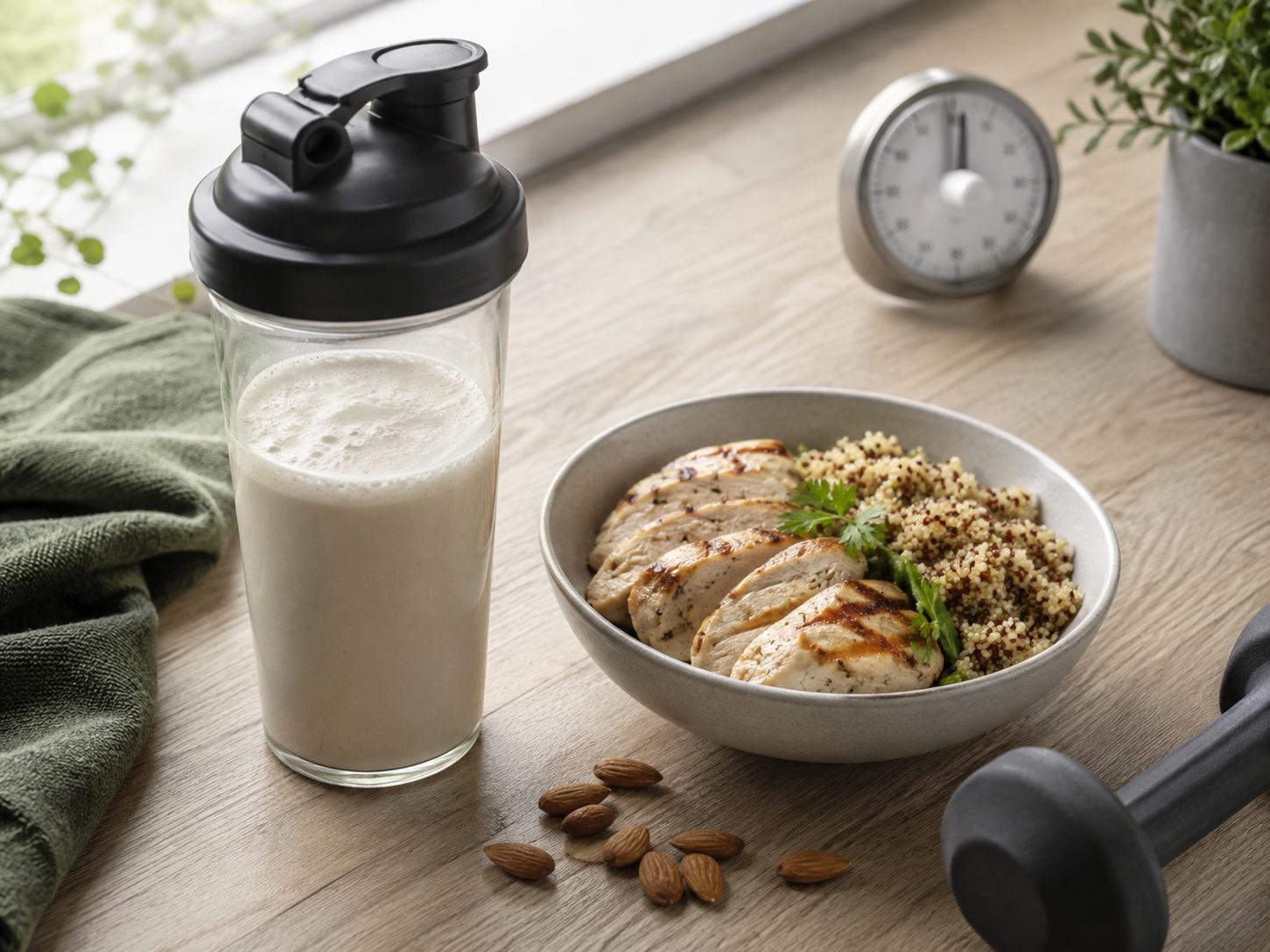
- Use a shake as a convenience tool, not a magic trigger. A protein shake is a practical way to hit a daily protein target when whole food is not available, not a supplement with unique anabolic properties tied to a countdown clock.
- If you are fasted-training and cannot eat quickly afterward, plan ahead. Keep a portable protein source (shake, jerky, Greek yogurt) accessible so the gap between waking, training, and eating does not stretch for hours.
Frequently Asked Questions
Is the post-workout anabolic window really only 30 minutes?
No. The 30-minute figure is a popularized simplification that does not match the underlying research. Reviews of the evidence describe a much wider effective window, particularly when a meal was eaten in the hours before training, since circulating amino acids from that meal remain elevated during and after the session (Aragon & Schoenfeld, 2013).
Does it matter if I do not eat protein immediately after a workout?
For most people who ate normally before training, a delay of one to two hours after training is unlikely to have a meaningful practical effect, as long as total daily protein intake still hits the target for the day.
What matters more than timing for muscle growth?
Total daily protein intake, consistent progressive resistance training, and adequate overall calories are the dominant factors. A 2013 meta-analysis found that the apparent benefit of protein timing on hypertrophy lost statistical significance once total protein intake was controlled for (Schoenfeld, Aragon & Krieger, 2013).
When does meal timing become more important?
Timing carries more practical weight during fasted training, when training multiple times in one day, during long gaps between meals, or in aggressive caloric-restriction phases, since these situations involve longer stretches without circulating amino acids to draw on.
How much protein should I eat per meal to support muscle protein synthesis?
Sports nutrition position-stand guidance describes roughly 0.4 grams of protein per kilogram of body weight per meal, spread across about three to four meals a day, as a reasonable general target for supporting muscle protein synthesis across the day (Jäger et al., 2017).
Should I still take a protein shake after training?
A shake is a convenient way to reach your daily protein target, especially when whole food is not readily available. It is a useful convenience tool rather than a requirement tied to a strict countdown clock.
Key Terms Explained
Anabolic window refers to the period after exercise during which the body is thought to be especially receptive to nutrients for muscle repair and growth. Research indicates this window is considerably wider and more flexible than the popularized 30-minute figure, especially when a pre-workout meal was consumed.
Muscle protein synthesis is the physiological process by which the body builds new muscle proteins, using amino acids from dietary protein, to repair and adapt muscle tissue in response to resistance exercise.
Nutrient timing is the practice of strategically scheduling food and macronutrient intake around exercise sessions, with the goal of supporting performance, recovery, and training adaptations.
Leucine threshold describes the general concept that a meal needs to supply a sufficient amount of the amino acid leucine to meaningfully activate the cellular signaling pathways that turn on muscle protein synthesis; below that amount, the stimulating effect on protein synthesis is comparatively weaker.
Protein pulsing is a feeding pattern that distributes protein intake into several small-to-moderate servings spread across the day, rather than concentrating it into one or two very large meals, an approach studied for its effect on protein synthesis rates over extended recovery periods.
References
- Aragon AA, Schoenfeld BJ. Nutrient timing revisited: is there a post-exercise anabolic window? Journal of the International Society of Sports Nutrition. 2013;10:5. https://doi.org/10.1186/1550-2783-10-5
- Schoenfeld BJ, Aragon AA, Krieger JW. The effect of protein timing on muscle strength and hypertrophy: a meta-analysis. Journal of the International Society of Sports Nutrition. 2013;10:53. https://doi.org/10.1186/1550-2783-10-53
- Jäger R, Kerksick CM, Campbell BI, et al. International Society of Sports Nutrition Position Stand: protein and exercise. Journal of the International Society of Sports Nutrition. 2017;14:20. https://doi.org/10.1186/s12970-017-0177-8
- Kerksick CM, Arent S, Schoenfeld BJ, et al. International Society of Sports Nutrition Position Stand: nutrient timing. Journal of the International Society of Sports Nutrition. 2017;14:33. https://doi.org/10.1186/s12970-017-0189-4
- Areta JL, Burke LM, Ross ML, et al. Timing and distribution of protein ingestion during prolonged recovery from resistance exercise alters myofibrillar protein synthesis. The Journal of Physiology. 2013;591(9):2319-2331. https://doi.org/10.1113/jphysiol.2012.244897