






















Shopping with awareness means matching your cart to your values, health goals, and budget—without falling for marketing noise. Mindful Grocery Shopping is the practice of planning, reading, and choosing with intention so every item has a purpose. In a sentence: it’s building a cart you’ll be glad to eat from all week. This guide is educational and not medical advice; if you have a medical condition or special diet, consult a qualified professional.
Quick-start steps: make a meal-based list, check your pantry first, read %DV on the label, compare unit price, favor minimally processed foods, and buy only what you can store safely.
1. Plan Your Cart Around Meals (Not Cravings)
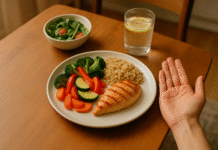
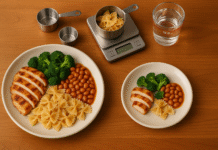
Start by deciding what you’ll actually cook and eat over the next 3–7 days; then buy exactly those ingredients. This flips shopping from “what looks good?” to “what completes my plan?” and prevents random items from expiring in your fridge. Use a two-part list: (1) a short meal plan with 3–5 mains you’ll rotate and (2) a staples list (produce, grains, proteins, dairy/fortified soy, healthy fats, spices). Align it with a plate model so you remember variety—vegetables and fruits, grains (preferably whole), protein foods, and dairy or fortified alternatives. Planning also helps you decide what can be fresh versus frozen or canned, which matters for shelf life and price. Finally, shop your kitchen first: inventory your fridge, freezer, and pantry so you only replace what you’re out of.
1.1 How to do it
- Pick 3 mains you’ll repeat (e.g., lentil chili, sheet-pan chicken/veg, tofu stir-fry).
- List ingredients by aisle; group produce → center store → dairy/frozen → bakery/meat.
- Pre-mark what you already have to avoid duplicates.
- Tag perishables with a “use by” day (Mon/Tue, etc.) in your notes app.
- Pre-assign leftovers for lunches to stretch your budget.
1.2 Mini-checklist
- Do I have a plan for each perishable?
- Do I have at least one fast dinner for busy nights?
- Did I buy the right sizes for my household?
Close by double-checking that each item supports a planned meal; this one-minute scan is the simplest way to cut waste and impulse buys.
2. Use the Nutrition Facts Label to Triage Fast
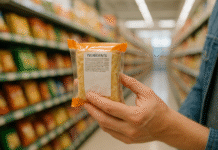
The fastest label scan is to read serving size and % Daily Value (%DV) first. Serving size tells you what the numbers refer to; %DV shows if a nutrient is low (≈5% DV or less) or high (≈20% DV or more). Prioritize higher %DV for fiber, potassium, iron, calcium, and vitamin D; and look for lower %DV for saturated fat, sodium, and added sugars. Knowing a few anchor numbers helps: the Daily Value for added sugars is 50 g (per 2,000 kcal diet), and fiber’s 100% DV is 28 g. This lets you decide in seconds if a cereal or snack fits your goals.
2.1 How to do it
- Step 1: Check serving size and servings per container—many “single-serve” items hide 2+ servings.
- Step 2: Scan %DV: pick items with ≤5% DV for nutrients to limit and ≥20% DV for nutrients to get more of.
- Step 3: Look for Added Sugars separately from total sugars.
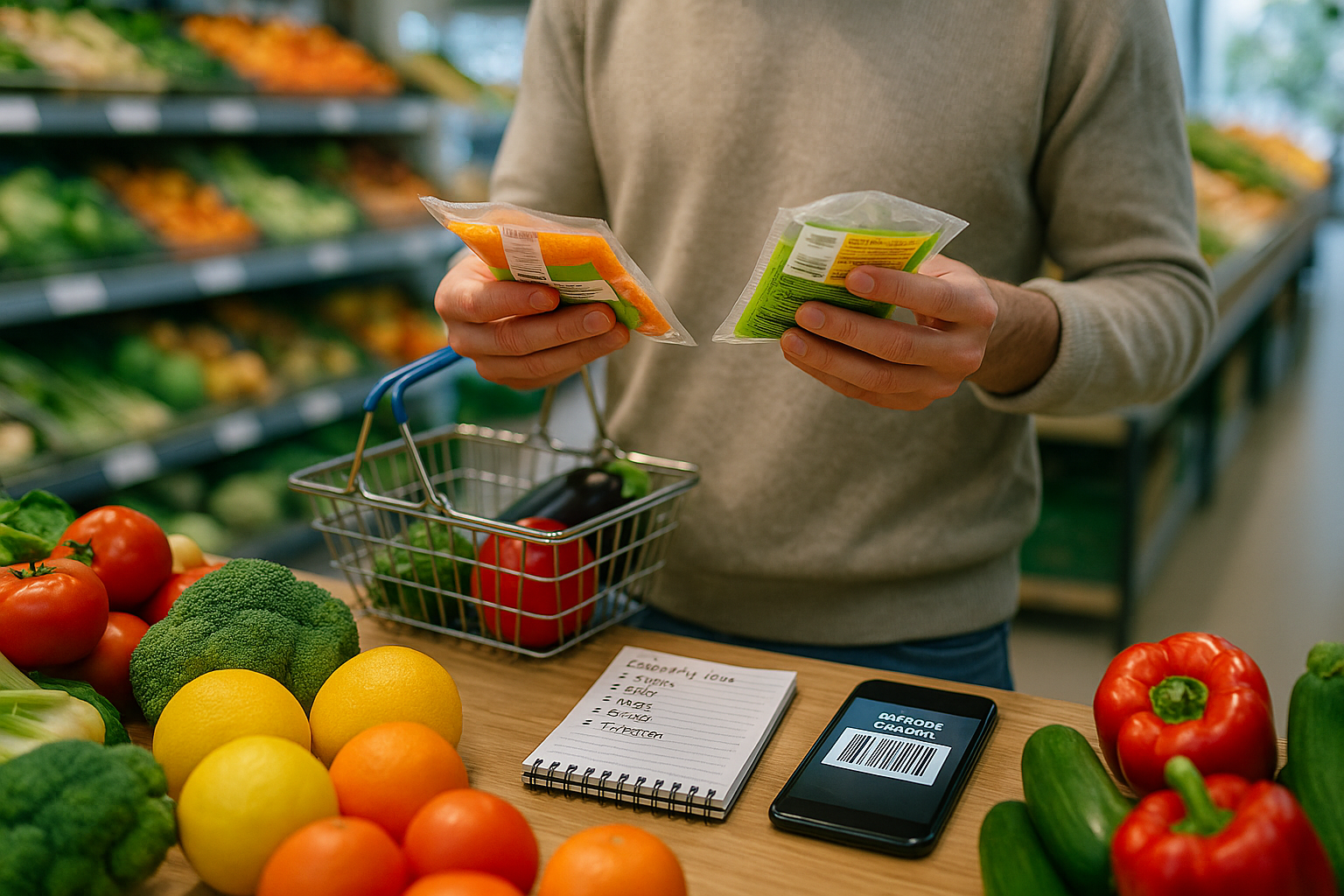
- Step 4: Compare two products side-by-side using %DV; choose the one that better matches your targets.
2.2 Numbers & guardrails
- Added sugars: Aim for low %DV; 100% DV = 50 g/day.
- Sodium: See Habit 6 for limits; use %DV to judge quickly.
- Fiber: “High fiber” choices move you toward 28 g/day.
A disciplined %DV scan prevents health-washing; it’s your best first-pass filter before ingredient lists and claims.
3. Read Ingredient Lists & Claims With a Skeptic’s Eye
Ingredient lists are ordered by weight, so the first few items tell you most of what you’re buying. Shorter lists aren’t automatically better, but they’re easier to understand and compare. Certifications can help—USDA Organic (strict production standards) and the Whole Grain Stamp (signals grams of whole grains per serving)—while broad claims like “natural” aren’t tightly regulated in many contexts. In the U.S., “natural” is a longstanding policy statement, not a formal definition, so it doesn’t guarantee nutrition quality. Use claims as clues, not verdicts.
3.1 Tools & examples
- Whole Grain Stamp: “100% Stamp” means all grain ingredients are whole, typically ≥16 g whole grain per serving; the “50%+ Stamp” means at least half of grain ingredients are whole (≥8 g per serving).
- USDA Organic: “Organic” guarantees ≥95% certified organic ingredients; “Made with organic …” is ≥70% and cannot use the USDA Organic seal.
- Ingredient order: If sugar appears in the first three ingredients of a cereal, consider a lower-sugar option.
3.2 Common misunderstandings
- “Natural” ≠ healthy; it usually means no artificial/synthetic additives expected in that food.
- “Multigrain” ≠ whole grain; verify with “whole” in the first ingredients or a recognized stamp.
- “Lite”/“reduced” food claims refer to reductions versus a reference product, not absolute healthfulness.
Read claims in context of the Nutrition Facts; if the numbers don’t back the promise, leave it.
4. Favor Minimally Processed Over Ultra-Processed (When Practical)
Processing exists on a spectrum. The NOVA system groups foods into unprocessed/minimally processed (e.g., oats, vegetables, plain yogurt), processed culinary ingredients (oils, sugar, salt), processed foods (canned fish, cheese, bread), and ultra-processed foods (UPFs)—formulations with ingredients not commonly used in home kitchens (e.g., certain emulsifiers, flavorings, colorings) designed for hyper-palatability and convenience. You don’t need to eliminate UPFs entirely to shop mindfully; you just want a cart anchored by minimally processed items, supplemented with convenient processed options that still align with your nutrition goals.
4.1 How to do it
- Build meals around whole staples: beans/lentils, whole grains, eggs, vegetables, fruit, plain yogurt, tofu, nuts/seeds.
- When choosing convenience foods (soups, sauces, bars), scan %DV for sodium and added sugars and pick simpler ingredient lists.
- Keep a few high-utility UPFs (e.g., high-fiber wraps, fortified cereals) if they help you meet nutrient targets.
4.2 Mini case
- Cart A: flavored instant noodles, sugary cereal, processed meat snacks, soda.
- Cart B: quick-cook brown rice, canned tomatoes, frozen mixed veg, canned tuna, plain yogurt, fruit, eggs.
Cart B takes similar time to cook, costs about the same per serving, and usually delivers better fiber/protein with lower sodium/sugars.
Let convenience serve your plan—not the other way around.
5. Compare Value With Unit Pricing (Beat Shrinkflation)
Unit price (e.g., per 100 g, per kg, per L) lets you compare different package sizes and brands. Requirements to display unit price vary by country and—within the U.S.—by jurisdiction, so you’ll often see it in large supermarkets but not always elsewhere. When it isn’t shown, do the math: total price ÷ quantity. Unit pricing helps you spot “shrinkflation,” where a product costs the same but contains less.
5.1 How to do it
- Check the shelf tag for a smaller line showing price per 100 g/oz/L.
- Normalize units: if one yogurt is priced per 100 g and another per 1 oz, convert so you’re comparing like with like.
- Watch forms: compare canned vs. dried beans, bone-in vs. boneless chicken, pre-cut vs. whole produce—unit cost can flip your choice.
5.2 Numeric example
- Yogurt A: $1.39 for 150 g ⇒ $0.926 per 100 g.
- Yogurt B: $4.79 for 907 g (32 oz) ⇒ $0.528 per 100 g.
Even if Yogurt B is “premium,” it’s ~43% cheaper per 100 g.
Use unit pricing alongside nutrition: the “cheapest per unit” isn’t a win if it’s much higher in sodium or added sugars.
6. Set Nutrient Guardrails: Sodium, Added Sugars & Fiber
Guardrails make decisions easy. As of August 2025, adults are advised by global and national bodies to limit sodium to roughly <2,000 mg/day (≈5 g salt). On labels, that’s ~87% DV across a day (2,300 mg is 100% DV in some jurisdictions). For added sugars, the Daily Value is 50 g/day on a 2,000 kcal diet, so a 20 g snack is 40% DV—useful context. For fiber, aim toward 28 g/day (100% DV), so picks with ≥20% DV per serving help you get there. These numbers keep the big levers in view while you shop.
6.1 Mini-checklist at the shelf
- Sodium ≤5–10% DV per serving for everyday staples.
- Added sugars ≤5–10% DV per serving for routine snacks/cereals.
- Fiber ≥10–20% DV per serving when choosing grains/cereals/bars.
6.2 Practical swaps
- Choose no-salt-added canned tomatoes/beans; if not available, drain and rinse to reduce sodium.
- Pick plain yogurt + fruit instead of sweetened cups; add a drizzle of honey if needed.
- Choose breads/cereals with whole grain first and solid fiber %DV.
Guardrails prevent “decision fatigue.” If a product breaks them, you’ll know instantly whether to skip or make room for it.
7. Produce, Frozen, or Canned? Choose for Shelf Life and Waste
Fresh, frozen, and canned all have a place in a mindful cart. Fresh shines for texture and peak flavor; frozen is often harvested ripe and flash-frozen, preserving nutrients; canned is economical and shelf-stable. Smart shoppers mix forms to match the week’s rhythm: fresh for early-week meals, frozen/canned for later. Storage matters: keep your fridge at ≤40°F/4°C and learn your produce drawers’ humidity settings; use a food storage guide to know what lasts days vs. weeks.
7.1 How to do it
- Early-week: salad greens, berries, fresh herbs—use first.
- Mid-week: sturdier produce (carrots, cabbage, squash), frozen vegetables and fruit.
- Late-week & pantry: canned tomatoes, beans, tuna/salmon, jarred pesto—build reliable meals.
7.2 Numbers & guardrails
- For canned fruit, choose 100% fruit juice or water; for canned veg/beans, look for low-sodium or no-salt-added; drain and rinse if not.
- Many frozen fruits/veg have no added sugar/salt—check the ingredient line for “fruit/vegetable” only.
Close the loop by planning storage the moment you get home (see Habit 12); good storage protects your budget and reduces waste.
8. Build a Protein Plan (Lean, Plant-Forward, Satisfying)
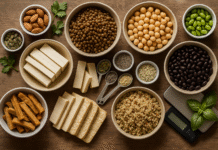
Protein anchors meals and satiety. A mindful plan mixes animal and plant sources in a way that hits your budget, nutrition targets, and values. Beans, lentils, tofu/tempeh, eggs, dairy/fortified soy, fish, and lean meats can all fit. Plant-forward choices often cost less per serving and, on average, have a smaller environmental footprint.
8.1 How to do it
- Keep 2 plant proteins on deck weekly (e.g., dry lentils + canned beans).
- Choose plain Greek yogurt or fortified soy yogurt for breakfast/protein snacks.
- Rotate canned fish (tuna/salmon) for quick omega-3-rich meals; pick versions packed in water and check sodium.
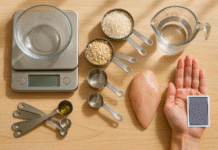
- Buy larger packs of chicken or tofu, portion and freeze to reduce cost per serving.
8.2 Mini case & numbers
- Cost example: dry lentils (1 lb/454 g) at $1.49 yield ~6 cups cooked (~10–12 servings), often <$0.15/serving before add-ins.
- Environmental note: life-cycle data show average emissions from beef far exceed beans or tofu; choosing plant proteins more often is a high-impact switch for footprint without sacrificing protein.
A pre-committed protein plan makes the rest of the cart snap into place—sides and sauces fall in line when protein is set.
9. Understand Front-of-Pack Labels (Traffic Lights, Scores, and What They Mean)
Front-of-pack (FOP) systems are designed for fast scanning. If you shop in the UK or some EU countries, you may see traffic light labels (red/amber/green for fat, saturates, sugars, salt per 100 g) or summary scores like Nutri-Score. These tools don’t replace the Nutrition Facts but can help you rule items in or out quickly, especially within a category (e.g., pick the green-salt soup over red-salt). If your region lacks standardized FOP labels, use %DV as your universal system.
9.1 How to use them
- Compare within a category (yogurts to yogurts), not across (yogurt vs. olive oil).
- Prioritize greens/ambers for sodium and sugars; treat reds as occasional.
- Still flip the pack: confirm serving size and ingredients align with your goals.
9.2 Region notes
- UK “traffic light” thresholds are set per 100 g/100 mL—great for apples-to-apples within categories.
- Different countries pilot different summary scores; your best defense is still knowing %DV and reading ingredients.
Think of FOP labels as shortcuts, not substitutes. If the shortcut says “maybe,” the full label gives the tiebreaker.
10. Stock a “Healthy Convenience” Arsenal for Real Life
Busy weeks derail the best intentions. Your counter-move is to build a convenience shelf that shortens prep without compromising nutrition. “Healthy convenience” means pre-prepped, minimally processed helpers: frozen veg/fruit, pre-washed greens, canned beans, rotisserie chicken (watch sodium), microwavable whole grains, plain yogurt, eggs, and jarred sauces with reasonable sodium and sugar.
10.1 Tools/Examples
- 15-minute dinners: frozen stir-fry veg + tofu + bottled sauce (check sodium); microwave brown rice.
- Grab-and-go: plain Greek yogurt + fruit; hummus + veg; nuts (unsalted/no salt added).
- Flavor builders: tomato paste tubes, low-sodium stock, spice blends, citrus, and vinegars.
10.2 Mini-checklist
- Does each “shortcut” keep me under my sodium/added sugar guardrails?
- Do I have at least one freezer meal and one pantry meal ready?
- Are my snacks protein/fiber-forward so they actually satisfy?
Convenience is mindful when it buys back time you use to cook (or rest) instead of defaulting to takeout.
11. Use Digital Tools (Apps, Barcodes, and Store Programs)
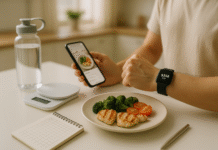
Smartphones can streamline mindful shopping. Store apps show weekly specials, digital coupons, and sometimes unit price. Barcode scanners can reveal nutrition info and price per unit; digital lists sync with households; some apps track pantry inventory and expiry dates. Even if you’re tech-light, taking a photo of your fridge before leaving can prevent duplicate buys.
11.1 How to do it
- Before you go: load digital coupons on items you already planned to buy.
- In the aisle: scan for price comparisons; verify label details if print is tiny.
- At home: keep a running list; when something hits 20–25% remaining, add it to the next list.
11.2 Guardrails
- Tech should support—not replace—label literacy. If an app’s “health score” conflicts with %DV and ingredients, trust the label.
- Respect privacy: turn off features you don’t need; stick to reputable apps and store programs.
Used well, digital tools reduce friction and reinforce your plan rather than opening the door to impulse buys.
12. Post-Shop Storage & Organization That Protects Food and Budget
Mindful shopping isn’t done at checkout. Store food safely the moment you get home to extend freshness and avoid foodborne illness. Keep your fridge at ≤40°F/4°C, freezer at 0°F/−18°C, and learn first-in, first-out rotation. Use the crisper drawers: high humidity for leafy greens; low for ethylene-sensitive produce. Label leftovers with the date; most are best used within 3–4 days. For canned goods, check integrity (no bulges, major dents); for frozen foods, note that quality declines over time but safety remains when kept at 0°F.
12.1 Mini-checklist
- Zone your fridge: raw proteins on the lowest shelf; milk/yogurt mid-shelf; condiments in the door; greens in the high-humidity drawer.
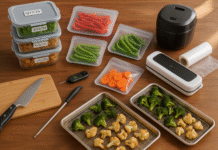
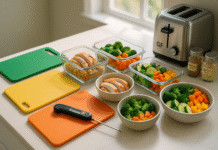
- Batch-prep: wash/dry greens, chop a few veggies, cook a pot of grains—store in clear containers at eye level.
- Waste watch: build a “use-first” bin so fragile items get eaten before they wilt.
12.2 Why it matters
- Safer storage reduces spoilage and cuts household food waste—an environmental and budget win.
- A tidy fridge is a nudge: when healthy food is visible and ready, you’ll eat it.
Close your loop weekly: quick inventory, a simple plan, and your next mindful list practically writes itself.
FAQs
1) What does “Mindful Grocery Shopping” actually mean in one or two moves?
It means you decide what to cook first, then shop to fill that plan, and you use the Nutrition Facts (serving size and %DV) to sanity-check every packaged item. Those two moves—planning and label triage—prevent impulse buys, reduce waste, and make your cart match your health and budget goals.
2) If I only change one habit, which should it be?
Adopt a two-list system: a short meal plan plus a staples list. Bring it to the store and stick to it. This quickly lowers spend and spoilage because every perishable has a job. Add a label glance (%DV for sodium/sugar/fiber) and you’ve covered the biggest pitfalls without extra effort.
3) Are frozen and canned foods as healthy as fresh?
Often, yes. Frozen produce is typically harvested at peak ripeness and flash-frozen, preserving nutrients. Canned beans and tomatoes are budget-friendly and shelf-stable; choose no-salt-added or low-sodium and rinse standard cans to reduce sodium. The better question is: does this form help me cook and waste less? If yes, it’s a win.
4) What’s a realistic sodium target when shopping?
Aim for products with ≤5–10% DV sodium per serving for staples, and save higher-sodium items for occasional use. As a daily boundary, international guidance recommends keeping sodium under about 2,000 mg/day (≈5 g salt) for adults. Using %DV helps you budget sodium across the day.
5) How do I cut added sugars without feeling deprived?
Check the Added Sugars line. If a yogurt or cereal shows 10 g (20% DV) added sugars per serving, consider a plain version and sweeten it yourself with fruit. Save higher-sugar items as treats, not daily staples. Over a few weeks, your palate adapts to less sweetness.
6) What’s the deal with “natural,” “organic,” and “whole grain” labels?
“Natural” is a loose policy term in the U.S. and doesn’t guarantee healthfulness. “Organic” is regulated: ≥95% certified organic ingredients may carry the USDA Organic seal. For grains, the Whole Grain Stamp helps: the 100% Stamp means all grain ingredients are whole and typically ≥16 g whole grain per serving.
7) Is local always better for the environment?
Not necessarily. Transport is usually a small slice of a food’s total footprint; what you eat often matters more than how far it traveled. Shifting one or two meals a week toward plant proteins (beans, lentils, tofu) is a high-impact, budget-friendly change, whether those foods are local or not.
8) How do I keep produce from going slimy?
Plan early-week vs. late-week produce; use high-humidity drawer for leafy greens and low humidity for ethylene-sensitive items. Keep the fridge at ≤40°F/4°C and store fragile items front-and-center as a “use-first” bin. Wash and prep a portion right away so it’s grab-ready.
9) What if my store doesn’t show unit prices?
Do the quick math: total price ÷ quantity (convert units if needed). You’ll catch many deceptive deals, especially during sales or with “family size” packaging. Compare versus your nutrition guardrails—cheapest isn’t best if it derails your sodium/sugar limits.
10) Are all ultra-processed foods “bad”?
Ultra-processed is a category, not a moral label. Some items (e.g., fortified cereals, high-fiber wraps) can be useful. The mindful approach is to anchor your cart in minimally processed foods and add convenient items that still meet your %DV and ingredient standards.
11) How long do leftovers last?
Most cooked leftovers are best within 3–4 days refrigerated; freeze if you won’t eat them in that window. Label containers with dates and keep the fridge at ≤40°F/4°C. Reheat thoroughly and avoid letting food linger in the “danger zone” (40–140°F / 4–60°C).
12) What apps are worth it?
Store apps for digital coupons and price checks, a simple shared list app, and (if you like) a barcode scanner for nutrition details. Use them to reinforce your plan, not replace reading labels. Turn off features you don’t need and stick with reputable providers.
Conclusion
Mindful Grocery Shopping isn’t about perfection; it’s a repeatable process that gets faster every week: plan meals, shop your kitchen first, use labels and unit pricing to choose, and store food safely when you get home. Anchoring your cart in minimally processed staples, setting numeric guardrails for sodium/sugars/fiber, and mixing fresh with frozen/canned protects both health and budget. Layer in digital tools and a “healthy convenience” shelf, and you can handle busy weeks without defaulting to takeout. Most importantly, connect each item to a real meal you’ll look forward to eating. Start with one or two habits today—the payoff shows up at dinner, in your wallet, and in less food wasted.
CTA: Build your two-list plan now—pick three dinners, check your kitchen, and shop with purpose.
References
- How to Understand and Use the Nutrition Facts Label, U.S. Food & Drug Administration (Mar 5, 2024). https://www.fda.gov/food/nutrition-facts-label/how-understand-and-use-nutrition-facts-label
- The Lows and Highs of Percent Daily Value on the Nutrition Facts Label, U.S. Food & Drug Administration (Mar 5, 2024). https://www.fda.gov/food/nutrition-facts-label/lows-and-highs-percent-daily-value-nutrition-facts-label
- Added Sugars on the Nutrition Facts Label, U.S. Food & Drug Administration (Mar 5, 2024). https://www.fda.gov/food/nutrition-facts-label/added-sugars-nutrition-facts-label
- Sodium Reduction – Fact Sheet, World Health Organization (Feb 7, 2025). https://www.who.int/news-room/fact-sheets/detail/sodium-reduction
- Grocery Shopping – Tip Sheet, MyPlate, U.S. Department of Agriculture (accessed Aug 2025). https://www.myplate.gov/tip-sheet/grocery-shopping
- Food Labels: How to Read Food Labels, NHS (UK) (last reviewed 2021). https://www.nhs.uk/live-well/eat-well/food-guidelines-and-food-labels/how-to-read-food-labels/
- Ultra-Processed Foods: Definitions and Policy Issues, M.J. Gibney, Proceedings of the Nutrition Society (2018). https://pmc.ncbi.nlm.nih.gov/articles/PMC6389637/
- Environmental Impacts of Food Production, Our World in Data (updated 2022). https://ourworldindata.org/environmental-impacts-of-food
- Food Waste Index Report 2024, United Nations Environment Programme (Mar 27, 2024). https://www.unep.org/resources/publication/food-waste-index-report-2024
- Cold Food Storage Chart, FoodSafety.gov (U.S. Government) (accessed Aug 2025). https://www.foodsafety.gov/food-safety-charts/cold-food-storage-charts
- Whole Grain Stamp – Identifying Whole Grain Products, Whole Grains Council (accessed Aug 2025). https://wholegrainscouncil.org/whole-grain-stamp
- Use of the Term “Natural” on Food Labeling, U.S. Food & Drug Administration (policy page; current as of 2018, accessed Aug 2025). https://www.fda.gov/food/nutrition-food-labeling-and-critical-foods/use-term-natural-food-labeling
- Unit Prices for Groceries, Australian Competition & Consumer Commission (updated 2025). https://www.accc.gov.au/consumers/pricing/unit-prices-for-groceries
- Sodium in Your Diet: Use the Nutrition Facts Label, U.S. Food & Drug Administration (brochure, accessed Aug 2025). https://www.fda.gov/media/84261/download
- Effect of Draining and Rinsing on the Sodium and Water Content of Canned Vegetables, USDA ARS (2011). https://www.ars.usda.gov/ARSUserFiles/80400525/articles/eb11_drainedveg.pdf