























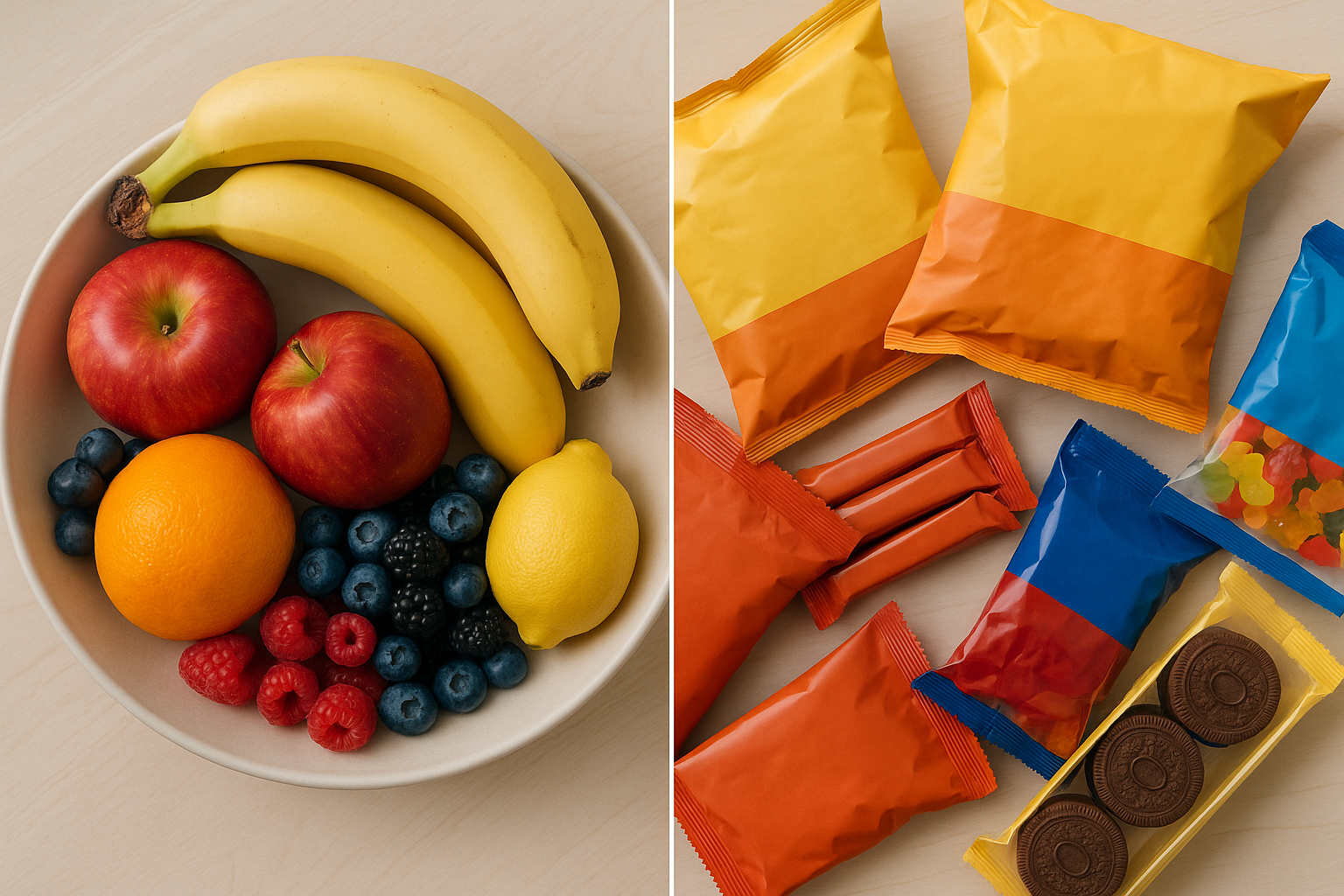
If you want snacks that actually nourish you, whole fruit usually wins—hands down—over most processed snacks. Nutrient-dense foods deliver more vitamins, minerals, fiber, and beneficial compounds for every calorie. In the head-to-head of Fruit vs. Processed Snacks, fruit typically offers higher nutrient density and lower energy density, while many packaged snacks pack extra sugars, sodium, and refined fats. Here’s exactly where fruit pulls ahead—and how to use that knowledge to stock smarter snacks. General nutrition guidance only; if you have a medical condition, check with your clinician or dietitian.
Quick answer (for the featured snippet): Choosing nutrient-dense snacks means prioritizing foods with more vitamins, minerals, and fiber per calorie. Whole fruits fit that bill; many processed snacks are energy-dense with added sugar, sodium, and refined fats, so they’re usually less nutrient-dense overall.
Fast pick checklist (5 seconds):
- Whole fruit or fruit + protein (nuts, yogurt) beats chips/candy for fiber and fullness.
- Scan labels: added sugars low, fiber higher, sodium low.
- Favor fresh, frozen, canned (in 100% juice), or dried (no added sugar) fruit.
1. Nutrient Density Per Calorie: Fruit Delivers More for Less
Whole fruit is generally more nutrient-dense than processed snacks because it bundles vitamins, minerals, antioxidants, and fiber into a relatively modest calorie package. Contrast that with many snack foods that concentrate calories (especially from fat and refined starch) while offering fewer beneficial nutrients per bite. The Nutrition Facts framework itself acknowledges that macronutrients contribute energy differently—fat has 9 kcal/g whereas carbohydrate and protein have 4 kcal/g—so snacks rich in refined oils can be very energy-dense without adding many micronutrients. Practically, 100 g of gala apple has about ~61 kcal and naturally occurring vitamin C and fiber; 100 g of plain potato chips clocks in around ~532 kcal with minimal micronutrients and little fiber by comparison. That’s the essence of nutrient density: more nutrients per calorie, not just fewer calories.
1.1 Why it matters
Nutrient-dense snacks help you meet daily vitamin, mineral, and fiber goals without overshooting calories, making weight management and cardiometabolic health easier over time. They also support better meal-to-meal energy thanks to fiber and water content that slow digestion.
1.2 Numbers & guardrails
- Calories per gram (label math): Fat 9, carbohydrate 4, protein 4. Higher-fat snacks tend to be more energy-dense.
- Real-world contrast (100 g): Gala apple ≈ 61 kcal vs. potato chips ≈ 532 kcal.
- Daily fiber targets: ~25 g/day (women) to ~38 g/day (men) or ~14 g/1,000 kcal; fruit helps you get there. Mayo Clinic
Mini-checklist: When comparing snacks, ask: Does this deliver fiber and micronutrients per 100–150 kcal, or is it mostly refined starch/fat?
Bottom line: For nutrient density, fruit wins most matchups with fewer calories and more helpful nutrients per bite.
2. Added Sugars: Whole Fruit Beats “Sugary” Processed Snacks
The sugars in whole fruit come packaged with fiber, water, and phytochemicals, which slow absorption and support satiety. Many processed snacks add free/added sugars without fiber, making it easy to overshoot daily limits. The World Health Organization recommends keeping free sugars below 10% of energy (and suggests <5% for additional benefits), guidance still cited globally as of 2025. That means ≤50 g/day on a 2,000-kcal diet (ideally ≈25 g). Fruit’s intrinsic sugars don’t count as “added,” and the intact structure helps temper glucose spikes compared with sugary snacks.
2.1 How to do it (labels & swaps)
- Check “Added Sugars” on the label; choose snacks with 0–5 g/serving when possible.
- Swap a candy bar for 1 banana (100 g: ~12 g natural sugar + ~3 g fiber), or 1 apple; you’ll feel fuller for similar calories.
- Watch juices, sweetened yogurts, and “fruit snacks”—they often deliver free sugars without fiber.
2.2 Small numeric example
A typical 28 g serving of chips lists 0 g added sugar but little fiber; a typical cookie or candy can add 10–20 g of added sugar per serving. Choosing a whole piece of fruit trades added sugars for fiber and micronutrients, improving overall quality.
Bottom line: Keep added sugars within WHO limits; intact fruit is the simplest way to satisfy a sweet tooth without adding free sugars.
3. Fiber & Fullness: Fruit Helps You Stay Satisfied
Fiber is a major reason fruit outperforms processed snacks. Soluble fiber forms a gel in the gut that slows digestion and helps regulate blood glucose; insoluble fiber adds bulk that supports regularity. Most adults fall short of fiber targets (roughly 25 g/day for women, 38 g/day for men, or ~14 g per 1,000 kcal). A medium apple provides several grams of fiber for ~95 kcal; a banana gives roughly 3 g per 100 g—both far more than most sweet snacks per calorie. Fiber also supports a healthier lipid profile and gut function, making fruit a multitasker your snack drawer can’t match. My Food Data
3.1 Why it matters
Higher-fiber eating patterns are linked with better satiety between meals and improvements in cardiometabolic risk factors. That makes fruit-forward snacks an easy lever for appetite control and long-term health. Mayo Clinic
3.2 Mini checklist
- Aim for 3–5 g fiber in a snack by pairing fruit with nuts/seeds or whole-grain crackers.
- Choose fruit with edible peels (apples, pears) when feasible for extra fiber.
- Use frozen berries to boost yogurt or oats with minimal prep.
Bottom line: Fiber is a decisive win for fruit—more fullness for fewer calories, and better long-term markers to boot.
4. Energy Density & Satiety: More Volume, Fewer Calories
Energy density is calories per gram of food. Foods high in water and fiber (like fruit) have lower energy density, meaning you get a larger, more satisfying portion for the same calories compared with chips or cookies. A classic example: 100 g gala apple ≈ 61 kcal vs. 100 g plain potato chips ≈ 532 kcal—nearly a nine-fold difference in calories for the same weight. Research shows that lowering energy density reduces total energy intake and can improve fullness, a cornerstone of the “volumetrics” approach. PubMed
4.1 How to do it
- Build snacks around low-energy-dense foods: whole fruit, veggies, soups, and yogurt.
- Hydrate + fiber: The water and fiber in fruit add volume without calories, helping you feel full on fewer calories. PMC
- Keep portions of high-energy-dense items (chips, cookies, nuts) modest and pair with fruit to balance the plate. Mayo Clinic
4.2 Mini case
Snack A: 150 kcal from chips (≈28 g) may barely cover a palmful. Snack B: 150 kcal from fruit could be a medium apple plus a cup of berries—much more volume for the same calories, and more fiber to tide you over.
Bottom line: Energy density is where fruit shines; you’ll feel satisfied with fewer calories when the bulk of your snack is fruit-based.
5. Glycemic Impact: Whole Fruit Usually Outperforms Juice & Sweets
Whole fruits tend to have a lower glycemic impact than ultra-processed sweets because their fiber and cellular structure slow carbohydrate absorption. Evidence links higher whole-fruit intake (especially apples, blueberries, grapes) with lower type 2 diabetes risk, whereas higher fruit juice intake trends the other way. That doesn’t mean fruit sugar is “free”—it means the package matters. If you manage blood sugar, opt for intact fruit, pair it with protein or fat (nuts, yogurt), and watch portions. PubMed
5.1 Numbers & guardrails
- Whole fruit fiber slows digestion; juices lack fiber and can spike blood sugar more quickly.
- Observational data suggest replacing several juice servings/week with whole fruit lowers diabetes risk.
- GI/GL are useful concepts, but individual responses vary; focus on whole foods and pairing strategies.
5.2 Practical pairings
- Apple + 2 Tbsp peanut butter
- Banana + plain yogurt
- Berries + handful of almonds
Bottom line: For glycemic control and steady energy, whole fruit (especially when paired with protein/fat) is typically a safer bet than juice or sugary snacks.
6. Sodium & Unhealthy Fats: Processed Snacks Pack More
Many processed snacks rely on salt and refined fats for flavor and texture. Global guidance (as of Feb 2025) recommends keeping sodium below ~2,000 mg/day (≈5 g salt), while U.S. advice sets an upper limit of 2,300 mg/day, with an ideal target of 1,500 mg for many adults. A single ounce (28 g) of plain potato chips often carries ~150 mg sodium—manageable until multiple servings creep in. Fruit, by contrast, is naturally low in sodium and free of industrial trans fat; it also avoids the saturated-fat load in many fried snacks. My Food Data
6.1 Why it matters
High sodium intake is tied to elevated blood pressure and cardiovascular risk; keeping snack sodium modest helps protect heart health. Meanwhile, global policy continues pushing industrial trans fat out of the food supply, but some regions and legacy products may still pose exposure—another reason to default to minimally processed options like fruit.
6.2 Smart moves
- Choose unsalted nuts or low-sodium options and pair with fruit.
- If you buy chips/crackers, stick to single-serve packs and pair with fruit to control portions and improve the nutrient profile.
- Scan labels for sodium per serving and aim low (e.g., <140 mg qualifies as “low sodium” in U.S. labeling context).
Bottom line: Fruit’s naturally low sodium and absence of industrial trans fat make it a heart-friendlier default than salty, fried snack foods.
7. Processing Level & Additives: Why Ultra-Processed Often Loses
Not all processing is bad (freezing, drying, and canning can preserve nutrition), but ultra-processed foods (UPFs)—formulations of refined ingredients with cosmetic additives—are consistently associated with worse health outcomes in observational research. The NOVA system defines UPFs and helps explain why many snack foods (chips, candies, packaged pastries) are energy-dense, hyper-palatable, and easy to overeat. A 2024 umbrella review in BMJ linked higher UPF exposure to higher risk of multiple adverse outcomes (especially cardiometabolic and mortality outcomes). That doesn’t prove causation, but it’s another reason to lean on whole fruit for snacks. PubMed
7.1 How to use this insight (without fear)
- Prefer Group 1 (minimally processed) choices like fresh, frozen, or dried fruit without added sugars. PMC
- Treat UPFs as sometimes foods; when you choose them, plan the portion and add fruit for fiber and micronutrients.
- Remember the nuance: the category is broad and research is evolving; quality and context still matter. Science Media Centre
7.2 Mini checklist
- Short ingredient lists, recognizable foods
- No added sugar/syrups for fruit products
- Fiber present, sodium modest
Bottom line: The more a snack is ultra-processed, the harder it is to call it nutrient-dense; fruit is the simple, reliable alternative.
8. Convenience & Shelf-Life: Fresh, Frozen, Canned, or Dried (No Added Sugar)
Convenience doesn’t have to mean ultra-processed. Fresh, frozen, canned (100% juice), and dried (no added sugar) fruits all fit a healthy pattern; frozen fruit can be just as nutritious as fresh because it’s picked and frozen at peak ripeness. For busy days, shelf-stable and freezer-ready fruit options make it easier to dodge the snack aisle landmines. Choose canned fruit in 100% juice and rinse if syrupy; choose dried fruit with no added sugar and watch portions (it’s energy-dense).
8.1 Region-smart notes (South Asia example)
- Seasonal fresh picks: mango, guava, bananas, kinnow, grapefruit, pomegranate—all travel well and need minimal prep.
- Pantry/freezer: frozen berries, canned peaches in juice, dates/raisins (no added sugar) for quick trail mixes.
- Heat & storage: In hot climates, keep cut fruit refrigerated and lean on frozen fruit for smoothies and overnight oats.
8.2 Mini checklist
- Scan for “no added sugar” on dried/canned fruit.
- Keep frozen fruit on hand for instant smoothies and compotes.
- Pair fruit with protein (nuts, yogurt, cheese) for longer-lasting energy.
Bottom line: Convenience doesn’t require compromise—frozen, canned-in-juice, and dried-no-sugar fruit options keep nutrient-dense snacking easy.
9. Budget-Friendly, Practical Swaps That Stick
Nutrient-dense snacking is sustainable when it’s simple and affordable. Build a small rotation of fruit-first snacks that fit your budget and routine, and use labels to keep sodium and added sugars in check. Think “fruit + protein” and “fruit + crunch” templates for automatic balance. When you want processed snacks, plan portions and pair with fruit so the overall snack tilts nutrient-dense.
9.1 Templates that work
- Fruit + protein: banana + plain yogurt; apple + peanut butter; berries + cottage cheese.
- Fruit + crunch: orange + a few almonds; grapes + whole-grain crackers; pear + pumpkin seeds.
- Quick batch-prep: freeze berry yogurt bites; portion nuts into 20–30 g snack bags; pre-wash apples and keep in a visible bowl.
9.2 Label-reading playbook
- Added sugars: keep low; remember whole fruit has 0 g added.
- Sodium: aim low; most fruit has negligible sodium.
- Fiber: seek 3+ g in the snack combo; fruit helps you reach daily targets. Harvard Health
Bottom line: Make fruit the default, use processed snacks strategically, and your day-to-day choices will trend nutrient-dense without effort.
FAQs
1) Are the sugars in fruit “better” than the sugars in candy?
Sugar molecules are chemically similar, but the package differs. Fruit brings fiber, water, and micronutrients that slow absorption and increase fullness; candy typically adds free sugars without fiber. Keeping added sugars under WHO limits while leaning on whole fruit helps control calories and cravings.
2) How many servings of fruit should I aim for daily?
Most guidelines recommend a variety of fruits and vegetables daily; many people thrive with 1–2 fruit servings per day as part of a balanced diet. If blood sugar is a concern, pair fruit with protein/fat and choose lower-GI fruits more often.
3) Is dried fruit as healthy as fresh?
Dried fruit can be nutritious but is more energy-dense because water is removed. Choose versions with no added sugar and keep portions modest (e.g., 2 Tbsp raisins). Pairing dried fruit with nuts or yogurt helps with satiety.
4) What about fruit juice and smoothies?
Even 100% fruit juice lacks the fiber of whole fruit and can spike blood sugar more quickly; smoothies vary depending on ingredients and portions. If you blend, include whole fruit, add protein (yogurt) and fiber (oats/chia), and watch serving size.
5) Which fruits are best for steady energy?
Berries, apples, pears, and citrus typically provide fiber and water for steady energy. Bananas are great, too—pair them with yogurt or nuts for slower digestion and longer satiety.
6) Can processed snacks ever fit a healthy diet?
Yes—context and portion matter. Use them strategically (planned portions), pair with fruit, and keep an eye on sodium and added sugars. Think of UPFs as “sometimes foods,” not everyday staples.
7) Do frozen fruits have fewer nutrients than fresh?
Not necessarily. Frozen fruit is often picked and frozen at peak ripeness and can be nutritionally comparable to fresh—especially when fresh has traveled or sat in storage. It’s a convenient, budget-friendly option. CDC
8) What’s the simplest way to compare snacks?
Use three cues: fiber up, sodium down, added sugars low. Then consider energy density: can you get more food volume per calorie? Fruit checks all three boxes more often than processed snacks. U.S. Food and Drug Administration
9) Are there any fruits I should limit?
Whole fruits are generally healthful. If you track carbs or manage blood sugar, mind portions of dried fruit and fruit juices, and balance fruit with protein/fat. The Nutrition Source
10) How do I beat afternoon cravings for chips or candy?
Front-load a fruit + protein snack (apple + almonds) before you get ravenous; drink water; keep fruit visible and single-serve processed snacks out of sight. The combo of fiber, water, and protein blunts cravings.
Conclusion
When the goal is nutrient density—more nutrition per calorie—fruit stands out. It offers fiber for satiety, water for volume, vitamins and minerals for health, and a naturally sweet taste that helps curb cravings. Processed snacks can fit occasionally, but their typical profile—added sugars, sodium, refined fats, and high energy density—makes them easy to overeat and hard to justify as everyday staples. The most workable approach is practical, not perfect: make fruit your default, add a protein or healthy fat for staying power, and use labels to keep sodium and added sugars in check. With a bowl of ready-to-eat fruit and a few strategic pairings in your routine, you’ll consistently choose snacks that nourish rather than just fill. Start today: swap one processed snack for a fruit-first combo and feel the difference.
References
- Guideline: Sugars Intake for Adults and Children, World Health Organization, 2015. World Health Organization
- Sodium Reduction — Fact Sheet, World Health Organization, Feb 7, 2025. World Health Organization
- How Much Sodium Should I Eat Per Day?, American Heart Association, Jul 15, 2025. www.heart.org
- 21 CFR §101.9—Nutrition Labeling of Food, U.S. eCFR (FDA/USDA Atwater factors), current as referenced. eCFR
- Carbohydrates and Blood Sugar, Harvard T.H. Chan School of Public Health (The Nutrition Source). The Nutrition Source
- Fiber — The Nutrition Source, Harvard T.H. Chan School of Public Health. The Nutrition Source
- Muraki I, et al. Fruit Consumption and Risk of Type 2 Diabetes, BMJ 2013;347:f5001. BMJ
- Healthy Habits: Fruits and Vegetables to Manage Weight, Centers for Disease Control and Prevention. CDC
- Lane MM, et al. Ultra-processed Food Exposure and Adverse Health Outcomes: Umbrella Review of Epidemiological Meta-analyses, BMJ 2024;384:e077310. BMJ
- Nutrition Facts — Snacks, Potato Chips, Plain, Salted (100 g), MyFoodData (USDA-based). My Food Data
- Nutrition Facts — Gala Apples (per 100 g), MyFoodData (USDA-based). My Food Data
- Food Service Guidelines Toolkit: Sample Language (Fruits & Vegetables), CDC, Mar 28, 2024. CDC