

























If your hips feel tight at the bottom of a squat or your torso tips forward under load, targeted hip mobility can be the fastest, safest way to unlock depth and stability. This guide gives you nine practical drills that directly translate to better squats, plus the exact sets, reps, and cues to use today. It’s written for lifters, athletes, and anyone who wants smoother, deeper, stronger squats—without random stretching that wastes time. Hip mobility drills are exercises that expand usable range in hip flexion, extension, abduction/adduction, and internal/external rotation while improving control and strength in those ranges. Use them to warm up before squats, to build capacity on non-lifting days, or as quick “movement snacks” that keep your hips happy between sessions.
Quick-start plan (skim this, then dive into the details):
- Warm up 5–8 minutes (light cardio + bodyweight squats).
- Pick 3–4 drills below that match your sticking point (depth, knees caving, hip pinch, torso lean).
- Do 1–2 sets per drill: 30–60 seconds per static hold or 8–12 reps per side for dynamic moves.
- Keep intensity at a 3–4/10 stretch sensation—never sharp pain.
- Retest your goblet or empty-bar squat immediately; move what matters, keep what works.
Brief safety note: This article is educational and not medical advice. If you feel sharp pain, catching, or persistent pinching in the hip, consult a qualified clinician before progressing.
1. 90/90 Hip Switches (Internal & External Rotation Control)
The 90/90 variation is a direct route to smoother, deeper squats because it trains both hip external and internal rotation—the subtle motions that keep knees tracking and hips centered under load. Start seated on the floor with both knees bent to 90 degrees: front leg in external rotation, back leg in internal rotation. The goal is to move slowly between sides without using your hands, building control in the exact angles that show up at the bottom of a squat. Expect your hips to feel “oiled” afterward and your knees to track more cleanly over mid-foot. This drill also exposes side-to-side differences you can fix before they become sticking points under the bar.
1.1 How to do it
- Sit tall, front shin parallel to torso, back thigh behind you; both knees ~90°.
- Without leaning back, rotate through the hips to switch sides, heels planted.
- Pause in each end range for a full breath; keep ribs stacked over pelvis.
- Progress by lifting the front foot or the back knee briefly (“lift-offs”).
- Dosage: 2 sets of 8–10 slow switches; optional 3–5 lift-offs per end range.
1.2 Numbers & guardrails
- Tempo: ~3 seconds each direction; 1–2 breath holds in end range.
- Sensation: 3–4/10 stretch; no pinching in the front of hip.
- Goal: Gradually reach thigh-to-floor contact without torso collapse.
1.3 Common mistakes
- Collapsing the chest to “cheat” range.
- Letting the pelvis rock excessively instead of rotating at the hip.
- Rushing through the sticky angles—those are the ones that fix your squat.
Synthesis: 90/90s give you the rotational freedom that keeps your knees and hips aligned, often improving depth within a single session.
2. Cossack Squat (Lateral Squat for Adductors & Groin)
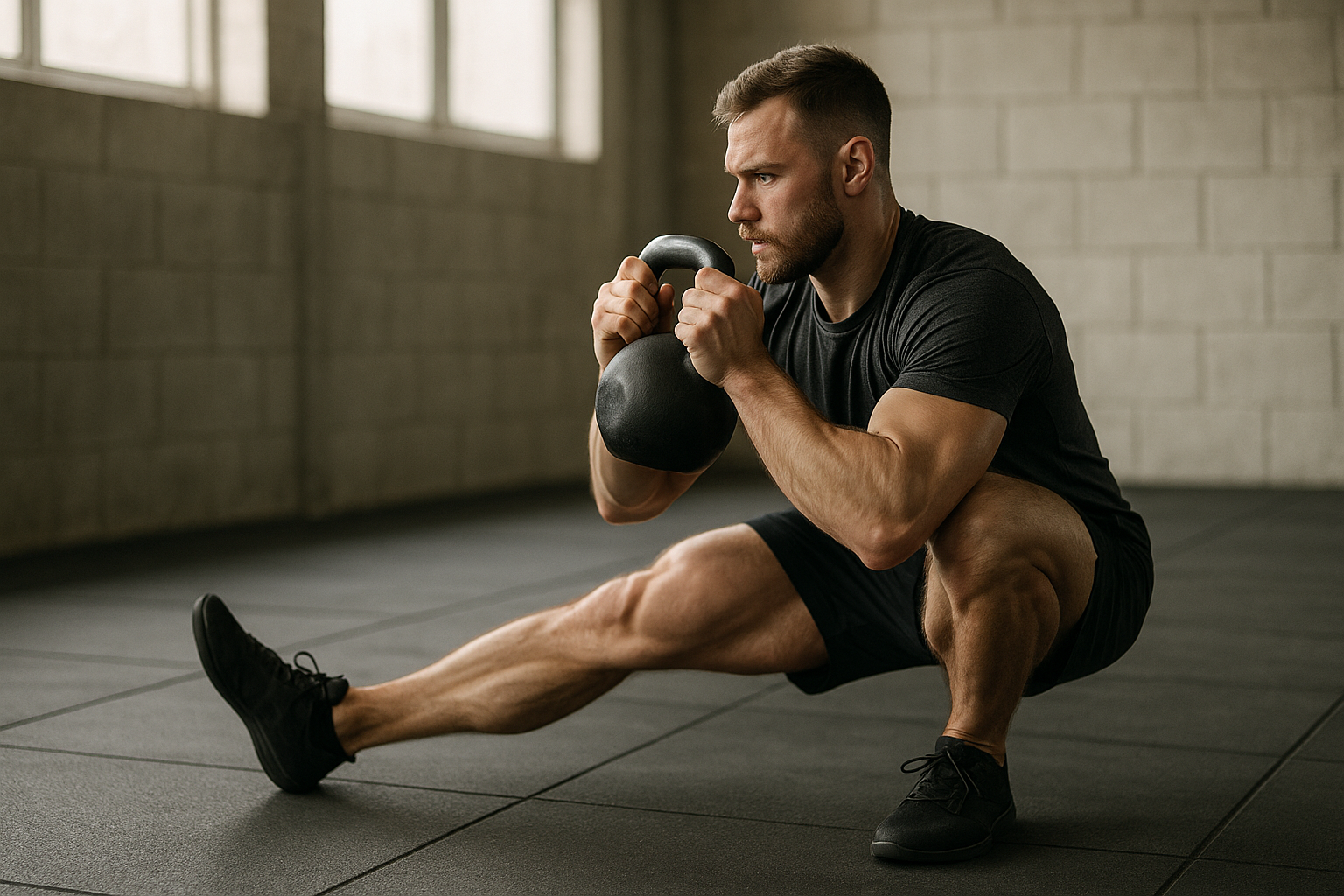
The Cossack squat is a lateral squat that targets adductors, glutes, and deep hip flexion on one side while opening the opposite groin. If your hips shift to one side at the bottom, or you feel tightness in the groin when you try to sit deeper, this is your tool. Because it’s loaded in a functional pattern, it helps your body “own” range, not just borrow it for a minute. You can start with a light counterweight to make balance easier and to encourage an upright torso, which mimics the position you want in squats.
2.1 How to do it
- Stand wide, feet 1.5–2× shoulder width, toes slightly out.
- Sit your hips back and down into one side, letting that knee track over toes.
- Keep the other leg straight with the heel down; chest tall, ribs stacked.
- Use a light kettlebell or plate as a counterweight if needed.
- Dosage: 2–3 sets of 6–8 reps per side, slow and controlled.
2.2 Numbers & guardrails
- Depth target: Hip crease below the bent knee line—without butt tuck or knee cave.
- Foot pressure: Tripod foot on working leg; heel stays down on the straight leg.
- Sensation: Strong stretch inner thigh of straight leg; no sharp knee pain.
2.3 Common mistakes
- Turning it into a forward lunge (keep it lateral).
- Letting the straight leg’s toes lift and foot roll in.
- Collapsing the lumbar spine to reach depth—keep the core lightly braced.
Synthesis: Build lateral control and adductor length so bilateral squats feel more centered and less pinchy at depth.
3. Half-Kneeling Hip Flexor Stretch (With Posterior Pelvic Tilt)
Feeling a “tug” at the front of the hip as you descend? Limited hip extension from tight hip flexors can tip your pelvis and torso, stealing depth and bracing. The half-kneeling hip flexor stretch, done with a firm posterior pelvic tilt (think “tuck tail”), lengthens the iliopsoas and rectus femoris in a position that carries over to squats and split squats. Adding a glute squeeze on the kneeling side creates an active, safer stretch and teaches you to hold neutral pelvis under load.
3.1 How to do it
- Set up half-kneeling: front knee at ~90°, back knee under hip.
- Tuck the pelvis (“zipper to ribs”) and gently squeeze the back-side glute.
- Shift the pelvis forward a few centimeters without losing the tuck.
- Raise the same-side arm and slightly side-bend away for more line of pull.
- Dosage: 2 sets of 30–45 seconds per side; breathe slow through the belly.
3.2 Numbers & guardrails
- Intensity: 3–4/10 stretch, steady—not a sharp pull.
- Pelvic position: Maintain the tuck; if you lose it, back off the range.
- Progression: Add a small band pulling the thigh backward (optional).
3.3 Common mistakes
- Arching the low back to “feel more.” That just moves the stretch away from the target.
- Letting the front knee collapse inward.
- Bouncing—keep it smooth and breath-led.
Synthesis: Restoring hip extension with control helps you stay upright and stacked through the descent and ascent of every squat.
4. Banded Hip Distraction (Joint-Centric Mobilization)
When you feel a pinch at the front of the hip in deep flexion, a gentle lateral or posterior band distraction can change where the femoral head sits in the socket and reduce that impinged feeling. Although evidence is mixed on long-term structural change, many lifters get immediate relief and better depth when this is used as a brief warm-up primer. Think of it as a joint-focused mobilization that complements your soft-tissue work and movement drills—not a stand-alone fix.
4.1 How to do it
- Anchor a thick band low to a rack; loop it high around the thigh near the groin.
- Step away to create light-to-moderate tension; position for lateral or posterior pull.
- Move into ranges you need: deep hip hinge, quadruped rock-backs, or lunge angles.
- Keep ribs stacked, hips square; breathe into tight spots for 3–4 slow breaths.
- Dosage: 1–2 minutes per hip, then retest a bodyweight squat immediately.
4.2 Numbers & guardrails
- Tension: Firm but comfortable; if the band bites, pad it or reduce tension.
- Sensation: Pressure or space—not nerve tingling or joint pain.
- Use: Warm-up only; don’t rely on it as your sole mobility strategy.
4.3 Common mistakes
- Placing the band too low on the thigh (it should sit high, near the crease).
- Cranking tension so high you guard and can’t breathe smoothly.
- Skipping the retest—always check if it actually improved your squat.
Synthesis: Use banded distraction strategically to reduce pinchy end-range so your other drills (and your squats) land better.
5. Pigeon / Figure-4 Glute Mobilization (Posterior Capsule)
Tight posterior hip tissues can pull your femur backward and outward, creating the classic “hip pinch” and forcing your torso forward. The pigeon or supine figure-4 variation targets the deep rotators and posterior capsule. Done actively—with breath and light engagement on the outer hip—this can unlock a cleaner, deeper bottom position and reduce the urge to shift to one side under the bar.
5.1 How to do it
- Option A (pigeon): From quadruped, bring one knee forward outside wrist, shin angled; extend the back leg.
- Square the pelvis to the front, ribs stacked; hinge forward from the hips, not the spine.
- Option B (supine figure-4): Lie on back, ankle over opposite knee; pull the thighs toward your chest.
- Add light outer-hip contractions (5 seconds on, 5 seconds off) in the end range.
- Dosage: 2 sets of 30–60 seconds per side, breath-led.
5.2 Numbers & guardrails
- Intensity: Keep it at 3–4/10; numbness or sharp pain = stop.
- Pelvic square: Imagine headlights on the front of your hips; keep them pointing straight.
- Progression: Elevate the hips on a pad or bench if the knee feels cranky.
5.3 Common mistakes
- Collapsing the chest and rounding the low back to fake hip rotation.
- Forcing knee torque instead of moving from the hip.
- Holding your breath; exhale softly into more space.
Synthesis: Freeing the posterior hip reduces pinching and lets the pelvis sit comfortably between the femurs at the bottom of a squat.
6. Deep Squat Sit with Prying (Counterbalanced Goblet)
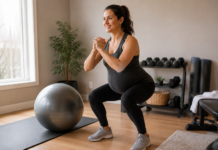
This drill grooves the actual bottom position you want—hips opened, torso tall, feet rooted—by letting you explore depth with a small counterweight. “Prying” gently moves the knees out and the hips around while you breathe into the end range, turning passive flexibility into usable squat posture. If your squat stalls just above parallel or you fold forward, this is a high-return primer right before you lift.
6.1 How to do it
- Hold a light kettlebell or plate at chest height; take your normal squat stance.
- Descend slowly into a deep squat; elbows inside knees.
- Keep heels down, chest tall, ribs stacked; breathe slowly through your nose.
- Pry gently: press elbows out against knees, shift weight side to side, rotate hips.
- Dosage: 2–3 rounds of 30–45 seconds, then stand and perform 3–5 crisp goblet squats.
6.2 Numbers & guardrails
- Depth: Hip crease below parallel without butt wink; if pelvis tucks early, limit range.
- Spine: Neutral; no jammed chin or overextended low back.
- Foot pressure: Tripod—big toe, little toe, heel.
6.3 Common mistakes
- Letting the counterweight drift away from the chest (it should help you stay tall).
- Bouncing at the bottom; prying should be gentle and controlled.
- Forcing the knees outward so far that the arches collapse.
Synthesis: Practice the position you want with breath and gentle movement, then lock it in with a few quality goblet squats.
7. Adductor Rockbacks / Frog Stretch (Groin Length with Core Control)
Tight adductors can block depth and cause knees to cave as you stand up. Quadruped rockbacks and frog variations lengthen the groin while keeping your spine neutral and your core engaged—exactly how you want to move under a bar. Many lifters feel immediate freedom in the bottom of a squat after 1–2 minutes of this drill, especially if they’ve been sitting a lot.
7.1 How to do it
- Quadruped rockback: Hands under shoulders, knees under hips; step one foot forward slightly outside the hand; rock hips back toward the heel.
- Frog: Knees wide with shins parallel; knees under or slightly behind hips; rock back and forth gently.
- Maintain ribs stacked over pelvis; keep the spine long, not rounded.
- Optional: Add a brief isometric squeeze (knees into the floor) for 5 seconds, then relax further back.
- Dosage: 2 sets of 8–10 slow rocks per side (quadruped) or 60–90 seconds (frog).
7.2 Numbers & guardrails
- Intensity: 3–4/10 stretch; no sharp inner-knee pain.
- Range: Only as far back as you can keep the spine neutral.
- Progression: Add light band pulling the hips backward to cue hinge pattern.
7.3 Common mistakes
- Arching the low back to “get lower.”
- Letting the knees drift too far outside the ankles (especially in frog).
- Holding breath—each exhale should invite a little more space.
Synthesis: Freeing the adductors makes it easier to keep knees tracking and pelvis neutral as you settle into and drive out of the hole.
8. Hip Airplanes (Single-Leg Rotation & Pelvic Control)
Hip airplanes train the small but mighty rotators and abductors that keep your knees from caving and your pelvis level in a squat. Balancing on one leg in a hinge, you rotate your pelvis around the femur, then re-center—all without losing foot pressure or spinal position. This is control in the ranges you earn from the other drills, and it pays off in heavier, cleaner reps.
8.1 How to do it
- Stand on one leg with a soft knee; hinge to ~45° while keeping a long spine.
- Open the pelvis toward the standing leg (external rotation), then close slightly (internal).
- Keep the knee tracking over the middle toes; foot tripod glued to the floor.
- Use a dowel or rack lightly for balance if needed.
- Dosage: 2–3 sets of 5–8 slow “open/close” cycles per side.
8.2 Numbers & guardrails
- Range: Small and controlled; quality > amplitude.
- Tempo: ~3 seconds to open, ~3 seconds to close; pause in center.
- Sensation: Outer-hip burn is normal; knee or back pain is not.
8.3 Common mistakes
- Rotating from the low back instead of the hip.
- Letting the arch collapse and the knee dive inward.
- Rushing—this is about control, not how far you can twist.
Synthesis: Build the rotational strength that stops knee valgus and keeps your pelvis steady, especially as loads climb.
9. Hip CARs (Controlled Articular Rotations)
CARs are slow, deliberate circles that take your hip through its full available range under muscular control. They’re perfect as a daily “joint hygiene” habit and as a warm-up bookend to keep the hips responsive. Unlike passive stretching, CARs teach your nervous system to use range actively, so it shows up when you squat.
9.1 How to do it
- Stand tall, light support from a rack or wall; brace lightly through the torso.
- Raise one knee toward chest (flexion), move out to the side (abduction), rotate in and back (internal rotation/extension), then reverse.
- Keep pelvis square and ribs stacked; move slowly with steady pressure.
- Imagine you’re “drawing” the biggest clean circle your hip can make.
- Dosage: 1–2 slow circles each direction per hip, 5–6 days per week.
9.2 Numbers & guardrails
- Tempo: 6–8 seconds per quarter of the circle; total ~24–32 seconds each way.
- Effort: 30–50% of max tension; don’t strain or compensate.
- Range: Prioritize clean control over size; no pinching or snapping.
9.3 Common mistakes
- Swaying the torso or hiking the hip to fake range.
- Rushing through sticky angles (those are the keepers).
- Holding breath; match movement to slow exhales.
Synthesis: Daily CARs maintain the range you gain from other drills and keep your hips ready to squat well anytime.
FAQs
How long should hip mobility take before squats?
Most lifters do well with 8–12 minutes: 5 minutes to raise temperature and groove bodyweight squats, then 2–3 drills for 1–2 sets each. If you’re short on time, prioritize a prying deep squat plus one rotation drill (90/90 or hip airplanes). Retest your squat after each drill and keep only what clearly helps.
Should I stretch statically or use dynamic drills before lifting?
Before strength work, emphasize dynamic drills and isometrics in the end range. Long static holds (>60 seconds per muscle) can transiently reduce force in some people, while shorter, gentle holds (≤30 seconds) aren’t likely to hurt performance and may help range. Save longer static stretching for after training or on off days.
What if I feel a pinch in the front of my hip at the bottom?
Back off the depth and test a gentle banded hip distraction plus a posterior capsule drill (pigeon/figure-4). If pinching persists or you notice a hard block, consult a clinician—structural variations like femoroacetabular impingement can limit deep flexion tolerance. You can still squat productively by adjusting stance, depth, or bar style.
Can hip mobility fix “butt wink”?
Sometimes—butt wink (posterior pelvic tilt at depth) has multiple contributors: hip anatomy, hamstring length, adductor tension, and how you brace. Improving hip rotation and adductor length helps many lifters. Also play with stance width and toe-out, elevate heels, and keep ribs stacked; your goal is a neutral pelvis through your comfortable depth.
How do I know if it’s my hips or ankles limiting depth?
Compare a bodyweight squat with heels flat versus heels elevated on plates. If depth and torso angle improve dramatically with heels up, ankle dorsiflexion is a key limiter. If little changes, hip rotation or adductor flexibility may be the bigger factor; emphasize 90/90s, Cossacks, and prying squats.
How often should I do these drills?
For maintenance, 3–4 days per week is plenty. If you’re actively chasing depth, add brief daily CARs and 1–2 focused drills on non-lifting days. Keep total time reasonable (10–15 minutes) and retest your squat frequently—dosage should be the minimum that delivers a clear benefit.
Do I need bands and kettlebells?
No. Bands and light weights can help with feel and leverage, but every drill here has a bodyweight version. If you lift regularly, a light kettlebell or plate (5–12 kg / 10–25 lb) is ideal for prying squats; a medium hip band expands your options but isn’t mandatory.
Is soreness normal after mobility work?
Mild, short-lived soreness around the hips or glutes is common as tissues adapt, especially after new isometrics or deeper ranges. Sharp joint pain, pinching, or nerve-like symptoms are not normal. Reduce intensity, shorten holds, or change drills; if symptoms persist, get assessed.
Will mobility work actually make my squat stronger?
Indirectly, yes. Mobility gives you access to better positions—upright torso, full-foot pressure, neutral pelvis—so more of your strength shows up under the bar. Pair these drills with progressive strength work (e.g., tempo squats, pauses) to turn new range into loadable capacity.
What’s a good minimalist routine for busy days?
Try 5 minutes of light cardio, 1 set of 90/90 hip switches (8/side), 1 set of adductor rockbacks (8/side), and a 30-second prying deep squat—then go straight into ramp-up sets. You’ll touch rotation, adductors, and the bottom position in under 8 minutes.
Conclusion
Better squats aren’t just about stronger legs; they’re about hips that move freely and predictably under load. The nine drills in this guide cover the major motions you need—flexion, extension, rotation, and lateral opening—while teaching your nervous system to control those ranges in positions that look and feel like your squat. Start with a quick warm-up, pick two to four drills that clearly target your sticking point, and keep intensity at a comfortable 3–4/10 stretch. Retest your squat after each drill and keep only the ones that pass the test. Over a few weeks, expect to see deeper, more stable reps, a steadier torso, and less pinching at the bottom. As you build capacity, reinforce your new ranges with tempo or pause squats and consistent, light daily hip CARs. The key is consistency: small, high-quality doses beat marathon stretch sessions every time.
Ready to start? Choose three drills, set a timer for 10 minutes, and retest your squat between sets.
References
- Behm, D. G., & Chaouachi, A. “A Review of the Acute Effects of Static and Dynamic Stretching on Performance.” European Journal of Applied Physiology, 2011. https://doi.org/10.1007/s00421-011-1879-2
- Kay, A. D., & Blazevich, A. J. “Effect of Acute Static Stretch on Maximal Muscle Performance: A Systematic Review.” Medicine & Science in Sports & Exercise, 2012. https://pubmed.ncbi.nlm.nih.gov/21659901/
- Sharman, M. J., Cresswell, A. G., & Riek, S. “Proprioceptive Neuromuscular Facilitation Stretching: Mechanisms and Clinical Implications.” Sports Medicine, 2006. https://doi.org/10.2165/00007256-200636110-00002
- Schoenfeld, B. J. “Squatting Kinematics and Kinetics and Their Application to Exercise Performance.” Strength & Conditioning Journal, 2010. https://journals.lww.com/nsca-scj/Fulltext/2010/08000/Squatting_Kinematics_and_Kinetics_and_Their.7.aspx
- Escamilla, R. F. “Biomechanics of the Squat Exercise.” Medicine & Science in Sports & Exercise, 2001. https://pubmed.ncbi.nlm.nih.gov/11194098/
- Fowles, J. R., Sale, D. G., & MacDougall, J. D. “Reduced Strength After Passive Stretch of the Human Plantarflexors.” Journal of Applied Physiology, 2000. https://pubmed.ncbi.nlm.nih.gov/10658062/
- Nepple, J. J., Zebala, L. P., Clohisy, J. C. “Labral Disease Associated with Femoroacetabular Impingement.” Clinical Orthopaedics and Related Research, 2011. https://pubmed.ncbi.nlm.nih.gov/21710246/
- American College of Sports Medicine. “ACSM Position Stand: Quantity and Quality of Exercise for Developing and Maintaining Cardiorespiratory, Musculoskeletal, and Neuromotor Fitness in Apparently Healthy Adults.” Medicine & Science in Sports & Exercise, 2011. https://pubmed.ncbi.nlm.nih.gov/21694556/
- Sato, K., Fortenbaugh, D., & Hydock, D. S. “Kinematic Changes Using Weightlifting Shoes on Barbell Back Squat.” Journal of Strength and Conditioning Research, 2012. https://pubmed.ncbi.nlm.nih.gov/22202054/
- Pappas, G. P., & Wong-Tom, W. M. “Prospective Factors for Patellofemoral Pain Syndrome.” Clinics in Sports Medicine, 2012 (context for knee tracking). https://pubmed.ncbi.nlm.nih.gov/22657993/