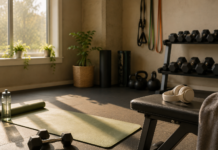



























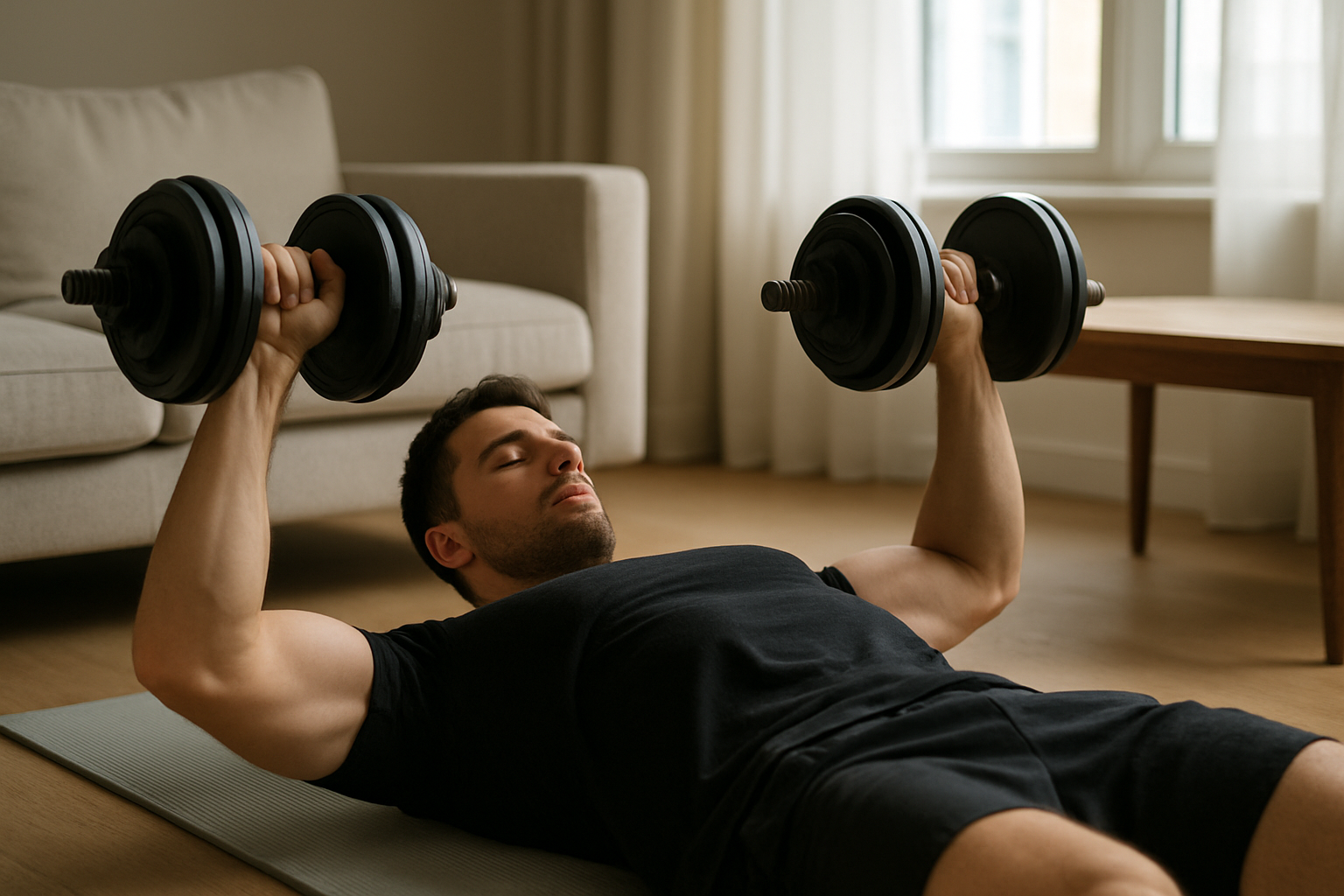
Want a strong chest, back, shoulders, and arms without a gym? These eight dumbbell routines are built for home—clear instructions, exact sets and reps, and simple progressions. If you can lift two dumbbells and have a few square meters of space, you can train effectively and safely. You’ll see options whether you’re a beginner or chasing serious muscle and strength, plus formats that fit 20-minute windows. As a quick safety note: if you have pain or a medical condition, consult a qualified professional before starting. Broad public-health guidance recommends muscle-strengthening at least twice weekly for adults; the plans below fit that target.
What is an “upper body home workout with dumbbells”?
A structured session using only dumbbells to train the chest, back, shoulders, and arms—typically 6–10 total sets per muscle group weekly, scaled by experience and goals. Loads can be light or heavy; hypertrophy is attainable across a wide range if sets are taken near technical failure.
Fast start (this week):
- Pick 2–3 routines below and alternate them on two non-consecutive days.
- Use loads that reach an RPE 7–9 (or 1–3 Reps In Reserve).
- Rest 60–120 seconds for muscle gain; 2–3+ minutes for strength emphasis.
- Add 1–2 total reps or 1–2 kg per side weekly until progress slows.
1. Beginner Upper-Body Foundations (All-in-One Circuit)
If you’re starting out or returning after a break, this circuit builds skill, endurance, and muscle with minimal setup. Do it when you want one simple sequence that hits chest, back, shoulders, and arms without a bench or rack. You’ll cycle through six movements with controlled tempos, moderate rests, and conservative loading so your joints and tendons adapt. Expect to sweat—circuits elevate heart rate—but the true aim is learning stable positions and clean reps. Keep a rep or two “in the tank” (RPE ~7) on early weeks, then push toward RPE 8–9 as technique solidifies. This format also teaches you to move between pushes and pulls, which balances stress across the shoulder girdle and helps posture over time. As you repeat it twice weekly, you’ll accumulate 12–20 quality sets across key muscles—enough for clear progress while you master form.
How to do it
- Circuit (3 rounds):
- Dumbbell Floor Press — 10–12 reps
- One-Arm Dumbbell Row (tripod stance) — 10–12/side
- Seated Overhead Press — 8–10 reps
- Hammer Curl — 10–12 reps
- Overhead Triceps Extension — 10–12 reps
- Bent-Over Reverse Fly — 12–15 reps
- Tempo: ~2 seconds down, 1 second up; pause 1 second at the bottom on rows.
- Rest: 45–75 seconds between exercises; 2 minutes between rounds.
Numbers & guardrails
- Load: Start with weights you could lift for ~2 more reps than prescribed (RIR 2). Move up when you exceed the top rep target with RIR ≤1.
- Weekly plan: 2 sessions (e.g., Mon/Thu).
- Common mistakes: Rushing the eccentric, flaring elbows on presses, shrugging during rows.
- Mini-checklist: Neutral wrist; ribs down on presses; hinge from hips on reverse fly.
Close the round feeling challenged but tidy. When you can complete all three rounds at the top end of the rep ranges, add 1–2 kg per dumbbell and repeat.
2. Push-Focused Hypertrophy (Chest, Triceps, Front/Side Delts)
Use this when your priority is pushing strength and visible growth through the chest, triceps, and anterior/medial delts. You’ll train moderate-to-high reps with short-to-moderate rests, emphasizing constant tension and solid lockouts. This session works even without a bench—floor presses prevent excessive shoulder extension and are shoulder-friendly for many lifters. Pairing multi-joint presses with isolation for delts and triceps maximizes stimulus without demanding huge loads. Don’t overthink angles; with dumbbells, a neutral or slight diagonal press path often feels strongest and wrist-friendly. Keep scapulae pulled back and down at setup, then allow natural movement as you press. Select loads that get hard around reps 8–15 and finish sets within 0–2 reps of technical failure to drive muscle gain efficiently.
How to do it
- A1. Dumbbell Floor Press — 4×8–12, rest 90s
- B1. Standing or Seated Overhead Press — 3×8–12, rest 90s
- C1. Dumbbell Squeeze Press (light, slow) — 3×12–15, rest 60s
- D1. Lateral Raise — 3×12–15, rest 60s
- E1. Overhead Triceps Extension or Kickback — 3×10–14, rest 60s
Numbers & guardrails
- Tempo: 2–3 sec down on presses; full stop on floor; smooth drive up.
- Intensity: RPE 7–9; last set of A1 and B1 may reach RPE 9.
- Progression example (4 weeks): +2 total reps per lift weekly; in Week 4, increase each dumbbell by 2 kg and reset reps to the low end.
- Rest guidance: 60–120s between hypertrophy sets is sufficient for most (extend to 2–3 min if performance drops).
Finish with triceps that feel pumped yet elbows happy. If shoulders pinch during overhead moves, swap in neutral-grip landmine-style presses (half-kneeling) or reduce range to pain-free angles; consult a clinician if symptoms persist.
3. Pull-Focused Hypertrophy (Back Thickness, Rear Delts, Biceps)
Choose this when your goal is a stronger back and better posture. Rows build lats and mid-back; rear-delt work balances all the pressing you do; curls finish the elbow flexors. You’ll use stable positions that don’t require a bench—tripod rows and chest-supported setups (lying face-down on pillows or a low ottoman) reduce low-back fatigue so you can focus on pulling. Keep your ribs down, hinge at the hips, and drive elbows toward your back pockets; think “wrap lats around the spine” to avoid shrugging. Keep wrists neutral on curls and rows. Sets should land within 1–2 reps of failure in the 8–15 range to stimulate hypertrophy, regardless of whether your dumbbells are light or heavy.
How to do it
- A1. One-Arm Dumbbell Row (tripod stance) — 4×8–12/side, rest 75–90s
- B1. Chest-Supported Dumbbell Row (prone on cushions) — 3×10–12, rest 75–90s
- C1. Rear-Delt Raise or Rear-Delt Row — 3×12–15, rest 60s
- D1. Hammer Curl — 3×10–14, rest 60–75s
- E1. Incline or Cross-Body Curl (slow) — 2×12–15, rest 60s
Numbers & guardrails
- Tempo: Pause 1 second at chest/hip contact on rows; 2-sec negatives on curls.
- Grip: Try neutral grips to spare elbows and forearms.
- Common errors: Pulling straight up (trap-dominant), over-rounding the back, yanking with momentum.
- Resource for cues: See technique notes for dumbbell rows and rear-delt variations.
End with the feeling of your mid-back doing the work—not your lower back or biceps alone.
4. Shoulder & Posture Rebuild (Joint-Friendly)
Run this when you need a careful, joint-friendly upper-body day: think desk-bound neck/shoulder tightness, previous impingement, or “clicky” overhead work. The goal is controlled range, light loads, and lots of scapular motion—less ego, more quality. You’ll pair lighter front-plane work (scaption, external rotation) with supported presses and pulls. Move in pain-free arcs only; if a movement pinches, adjust angle or swap it out. Don’t chase maximal pump here—chase smooth reps and better position. Over time, many people tolerate more overhead work after restoring scapular upward rotation and rotator cuff endurance. If pain persists or worsens, stop and seek an evaluation from a clinician.
How to do it
- A1. Half-Kneeling Neutral-Grip Press (light) — 3×10–12, rest 75–90s
- B1. Scaption Raise (thumbs up, 30° forward) — 3×12–15, rest 60s
- C1. Chest-Supported Row (light, long pause) — 3×12–15, rest 75s
- D1. External Rotation (tucked elbow or side-lying) — 3×12–15/side, rest 45–60s
- E1. Face Pull with Dumbbells (bent-over) — 2–3×12–15, rest 60s
Numbers & guardrails
- Tempo: 3-sec negatives; 1-sec pause in the “shoulder-blades-together” position.
- Intensity: RPE 6–8; stop well before pain.
- Mini-checklist: Tall neck; ribs down; no shrugging; elbows under wrists when pressing.
This day should leave you feeling better than when you started—looser mid-back, calmer shoulders, and no sharp discomfort. If symptoms flare routinely, get personalized guidance. Hospital for Special Surgery
5. 20-Minute EMOM (Time-Crunched Upper Body)
This is your “no time, no problem” workout. EMOM (“every minute on the minute”) alternates short bursts of work with built-in rest; it’s simple, time-boxed, and sneaky effective. You’ll complete a set at the top of each minute, then rest the remainder. The trick is choosing reps that take ~30–40 seconds so you have ~20–30 seconds to recover. Because the clock enforces density, keep loads modest and technique strict. This won’t replace heavier training forever, but on busy days it preserves skill, keeps volume ticking upward, and delivers a pleasant burn. Have a timer ready and pre-stage your dumbbells so transitions stay crisp.
How to do it
- 20 minutes total:
- Odd minutes: Dumbbell Floor Press — 8–10 reps
- Even minutes: One-Arm Row — 8/side
- Minutes 11 & 12: Overhead Press — 8–10 reps
- Minutes 13 & 14: Hammer Curl — 10–12 reps
- Minutes 15 & 16: Overhead Triceps Extension — 10–12 reps
- Minutes 17–20: Cycle presses/rows for 4 more rounds at 6–8 reps
Numbers & guardrails
- Load: Pick weights you could do for ~12–14 reps fresh; EMOM fatigue will pull you to RPE 8–9 by the end.
- Progression: Add 1 rep to presses and rows next time, then 1–2 kg per dumbbell.
- Rest strategy: Sit, breathe through the nose, shake arms; extend a minute if form crumbles.
A tight schedule shouldn’t derail training—this format keeps you consistent and honest, and it scales well with travel or small spaces.
6. Strength-Biased Low-Rep Day (Heavier Dumbbells, Longer Rests)
Use this when you have heavier dumbbells and want to nudge pure strength. You’ll work in the 4–6 rep range on big presses and rows with long rests. Expect slower bar speeds, tighter bracing, and fewer total sets than a hypertrophy day. Strength loves patience; you’ll rest 2–3 (sometimes 4) minutes between the main sets to let phosphocreatine replenish so the next set stays crisp. Heavier loading is particularly valuable for maximal strength gains, while muscle size can still grow across a spectrum of loads when effort is high.
How to do it
- A1. Dumbbell Floor Press (heavy) — 5×4–6, rest 2–3+ min
- B1. One-Arm Dumbbell Row (heavy) — 5×4–6/side, rest 2–3 min
- C1. Z-Press (seated on floor, strict) — 3×5–6, rest 2–3 min
- D1. Curl Variation (EZ tempo) — 3×6–8, rest 90s
- E1. Triceps Extension (2-sec pause) — 3×6–8, rest 90s
Numbers & guardrails
- Warm-up: 2–3 ramping sets up to working load.
- Intensity: RPE 7–9 on top sets; stop before grinding form breaks.
- Progression: Add ~1–2 kg per dumbbell when you hit all sets × reps clean.
- Rest evidence: Longer rests support strength and can aid hypertrophy when volume is equated.
This day is about precision. Take your time, protect positions, and enjoy the feeling of moving heavier loads with confidence.
7. No-Bench Upper Body (Floor-Only Solutions)
No bench? No problem. The floor is a built-in range-of-motion limiter for presses and pullovers, which can be shoulder-friendly while still delivering high tension. Rows, raises, and curls need nothing more than a hinge or a hip-supported stance. You’ll emphasize setups that avoid awkward furniture contortions and keep dumbbells close to the body. Expect moderate reps and pauses where needed. Pairing pullovers with rows gives a “lengthened” lat stimulus and a mid-back squeeze in one session. Keep elbows ~45° on presses and let the triceps share the load.
How to do it
- A1. Floor Press (neutral or 45° grip) — 4×8–12, rest 90s
- B1. Dumbbell Pullover (floor, hips down) — 3×10–12, rest 75–90s
- C1. One-Arm Row (tripod) — 3×8–12/side, rest 75–90s
- D1. Rear-Delt Raise — 3×12–15, rest 60s
- E1. Curl Superset: Alternating Curl 10–12 + Hammer Curl 10 — 2 rounds, rest 60–75s
Numbers & guardrails
- Tempo: 2–3 sec down on presses and pullovers; squeeze at the bottom of rows.
- Substitution: Swap B1 for chest-supported row if pullovers bother shoulders.
- Technique resources: Form notes for lying/bench-supported rows are useful cues you can apply to floor setups.
This minimalist day proves you don’t need extra furniture to train well—just consistent effort and tidy mechanics.
8. Unilateral & Core-Stability Focus (Anti-Rotation Strong)
Run this when you want to fix side-to-side imbalances, bulletproof your trunk, and make pressing and rowing feel more connected. Single-arm pressing and rowing challenge your core to resist rotation, which improves transfer to everyday tasks and heavier lifts. You’ll use half-kneeling and split-stance positions to level hips and stack ribs over pelvis. Expect slightly lighter loads than bilateral work but very high local tension. Your brace should feel like “zip up the abs and belt the ribs down,” not a breath-holding contest. Keep shoulders away from ears, exhale gently on the effort, and let the obliques do their job.
How to do it
- A1. Half-Kneeling One-Arm Overhead Press — 4×8–10/side, rest 75–90s
- B1. Split-Stance One-Arm Row — 4×8–12/side, rest 75–90s
- C1. Single-Arm Floor Press (pause) — 3×8–12/side, rest 75–90s
- D1. Cross-Body Curl — 3×10–12/side, rest 60–75s
- E1. Single-Arm Overhead or Skull-Crusher Extension — 3×10–12/side, rest 60–75s
- Optional Finisher: 2–3×30–45-second suitcase hold or carry per side (if space allows)
Numbers & guardrails
- Intensity: RPE 7–9; if your torso twists or ribs flare, reduce load.
- Progression: Add reps first, then weight; aim to match left/right totals each week.
- Checklist: Front knee stacked over ankle; packed shoulder; exhale on the way up.
You’ll finish feeling “locked in” from hips to hands—exactly what unilateral work should deliver.
FAQs
1) How many days per week should I train my upper body at home?
Most people do well with 2 days per week for upper body, especially when starting, ensuring at least one rest day between similar sessions for recovery. As you adapt, add a third day or increase volume within sessions. Public-health guidance recommends muscle-strengthening on 2+ days weekly; these templates satisfy that while leaving room for walks or cardio on other days.
2) What dumbbell weight should I buy for home?
Pick a range that lets you press for 8–12 clean reps and row for 10–15. If budget allows, adjustable dumbbells covering roughly 5–32 kg (10–70 lb) per hand will carry most lifters from beginner to advanced. If you only have light bells, chase higher-rep sets near failure to grow muscle; hypertrophy can occur across loads when effort is high.
3) How should rest times change for strength vs. muscle gain?
For strength, rest 2–3+ minutes between hard sets, especially on presses and rows. For hypertrophy, 60–120 seconds works for most exercises, extending rest if performance nosedives. Longer rests help preserve output and may improve size gains when total work is equated.
4) Do I need a bench for an effective dumbbell upper-body workout?
No. The floor press limits risky shoulder extension while letting you press heavy enough to stimulate growth. Combine floor presses with rows, pullovers, raises, and arm work for a complete session. Many lifters find floor-only days more shoulder-friendly and just as productive with smart progressions.
5) What’s RPE or “Reps In Reserve,” and how do I use it at home?
RPE (or RIR) estimates how many reps you had left before technical failure—e.g., RIR 2 means you could have done two more clean reps. Aim for RIR 1–3 (RPE 7–9) on most sets to balance stimulus and recovery. It’s a practical way to auto-adjust for good and bad days without fancy equipment.
6) Are light dumbbells enough to build muscle?
Yes—if you take sets close to failure and do enough total work weekly. Evidence shows hypertrophy is similar across a broad loading range, with heavier loads better for max strength. If your bells are light, push reps to 15–30 and slow the negatives to raise time under tension.
7) My shoulders feel pinchy on overhead work. What should I change?
Stay in pain-free ranges, try neutral-grip pressing, reduce load, and increase scaption/rear-delt work. Half-kneeling presses and chest-supported rows are friendlier for many. If symptoms persist, seek a qualified assessment; targeted exercises often help subacromial irritation.
8) How do I progress these routines over months?
Add reps first, then load, and finally sets if recovery allows. A simple pattern: add 1–2 total reps per movement weekly; when you hit the top of the range for all sets, increase each dumbbell by 1–2 kg and reset reps to the low end. Every 4–8 weeks, deload by cutting volume or intensity by ~30%.
9) Can I combine these with running or cycling?
Absolutely. Keep two upper-body days (e.g., Mon/Thu) and sprinkle cardio on other days. If fatigue affects pressing/rowing, insert an extra rest day or shorten cardio the day before strength. Meeting weekly aerobic and strength targets is the long-term win.
10) What if I only have 20 minutes?
Use the EMOM template. Keep reps modest (6–10), choose loads you could do for ~12–14 fresh, and run 20 minutes total. You’ll maintain skill, accumulate meaningful volume, and keep the habit alive on the busiest days.
11) Is there an optimal rep range for arms?
Triceps and biceps grow across 6–20+ reps when sets approach failure. Use lower reps (6–10) if you have heavy bells and your elbows tolerate it; use 10–15+ with lighter bells and slower negatives to reduce joint stress while keeping tension high. Evidence supports hypertrophy across loading ranges with high effort.
12) How much total upper-body volume should I aim for weekly?
Start around 10–14 hard sets per major upper-body muscle group per week, split across 2–3 sessions. Adjust up or down based on recovery and progress. More isn’t always better; the best volume is the minimum that reliably produces strength or size gains you can recover from.
Conclusion
A great Upper Body Home Workout with Dumbbells doesn’t require a bench, a rack, or hours of free time—just consistent effort and a plan that matches your goals. Across these eight routines, you have beginner-friendly circuits, hypertrophy-focused push/pull days, a shoulder-kind option, a brutally efficient 20-minute EMOM, a heavy low-rep strength day, and minimalist floor-only or unilateral templates. The thread connecting them is simple: pick smart positions, take sets close to technical failure, rest appropriately for your goal, and progress either reps or load each week. With those basics in place—and the flexibility to swap movements that feel better for your joints—you’ll steadily add muscle, strength, and confidence, all from your living room.
Ready to lift? Pick two routines and schedule them for the next seven days—then show up.
References
- Adult Activity: An Overview | Physical Activity Basics — Centers for Disease Control and Prevention (CDC). Updated December 20, 2023. CDC
- What You Can Do to Meet Physical Activity Guidelines — CDC. Updated April 16, 2024. CDC
- World Health Organization 2020 Guidelines on Physical Activity and Sedentary Behaviour — WHO. Published November 25, 2020. World Health Organization
- American College of Sports Medicine Position Stand: Progression Models in Resistance Training for Healthy Adults — Medicine & Science in Sports & Exercise. March 2009. PubMed: PubMed
- A Brief Review: Factors Affecting the Length of the Rest Interval Between Resistance Exercise Sets — Journal of Strength and Conditioning Research. 2006. Lippincott Journals
- How to Manipulate Rest Intervals to Maximize Strength Training Effectiveness — NSCA, Personal Training Quarterly 10(1), 2023. NSCA
- Low-Load vs. High-Load Resistance Training: A Systematic Review and Meta-Analysis — Schoenfeld BJ et al., 2017. PubMed: PubMed
- The Effects of Low-Load vs. High-Load Resistance Training on Muscle Fiber Hypertrophy — Grgic J. et al., 2020. PMC: PMC
- Shoulder Impingement Syndrome: Symptoms & Treatment — Hospital for Special Surgery (HSS). Updated March 17, 2025. Hospital for Special Surgery
- Reps in Reserve (RIR): What You Need to Know — National Academy of Sports Medicine (NASM). Accessed 2025. NASM Blog
- Dumbbell Bent-Over Row — ExRx.net. Accessed 2025. exrx.net
- Dumbbell Lying Row — ExRx.net. Accessed 2025. exrx.net