






















A full-body circuit workout at home strings several movements back-to-back with minimal rest so you can train strength, cardio, and core in one efficient session. You’ll rotate through 5–8 exercises that cover major patterns—squat, hinge, push, pull, carry/locomotion, and trunk—rest briefly, then repeat for 3–5 rounds. Done right, circuits are time-smart, scalable, and require little or no equipment. This guide shows you eight practical ways to plan, set up, and progress your circuits—whether you’re new to training or dialing in a competitive engine. Quick note: if you have a medical condition, are pregnant, or returning from injury, consult a qualified professional first and keep intensity moderate until cleared.
Fast definition: A home circuit is a sequence of exercises performed consecutively with planned work and rest intervals to train multiple fitness qualities in minimal space.
Quick-start steps: pick 6 moves → set 30–45 seconds work/15–30 seconds rest → run 3–4 rounds → keep effort at RPE 7–8/10 → cool down and hydrate.
1. Start With a Simple Circuit Structure (Work, Rest, Rounds)
Begin with a straightforward timing scheme: 30–40 seconds of work followed by 20–30 seconds of rest per exercise, for 3–4 total rounds. This structure is easy to learn, easy to scale, and balances effort with quality reps so you don’t fry your form. For most people, six exercises at 30:20 or 40:20 yields 18–24 working minutes—enough to raise heart rate, build muscular endurance, and feel accomplished without dragging on. Treat your first two sessions as calibration: adjust work or rest by ±10 seconds to land at an intensity you could sustain one more round if you had to.
1.1 Why it works
A consistent “clock” removes decision fatigue and maintains pace. By keeping rest short but present, you preserve movement quality, reduce dizziness from constant positional changes, and keep your reps crisp.
1.2 Numbers & guardrails
- Work: 30–45 seconds per station (or 8–15 controlled reps).
- Rest: 15–30 seconds between stations; 60–90 seconds between rounds.
- Rounds: 3 for beginners, 4–5 for intermediates, 5+ only if technique stays clean.
- RPE: Aim 7–8/10—breathing hard but conversational in short phrases.
- Time cap: 30–40 minutes total including warm-up and cool-down.
Mini-checklist
- Set a repeating timer on your phone or a gym-timer app.
- Pre-write your sequence and keep it visible.
- Stop each interval with 1–2 reps “in the tank.”
Close your structure with a 60–90 second reset after each round to sip water, breathe through the nose, and scan technique for the next pass.
2. Choose Compound Moves That Cover Every Major Pattern
Select multi-joint exercises that hit large muscle groups and movement patterns so one circuit truly trains your whole body. A balanced set looks like this: squat (lower push), hinge (posterior chain), horizontal push (e.g., push-up), horizontal pull (e.g., row), lunge or step (unilateral control), core anti-extension/anti-rotation, and locomotion/carry (heart rate and grip). When possible, favor variations you can scale easily at home—bodyweight first, then add a backpack, bands, or dumbbells.
2.1 How to build a 6-station base circuit
- 1. Squat: bodyweight squat → goblet squat (backpack/dumbbell).
- 2. Hinge: hip hinge/good morning → banded RDL → backpack deadlift.
- 3. Push: incline push-up (hands on table) → floor push-up → decline push-up.
- 4. Pull: backpack row → band row → table row (supported) or door-anchor towel row*.
- 5. Lunge/step: alternating reverse lunge → split squat → rear-foot elevated split squat.
- 6. Core: dead bug → high-plank shoulder taps → hollow hold or side plank.
*Use a solid hinge/anchor at hip height and test with bodyweight before loading; never yank on a door you can’t lock.
2.2 Common mistakes
- Too many isolation moves. Curls and crunches can live in a “finisher,” but let compounds drive the session.
- Pattern gaps. Skipping pulls or hinges leads to shoulder or low-back crankiness.
- Always bilateral. Include at least one single-leg or single-arm move each circuit.
A thoughtful spread of patterns keeps workloads even and joints happy while delivering more training effect per minute.
3. Set Smart Work-to-Rest Ratios (and When to Use EMOM, AMRAP, or Tabata)
Match your timing to your goal: use 1:1 or 2:1 work-rest (e.g., 30:30 or 40:20) for general fitness; choose EMOM (“every minute on the minute”) for strength-skill practice; try AMRAP (“as many rounds as possible”) for a conditioning challenge; deploy Tabata (20:10 × 8) sparingly as a short, intense finisher. The ratio controls how much you can do while keeping quality high and fatigue in check.
3.1 Quick prescriptions
- General fitness: 30:30 or 40:20, 6 stations × 3–4 rounds (18–24 minutes work).
- Strength-skill EMOM (10–15 min): Minute 1: 8 goblet squats; Minute 2: 6–8 push-ups; Minute 3: 10 band rows; repeat. Rest is what’s left within each minute.
- AMRAP 12–15: 8 squats, 6 push-ups, 10 rows, 8 reverse lunges/leg, 20-second plank; loop with steady pace.
- Tabata finisher (4 min): alternating mountain climbers and squat jumps, focusing on crisp reps.
3.2 Numbers & guardrails
- Work windows: Shorter intervals (20–30 s) favor power and speed; longer (40–60 s) favor endurance and mind-muscle control.
- Rest windows: If form breaks, extend rest by 10–15 seconds per station.
- Heart rate feel: You should recover to nasal breathing within 60–90 seconds between rounds.
Choose a scheme that fits your space and mood for the day; the “best” ratio is the one that lets you hit perfect reps consistently.
4. Set Up Your Space and Minimal Gear for Seamless Flow
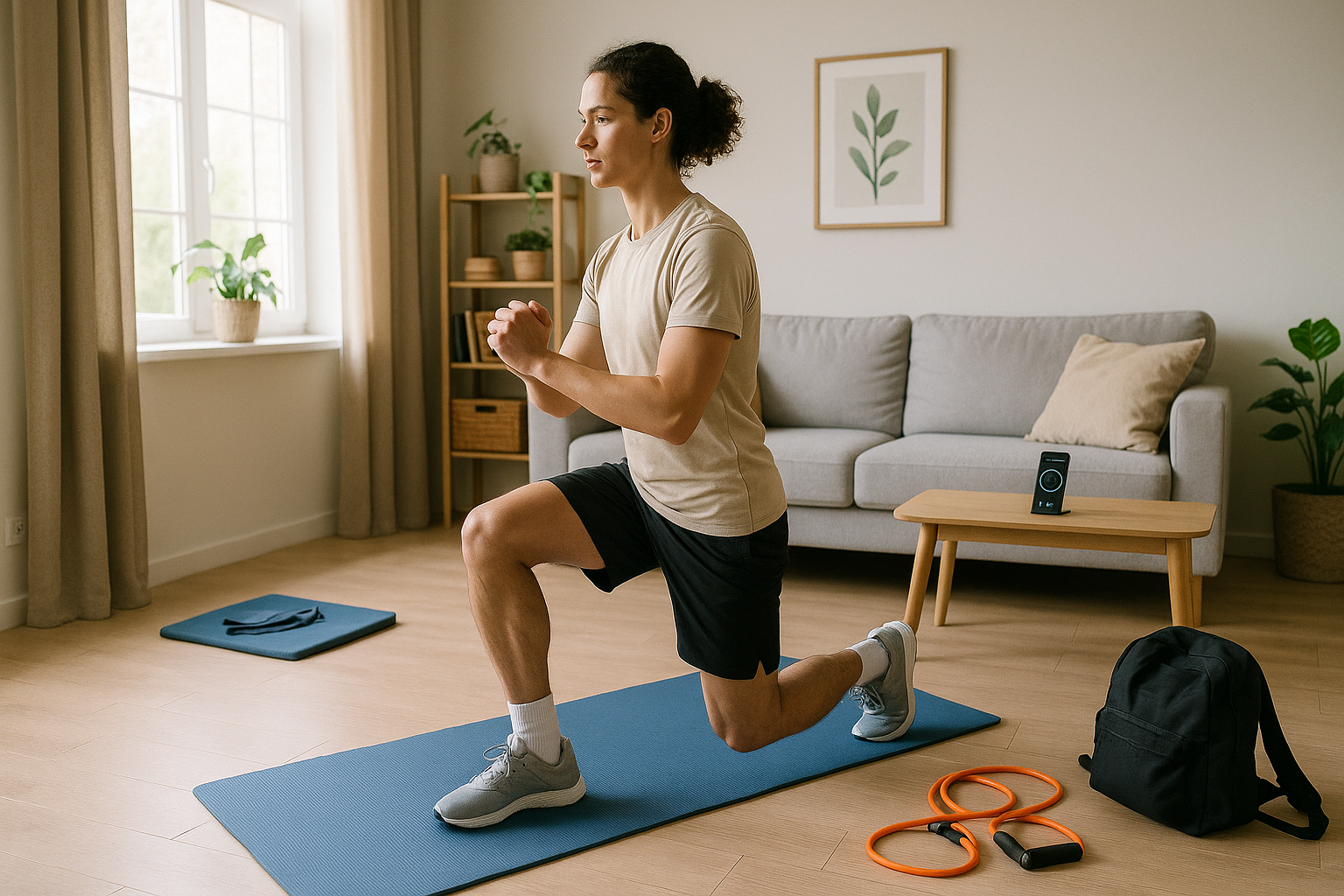
Arrange your room so transitions are fast and safe. You need roughly a 2 m × 2 m (6½ ft × 6½ ft) clear square, one non-slip surface (yoga mat or rug on stable flooring), and your timer within arm’s reach. Minimal gear extends options without clutter: a long light-to-medium resistance band, a sturdy backpack you can load to 5–15 kg (10–35 lb), and, if available, a single 10–20 kg (20–45 lb) dumbbell or kettlebell. Keep a small towel and water nearby, and position fans or windows for airflow if you train in a warm climate.
4.1 Setup tips
- Station staging: Place the mat centrally for floor work; stand pulls and squats to the sides to avoid collisions.
- Backpack loading: Use books, rice, or water bottles; stuff with a towel to prevent shifting.
- Band anchoring: Loop around a pillar, heavy sofa leg, or closed door with a commercial door anchor; test before work sets.
- Footwear: Barefoot or grippy trainers for stability; avoid socks on slick floors.
- Noise control: Choose low-impact substitutes (step-back instead of jump) in apartments.
4.2 Mini-checklist
- Clear obstacles and cords.
- Pre-select alternatives for each move (e.g., push-up ↔ incline push-up).
- Test one rehearsal round at half speed to ensure flow.
A tidy, staged space eliminates friction; when transitions are effortless, your circuit feels smoother and safer—and you get more out of every minute.
5. Warm Up With the RAMP Method and Prime the Patterns
Use a brief, purposeful warm-up so your first working reps already look good. The RAMP framework—Raise temperature and heart rate, Activate key muscles, Mobilize joints through range, and Potentiate with short, sharper reps—fits home training perfectly. In 6–8 minutes, you can elevate body temp, open hips and shoulders, and groove the exact patterns you’ll use in the circuit.
5.1 8-minute RAMP example
- Raise (2 min): brisk march in place → high knees → arm swings.
- Activate (2 min): glute bridge (10–12), dead bug (6–8/side), band pull-apart (12–15).
- Mobilize (3 min): world’s greatest stretch (3/side), ankle rocks (10), thoracic rotations (6/side).
- Potentiate (1 min): 2 rounds of 4 squat jumps (or fast bodyweight squats), 4 quick push-ups, 6 fast band rows.
5.2 Guardrails
- Keep warm-up effort at RPE 4–5/10; you should feel warm but not taxed.
- Match mobility to what you plan to train—extra hip work on lunge days.
- In hot weather, shorten Raise; in cold rooms, extend it by 1–2 minutes.
A targeted warm-up reduces injury risk, improves coordination, and makes your first interval the best one—not a throwaway set.
6. Scale, Substitute, and Progress Without Losing Form
Progress comes from doing a little more or a little better, week by week. Scale moves to your current level and progress one variable at a time—range, tempo, load, or density. When fatigue blurs technique, switch to a nearby regression to keep quality high without stopping the circuit.
6.1 Progression levers
- Range: Half squat → parallel squat → full depth within comfort.
- Tempo: 2–0–2 (down-pause-up) → 3–1–1 to increase time under tension.
- Load: Add 1–2 kg (2–5 lb) to a backpack or hold the bag closer to the chest.
- Density: Keep moves the same but reduce rest from 30 s to 20 s, or add one round.
6.2 Regression menu (by pattern)
- Push: incline push-up (hands on bench/table) → floor → knees down in last 10 seconds.
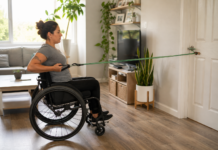
- Pull: switch to lighter band or single-arm band row if anchor height changes.
- Hinge: good morning (hands on hips) if low-back fatigues in backpack RDL.
- Lunge: step-back instead of jump; shorten stride if balance wobbles.
6.3 Mini case
Week 1: 6 stations × 30:30 × 3 rounds, RPE ~7.
Week 2: same moves at 35:25.
Week 3: add 1 kg to backpack and return to 30:30.
Week 4: 4 rounds at 30:30 if technique holds.
By nudging a single dial at a time, you maintain control, accumulate volume safely, and see steady improvements you can feel.
7. Coach-Designed Sample Circuits for Different Goals and Gear
Plug these plug-and-play templates into your week. Each fits a 25–35 minute window including warm-up and cool-down. Swap any move for a neighbor in the same pattern if needed.
7.1 No-equipment strength-endurance (30:20 × 4 rounds)
- Squat → 2) Incline push-up → 3) Good morning/hip hinge → 4) Reverse lunge → 5) Prone W-raise (squeeze shoulder blades) → 6) Side plank (20 s/side).
Tip: Elevate hands on a chair to keep push-ups crisp.
7.2 Band & backpack total body (40:20 × 3–4 rounds)
- Goblet squat (backpack) → 2) Band row → 3) Glute bridge march → 4) Push-up → 5) Split squat → 6) Hollow hold or dead bug.
Tip: If rows feel easy, step farther from the anchor for tension.
7.3 Conditioning bias—AMRAP 15
8 backpack squats, 8 push-ups, 10 band rows, 8 reverse lunges/leg, 20-second plank. Loop with even breathing; count completed rounds.
Guardrail: Stop each set 1–2 reps shy of form breakdown.
7.4 Power finisher—Tabata (4 minutes)
Alternate squat jumps (or fast squats) and mountain climbers 20:10 × 8.
Note: Use as a finisher 1–2×/week; prioritize soft landings and quiet feet in apartments.
Each template respects pattern balance, intensity control, and home realities—small space, minimal gear, and mixed goals.
8. Program Your Week, Recover Well, and Track What Matters
Aim for 2–4 circuit sessions per week depending on schedule and recovery. Pair circuits with walks or easy cardio and sprinkle mobility on non-training days. Recovery makes the work “stick”: prioritize sleep, protein with meals, and light movement to flush fatigue. Track a few simple metrics so you know when to nudge intensity or back off.
8.1 Weekly layouts
- Beginner (3 days): Mon—Circuit A; Wed—Mobility + walk; Fri—Circuit B.
- Intermediate (4 days): Mon—Strength-bias circuit; Tue—Zone-2 cardio (20–30 min); Thu—Circuit; Sat—AMRAP/finisher.
- Busy week (2 days): Tue & Fri—30:20 × 4 rounds; add 10-minute walks most days.
8.2 Recovery & readiness cues
- Sleep: 7–9 hours where possible.
- Soreness: Mild (≤3/10) is fine; if heavy, repeat last week or reduce one round.
- Hydration: Sip water before/during; add electrolytes in hot, humid climates.
- Protein: Include 20–40 g with meals; spread across the day.
8.3 What to track
- Session RPE (1–10), total rounds completed, best/worst-feeling movement.
- Heart-rate recovery (breathing through the nose within 60–90 s between rounds).
- Notes on substitutions that kept technique solid.
A simple plan you’ll follow beats a perfect plan you won’t; build momentum with consistent, repeatable weeks and adjust with the data you collect.
FAQs
How long should a full-body circuit workout at home last?
Most effective home circuits take 25–40 minutes including a short warm-up and cool-down. The working portion is typically 18–24 minutes (e.g., 6 stations × 30–40 seconds × 3–4 rounds). Shorter can work if intensity is high, but beginners should favor slightly longer rest to keep technique clean and joints happy.
Is circuit training the same as HIIT?
They overlap but aren’t identical. Circuit training organizes exercises back-to-back to cover patterns or muscles; intensity can range from easy to hard. HIIT is specifically high-intensity intervals near your max effort with planned recoveries. You can run a circuit at HIIT intensity, but many home circuits are moderate-to-hard, not all-out, which is often safer and more sustainable.
Can I build muscle with home circuits, or is it just cardio?
You can build or maintain muscle if you use compound moves, control tempo, and push sets close to technical failure while keeping form. Progress by adding load (heavier backpack or band), slowing the lowering phase, or adding a fourth round. Pair with adequate protein and sleep for best results.
What’s the best equipment to buy first?
Start with a long resistance band (light-to-medium) and a loadable backpack; both are inexpensive and versatile. Next, add a single dumbbell or kettlebell in the 10–20 kg (20–45 lb) range to open up goblet squats, weighted hinges, and carries. You don’t need a full home gym to get strong.
How many days per week should I do circuits?
Most people thrive on 2–4 sessions weekly with at least one rest or light-cardio day between harder circuits. If you’re new, start with two days, then add a third after two consistent weeks. If you also run or cycle, cap circuits at two hard days to balance recovery.
What if my knees or back hurt during certain moves?
Pain is a stop sign, not a challenge. Swap the pattern rather than pushing through—e.g., replace jump squats with step-back lunges, or backpack RDLs with hip bridges. Shorten ranges, slow tempo, or reduce load and see a clinician if pain persists. The goal is training longevity, not a single “hero” set.
Should I do circuits fasted or after eating?
Both can work, but many people feel stronger 1–3 hours after a balanced meal including protein and carbs. If training fasted, keep intensity moderate and sip water; consider a small snack (like fruit) if you feel light-headed. Post-session, eat a normal meal to support recovery.
How do I warm up if I’m short on time?
Use a 6-minute RAMP: 90 seconds of brisk marching/high knees; 90 seconds of glute bridges and dead bugs; 2 minutes of mobility (hips, thoracic spine, ankles); 60 seconds of faster practice reps (squats, push-ups, rows). A focused warm-up beats a long, unfocused one.
Can seniors or beginners do home circuits safely?
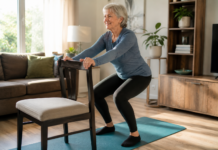
Yes—with lower impact moves, longer rests, and stable supports (e.g., chair for sit-to-stand squats, incline push-ups on a counter, band rows seated). Keep RPE at 6–7/10 and prioritize balance and control. Progress by adding reps or rounds before adding load.
How do I combine circuits with running or cycling?
Separate your hardest efforts by at least 24 hours. Pair steady-state cardio (easy runs, Zone-2 rides) with strength-bias circuits on alternate days. If same-day is your only option, perform strength circuits first when fresh, then finish with 15–20 minutes of easy cardio.
Conclusion
You don’t need a big gym, expensive gear, or complex programming to train your whole body effectively at home. With a clear structure, balanced movement selection, and a few smart timing schemes, circuits can deliver strength, stamina, and confidence in 30–40 minutes, several days a week. Start with a simple six-station layout, warm up with RAMP, and aim for crisp reps at a steady RPE rather than chasing exhaustion. Progress one dial at a time—range, tempo, load, or density—and keep an eye on recovery so each week builds on the last. Use the sample circuits as ready-made templates, then customize based on your space, equipment, and preferences. Your goal isn’t perfection; it’s repeatable, high-quality sessions that fit real life.
Ready to move? Pick a template above, set your timer, and start your first round today.
References
- Guidelines on Physical Activity and Sedentary Behaviour, World Health Organization, 2020. https://www.who.int/publications/i/item/9789240015128
- How much physical activity do adults need?, Centers for Disease Control and Prevention, 2024. https://www.cdc.gov/physicalactivity/basics/adults/index.htm
- Quantity and Quality of Exercise for Developing and Maintaining Fitness, American College of Sports Medicine Position Stand, 2011. https://www.acsm.org/resource-library/position-stands
- Benefits of exercise and how to warm up, NHS (UK), 2023. https://www.nhs.uk/live-well/exercise/how-to-warm-up-before-exercising/
- What Is Circuit Training?, American Council on Exercise, 2014 (updated). https://www.acefitness.org/education-and-resources/lifestyle/blog/543/what-is-circuit-training/
- Dynamic Warm-Up and the RAMP Method, National Academy of Sports Medicine, 2022. https://blog.nasm.org/ramp-warm-up
- Effects of moderate-intensity vs. high-intensity intermittent training on anaerobic capacity and VO₂max, Tabata I. et al., Medicine & Science in Sports & Exercise, 1996. https://pubmed.ncbi.nlm.nih.gov/8897392/
- Interval training for a stronger heart, Harvard Health Publishing, 2021. https://www.health.harvard.edu/healthbeat/interval-training-for-a-stronger-heart
- Target Heart Rates, American Heart Association, 2024. https://www.heart.org/en/healthy-living/fitness/fitness-basics/target-heart-rates