






















By Amara Williams
The upstairs-downstairs standoff is one of the quiet tensions of apartment living. You want to move your body after a long day at a desk. The people below you want their ceiling to stay silent after 9 p.m. Both of those needs are reasonable, and neither has to lose.
Most of what makes a workout loud isn’t the exercise itself, it’s the landing. Jump squats, burpees, box jumps, and anything involving a dropped dumbbell send a jolt through the floor joists that turns into a dull boom one level down. Swap the landing for a controlled step, add a mat, and the same muscles get trained with a fraction of the noise. This guide walks through the science of why impact noise travels the way it does, which exercises deliver real results without the thud, how to build a week of training around them, and what gear actually makes a measurable difference.
Why Some Workouts Are Loud and Others Aren’t
There are two different kinds of noise at play in a shared building, and they don’t behave the same way. Airborne noise, like a podcast playing through speakers or a loud phone call, moves through the air and gets absorbed reasonably well by walls, doors, and furniture. Impact noise, sometimes called structure-borne noise, is different: it’s generated when something strikes a surface directly, and the vibration travels through the building’s frame, floor joists, and concrete slabs before it re-emerges as sound in the room below. That’s why a thud from a dropped kettlebell can be heard clearly two floors down even though a normal conversation upstairs is barely audible.
Building engineers actually measure this. The Impact Insulation Class (IIC) rating describes how well a floor assembly blocks the transmission of impact sounds like footsteps, and it’s tested with a standardized mechanical tapping device rather than a live person walking around. A higher IIC number means better sound blocking. Older buildings, converted lofts, and anything with exposed joists or thin subfloors tend to have lower IIC ratings, which is part of why some apartments feel like they transmit every footstep while others stay fairly quiet no matter what’s happening upstairs.
The practical takeaway: the goal isn’t to avoid exercise, it’s to avoid vertical impact. Anything where your feet (or a weight) leave a surface and land again with force is the category to modify. Anything that keeps continuous contact with the floor, or that redirects force horizontally instead of downward, is generally fair game.
“The exercise doesn’t have to be gentle to be quiet. Intensity comes from tempo, resistance, and time under tension, not from how hard your feet hit the floor.”
The Ground Rules of Quiet Training
Before getting into specific moves, a few principles carry across almost every apartment workout. Keep these in mind and most exercises can be adapted on the fly.
- Trade jumps for steps. A jump squat becomes a slow squat with a calf raise at the top. A jumping jack becomes a step-out jack. The muscle recruitment stays close to the original; the floor impact drops to almost nothing.
- Slow the eccentric (lowering) phase. Dropping into a push-up or lunge fast and bouncing out of it creates noise and shortcuts the muscle work. A 3-second lowering phase is quieter and more effective.
- Set weights down, don’t drop them. This is the single biggest source of complaints in shared buildings. Place dumbbells and kettlebells down with control, ideally onto a mat, every single time.
- Use a mat under everything, not just yoga. A dense exercise mat absorbs vibration before it reaches the subfloor. This matters even for exercises that feel quiet, like standing dumbbell work.
- Mind the clock, not just the volume. Many buildings have informal or lease-stated quiet hours, often somewhere around 10 p.m. to 7 or 8 a.m. A moderately noisy workout at 3 p.m. draws far less attention than a quiet one at 11 p.m.
Low-Impact Cardio That Still Raises Your Heart Rate
A common assumption is that low-impact automatically means low-effort. That’s not accurate. Intensity is a function of pace, resistance, range of motion, and duration, not how hard your feet strike the ground. Research presented by the American Council on Exercise on a low-impact dance cardio class (Zumba Gold) found participants burned an average of 197 calories per session, with the majority of participants reaching heart rates consistent with moderate-intensity exercise, and some even reaching vigorous-intensity ranges. In other words, a floor-friendly session can still land squarely in the zone that public health guidance is built around.
Both the CDC and the UK’s NHS frame their adult activity targets in terms of intensity and duration, not specific exercises: at least 150 minutes of moderate-intensity activity per week, or 75 minutes of vigorous-intensity activity, plus muscle-strengthening work on at least two days a week. Moderate intensity is generally described as a pace where you can still talk but not sing; vigorous intensity means you can only get a few words out before needing a breath. Neither definition requires jumping.
| Cardio Option | Floor Impact | Typical Intensity | Equipment |
|---|---|---|---|
| Shadow boxing / slow bag work | Very low | Moderate to vigorous | None (gloves optional) |
| Stationary cycling | Very low | Moderate to vigorous | Stationary bike |
| Low-impact step patterns | Low | Moderate | Mat |
| Walking pad / treadmill (no run) | Low | Light to moderate | Walking pad |
| Low-impact dance cardio | Low | Moderate | Mat, open floor space |
| Resistance band circuits | Minimal | Moderate | Bands, door anchor |
Shadow boxing deserves a specific mention because it’s underused. Throwing combinations at a steady pace for three-minute rounds, the same structure used in boxing training, elevates heart rate meaningfully while both feet stay planted or shuffle rather than leave the ground. A slow bag (a heavy bag struck with control rather than power) adds resistance without adding noise.
Strength Training Without the Thud
Mayo Clinic’s guidance on strength training basics is a useful baseline here: aim for at least two sessions a week, roughly 20 to 30 minutes each, working all the major muscle groups, with one full day of rest between sessions targeting the same muscles. A single set of 12 to 15 repetitions at a challenging weight is enough for most people to see progress over time, and much of that work can be done with little or no equipment, using push-ups, lunges, and squats as a foundation before adding resistance tools.
The apartment-specific adjustment is mostly about how you move through each rep, not which exercises you choose.
Bodyweight strength that stays quiet
- Slow-tempo squats and lunges — control the descent, pause briefly at the bottom, rise without pushing off explosively.
- Push-up variations — standard, incline (hands on a sturdy chair or counter), or knee push-ups, all silent by nature.
- Planks and side planks — zero impact, and genuinely challenging when held with good form.
- Glute bridges and single-leg bridges — flat on the mat throughout.
- Wall sits — static, silent, and deceptively difficult past the one-minute mark.
Equipment-based strength that stays quiet
- Resistance bands — rows, presses, squats, and lateral walks, anchored to a door or looped under feet, with no metal-on-metal or floor contact at all.
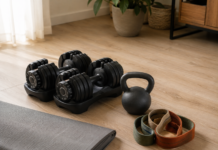
- Light to moderate dumbbells — presses, curls, rows, and deadlift patterns, always placed down rather than dropped, ideally onto a mat.
- Isometric holds with added load — holding a loaded squat or a weighted plank builds strength through time under tension instead of repeated impact.
Isometric work is worth calling out on its own. An isometric contraction is one where the muscle generates force without changing length, think of a wall sit, a plank, or pausing halfway through a squat and holding. Because there’s no eccentric drop and no landing, isometrics are close to silent while still producing real strength and endurance adaptations, which makes them one of the most apartment-friendly tools available.
Flexibility, Mobility, and Recovery Work
Stretching and mobility sessions are naturally about as quiet as exercise gets, and they’re easy to underrate. Harvard Health notes that regular stretching keeps muscles flexible and healthy and helps maintain range of motion in the joints, and recommends doing it often, ideally daily, or at minimum three to four times a week, with each stretch held for around 30 seconds after the muscles are warm. Static stretching is generally more effective after a workout than before one, when muscles are already warm and pliable.
Yoga and slow-flow mobility routines fit the same profile: continuous floor contact, controlled transitions, and a pace that’s naturally suited to any time of day. A 20-minute mobility flow covering hips, shoulders, and the thoracic spine makes a genuinely useful recovery day between strength sessions, and it never risks a noise complaint.
Sound-Dampening Gear Worth Actually Buying
Equipment choices make a measurable difference to how much sound reaches the apartment below, even before you change a single exercise. Ranked roughly by impact-per-dollar:
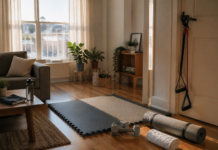
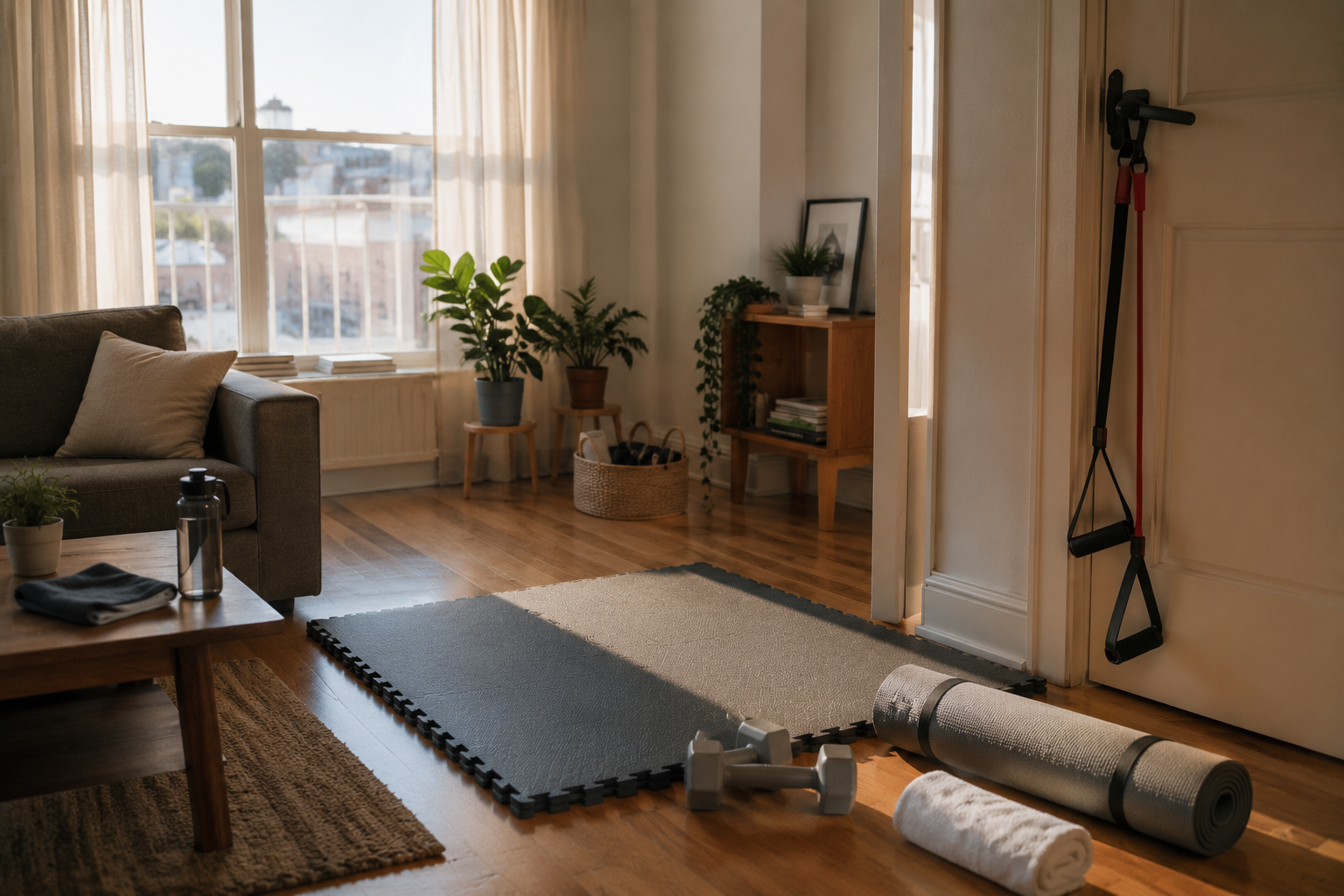
- A dense interlocking foam mat (¾ to 1 inch thick). This is the highest-value purchase for anyone training in a shared building. Interlocking foam tiles cover more floor area than a single yoga mat and absorb vibration before it reaches the subfloor.
- A thick area rug underneath the mat. Layering a rug or rug pad beneath the foam tiles adds another buffer layer and helps with airborne noise from music or a podcast as well.
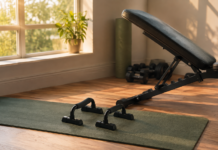
- Rubber feet or pads under any equipment with legs. Adjustable benches, bike stands, and folding equipment all transmit vibration through their feet; small rubber isolation pads under each leg cut that transfer noticeably.
- A designated “landing zone” for weights. Keeping one mat specifically for setting down dumbbells, kettlebells, or a barbell means you’re not relying on memory mid-set to place them gently somewhere improvised.
- Resistance bands and a door anchor. Not dampening gear exactly, but worth having on hand since bands replace an entire category of movements that would otherwise involve weights touching the floor.
None of this requires a full renovation or landlord approval in most cases. A stack of interlocking foam tiles and a rug typically costs less than a single month of a gym membership and can be rolled up and stored when not in use.
A Sample Apartment-Friendly Training Week
This structure follows the general public health guidance of roughly 150 minutes of moderate activity plus two strength sessions a week, arranged so no single day runs long or repetitive.
Strength (bodyweight + bands), 25 min
Shadow boxing or bike, 25–30 min
Mobility + stretching, 20 min
Strength (dumbbells + isometrics), 25 min
Low-impact dance cardio, 25–30 min
Walk outside or walking pad, 30–40 min
Rest or gentle stretching
Rotate which strength day covers upper body versus lower body based on how sore you are, and don’t hesitate to swap Saturday’s walk for an extra rest day if the week has been demanding. The point of the structure is consistency, not rigidity.
Timing, Etiquette, and Talking to Neighbors
Even a perfectly quiet routine benefits from basic timing awareness. Most lease agreements and building rules set quiet hours somewhere between 10 p.m. and 7 or 8 a.m., and even outside those hours, early morning or late evening sessions are the times neighbors are most likely to be sensitive to noise, since that’s often when people are sleeping, working from home on calls, or trying to relax.
If you’re not sure whether your routine is coming through, a short, friendly conversation with the downstairs neighbor goes a long way. Mentioning that you work out around a certain time and asking them to flag it directly if anything is disruptive tends to prevent the passive-aggressive note-on-the-door scenario entirely. Most noise complaints in shared buildings come from surprise and repetition, not from a single loud session.
Modifying the Exercises You Already Love
You don’t necessarily need to abandon a workout program you already like, just adjust the loudest parts of it.
| Loud Version | Quiet Swap |
|---|---|
| Jump squats | Slow squat + heel raise at the top |
| Burpees | Step-back plank + slow stand, no jump |
| Jumping jacks | Step-out jacks, arms still moving fully |
| Box jumps | Step-ups, controlled tempo both directions |
| Dropping weights after a heavy set | Guided lower onto a dedicated mat |
Interestingly, several of these swaps also reduce joint strain, which is part of why low-impact training is often recommended for people managing joint sensitivity or returning from injury, not only for apartment dwellers. The load on the body doesn’t disappear when you remove the jump, it shifts into the muscle instead of the joint, which for many people is a reasonable trade either way.
Building a Space That Encourages Consistency
The physical layout of your workout corner matters almost as much as the exercises you pick. A cramped, cluttered space makes people rush their reps, which is when form breaks down and impact creeps back in. Clearing roughly a six-by-six-foot area, enough room for a full lunge stride or a plank without knocking into furniture, removes the temptation to hurry.
Placement relative to the floor plan also matters more than most people realize. If you have any choice in the matter, position your mat over a hallway, closet, or bathroom rather than directly above a neighbor’s bedroom or living room seating area. Structural noise still travels, but a hallway below is a far more forgiving landing zone than a spot above someone’s headboard. If you don’t know the layout of the unit below you, a quick, polite question to the neighbor (or the building manager) usually clears it up.
Lighting and air flow play a smaller but real role too. A space with a bit of natural light and airflow tends to get used more consistently than a dim corner, and consistency is what actually produces results over weeks and months. None of the exercises in this guide require a dedicated room. A cleared rug, a mat, and enough space to extend your arms fully in every direction is sufficient for the entire routine described here.
Tracking Progress Without Relying on Noise as Feedback
One underappreciated side effect of loud training styles is that the noise itself becomes a kind of feedback loop: the thud of a heavy landing feels like proof of effort. Quiet training removes that cue, which means it helps to build in other ways of tracking whether a session is actually working.
A simple approach is to track three things across each session: total time under tension for strength work, heart rate or perceived exertion for cardio work, and how many reps you can complete with good form before technique starts to slip. None of these require special equipment. A basic fitness watch or even a manual pulse check partway through a cardio session gives a reasonable read on intensity, and a phone timer is enough to track how long you’re holding a plank or a wall sit.
Progressive overload, the gradual increase in resistance, reps, or time, still applies fully to quiet training. A band that starts to feel easy after a few weeks should be swapped for a heavier one. A 30-second wall sit that no longer feels challenging should become 45 seconds. The absence of noise doesn’t mean the absence of progress; it just means the signals of progress live somewhere other than your ears.
Before You Start
As with any new exercise routine, check in with a doctor first if you have an existing health condition, are recovering from an injury, are pregnant, or haven’t been active in a while. This is general information, not individualized medical or fitness advice, and a qualified professional can help you adjust intensity or movement selection to your specific situation.
Frequently Asked Questions
Will low-impact workouts still help me lose weight or build noticeable strength?
Yes. Weight management and strength gains depend far more on consistency, resistance, and effort level than on whether your feet leave the ground. A low-impact dance cardio study from the American Council on Exercise found participants burning close to 200 calories per session while reaching moderate to vigorous heart rate zones, and bodyweight or band-based strength work can absolutely build muscle when taken close to fatigue with good form.
What time of day is safest for a home workout in an apartment?
Midday and early afternoon tend to be the safest window, since most people aren’t sleeping or on calls then. Early mornings before roughly 7 or 8 a.m. and evenings after 10 p.m. are the times most building quiet-hour policies cover, so it’s worth checking your lease and saving any higher-intensity or equipment-based sessions for outside that window.
Do I really need a mat, or is a rug enough?
A rug alone helps a little but a dense, purpose-built exercise mat (interlocking foam tiles work especially well) makes a bigger difference because it’s designed to absorb vibration rather than just cushion a fall. Combining a mat on top of a rug gives you two layers of dampening, which is the most effective low-cost setup.
Are resistance bands actually as effective as dumbbells?
For most goals, yes. Bands provide variable resistance that increases through the range of motion, which challenges muscles differently than a fixed dumbbell weight but is comparably effective for building strength and endurance, according to strength-training guidance from sources like Mayo Clinic that recommend resistance tools broadly rather than any one type as superior.
How do I know if my workout is actually disturbing my neighbors?
The most reliable way is to ask. A short, friendly message or conversation letting a downstairs neighbor know roughly when you exercise, and inviting them to say something if it’s an issue, tends to surface problems early and prevents the discomfort of a formal complaint. If you’ve made the swaps described above (no jumping, weights placed rather than dropped, a proper mat) most routines fall well within a reasonable noise range.
Can I still do HIIT-style training without jumping?
Yes. High-intensity interval training is defined by alternating short bursts of hard effort with recovery, not by whether the movements involve jumping. Fast-paced bodyweight circuits (squats, push-ups, mountain climbers performed with a plank hold instead of a jump, shadow boxing rounds) can hit the same heart-rate targets as a jump-based circuit when the tempo and effort are high enough.
References
- Centers for Disease Control and Prevention, Physical Activity Guidelines for Adults
- NHS, Physical Activity Guidelines for Adults Aged 19 to 64
- Mayo Clinic, Strength Training: Get Stronger, Leaner, Healthier
- Harvard Health Publishing, The Importance of Stretching
- Wikipedia, Impact Insulation Class
- American Council on Exercise, Low-Impact vs. High-Impact Exercise: What’s the Difference?