


























By Sophie Taylor
Walk into any gym and you’ll see the same five or six barbell movements repeated by lifters of every level: the squat, the deadlift, the bench press, the overhead press, the barbell row, and maybe a power clean if someone’s feeling ambitious. That’s not an accident. These lifts survived decades of trial, error, and coaching evolution because they move the most muscle for the least time invested. For a beginner with 45 minutes, two or three days a week, the question isn’t “which exercise is best” in some abstract sense. It’s which lifts pay you back fastest for the minutes you actually have.
This guide ranks the core beginner barbell lifts by that exact standard: return per minute. That means weighing how much muscle mass each lift trains, how quickly you can safely load it, how much setup and rest it demands, and how directly it builds the strength and coordination that carry over to everyday tasks like carrying groceries, climbing stairs, or lifting a suitcase into an overhead bin. A single well-executed set of a compound lift trains more muscle groups in less time than three isolation exercises combined, which is exactly why national health guidance treats “muscle-strengthening activity” as a single category rather than prescribing a shopping list of machines.
Why “return per minute” is the right lens for beginners
New lifters usually have the least time and the least recovery capacity of any training population. You’re learning technique, your joints and connective tissue are adapting to new stresses, and your nervous system hasn’t yet learned to recruit muscle efficiently. Every minute you spend under a bar should be doing real work.
The Centers for Disease Control and Prevention recommends adults get muscle-strengthening activity that works all major muscle groups at least two days a week. Notice what that guidance does not say: it doesn’t say twelve exercises, or an hour of isolation work, or a body-part split. Two focused sessions covering the major muscle groups is the baseline the CDC considers sufficient for meaningful health benefit. That’s a low bar to clear, but only if you pick exercises that actually hit multiple major muscle groups per set instead of one small muscle at a time.
The American College of Sports Medicine’s position stand on resistance training progression backs this up from a programming angle: for novice lifters, it recommends loads in the 8-12 repetition maximum range, two to three sessions a week, and, critically, sequencing multi-joint exercises before single-joint ones and larger muscle groups before smaller ones. In plain language: do the squat before the calf raise, not after.
“Sequence exercises so that multiple-joint exercises are performed before single-joint exercises, and higher-intensity exercises are performed before lower-intensity exercises.” (ACSM Position Stand, Progression Models in Resistance Training for Healthy Adults)
The ranking: beginner barbell lifts by return per minute
Rankings like this always involve some judgment call, so here’s the method: each lift is scored on muscle mass recruited per set, technical learning curve (how fast a true beginner reaches a safe, effective working weight), time cost per set including rest, and versatility (whether it’s easy to program around common beginner limitations like a small home gym or tight schedule). The order below runs from highest return to lowest, among lifts that belong in a beginner’s first three months.
1. Barbell Back Squat: the highest return in the gym
The squat trains the quadriceps, glutes, hamstrings, adductors, and the entire trunk musculature isometrically, in a single movement pattern that also builds the hip and ankle mobility beginners need for everyday function. It’s the most “expensive” lift to learn in terms of coaching attention up front, but the payoff curve is steep: most beginners can safely add working weight every session for the first several weeks (often called “newbie gains” or beginner linear progression). Because it trains the largest muscle group in the body plus a long list of stabilizers, a single squat working set does more total muscular work than almost anything else you can do in the same sixty to ninety seconds.
2. Conventional Deadlift: maximum load, minimum reps needed
The deadlift recruits the posterior chain (hamstrings, glutes, spinal erectors), the upper back, the forearms and grip, and the core, all in one pull. Because it starts from a dead stop on the floor, you typically need fewer reps and fewer sets to get a meaningful training effect than lifts you can “cheat” through with momentum. Many beginner programs prescribe just one heavy working set of the deadlift per session for exactly this reason: it’s efficient enough that more volume often isn’t necessary. It ranks just below the squat mainly because of a steeper technical learning curve around hip hinge mechanics and neutral spine positioning.
3. Barbell Row: the most overlooked time-efficient lift
The barbell row builds the lats, rhomboids, traps, rear delts, and biceps, plus real isometric core and lower-back endurance from holding the bent-over position. Beginners often skip it in favor of machine rows or lat pulldowns, but the free-weight version trains more stabilizing muscle per set and directly supports the posture most desk-bound adults need to counterbalance from hours of sitting. It loads up quickly once hip hinge technique is established (which the deadlift will already have taught you), making it a fast add to any three-lift session.
4. Barbell Bench Press: high return, but narrower muscle recruitment
The bench press builds the chest, front shoulders, and triceps in one push, and it’s usually the fastest lift for a beginner to learn because the movement path is fixed and stable (you’re lying on a bench, not balancing standing weight). It ranks below the squat, deadlift, and row here only because it trains a smaller share of total body muscle mass per set, and beginners tend to plateau on it sooner than on lower-body lifts. Still, for upper-body pushing strength, nothing beats it minute for minute.
5. Overhead Press: smaller muscles, but genuine full-body carryover
Pressing a bar overhead trains the shoulders and triceps directly, but it also demands real core and upper-back stability to keep the bar path straight and the ribcage from flaring, which is why coaches often call it a stealth core exercise. It moves less total weight than the other four lifts (most beginners overhead press well under what they bench or squat), so its per-minute return is real but smaller. It earns its place in a beginner routine for shoulder health and pressing balance, not as a primary mass-builder.
How the ranking changes based on your actual goal
Return per minute isn’t a fixed number: it shifts depending on what you’re optimizing for. Someone training purely for general health and longevity gets a different answer than someone training to add visible muscle, and both differ from someone training around a nagging shoulder.
A realistic beginner session built around this ranking
You don’t need all five lifts every session. In fact, cramming every barbell movement into one workout usually lowers your per-minute return because fatigue erodes form on whichever lift you do last. A simple two-day split covers everything the CDC and NHS both recommend without wasting time.
Session A
- Barbell back squat: 3 sets of 8-12 reps
- Barbell bench press: 3 sets of 8-12 reps
- Barbell row: 3 sets of 8-12 reps
Session B
- Conventional deadlift: 1-3 sets of 5-8 reps
- Overhead press: 3 sets of 8-12 reps
- Barbell back squat (lighter) or an accessory of choice: 2-3 sets
This structure lines up with the ACSM’s novice recommendation of an 8-12 rep max load range and two to three weekly sessions, and it satisfies the CDC and NHS baseline of at least two days of muscle-strengthening work covering the major muscle groups. Rest one full day between sessions that hit the same muscle groups hard, which is also what Mayo Clinic’s guidance recommends for recovery between strength workouts.
Technique basics that protect your time investment
A lift only returns value if you can keep doing it. An injury early on doesn’t just cost you recovery time, it also erases whatever progress you’d banked. A few non-negotiables:
- Warm up first. A few minutes of brisk movement before loading a barbell prepares muscles and joints for the work ahead, per Mayo Clinic’s guidance.
- Start light and prioritize form over load. Mayo Clinic specifically recommends learning correct technique, ideally with a trainer or knowledgeable coach, before increasing weight.
- Stop if something hurts. Sharp or joint-level pain during a lift is a stop signal, not something to push through. Mild muscle fatigue is expected; joint pain is not.
- Breathe. Don’t hold your breath through a heavy rep; steady, braced breathing keeps blood pressure and core stability in check.
- Give muscle groups a rest day. Recovery is where the adaptation actually happens, not the workout itself.
If you’re new to exercise, returning after a long break, managing a chronic condition, or pregnant, it’s worth checking in with a doctor before starting a new barbell program, particularly around loaded spinal movements like the squat and deadlift.
What you actually need to get started
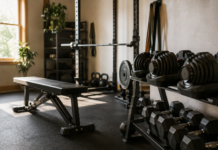
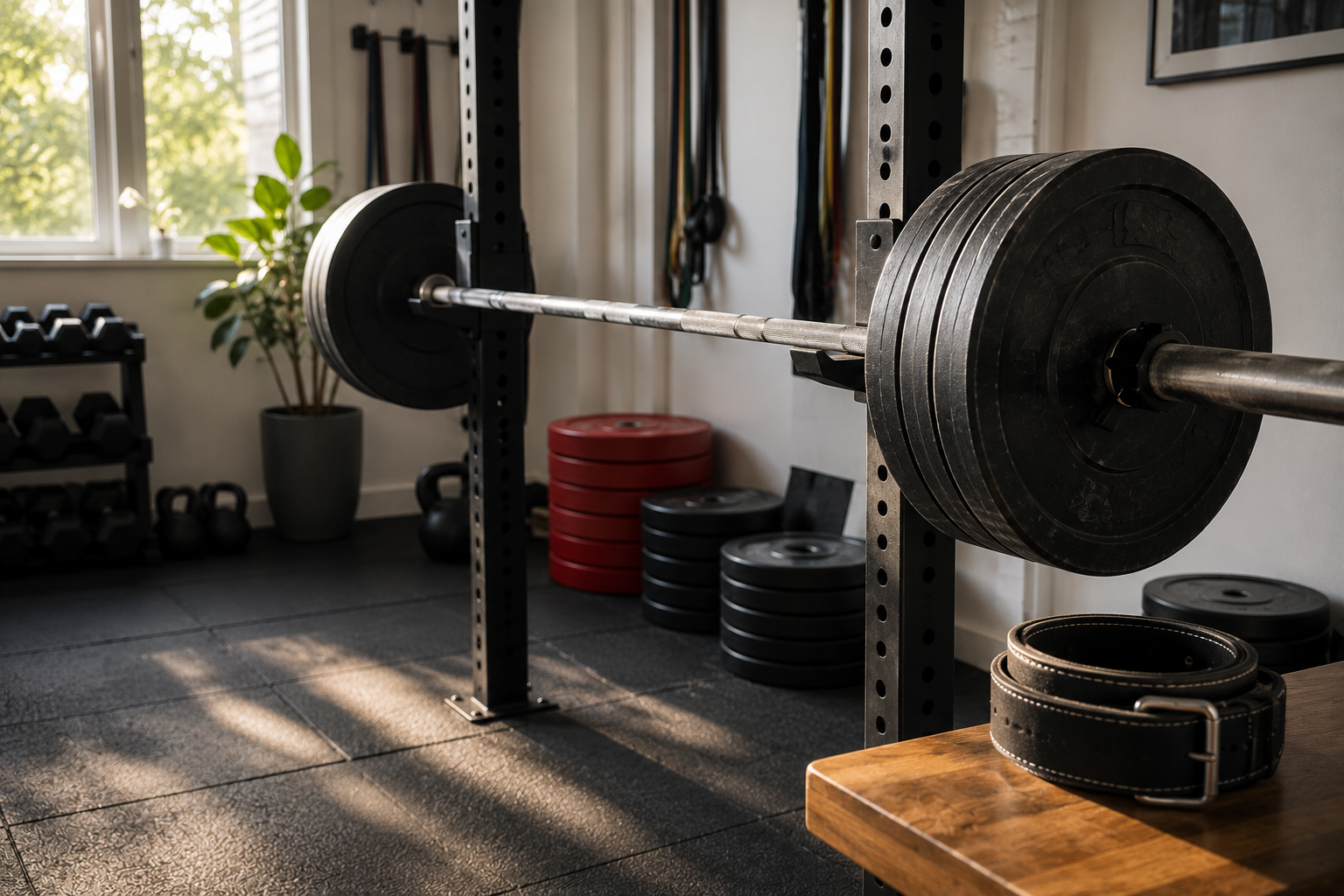
Part of why these lifts return so much value per minute is that the equipment barrier is low. You don’t need a rack of dumbbells climbing to 100 pounds or a room full of machines. A barbell, a set of plates, and a way to rack the bar safely for squats and presses covers all five lifts in this guide.
Minimum equipment checklist
- An Olympic barbell. Standard bars run about 20 kg (45 lb) for men’s bars and 15 kg (33 lb) for women’s bars; either works fine for a true beginner.
- A set of plates in small increments. Look for at least one pair of 2.5 kg or 5 lb plates so you can add small jumps as strength improves, rather than being stuck jumping from bar weight straight to a heavier fixed increment.
- A squat rack or power cage. This is the one piece of equipment that’s genuinely hard to substitute for the squat and overhead press, since you need a safe way to get a loaded bar onto your shoulders.
- A flat bench. Needed for the bench press, and useful as a place to sit between sets.
- Flat, stable shoes or bare feet. Cushioned running shoes actually work against you on the squat and deadlift because they compress under load; a flat sole gives a more stable base.
If a full rack isn’t available where you train, you can still get most of this ranking’s benefit: the deadlift and barbell row need no rack at all, and the bench press only needs a bench with the bar resting on safety pins or a partner handing it off. The squat and overhead press are the two lifts where a rack genuinely matters for safety, since it lets you fail a rep without the weight trapping you. If you’re training at a small studio or a home setup without a rack, a trap bar deadlift or dumbbell goblet squat can stand in temporarily while you build a case for investing in a rack down the line.
Common mistakes that quietly lower your return
Most of the value lost in a beginner’s early months doesn’t come from picking the “wrong” lift. It comes from small execution errors that turn a high-return exercise into a mediocre one. A few worth watching for:
Squat and deadlift
- Squatting to a shallow depth reduces how much of the glutes and hamstrings actually get trained; aim for at least reaching parallel, where the hip crease drops level with the top of the knee.
- Rounding the lower back on the deadlift shifts stress away from the muscles you’re trying to train and onto the spine passively; keep a neutral, braced spine from setup through lockout.
- Letting the bar drift forward away from the body on either lift increases the leverage disadvantage and makes the same weight feel heavier than it should.
Bench press, row, and overhead press
- Bouncing the bar off the chest on the bench press turns a controlled strength movement into a momentum trick that trains less muscle for the same perceived effort.
- Using body English, a jerking hip motion, to heave the bar up on a barbell row shifts work away from the back and onto momentum, which is exactly the trade-off you’re trying to avoid.
- Leaning back excessively on the overhead press to press around a tight shoulder, rather than through it, can turn a shoulder-building exercise into a lower-back stressor instead.
None of these mistakes are moral failings. They’re the natural result of learning a new motor pattern under load, which is exactly why Mayo Clinic and most coaching bodies recommend working with a trainer, at least briefly, when you’re new to barbell training. A short investment in coaching up front tends to pay for itself many times over in preserved time and avoided setbacks later.
What “return per minute” does not mean
It’s worth being direct about the limits of this framework. Ranking lifts by efficiency doesn’t mean the lower-ranked lifts are optional forever, or that you should only ever do the top one or two. The overhead press, for instance, ranks lower on raw muscle-mass-per-minute, but skipping it long-term tends to create shoulder imbalances that a squat and deadlift alone won’t fix. Efficiency is a starting filter for a beginner deciding where to spend limited time and attention, not a permanent hierarchy. As your training experience grows past the novice stage, the ACSM position stand itself shifts its recommendations toward more varied loading and higher weekly frequency, because the “law of diminishing returns” that makes ranking useful early on matters less once you’re not a beginner anymore.
It’s also worth remembering that “return” here refers to strength and muscle-recruitment efficiency, not the only thing that matters in a training program. Mobility work, walking, and simple conditioning still deserve a place in a well-rounded routine; this ranking is specifically about which barbell lifts to prioritize when your time for structured strength training is limited, not a claim that strength training alone covers every fitness need.
Frequently asked questions
Do I need a gym membership to do these lifts, or can I start at home?
You need a barbell, plates, and ideally a squat rack or power cage for the squat and overhead press; a deadlift, row, and even a flat bench press can technically be done with just a bar and plates on the floor. Many beginners start at a commercial gym specifically to access a squat rack safely, then transition to a home setup once they understand loading and plate math.
Is it safe for a complete beginner to deadlift and squat in the same week?
Yes, for most healthy adults, provided the load and technique are appropriate to a true beginner level and you allow at least a day of rest between sessions targeting the same muscle groups, consistent with Mayo Clinic’s recovery guidance. If you have an existing back, hip, or knee condition, check with a doctor or physical therapist before starting.
How many sets and reps should a beginner actually do?
The ACSM position stand on resistance training recommends novice lifters use loads in the 8-12 repetition maximum range, training two to three days a week. The deadlift is a common exception, often programmed for fewer reps (around 5-8) per set given how much load it moves relative to other lifts.
Can I skip isolation exercises entirely and just do these five lifts?
For general health and strength purposes, yes, these five lifts alone satisfy CDC and NHS baseline recommendations for muscle-strengthening activity covering all major muscle groups. If your goal shifts toward bodybuilding-style muscle growth or rehabbing a specific weak point, isolation work becomes more useful, but it’s an addition, not a prerequisite.
Which lift should an absolute beginner learn first?
Most coaches start beginners with the squat or a supported variation like the goblet squat, since it teaches the hip hinge and bracing patterns that carry over directly to the deadlift and barbell row. The bench press is often introduced early too, since its fixed movement path makes it comparatively quick to learn.
How long should a beginner barbell session actually take?
Mayo Clinic notes that about 20 to 30 minutes of strength training, two or more times a week, is enough for most beginners to see meaningful benefit. A focused three-lift session with adequate rest between sets typically fits comfortably inside 45 minutes, which is why prioritizing high-return lifts matters so much when time is tight.
How soon will a beginner notice real strength gains?
Many new lifters notice the bar feeling lighter within the first few weeks, partly from genuine neuromuscular adaptation (the nervous system getting better at recruiting muscle) and partly from improved technique and confidence under the bar. Visible changes in muscle size typically take longer, often a couple of months of consistent training, since strength gains in the earliest phase outpace visible tissue change. Consistency across the two-day-a-week minimum matters more than any single session.
References
- Centers for Disease Control and Prevention. “Physical Activity Guidelines for Adults.” cdc.gov/physical-activity-basics/guidelines
- NHS. “Strength Exercises.” nhs.uk/live-well/exercise/strength-exercises
- Mayo Clinic. “Strength Training: Get Stronger, Leaner, Healthier.” mayoclinic.org/healthy-lifestyle/fitness/strength-training
- Ratamess, N.A., et al. “Progression Models in Resistance Training for Healthy Adults.” American College of Sports Medicine Position Stand. pubmed.ncbi.nlm.nih.gov/19204579
This article is for general educational purposes and is not a substitute for individualized medical or professional fitness advice. Consult a doctor before starting a new exercise program, especially if you have an existing injury or health condition.