





















If you tend to finish meals in minutes, “chewing exercises” give you simple, repeatable drills to slow down, enjoy your food, and support healthy digestion. In short: chewing exercises are structured cues and mini-routines that increase chewing and oral processing time so you eat at a calmer pace. They help you notice flavor and fullness sooner, which research links with lower meal-time energy intake and better appetite regulation. This article offers 12 high-leverage drills you can use at home, work, or restaurants—no special equipment required. Quick note: this is educational content, not medical advice; if you have dental, jaw (TMJ), swallowing, or metabolic conditions, consult a clinician or registered dietitian.
Quick start (optional):
- Pick one drill below and practice it for the next three meals.
- Aim for 20–30 minutes per main meal; a timer helps.
- Favor smaller bites and foods with more texture; both naturally slow eating.
- Put utensils down between bites to build pauses.
- Check your hunger/fullness at least twice during the meal.
1. The 30-Chew Drill
The 30-Chew Drill is a simple count-per-bite routine that lengthens oral exposure and slows eating rate. Start each bite by placing food in your mouth, then chew deliberately ~20–30 times before swallowing. This raises “oral processing time,” the period your food spends in the mouth, which multiple trials link to lower energy intake during meals and clearer satiety signals—even though the exact “best” chew count varies by person and food type. In randomized and crossover studies, slower eating (via extra masticatory cycles or longer meal duration) reduces meal-time calorie intake in many participants and enhances fullness ratings, though effects can differ by weight status and clinical condition. Use this drill to build awareness of bite size, jaw fatigue, and flavor release; it’s a foundational skill for the rest of the exercises.
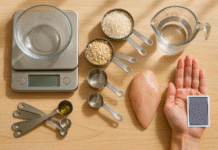
1.1 How to do it
- Take a smaller bite than usual.
- Chew and count to 20–30 (adjust for very soft/very hard foods).
- Pause once you hit your target; notice flavor and texture changes.
- Swallow, set utensil down, and breathe before the next bite.
1.2 Numbers & guardrails
- Research shows slower eating lowers energy intake overall (meta-analysis of 22 studies).
- In type 2 diabetes, slow spaced eating improved fullness and reduced hunger even without hormone changes.
Synthesis: Counting chews is an easy entry point; treat 20–30 as a training range, not a rule carved in stone. Adjust by food texture and comfort.
2. Timer-Paced Bites
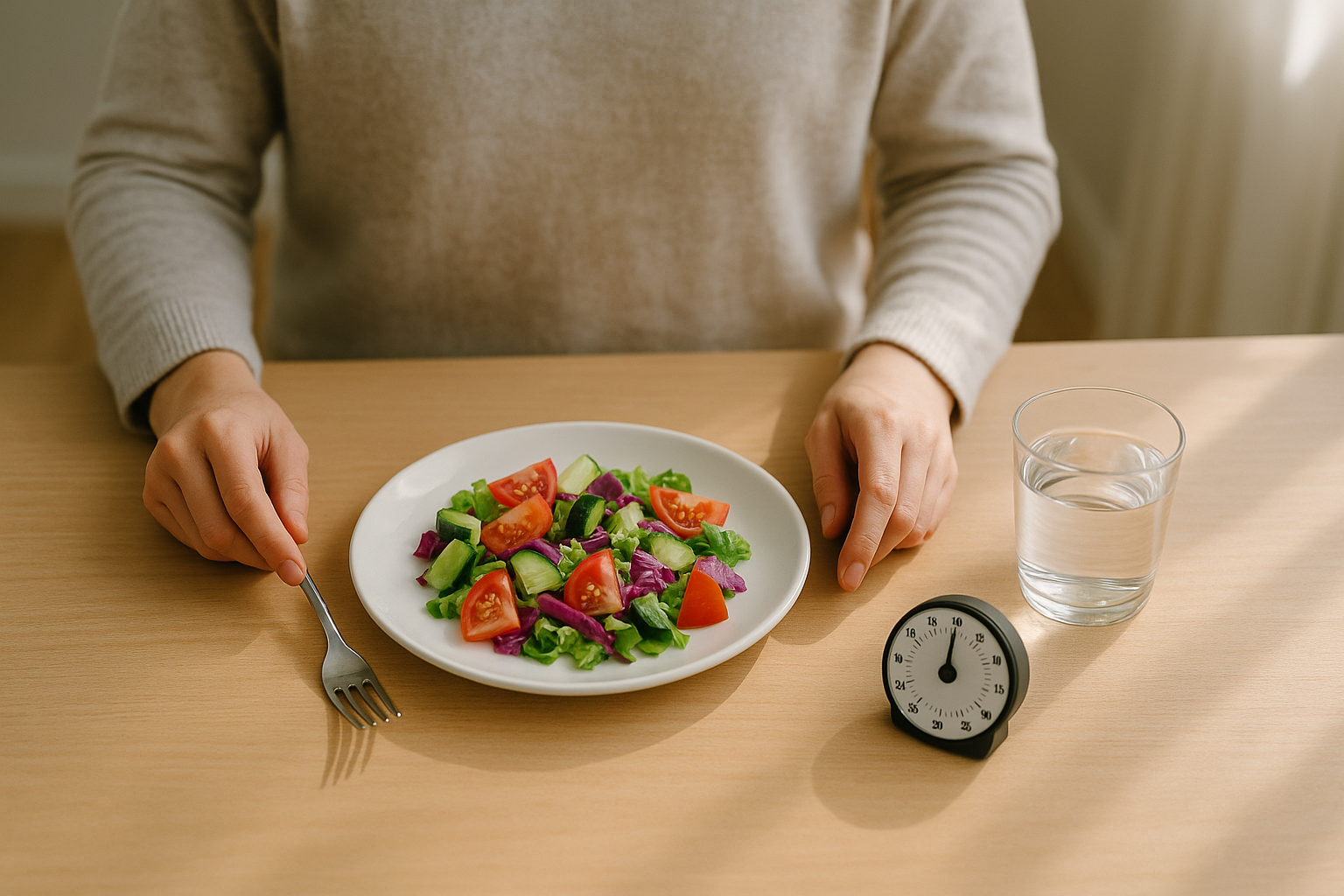
Timer-Paced Bites use a clock to space your bites and extend meal duration. By pairing chewing with short timed pauses (e.g., 30–60 seconds between bites), you systematically slow your eating rate and boost satiety cues that have time to reach awareness. Trials consistently report that slower rates reduce energy intake during meals; pairing instructions (“eat slowly”) with a structured time cue makes the behavior stick. Texture manipulations that lengthen oral processing (i.e., more chews per bite) show similar intake-reducing effects, so a timer is a stand-in for those sensory brakes.
2.1 How to do it
- Use a phone or watch timer set to 30–60 seconds.
- Take a bite, chew thoroughly, swallow, then wait for the beep.
- While waiting, put utensils down and take a calm breath.
2.2 Mini-checklist
- If the timer feels too long, start at 30 s and add 5 s every two meals.
- If dining with others, sync your pace with the slowest eater at the table.
Synthesis: A timer externalizes pacing—perfect when you’re hungry, busy, or distracted—and builds the habit of deliberate bites.
3. Chopsticks or Small-Utensil Method
Switching to chopsticks or a smaller spoon/fork naturally shrinks bite size and slows eating. Controlled experiments show that smaller spoons decrease bite size, eating rate, and ad libitum intake in healthy young males—likely by increasing oral processing per bite. Slower eating, in turn, is associated with lower meal-time energy intake in many lab studies and some populations. The goal here isn’t perfection with chopsticks; it’s using tool friction to nudge awareness and pace.
3.1 Tools/Examples
- Chopsticks for rice bowls, noodles, salads, and stir-fries.
- Teaspoon or child-size fork for grain bowls or pasta.
- Two-hand rule: utensil in non-dominant hand (see #8) to compound the effect.
3.2 Common mistakes
- “Scooping” oversized bites with a small spoon.
- Speeding up to compensate—remember the put-down pause between bites.
Synthesis: Smaller tools make smaller bites; smaller bites mean more chews and slower eating—an elegant chain reaction.
4. The Put-Down Pause
This drill adds a micro-pause after every bite: place your utensil down, chew fully, swallow, then pick it back up. Simple as it sounds, this breaks the reflex to load the next bite while the previous one is still in your mouth, and it is a core mindful-eating cue recommended by major health sources. These built-in pauses increase oral exposure time without counting chews or watching the clock.
4.1 How to do it
- Bite → fork/spoon down → chew → swallow → breath → pick up again.
- Pair with a sip of water if helpful, then resume.
4.2 Why it matters
- The pause gives satiety signals time to surface and discourages stacking bites, a behavior linked with faster eating.
- Combined with other strategies (smaller utensils, texture changes), it can meaningfully reduce eating rate.SHURA
Synthesis: The Put-Down Pause is tiny but powerful—especially in social meals—because it’s invisible, polite, and repeatable anywhere.
5. Texture Ladder Training
Texture Ladder Training leverages the fact that harder, chewier foods require more chews, smaller bites, and longer oro-sensory exposure, which consistently reduces eating rate and energy intake across meals. You’ll practice on a spectrum—from very soft to crunchy—so your chewing muscles, patience, and attention all improve without frustration.
5.1 How to do it
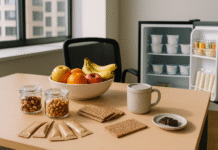
- Build a three-step plate: (1) soft (e.g., yogurt + berries), (2) medium (e.g., beans/grains), (3) hard/crunchy (e.g., apples, carrots, nuts).
- Spend 3–4 minutes on each zone, noticing bite size, jaw effort, and flavor release.
- Finish with the crunchy segment to reinforce thorough mastication.
5.2 Numbers & guardrails
- Trials show harder textures halved chews per bite vs. soft and cut daily energy intake by ~33% in controlled settings with matched menus.
- Texture + slow-eating instructions together are particularly effective.ScienceDirect
Synthesis: Train with texture as your coach—your eating rate will slow even when you’re not counting or timing.
6. Breath-Anchor Chew
The Breath-Anchor Chew ties your breathing pattern to bites: inhale before the bite, chew through a slow exhale, and take one calm nasal breath before the next bite. Mindful-eating protocols often pair breath work with utensil pauses to reduce stress arousal and bring attention to taste, smell, and texture. By dropping out of “fight or flight” and into a more rest-and-digest state, you make slow eating feel natural.
6.1 How to do it
- Before the first bite, take 3 deep belly breaths.
- For each bite: inhale → bite → chew during a long exhale → swallow → one extra calm breath.
- If conversation interrupts, reset with a single deep breath.
6.2 Mini-checklist
- Shoulders relaxed; jaw unclenched.
- No breath-holding while chewing.
Synthesis: Breath is the metronome you always carry; when it slows, chewing follows.
7. Posture & Mirror Reset
Posture & Mirror Reset is a quick alignment check that can reduce rushed, noisy chewing and aerophagia (swallowing excess air). Sit tall with feet grounded, chin neutral, and keep lips together while chewing. While not a medical treatment, this simple cue promotes calmer, quieter mastication and helps you notice if you’re wolfing down food. Many mindful-eating frameworks include posture and environment adjustments to encourage single-task focus.
7.1 How to do it
- Sit at a table (not the couch or car).
- Place both feet on the floor; relax shoulders and jaw.
- If at home, try one meal with a small mirror nearby to spot clenched chewing or rapid bite-loading.
7.2 Common mistakes
- Eating while standing, in transit, or in front of screens—these contexts speed eating.
Synthesis: Better posture equals better focus; better focus equals slower, more satisfying bites.
8. Non-Dominant-Hand Eating
Switching the utensil to your non-dominant hand adds just enough awkwardness to reduce bite size and speed, similar in spirit to using smaller utensils. While direct trials on handedness are sparse, studies show that feedback devices and utensil changes slow eating rates in naturalistic settings, supporting the behavioral logic. Use this when you’re hungry and likely to rush.
8.1 How to do it
- For one course (e.g., protein or starch), hold the fork/spoon in your non-dominant hand.
- Combine with the Put-Down Pause and Timer-Paced Bites to reinforce pacing.
8.2 Mini-checklist
- Start with fork-friendly meals (grains, salads).
- Avoid knife-heavy dishes until comfortable.
Synthesis: A tiny coordination challenge creates a sizable pacing benefit—great for fast eaters who don’t like counting.
9. Bite-Size Pre-Portioning
Bite-Size Pre-Portioning means cutting or arranging food into 1–2 cm pieces before you start. Smaller, uniform pieces encourage more chews per bite and slow intake rate—effects mirrored by the small-spoon and texture studies. It also improves flavor exploration because each bite is consistent and easy to savor.
9.1 How to do it
- Pre-cut proteins, veggies, and starches into bite-size before the first bite.
- Scatter pieces, leaving visible plate space to discourage big scoops.
- Pair with the 30-Chew Drill for the first 3–4 bites, then relax.
9.2 Numbers & guardrails
- In lab settings, smaller bites and longer oral exposure correlate with lower energy intake.
Synthesis: Prep your bites up front and your chewing will take care of itself.
10. Satiety Scale Interludes
Satiety Scale Interludes deliberately pause the meal at least twice to score hunger/fullness on a 1–10 scale (e.g., start, middle, end). Naming your internal state nudges you toward mindful pacing and finishing around 6–7 (comfortably satisfied) rather than “stuffed.” Universities and health systems commonly teach 1–10 hunger scales as a practical awareness tool.Denver Health
10.1 How to do it
- Before the first bite, note hunger (3–4 is ideal to start).
- Mid-meal check: utensils down, 10-second breath, assign a number.
- Decide: continue slowly, or stop at satisfied and save leftovers.
10.2 Mini-checklist
- If you hit 7, take two-minute pause; if still satisfied, wrap it up.
- If you’re at 5 and still hungry, continue with Timer-Paced Bites (#2).
Synthesis: Measuring fullness mid-meal makes stopping points visible—and easier to honor.
11. Distraction-Free 10-Minute Starter
This drill commits the first 10 minutes of each meal to zero screens and single-task eating, which reliably improves attention to sensory cues (taste, smell, texture) and reduces autopilot rapid eating. Mindful-eating curricula emphasize “only eat while eating” as a core habit; even one focused interval changes the tone of the meal.
11.1 How to do it
- Set a 10-minute timer; silence notifications.
- For those minutes, practice Put-Down Pause and Breath-Anchor Chew.Harvard Health
- After 10 minutes, decide whether to keep the focus or relax it.
11.2 Common mistakes
- Grazing while scrolling, working, or driving—contexts shown to undermine mindful cues.Mindful
Synthesis: A protected 10-minute window anchors slower chewing even on busy days.
12. The Chew-Count Ladder (Gamified)
The Chew-Count Ladder gamifies your meal: increase chew counts across the meal (e.g., 15 → 20 → 25) or across courses. It provides progression without rigidity, similar to interval training for pacing. Because slower eating reduces intake in many settings, the ladder helps you practice lengthening oral exposure while still enjoying variety.
12.1 How to do it
- Decide your three rungs (e.g., first 5 bites = 15 chews, next 5 = 20, final 5 = 25).
- Use a tally on paper or phone; reset if you forget.
- Combine with Texture Ladder Training (#5) for a double effect.
12.2 Mini-checklist
- Skip the ladder for very soft foods (e.g., soups); use Timer-Paced Bites instead.
- End each rung with a Put-Down Pause.
Synthesis: The ladder keeps slow eating playful and measurable—ideal for competitive personalities or family dinners.
FAQs
1) Do chewing exercises really change how much I eat?
Often, yes—especially in lab settings. A meta-analysis of 22 studies found slower eating reduces energy intake during the meal, regardless of how the pace was manipulated. Real-world effects vary by person and context, but the direction is consistent. Start with one drill, keep meals ~20–30 minutes, and notice your own patterns.
2) Is there a “magic number” of chews per bite?
No single number fits all foods. Softer foods need fewer chews; harder textures demand more and tend to slow eating naturally. Studies show texture shifts that increase chews and oral exposure also lower intake, so aim for a comfortable range (~20–30) and let texture guide you.
3) I live with diabetes—will slow eating change my glucose or hormones?
Evidence is mixed. In adults with type 2 diabetes, slow spaced eating increased fullness and reduced hunger versus fast eating, but did not significantly change GLP-1, PYY, or ghrelin in that trial. It’s still a low-risk strategy to help pacing, but keep medical therapy and diet guidance central.
4) Can utensil swaps (chopsticks, small spoons) really help?
Yes. A controlled study found small spoons decreased bite size, eating rate, and ad libitum intake in healthy young men. Paired with Put-Down Pauses, utensil swaps are a simple mechanical brake on speed.
5) Do textures and food processing levels matter?
They do. Harder textures and intact food structures slow eating rate and reduce intake even when meals are otherwise matched. Trials also suggest texture manipulations can offset large portions and energy density.
6) What if I still rush when I’m very hungry?
Use Timer-Paced Bites to create external structure and start with protein + fiber-rich textures (beans, crunchy veg) to encourage chewing. Keep a 5-minute pre-meal pause (water + breath) to take the edge off before the first bite.Massachusetts General Hospital
7) Are chewing exercises safe for jaw/TMJ issues?
If you have jaw pain, joint noise, or a history of TMJ disorders, avoid extreme chew counts and emphasize Timer-Paced Bites, Put-Down Pause, and softer textures. For persistent symptoms, see a dentist or clinician. (General mindful-eating practices are fine for most people.)
8) Do these drills help kids or older adults?
Principles are similar—smaller bites, utensil pauses, and textures that encourage chewing—but tailor to ability and safety. For older adults, choose textures that are chew-friendly but still slow eating (e.g., tender meats, well-cooked veg with slight firmness).
9) Is music tempo or gadgets worth trying?
Emerging tools (e.g., vibrotactile forks) show promise in reducing eating rate in naturalistic settings. If you like tech nudges, experiment—but the basic drills work without gadgets.
10) How do I track progress without obsessing?
Pick one drill for one week, note meal duration (goal ~20–30 min), and add two mid-meal fullness checks (aim to stop around 6–7/10). If you feel calmer and more satisfied, you’re winning—even if the exact chew count fluctuates.
Conclusion
Chewing exercises aren’t about perfection; they’re about adding just enough friction to transform rushed meals into calmer, more satisfying experiences. By deliberately increasing oral processing time—via chew counts, utensil pauses, textures, timers, or breath—you give your brain the minutes it needs to register fullness and your palate the attention it deserves. The studies are clear that slower eating reduces within-meal energy intake for many people, while mindful-eating practices provide a supportive framework for focus and enjoyment.PMC You don’t need to overhaul your diet or buy special products: start with one drill, keep meals closer to 20–30 minutes, and notice how you feel at the midpoint and the end. Over time, you’ll build a personal toolkit that works in family dinners, busy workdays, and nights out—helping digestion, curbing autopilot overeating, and bringing pleasure back to the table. Pick one exercise above and try it at your next meal—your future self will thank you.
References
- A systematic review and meta-analysis examining the effect of eating rate on energy intake and hunger, American Journal of Clinical Nutrition, 2014. PubMed
- The effect of slow spaced eating on hunger and satiety in overweight and obese patients with type 2 diabetes mellitus, BMJ Open Diabetes Research & Care, 2014. PMC
- Oral Processing, Satiation and Obesity, Diabetes, Metabolic Syndrome and Obesity, 2021. PMC
- Texture-based differences in eating rate influence energy intake for minimally-processed and ultra-processed meals, Nutrients, 2022. PMC
- Speed limits: the effects of industrial food processing and food texture on daily energy intake and eating behaviour in healthy adults, European Journal of Clinical Nutrition, 2023. SpringerLink
- Slower Eating Speed Lowers Energy Intake in Normal-Weight but not Overweight/Obese Subjects, Journal of the Academy of Nutrition and Dietetics, 2014. PubMed
- Effects of eating with an augmented fork with vibrotactile feedback on eating rate and body weight: a randomized controlled trial, JMIR mHealth and uHealth, 2019. PMC
- Eating with a smaller spoon decreases bite size, eating rate and ad libitum food intake in healthy young males, British Journal of Nutrition, 2018. Cambridge University Press & Assessment
- Mindful Eating, Harvard T.H. Chan School of Public Health – The Nutrition Source, accessed 2025. The Nutrition Source
- 8 steps to mindful eating, Harvard Health Publishing, 2016. Harvard Health
- Slow down—and try mindful eating, Harvard Health Publishing, 2022. Harvard Health
- The Hunger-Satiety Scale (PDF), UC Berkeley University Health Services, 2019. University Health Services