



























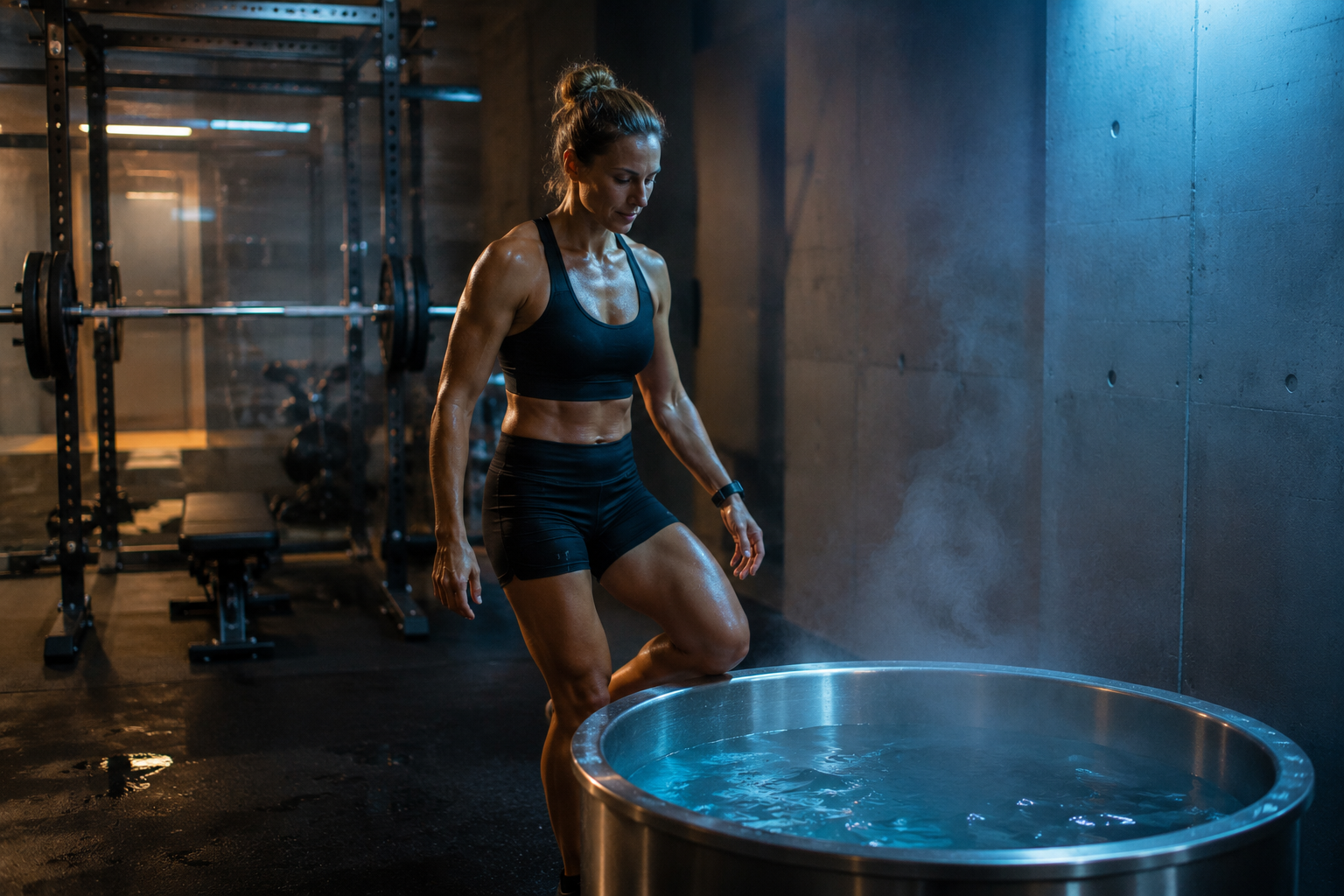
A cold plunge feels like the perfect finish to a hard lifting session: sore muscles calm down, the nervous system resets, and the workout feels officially “closed out.” But a small, consistent body of exercise-science research says the timing of that plunge matters more than most lifters realize. Step into cold water within the first hour or two after a resistance-training session, and you may be dampening the exact signal your muscles need to grow.
This is not a claim that cold water immersion is bad for you, or that cold plunges and lifting can never coexist. It is a narrower, better-supported claim: the window in which you take the plunge changes what it does to your training adaptations. Immediately post-lifting, cold exposure appears to blunt anabolic signaling and fiber-level hypertrophy in ways that separate it from the same plunge taken hours later, on a rest day, or after a conditioning session instead of a strength session.
What Happens When You Plunge Right After Lifting
Resistance training creates mechanical tension and metabolic stress in muscle fibers. In the hours that follow, that stimulus triggers a cascade of cellular events collectively described as muscle protein synthesis (MPS), the process by which muscle cells build new contractile proteins to repair and, over time, enlarge the fiber. A key regulatory hub in that cascade is the mTORC1 signaling pathway, along with satellite cells that donate nuclei to growing fibers and support long-term hypertrophy.
Cold water immersion works against parts of this cascade. Lowering tissue temperature reduces blood flow to the worked muscle, slows the inflammatory response that normally helps kick off repair, and appears to interfere with the phosphorylation of proteins in the mTORC1 pathway. Researchers sometimes describe this as an “interference effect,” borrowing language originally used for the way endurance work can blunt strength adaptations when the two are combined carelessly. Here, the interference is thermal rather than metabolic, but the practical result is similar: two recovery inputs pulling in opposite directions when they’re stacked too close together.
Part of the mechanism traces back to thermogenesis, the body’s process of generating heat to defend its core temperature. When tissue is chilled, the body redirects effort toward rewarming rather than toward the local repair processes a lifter actually wants running at full speed in the worked muscle. Blood vessels in the cooled area constrict, which is useful for limiting swelling after an acute injury but counterproductive when the goal is delivering amino acids and inflammatory signaling molecules to a muscle that just did productive mechanical work. That dual role, helpful for injury-type swelling, unhelpful for planned training adaptation, is part of why the research on cold plunging reads differently depending on the goal.
The Research Behind the Warning
Roberts et al., 2015: The Original Signal
The most cited study in this area comes from a 2015 trial published in The Journal of Physiology. Twenty-one resistance-trained men completed a 12-week lower-body strength program, training twice weekly with leg press, knee extension, knee flexion, lunges, and plyometric work at loads of roughly 3 to 6 sets of 8 to 12RM. After each session, half the group sat in cold water at about 10°C for 10 minutes; the other half performed a low-intensity active-recovery cooldown.
The difference in outcomes was substantial. Quadriceps cross-sectional area, measured by MRI, increased by roughly 15 percent in the active-recovery group compared with about 2 percent in the cold-water group. One-rep-max leg press strength rose approximately 59 percent in the active-recovery group versus about 42 percent in the cold-water group. At the cellular level, the cold-water group showed a near-complete blunting of the expected rise in Pax7-positive satellite cells and myonuclear content, the very machinery muscle fibers rely on to add new tissue over a training block. The timing in this trial was aggressive: immersion began immediately after training, every session, for three months straight.
Fyfe et al., 2019: Confirmation, With Nuance
A follow-up trial published in the Journal of Applied Physiology tested a whole-body resistance program (squats, bench press, lat pulldown, lunges, shoulder press, and arm work) in 16 recreationally active men over seven weeks, three sessions per week. This time, cold water immersion was 15 minutes at 10°C, applied about five minutes after each session ended.
Once again, Type II (fast-twitch) muscle fiber cross-sectional area increased less in the cold-water group than in the passive-control group, and rps6 phosphorylation (a downstream marker of mTORC1 activity) was measurably lower in the cold-water group at one hour and again at 48 hours post-exercise. Strength outcomes told a slightly different story: one-rep-max gains in leg press and bench press did not differ meaningfully between groups. That split result, fiber hypertrophy blunted while strength was preserved, is now a recurring theme in this literature and a reason researchers describe hypertrophy and maximal-strength adaptations as at least partially separable processes.
Piñero et al., 2024: What the Pooled Data Show
A 2024 systematic review and meta-analysis in the European Journal of Sport Science pooled data across eight controlled trials examining post-exercise cold water immersion and resistance-training-induced hypertrophy. Resistance training alone produced a small-to-moderate hypertrophic effect (standardized mean difference of 0.36). When cold water immersion was added immediately after training, the pooled effect dropped to a small-to-negligible 0.14, and the researchers concluded that immediate post-training cold water immersion “may attenuate hypertrophic changes.” A meta-regression found no significant moderating effect of training status, meaning both newer and more experienced lifters showed a similar pattern.
Quick reference: what the numbers actually showed
| Study | Protocol | Hypertrophy outcome | Strength outcome |
|---|---|---|---|
| Roberts et al., 2015 (J Physiol) | 10 min, ~10°C, immediately post-session, 2x/week for 12 weeks | ~2% CSA gain (cold) vs. ~15% (active recovery) | ~42% 1RM gain (cold) vs. ~59% (active recovery) |
| Fyfe et al., 2019 (J Appl Physiol) | 15 min, ~10°C, ~5 min post-session, 3x/week for 7 weeks | Type II fiber CSA blunted vs. control | No significant difference between groups |
| Piñero et al., 2024 (meta-analysis, 8 trials) | Pooled immediate post-training protocols | SMD 0.36 (RT alone) vs. 0.14 (RT + immediate CWI) | Not the primary outcome pooled |
The Timing Windows That Matter
None of the trials above tested a wide menu of delayed timing options head-to-head, so the guidance below is a synthesis of the mechanistic window for mTORC1 signaling (activity peaks in the first one to three hours post-lifting and stays elevated for up to 24 to 48 hours), combined with sports-medicine guidance built on that same physiology. The American College of Sports Medicine’s public-facing recovery guidance, for instance, advises athletes prioritizing strength and hypertrophy to delay cold-water exposure for roughly four to six hours after resistance training, reserving immediate immersion for situations where next-day performance recovery matters more than long-term muscle growth.
Approximate interference risk by time elapsed between a lifting session and cold water immersion, based on mTORC1 signaling kinetics and ACSM recovery guidance. Not derived from a single head-to-head timing trial.
Practically, this maps to three simple options for someone training for muscle size or strength: cold-plunge on non-lifting days, save it for the evening after a morning lift, or push it several hours past the session if same-day plunging is part of a fixed routine. None of these require giving up cold plunging altogether; they just separate it from the exact window where new muscle protein is being assembled.
Temperature and Duration Ranges Used in the Research
Protocols across this body of work cluster in a fairly narrow band. Roberts and colleagues used 10 minutes at approximately 10.1°C; Fyfe and colleagues used 15 minutes at 10°C. ACSM’s recovery guidance cites two commonly studied protocols outside the hypertrophy-specific trials: two five-minute immersions at 10°C separated by a two-minute break at room temperature, or a single 11-to-15-minute immersion at 11°C to 15°C. In other words, the water doesn’t need to be painfully frigid or the exposure especially long to produce a measurable physiological effect; most of the studied protocols sit between about 10°C and 15°C for 10 to 15 minutes.
This matters because some of the discussion around cold plunging online conflates “colder and longer is more effective” with better outcomes. For general soreness relief, the evidence doesn’t support extending duration much past 15 minutes, and for the specific question of hypertrophy interference, the effect shows up at moderate, commonly used protocols rather than only at extreme temperatures. A home cold plunge tub set to the low 50s Fahrenheit (roughly 10 to 12°C) for a 10-to-15-minute sit is already within, or colder than, the range used in the trials that found blunted hypertrophy, which is worth keeping in mind before assuming a milder home setup is automatically a lower-risk choice.
How This Differs From General Contrast Therapy
It’s worth separating this specific concern from the broader topic of contrast therapy, the practice of alternating hot and cold exposure (such as sauna followed by cold plunge, or hot and cold pools back to back) for general recovery and circulation benefits. Contrast protocols are typically evaluated for their effects on subjective soreness, perceived recovery, and next-day readiness across a training week, not for their effects on the molecular signaling that drives muscle growth from one specific lifting session.
The research summarized in this article is narrower and more mechanistic: it isolates cold water immersion, on its own, applied at a specific point relative to a resistance-training session, and measures its effect on muscle protein synthesis and fiber-level hypertrophy. A lifter who alternates sauna and cold plunge twice a week as a general wellness habit is engaging in a different practice, evaluated against different outcomes, than a lifter who cold-plunges immediately after every single hypertrophy-focused leg day for three straight months. The timing principle in this article applies specifically to the latter scenario: cold exposure stacked directly onto the post-lifting signaling window, repeated consistently over a training block.
When Timing Matters Less
Endurance Athletes
The hypertrophy-blunting research above is built almost entirely on resistance-training populations. A separate line of research looking at cold water immersion after sprint-interval and endurance-style training has found a different pattern: post-exercise cold water immersion following sprint-interval training did not significantly alter endurance-related signaling pathways or training adaptations in skeletal muscle, according to a controlled trial published in the American Journal of Physiology-Regulatory, Integrative and Comparative Physiology. A related 2026 trial found that regular cold water immersion after high-intensity interval training did not measurably change intramuscular adaptation markers, inflammatory profile, or endurance performance outcomes.
The likely explanation is mechanistic: endurance adaptations lean more heavily on mitochondrial biogenesis pathways (such as PGC-1alpha signaling) than on the mTORC1-driven fiber-hypertrophy pathway that cold exposure seems to interfere with. An endurance athlete cold-plunging after a tempo run or interval session is not obviously working against the same biology that a lifter is working against after a hypertrophy-focused set of squats.
In-Season Recovery vs. Off-Season Hypertrophy Blocks
Timing precision matters far less when the training goal isn’t maximal muscle growth. During a competitive season, when the priority is often being ready to perform again in 24 to 48 hours rather than maximizing long-term fiber growth, the calculus shifts toward whatever helps an athlete feel and move better for the next game or match, and cold water immersion has reasonably good support for reducing perceived soreness and next-day performance decrements after strenuous exercise, even if it doesn’t add much to muscle growth.
An off-season hypertrophy block is the opposite case: the entire point of the training block is to accumulate as much muscle protein synthesis as possible over weeks of consistent lifting. This is exactly the context in which same-day, immediate-post-lifting cold plunging looks least appealing, and where separating the two by hours, or by training day, has the clearest theoretical payoff.
Training Age, Sex, and Individual Variation
Most of the controlled trials in this space, including both Roberts et al. and Fyfe et al., were conducted in adult men, and the participant counts in each individual trial were modest (16 to 21 people per study). The Piñero meta-analysis found no significant moderating effect of training status, meaning the blunting pattern showed up in both newer and more experienced lifters in the pooled data, but it could not fully test for sex differences, age-related differences, or genetic variation in cold tolerance because the underlying trials didn’t have the sample sizes to support that kind of subgroup analysis. None of this weakens the core finding so much as it limits how confidently the effect size can be generalized to every population of lifters.
Who should actually care about this
- Off-season lifters chasing size. If the current training block exists specifically to build muscle, immediate post-lifting cold plunges are the habit most worth reconsidering.
- In-season team-sport athletes. If next-day readiness outranks long-term hypertrophy, the timing rules here matter less, and cold water immersion’s soreness and recovery benefits may be worth keeping close to the session.
- Endurance and mixed-modal athletes. Runners, cyclists, and rowers appear to have more flexibility, since the research showing interference is concentrated in resistance-training contexts.
- Anyone plunging purely for enjoyment or stress relief. If cold exposure isn’t tied to a specific hypertrophy goal, the timing question is far less consequential; do what feels sustainable.
What the Research Still Doesn’t Tell Us
A fair reading of this literature has to include its limits. No published trial has directly compared several delay lengths (say, one hour versus four hours versus eight hours) after the same lifting protocol to identify an exact cutoff where interference disappears. The four-to-six-hour figure cited by ACSM is a reasonable, physiology-informed estimate rather than a number pulled from a dedicated timing trial. Sample sizes across the hypertrophy-specific studies are small by modern standards, cohorts have skewed toward young, healthy men, and most trials used whole-body or lower-body immersion rather than testing whether partial immersion (just the legs, for example) produces a smaller effect.
There is also an open question about dose: does immersion once or twice a week produce meaningfully less interference than the daily protocols used in Roberts et al. and Fyfe et al.? The existing trials can’t answer that directly, since both used near-daily exposure across the full training block. Until a study specifically tests reduced frequency or a range of delay windows, the safest reading of the evidence is the conservative one: treat the four-to-six-hour, or separate-day, guidance as a sensible default rather than a precisely validated cutoff.
Practical Guidelines for Sequencing Cold Plunge and Lifting
Translating the research into a weekly routine doesn’t require overengineering. A few reasonable approaches, roughly in order of how closely they track the available evidence:
1. Separate days entirely. Cold plunge on rest days or cardio-only days, and skip it on lifting days. This is the cleanest way to avoid any overlap with the post-lifting signaling window.
2. Push it back by several hours. If a same-day plunge is important for a routine or mental-reset reason, aim for the evening after a morning session, roughly matching the four-to-six-hour delay referenced in ACSM’s guidance.
3. Reserve immediate plunges for maintenance phases. If a lifter is in a strength-maintenance or in-season phase rather than an active hypertrophy block, the cost of same-day, immediate cold exposure is lower, and the recovery benefits may be worth prioritizing.
4. Keep protocols moderate. Based on the temperature and duration ranges used across this research, roughly 10 to 15 minutes between about 10°C and 15°C reflects what’s actually been studied, rather than pushing toward longer or colder exposures in search of a bigger effect.
5. Track the pattern, not just one session. Because the strongest evidence for interference comes from repeated exposure across a full training block rather than a single event, the more useful question isn’t “did I plunge too soon after today’s workout?” but “does my routine consistently stack cold immersion onto the post-lifting window, week after week, for the duration of a hypertrophy phase?” A weekly training log that simply notes plunge timing alongside lifting days can make that pattern visible fast.
Common Mistakes Worth Avoiding
The most common misstep is treating every cold plunge as equally consequential. A single post-lifting plunge before a vacation, or an occasional plunge after an easy accessory day, is not the same exposure as a rigid daily habit of jumping in cold water within minutes of finishing every heavy session for months at a time, which is closer to what the Roberts and Fyfe trials actually tested. Context and consistency change the size of the effect.
A second mistake is assuming the strength data and the hypertrophy data tell the same story. Both trials above found that fiber-level and muscle-size growth was blunted by immediate cold exposure, but neither found a clear strength penalty. Someone training purely for a heavier one-rep max, rather than for visible muscle size, may be working with a different risk profile than someone in a dedicated hypertrophy block.
A third mistake is ignoring training goal entirely and applying the same rule to every athlete. An endurance athlete or an in-season team-sport player following a strength-lifter’s cold-plunge avoidance rules may be giving up a recovery tool that isn’t costing them much in their specific context.
Frequently Asked Questions
- Does a single cold plunge after lifting ruin muscle growth?
- No single session appears to be catastrophic. The studies showing blunted hypertrophy involved repeated, immediate-post-session cold water immersion over seven to twelve weeks of consistent training. An occasional plunge is a much smaller signal than a rigid daily habit repeated across an entire training block.
- How long after lifting should I wait to cold plunge?
- There isn’t a single trial that tested a range of delays head-to-head, but guidance from ACSM and the underlying signaling research points toward waiting roughly four to six hours, or simply plunging on a separate day, if the goal is maximizing hypertrophy from that specific session.
- Does this apply to sauna use or ice packs on sore muscles too?
- The research summarized here is specific to cold water immersion following resistance training. Heat exposure (sauna) has a different physiological profile and hasn’t shown the same interference pattern, and localized ice packs on a small area are a different intervention than full-body or lower-body cold water immersion.
- Is cold plunging bad for strength gains too, or just muscle size?
- In both the Roberts and Fyfe trials, muscle fiber size (hypertrophy) was blunted by immediate cold exposure, but one-rep-max strength gains were either less affected or not significantly different between groups. Hypertrophy and maximal strength appear to be at least partially separate adaptations here.
- Should endurance athletes worry about this?
- The interference research is concentrated in resistance-training contexts. A study on cold water immersion after sprint-interval training found no significant change in endurance-related signaling pathways or training adaptations, suggesting runners, cyclists, and similar athletes have more flexibility with timing.
- What temperature and duration were actually used in these studies?
- Roberts et al. used about 10 minutes at roughly 10°C; Fyfe et al. used 15 minutes at 10°C. Broader recovery guidance from ACSM cites protocols such as two five-minute immersions at 10°C or a single 11-to-15-minute immersion between 11°C and 15°C, so most studied protocols sit in a fairly moderate range rather than extreme cold or long duration.
The Bottom Line
Cold water immersion is not the enemy of muscle growth, and it isn’t required to be avoided altogether by anyone who lifts weights. What the research supports is more specific: taken immediately after a resistance-training session, and repeated consistently across a training block, cold water immersion appears to blunt the anabolic signaling and fiber-level growth that session was meant to produce, largely without costing much in terms of strength. Separate the plunge from the lift by a few hours, by a rest day, or by reserving it for maintenance and in-season phases, and that specific concern mostly falls away. The tub itself isn’t the problem. The clock is.
This article summarizes findings from peer-reviewed exercise-science research and does not replace individualized guidance from a qualified coach, physical therapist, or physician, particularly for athletes managing injury recovery, cardiovascular conditions, or cold sensitivity.
References
- Roberts, L.A., Raastad, T., Markworth, J.F., et al. (2015). Post-exercise cold water immersion attenuates acute anabolic signalling and long-term adaptations in muscle to strength training. The Journal of Physiology, 593(18). DOI: 10.1113/JP270570
- Fyfe, J.J., Broatch, J.R., Trewin, A.J., et al. (2019). Cold water immersion attenuates anabolic signaling and skeletal muscle fiber hypertrophy, but not strength gain, following whole-body resistance training. Journal of Applied Physiology, 127(5). DOI: 10.1152/japplphysiol.00127.2019
- Piñero, A., Burke, R., Coleman, M., et al. (2024). Throwing cold water on muscle growth: A systematic review with meta-analysis of the effects of post-exercise cold water immersion on resistance training-induced hypertrophy. European Journal of Sport Science. DOI: 10.1002/ejsc.12074
- Cold-water immersion following sprint interval training does not alter endurance signaling pathways or training adaptations in human skeletal muscle. American Journal of Physiology-Regulatory, Integrative and Comparative Physiology (2017). DOI: 10.1152/ajpregu.00434.2016
- Malta, E.S., et al. (2026). Regular cold-water immersion following HIIT does not affect intramuscular adaptation markers, inflammatory profile or endurance performance. Scandinavian Journal of Medicine & Science in Sports. DOI: 10.1111/sms.70241
- American College of Sports Medicine. Cold Water Immersion: Friend or Froze? ACSM recovery guidance. Available at: acsm.org/cold-water-immersion-friend-froze