


























By Rowan P. Briarwick
Walk into any run specialty shop or scroll any fitness feed and you will find compression socks, sleeves, and tights sold as near-universal fixes: faster recovery, better circulation, less soreness, even measurably quicker times. Some of that is grounded in real, published research. A good portion of it is marketing copy stretched well past what the underlying studies actually show. This is a plain accounting of which claims about compression garments hold up under controlled testing, which ones are modest but real, and which ones are simply not supported once you read past the product page.
Nothing here is a mystery or a marketing secret. It is a summary of what exercise physiology and vascular medicine journals have published, with the evidence quality flagged claim by claim so you can decide how much weight to put on each one.
What “Compression Gear” Actually Means
Not all snug-fitting athletic clothing is compression gear in the clinical sense. True compression garments are built to apply graduated compression: pressure that is highest at the extremity (the ankle, for a sock or stocking) and gradually decreases as the garment moves up the limb. That pressure gradient is what distinguishes a medical or sports compression sock from a merely tight one, and it is the mechanism behind most of the physiological effects researchers have actually measured.
Pressure is measured in millimeters of mercury (mmHg), the same unit used for blood pressure. Manufacturers and clinicians sort garments into bands based on that pressure, and the band matters, because the research on soreness, swelling, and clotting risk was mostly done at specific pressure ranges, not at “compression” in the abstract.
| Pressure (mmHg) | Common Class | Typical Use | Access |
|---|---|---|---|
| 8–15 mmHg | Mild support | General comfort, mildly tired or achy legs during long sitting or standing | Over the counter |
| 15–20 mmHg | Mild-to-moderate | Most “athletic recovery” socks, everyday wear, air travel, pregnancy-related swelling | Over the counter |
| 20–30 mmHg | Moderate (Class I/II) | The range used in most DOMS and DVT-prevention trials; often doctor-recommended for varicose veins and mild edema | OTC or prescription |
| 30–40 mmHg | Firm (Class II/III) | Moderate-to-severe swelling, diagnosed DVT management, post-surgical or post-fracture care | Prescription, professional fitting |
| 40–50 mmHg | Extra firm (Class III/IV) | Chronic venous insufficiency, severe swelling, active ulceration management | Prescription, specialist fitting only |
Most socks and sleeves marketed for training and recovery sit in the 15–25 mmHg band. That is a meaningful detail: it is roughly the same range used in the DVT travel trials and most DOMS studies cited below, which is one reason those specific claims have decent support while looser or non-graduated “compression-style” leggings often do not, because they were never tested at a controlled pressure.
The Plausible Mechanisms
Two physiological pathways come up repeatedly in this research, and both are legitimate, even where the downstream benefits are debated.
Venous return and the muscle pump
Blood returning to the heart from the legs relies partly on the rhythmic squeezing of the calf and thigh muscles against the deep veins, a mechanism physiologists call the skeletal muscle pump. External graduated pressure narrows the diameter of superficial veins and reduces the space blood can pool in, which can increase venous flow velocity at rest. This is well established in vascular physiology and is the basis for medical compression stockings prescribed for varicose veins and swelling, independent of any sport-specific claims.
Proprioception and sensory feedback
Firm, even pressure against the skin appears to stimulate cutaneous mechanoreceptors, the sensory receptors that feed the brain information about joint position and limb movement. That sensory input is a plausible reason some wearers report a subjective sense of “support” or joint stability while wearing compression garments, and it has been tested directly in a handful of position-sense studies described below.
Claim by Claim: What the Research Actually Shows
Below, each commonly marketed benefit is rated using a simple four-tier scale: strong (consistent, high-certainty evidence across multiple well-designed trials or a Cochrane-level review), moderate (positive findings across meta-analyses, though effect sizes are small-to-medium and study quality varies), weak (mixed or preliminary findings, often from a small number of studies or with inconsistent methodology), and none/oversold (current controlled research does not support the claim as marketed, even though a mechanism sounds plausible).
Claim: Compression reduces perceived muscle soreness (DOMS) after hard training. A 2014 meta-analysis in the British Journal of Sports Medicine, pooling 12 studies, found a moderate beneficial effect on DOMS (Hedges’ g = 0.403, 95% CI 0.236–0.569) when compression garments were worn after exercise that induced muscle damage. The effect was measured at 24, 48, and 72 hours post-exercise (Hill et al., 2014).
Claim: Compression speeds recovery of muscle strength and power output after hard sessions. The same 2014 meta-analysis found moderate benefits for strength recovery (g = 0.462) and power recovery (g = 0.487). A larger 2025 systematic review and meta-analysis in Life, covering 27 studies and 528 participants, confirmed significant strength and power recovery effects, most pronounced in the first 24 hours and again after 72 hours, with more pronounced benefit in trained individuals than untrained ones (Yu et al., 2025).
Claim: Compression lowers blood markers of muscle damage, such as creatine kinase (CK). Hill and colleagues (2014) also reported a moderate reduction in circulating CK in compression-garment groups (g = 0.439, 95% CI 0.171–0.706), suggesting some measurable reduction in the biochemical signature of muscle damage, not just how sore someone reports feeling.
“The garments help you feel less wrecked the next day, and that effect is real and reasonably consistent. It is a different question from whether they make you faster or heal microscopic muscle damage any quicker.”
Claim: Compression garments meaningfully improve running performance. An updated systematic review and meta-analysis published in the Journal of Sport and Health Science in 2025 re-examined running-specific outcomes, including running economy, time-trial performance, and sprint metrics, across the accumulated trial base. The overall conclusion was that compression garments do not produce a meaningful, reliable performance improvement for runners once the full body of evidence is pooled; any individual positive trials tend to be small, underpowered, or offset by null results elsewhere (Wang et al., 2025). Marketing language implying a “faster” outcome from wearing compression during a race is not supported by the aggregate data.
Claim: Compression improves proprioception and joint position sense. A 2021 study in PLOS ONE tested knee-length compression socks on ankle joint position sense in older adults and found that clinical-grade compression (20–30 mmHg) significantly reduced positioning errors compared to bare skin (p = 0.031), while lower, non-clinical compression and ordinary socks showed no such improvement (Woo et al., 2021). A separate systematic review and meta-analysis in the Annals of the New York Academy of Sciences (2024) examined proprioception effects more broadly across populations and found the evidence directionally supportive but inconsistent enough across study designs to be rated weak rather than established. The takeaway: pressure level appears to matter a great deal, and the effect is more clearly demonstrated in older or clinical populations than in healthy young athletes.
Claim: Compression garments make muscle tissue physically repair itself faster. This is the claim most often implied rather than stated outright. The published research supports reduced perceived soreness and some reduction in CK, a proxy marker, but it does not demonstrate accelerated structural regeneration of muscle fibers at the histological level. Perceived recovery and measured strength/power recovery are real and worth having; treating that as proof of faster true tissue repair overstates what CK and soreness scores can tell you.
Claim: Graduated compression stockings reduce symptomless (asymptomatic) DVT risk on long flights. A Cochrane systematic review (Clarke et al., 2021), pooling 12 randomized trials and 2,918 participants on flights of five hours or longer, found high-certainty evidence that compression stockings sharply reduce symptomless DVT: only 3 cases occurred in stocking-wearers versus 47 in controls among participants with follow-up data. The review also found a low-certainty reduction in leg swelling and moderate-certainty reduction in superficial vein thrombosis, with stockings reported as well tolerated and no serious adverse events across the trials. No trial in the review was large enough to detect an effect on symptomatic DVT or pulmonary embolism specifically, since those events are rare, but the swelling and clotting-marker data are the best-supported findings in this entire subject area.
Where the Studies Fall Short
It is worth being honest about the limits of this evidence base before drawing conclusions, because the same limitations explain why some claims sit at “moderate” rather than “strong,” and why marketing tends to round moderate up to certain.
Sample sizes are often small. Many of the individual trials feeding into these meta-analyses enrolled a few dozen participants, frequently recreational athletes rather than elite competitors, tested on a single bout of exercise rather than across a season of training. Pooling many small trials increases statistical power, but it cannot fully correct for inconsistent exercise protocols, garment pressures, or outcome measures across studies.
Blinding is nearly impossible. Participants know when they are wearing a compression sleeve versus a loose t-shirt sleeve. That awareness can influence self-reported soreness scores through simple expectation, an effect that is well documented across sports science research generally and is difficult to separate from a garment’s physiological action. This matters most for the DOMS and perceived-exertion outcomes and matters far less for objective measures like CK blood levels or DVT incidence, which is one reason the travel-related findings carry more weight than the soreness findings.
Funding and publication patterns tilt results. A meaningful share of compression-garment research has been funded, wholly or partly, by manufacturers, and studies showing no effect are less likely to be submitted or accepted for publication than studies showing a positive one. Meta-analyses try to account for this kind of publication bias statistically, but it cannot be eliminated entirely, which is a further reason to treat “moderate” ratings as genuinely moderate rather than as understated strong findings.
Outcome measures vary widely. “Recovery” gets measured differently from one trial to the next: some track self-reported soreness on a numeric scale, others track vertical jump height, others track maximal voluntary contraction force, and others track blood biomarkers. A garment that helps on one measure will not necessarily help on another, and headline claims often cherry-pick whichever outcome looked best in a single trial rather than reflecting the pooled picture across all of them.
Socks, Sleeves, Tights: Does the Garment Type Matter?
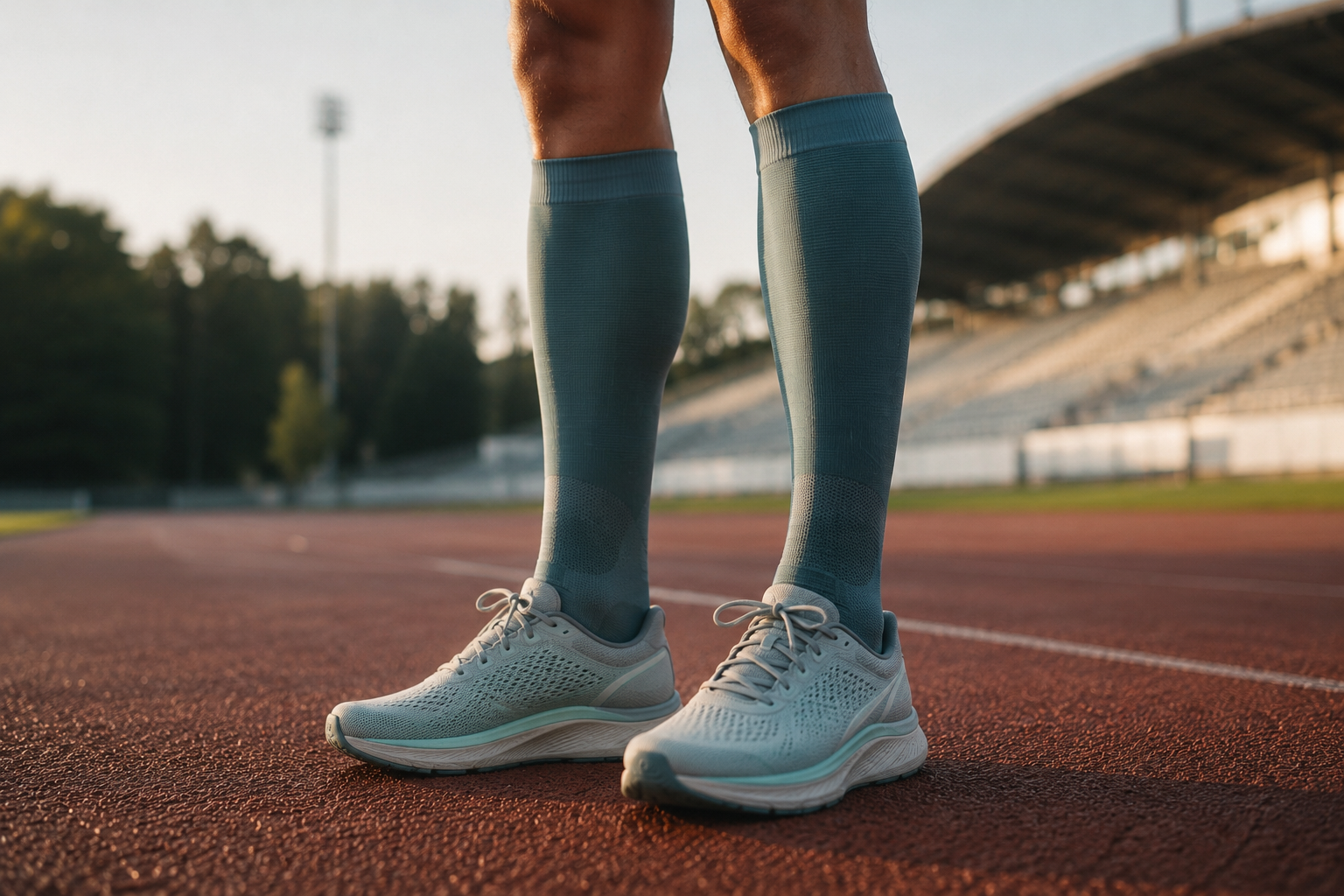
Most of the strongest research, including the DVT travel trials and a large share of the DOMS and strength-recovery trials, was conducted using full-length socks or stockings reaching to the knee or above, applying pressure across the calf where the largest volume of venous blood pools during sitting or standing. Calf-specific compression has the most direct line to the venous-return mechanism described earlier, which is one reason knee-high compression socks are the most consistently studied garment type in this entire field.
Compression sleeves, which cover only the calf without a foot section, and full compression tights, which extend up through the thigh and hip, have been studied less extensively and with more mixed designs. Sleeves are popular among runners specifically because they are easy to add or remove mid-race without changing shoes, but that convenience does not come with the same depth of supporting research as full socks. Full tights covering the thigh add potential benefit for quadriceps and hamstring soreness, which calf-only garments cannot address, though the trial base for upper-leg compression is comparatively thin. The practical implication: if you are choosing gear based specifically on the evidence in this piece, knee-high compression socks are the best-studied option, not necessarily because sleeves or tights don’t work, but because fewer controlled trials have tested them directly.
Where Compression Gear Is Genuinely Worth It
Stripping out the overstated claims still leaves a reasonably useful short list.
Long-haul travel
This is the strongest-evidence use case of everything covered here. If you are sitting still for five or more hours, 15–30 mmHg graduated compression socks reduce leg swelling and lower the odds of forming a symptomless blood clot, based on high-certainty randomized trial data. For anyone with a personal or family history of clotting issues, this is worth discussing with a physician rather than treating as optional gear.
Managing next-day soreness around a hard training block
If you have a race, a second training session, or simply want to feel less stiff the day after leg day or a long run, wearing compression garments (roughly 15–25 mmHg) in the hours after training and overnight has moderate support for reducing perceived soreness and speeding measured strength and power recovery. It will not replace sleep, protein intake, or a sensible training load, but it is a low-risk addition on top of those basics.
Older adults working on balance and fall prevention
The proprioception research, while still developing, points toward clinical-grade compression socks (20–30 mmHg) as a genuinely inexpensive tool that may sharpen ankle position sense in older adults, which is directly relevant to fall risk. This is a narrower, more specific use case than “athletic performance,” and the evidence fits that narrower claim better.
Where It’s Mostly Marketing
Two claims deserve real skepticism. First, that wearing compression during a race or workout will make you measurably faster: the pooled running-performance literature does not back this up once enough trials are combined. Second, that compression accelerates true tissue healing rather than easing the sensation of soreness and supporting measured strength recovery: those are related but distinct outcomes, and the marketing language often blurs them into one.
“Compression socks on a long flight are one of the better-supported pieces of gear you can buy. Compression socks promising a faster 10K are not.”
Choosing and Using Compression Gear Sensibly
A few practical points follow directly from the pressure-rating research above.
Match the pressure to the goal. For everyday recovery wear or travel, 15–25 mmHg covers most of what the research actually tested. Going higher than 30 mmHg without a prescription and a proper fitting is not “more effective,” it is a different clinical category intended for diagnosed venous conditions, and an ill-fitting high-pressure garment can restrict circulation rather than help it.
Fit matters more than brand. Graduated compression only works as designed when sizing matches your calf and ankle circumference. A garment that is too small for your leg will not apply a proper gradient, and one that is too large will not apply meaningful pressure at all. Most manufacturers publish a sizing chart based on circumference measurements; use it rather than guessing from shoe size.
Timing follows the evidence, not tradition. The DOMS and strength-recovery research generally applied compression garments in the hours immediately after exercise and through the following 24 to 72 hours, not necessarily during the workout itself. If your primary goal is next-day recovery, post-exercise wear is where the data actually points.
Do not expect it to replace training fundamentals. Sleep, progressive training load, and adequate protein and calorie intake have larger and more consistent effects on recovery than any garment. Compression gear is a modest add-on, not a substitute.
Watch for warning signs of a garment that is too tight. Numbness, tingling, discoloration of the toes, or pain that increases rather than eases after putting a compression garment on are signs the pressure or the fit is wrong for your leg. Graduated compression is meant to feel snug and supportive, not painful or numbing; those symptoms warrant removing the garment and reassessing sizing rather than pushing through, and anyone with diagnosed circulatory conditions should get a fitting recommendation from a clinician rather than choosing a pressure level independently.
Track how you actually respond, not just how the label reads. Individual variation in the DOMS and strength-recovery trials was considerable. Some participants showed a clear benefit, others showed almost none, which is normal for an intervention with a moderate, not strong, average effect size. Treating a few weeks of personal trial and error, comparing how you feel and perform with and without the garment across similar training sessions, as more informative than a single product review is a reasonable way to decide whether it is worth keeping in your kit.
Frequently Asked Questions
Do compression socks actually reduce muscle soreness after a workout?
Yes, with moderate supporting evidence. A 2014 meta-analysis in the British Journal of Sports Medicine found a moderate reduction in delayed-onset muscle soreness when compression garments were worn after muscle-damaging exercise, with the effect measured out to 72 hours (Hill et al., 2014).
Can compression garments make me run faster or improve endurance performance?
Not reliably. An updated 2025 systematic review and meta-analysis in the Journal of Sport and Health Science concluded that compression garments do not produce a meaningful performance benefit for runners once all available trials are pooled together (Wang et al., 2025).
What mmHg level should I choose for exercise recovery versus a long flight?
Both use cases are well covered by 15–25 mmHg graduated compression, which is the range used in most of the underlying DOMS and travel-related trials. Higher pressures (30 mmHg and above) are intended for diagnosed medical conditions and generally require a professional fitting.
Is there a real clotting risk on flights, and do compression socks help?
Prolonged sitting on long flights is a recognized risk factor for blood clots forming in the legs. A Cochrane review found high-certainty evidence that graduated compression stockings sharply cut the rate of symptomless DVT on flights of five or more hours, with far fewer cases among stocking-wearers than non-wearers across pooled trial data (Clarke et al., 2021).
Do compression garments help with balance or joint awareness?
There is early, weak-to-moderate evidence for this, strongest in older adults. A 2021 study in PLOS ONE found that clinical-grade compression socks (20–30 mmHg) improved ankle joint position sense in older adults compared to bare skin, though lower-pressure or non-graduated socks did not show the same benefit (Woo et al., 2021).
Does wearing compression gear speed up actual muscle tissue repair, not just how sore I feel?
The current research does not show that. Studies demonstrate reduced perceived soreness and some reduction in a blood marker of muscle damage (creatine kinase), plus faster recovery of measured strength and power, but none demonstrate accelerated structural regeneration of muscle fibers. Feeling and testing better is a real, worthwhile outcome; it is a different claim from tissue healing itself being faster.
References
- Hill, J., Howatson, G., van Someren, K., Leeder, J., & Pedlar, C. (2014). Compression garments and recovery from exercise-induced muscle damage: a meta-analysis. British Journal of Sports Medicine. https://doi.org/10.1136/bjsports-2013-092456
- Yu, L., Feng, L., Liu, X., Lv, Y., Li, G., Du, L., Su, H., & Li, X. (2025). Effects of Compression Garments on Muscle Strength and Power Recovery Post-Exercise: A Systematic Review and Meta-Analysis. Life, 15(3), 438. https://doi.org/10.3390/life15030438
- Woo, M. T., Davids, K., Chow, J. Y., & Jaakkola, T. (2021). Acute effects of wearing compression knee-length socks on ankle joint position sense in community-dwelling older adults. PLOS ONE. https://doi.org/10.1371/journal.pone.0245979
- Clarke, M. J., et al. (2021). Compression stockings for preventing deep vein thrombosis in airline passengers. Cochrane Database of Systematic Reviews. https://doi.org/10.1002/14651858.CD004002.pub4
- Wang, W., Wang, Y., Zhang, Y., Si, D., Li, X., Liang, Q., Li, Q., Huang, L., Wei, S., & Liu, Y. (2025). Do compression garments enhance running performance? An updated systematic review and meta-analysis. Journal of Sport and Health Science. https://doi.org/10.1016/j.jshs.2025.101028
- Influence of compression garments on proprioception: A systematic review and meta-analysis. (2024). Annals of the New York Academy of Sciences. https://doi.org/10.1111/nyas.15144