
























By Ada L. Wrenford
Every piece of home strength equipment makes the same pitch: buy me and you will finally stick with strength training. Some of them deliver on that promise for ten dollars. Others cost several hundred and still end up as a coat rack by March. The difference usually isn’t the equipment’s quality. It’s whether the thing actually lets you hit enough different, genuinely useful exercises to build a full-body routine without needing a second or third purchase.
This guide ranks the most common home strength options by cost per useful exercise: the retail price divided by the number of distinct, well-supported movements the equipment can perform safely at home for most adults. A jump rope might be cheap, but it only does one thing. A pair of adjustable dumbbells costs more upfront but covers two dozen exercises across every major muscle group. That ratio, more than sticker price alone, is what determines whether a purchase earns its shelf space.
The federal Physical Activity Guidelines for Americans, as summarized by the CDC, recommend that adults do muscle-strengthening activity involving all major muscle groups (legs, hips, back, abdomen, chest, shoulders, and arms) on 2 or more days a week. Mayo Clinic’s guidance on strength training puts a similar number on it: at least two sessions a week, 20 to 30 minutes each, with one set of 12 to 15 repetitions often enough to produce a health benefit. Neither guideline says you need a rack of chrome plates to meet it. What you need is equipment that covers enough movement patterns that two sessions a week don’t feel repetitive within a month. (Full source links are in the References section below.)
As always with new exercise programs, check with a doctor first if you have an existing health condition, are recovering from an injury, or haven’t exercised in a while. Everything below is general information, not individualized medical advice.
How “cost per useful exercise” is calculated
For each equipment category, we counted exercises that meet three criteria:
- Distinct movement pattern. A goblet squat and a front squat with the same kettlebell don’t count twice; they’re the same pattern loaded slightly differently. We counted push, pull, hinge, squat, carry, and rotation patterns, plus their major variations (single-arm rows count separately from bent-over rows because they change stability demands and unilateral loading).
- Reasonably safe without a spotter or coach. Exercises that typically require supervision, like a heavy barbell back squat for a total beginner, were counted but flagged with caveats rather than excluded outright.
- Actually targets a major muscle group, consistent with the CDC’s list: legs, hips, back, abdomen, chest, shoulders, and arms.
Prices reflect typical mid-range retail costs for reasonably durable versions of each item at the time of writing, not the cheapest or most premium options on the market. Because prices shift and vary by region and retailer, treat the dollar figures here as ballpark planning numbers rather than exact quotes, and compare current listings before buying.
Quick Answer
Resistance bands and a doorway pull-up bar deliver the lowest cost per useful exercise of anything on this list. Adjustable dumbbells cost more upfront but have the best long-term ceiling for a single-purchase home gym. Cable-style functional trainers and squat racks are the most expensive per exercise and only make sense once you’ve outgrown the cheaper tiers.
The ranking: home strength equipment by cost per useful exercise
Here’s how the major categories stack up, from lowest cost per exercise to highest. “Useful exercises” reflects the count of distinct, major-muscle-group movements each item supports at home.
A few patterns jump out. Bands and a pull-up bar are the cheapest way to touch every major muscle group the CDC guidance calls out. Kettlebells and suspension trainers sit in a similar low-cost tier while adding load progression that bands can’t fully replicate. Adjustable dumbbells cost more per exercise than the cheapest tier, but they’re the last piece of equipment most people ever need to buy, because the exercise count keeps climbing as you add accessories like a bench. Barbells, squat racks, and cable machines are the most expensive per exercise on this list, largely because a big share of their cost buys stability and safety rather than additional movement variety.
Category breakdowns: what you actually get for the money
Resistance bands: the best cost-per-exercise ratio, with real limits
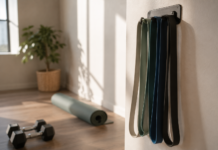
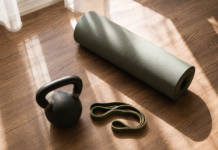
A basic set of loop bands and one or two tube bands with handles supports rows, presses, curls, triceps extensions, lateral raises, pull-aparts, squats, hip thrusts, monster walks, and anti-rotation core work. That’s most of a full-body program for the price of a casual dinner out.
The tradeoff is resistance curve and ceiling. Bands get harder as they stretch, so the hardest part of the movement is usually at the end range rather than matched to where your muscles are strongest, which is different from how a dumbbell or barbell loads a lift. Bands also cap out: once someone can comfortably do 25+ reps against the heaviest band, in a set, it’s time to add load elsewhere. For a true beginner or someone returning to activity after time off, that ceiling is often years away, not months.
“You can do many exercises with little or no equipment. Try pushups, pullups, planks, lunges and squats. Resistance tubing is another inexpensive, lightweight option, which gives resistance when stretched.” — Mayo Clinic, on accessible strength training options
Kettlebells: one object, a dozen patterns
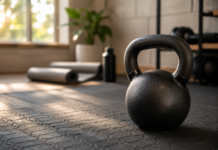
A single kettlebell of an appropriate weight covers swings, goblet squats, cleans, presses, rows, Turkish get-ups, farmer’s carries, and windmills. The swing and carry patterns in particular are hard to replicate cheaply with any other single piece of equipment, and they train hip hinge power and grip endurance that most home routines otherwise skip.
The catch is that one kettlebell locks you into one weight. Serious progress on presses or goblet squats eventually calls for a second, heavier bell, which changes the cost-per-exercise math since you’re not adding new exercises, just extending the ones you already had. Anyone planning to keep at this for more than a few months should budget for that second kettlebell from the start rather than treating a single one as a complete solution.
Adjustable dumbbells: the highest exercise count of any single product
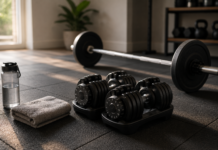
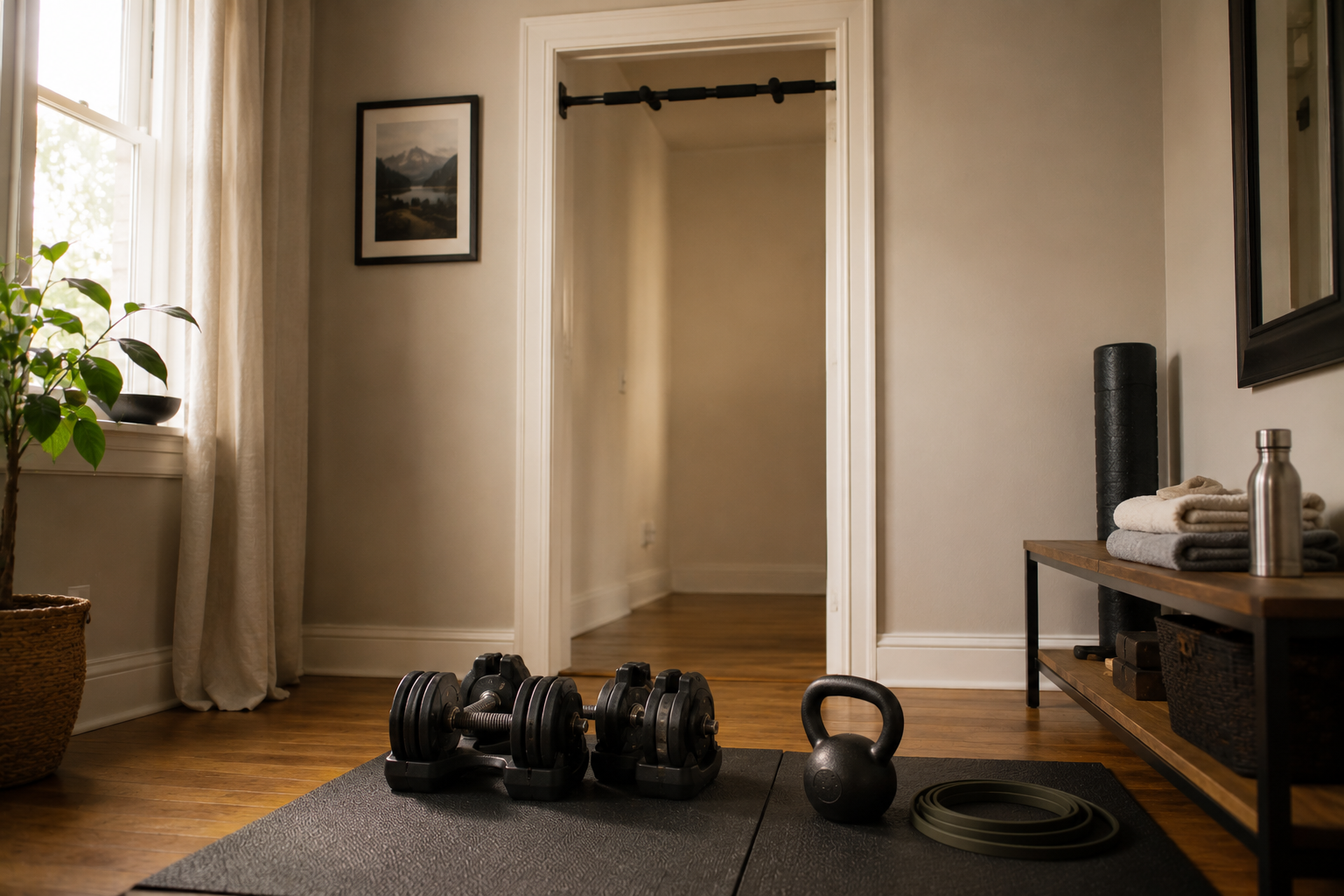
This is the category that most often turns into a genuine one-and-done purchase. A pair of adjustable dumbbells that ranges from roughly 5 to 50 pounds per hand covers presses (flat, incline, overhead), rows, curls, triceps work, lateral and front raises, goblet squats, lunges, step-ups, Romanian deadlifts, and floor presses, and every one of those can progress in small increments as strength improves.
The upfront cost is the highest of the “starter” tier equipment, several times what a resistance band set costs. But because the exercise count is also the highest of any standalone product, the cost per exercise still lands well below a barbell setup or a squat rack. Add an adjustable bench later, and the same dumbbells unlock several more exercises (incline press, step-ups, single-leg work) without needing anything new except the bench itself.
Suspension trainers: portable, but harder for true beginners to load safely
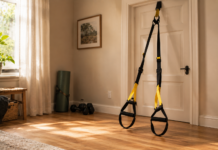
A suspension trainer anchored over a door covers rows, presses, triceps extensions, hamstring curls, planks, pikes, and lunges, using body weight rather than external load. The number of exercises is genuinely high for the price. The tradeoff is that regulating difficulty means changing your body angle rather than adding weight plates, which takes some practice to feel comfortable with, and a few of the harder variations (pikes, single-arm rows) are demanding on the shoulders if attempted too soon.
Barbells, squat racks, and cable machines: better per-pound, worse per-exercise
These three categories deliver superior long-term loading capacity. A barbell can eventually carry hundreds of pounds; a kettlebell or dumbbell pair usually can’t scale that far without buying an entirely new, heavier set. That’s a real advantage for someone with several years of consistent training ahead of them.
But for the purposes of this ranking, a large share of what you pay for with a rack or cable machine is safety infrastructure (the rack’s ability to catch a failed heavy squat, the cable’s smooth pulley system) rather than new movement variety. A squat rack mostly exists to make barbell squats and presses safer at higher weight; it doesn’t add exercises the barbell wasn’t already capable of. That’s why these categories post the highest cost-per-exercise numbers in the table above even though they’re the equipment most serious lifters eventually want.
A simple decision path
Step-by-step: choosing your first purchase
- Budget under $40 and want to start immediately: resistance band set. Covers most major muscle groups the same week it arrives.
- Have a doorway and want pulling strength covered: add a pull-up bar. Pulling exercises are the hardest pattern to train well with bands alone.
- Budget of $50–$150 and want one object that does the most: a single kettlebell or a suspension trainer, depending on whether you prefer loaded strength work (kettlebell) or bodyweight control work (suspension trainer).
- Ready to commit to strength training for the next year or more: adjustable dumbbells. Highest exercise count, clearest progression path, least likely purchase to regret.
- Already training consistently and want to push past what dumbbells allow: barbell and plates, later a rack if budget and space allow. Not a starting point for most people.
What the research and guidelines actually support
None of this ranking is about finding a shortcut around consistent effort. The CDC’s guidance is that adults get muscle-strengthening activity on 2 or more days a week, hitting the major muscle groups: legs, hips, back, abdomen, chest, shoulders, and arms. Mayo Clinic frames a workable minimum as two sessions a week of 20 to 30 minutes, with one set of 12 to 15 repetitions often enough to produce a benefit, and recommends resting a full day between sessions targeting the same muscle group. The NHS gives essentially the same frequency advice: strength exercises at least twice a week, and its home-exercise guidance explicitly includes basic tools like light weights or filled water bottles as legitimate starting equipment, alongside bodyweight moves like sit-to-stands and wall press-ups.
The larger point behind all three sources is that the equipment matters far less than showing up twice a week and working all the major muscle groups. The CDC also notes that adults who meet both the aerobic and muscle-strengthening guidelines see meaningfully better health outcomes, including being about half as likely to die from flu and pneumonia in the data it cites, and that physically active middle-aged and older adults have a lower risk of functional limitations as they age. An estimated 110,000 deaths a year among U.S. adults over 40 could be prevented with higher activity levels overall, per the CDC’s summary of the evidence. None of that depends on a $900 squat rack. It depends on picking equipment you’ll actually use twice a week and progressing it over time.
Common mistakes that inflate cost per exercise
- Buying a full rack before testing consistency. If two sessions a week for eight weeks hasn’t happened yet with bands or a single kettlebell, a bigger purchase won’t fix that. It just raises the amount of unused equipment sitting in a corner.
- Buying fixed-weight dumbbells in only one pair. A single fixed pair covers fewer exercises over time than adjustable dumbbells, because you can’t scale the load as you get stronger; you end up needing several pairs, which quietly multiplies the real cost.
- Skipping a bench and assuming dumbbells alone cover everything. Floor presses are a fine substitute for a bench press, but incline work and several core and single-leg variations genuinely need an elevated surface. A basic bench is a comparatively cheap add-on for the exercises it unlocks.
- Underestimating grip and floor space needs. Kettlebell swings and barbell work need more clearance than most apartments’ living rooms comfortably offer. Measure the actual space before buying, not after.
Putting a routine together with low-cost equipment
A resistance band set plus a pull-up bar, for well under $80 combined, can support a genuine full-body routine hitting every muscle group the CDC guidance names: banded squats and hip thrusts for legs and hips, rows and pull-ups (or assisted variations) for the back, banded presses for chest and shoulders, curls and triceps extensions for the arms, and anti-rotation or plank work for the abdomen. That’s a complete twice-weekly program without buying anything else, and it’s a reasonable place to stay for months before deciding whether to expand.
Where budget allows a bit more, adding a single kettlebell or moving straight to adjustable dumbbells extends the same routine’s progression window by roughly a year or more before anyone would need to buy additional equipment purely because they’ve outgrown what they own. That’s the practical heart of cost per useful exercise: it’s not just what something costs today, it’s how long it postpones your next purchase.
Durability and long-term value: the cost side of the equation
Cost per exercise only tells half the story if the equipment falls apart in a year. Resistance bands are the category most prone to wearing out: the rubber degrades with UV exposure and repeated stretching, and a band that’s been stored near a sunny window or used daily for months can develop micro-tears that eventually snap under tension. Most people get one to two years of regular use from a decent set before replacement makes sense, which is still an excellent return given the original price, but it does mean the true cost per exercise over a five-year span is a bit higher than the sticker price suggests if you replace a set every 18 months or so.
Kettlebells, dumbbells, and barbells rarely wear out in any meaningful sense. A cast-iron kettlebell bought today will still work exactly the same way in twenty years short of serious rust from being left outside in the rain. That durability is a quiet part of the cost-per-exercise calculation: a $60 kettlebell used twice a week for a decade works out to a fraction of a cent per session, which no subscription fitness app or gym membership can match.
Cable machines and suspension trainers fall in between. The straps and pulleys on both have moving parts and stitched or woven components that can fray with heavy use, though quality versions from established brands typically hold up for years of regular training before any part needs replacing. Check the manufacturer’s stated weight capacity and stitching quality before buying either, since the cheapest versions of both categories are where corners tend to get cut.
Space and setup considerations that affect the real cost
None of the pricing above accounts for space, but space has its own cost if you live somewhere compact. A resistance band set and a doorway pull-up bar store in a drawer and a doorframe respectively, adding essentially zero footprint to a room. A kettlebell or a pair of adjustable dumbbells needs a couple of square feet of floor space, usually tucked in a corner or under a bed. A bench, a barbell with plates, and especially a squat rack need a dedicated few square feet of permanent floor space that most apartments and smaller homes can’t spare without giving up a functional part of a room.
That’s worth factoring in before comparing raw cost-per-exercise numbers. A squat rack might make excellent sense for someone with a garage or basement to dedicate to it. The same purchase in a 600-square-foot apartment effectively costs more than its price tag, because it forces a tradeoff against living space that a band, kettlebell, or dumbbell set never requires. When comparing options, it helps to walk through the actual room where equipment will live and picture it there, not just on a comparison chart.
Frequently asked questions
Is it actually possible to build meaningful strength with just resistance bands?
Yes, at least through a beginner and intermediate phase. Bands provide progressive resistance and can train every major pattern the CDC guidance lists. The main limitation shows up later, once someone can comfortably move the heaviest band for high reps and needs a way to keep adding load, which is where dumbbells or a heavier band system typically get introduced.
How many home strength items does a typical person actually need?
Most people can run a complete program indefinitely on two or three items: a resistance band set or a kettlebell to start, then adjustable dumbbells, and eventually a bench. Beyond that, additions like a barbell or rack are for people specifically chasing heavier loads than dumbbells can provide, not a requirement for general health benefits.
Are adjustable dumbbells worth the higher upfront cost compared to a fixed pair?
For most home users, yes. A fixed pair is cheaper at first but only covers one weight, so reaching a useful range of loads (say, 10 to 40 pounds per hand) means buying several pairs over time, which usually costs more in total and takes up far more space than one adjustable set.
Do I need a squat rack or barbell to get real results at home?
No. Both the CDC guidelines and Mayo Clinic’s recommendations describe the benefit threshold as two sessions a week covering the major muscle groups, which bodyweight moves, bands, a kettlebell, or dumbbells can all satisfy. A rack and barbell mainly matter once someone is deliberately pursuing heavier loads than dumbbells can offer, which is a later-stage goal for most home exercisers, not a starting requirement.
What’s the safest way to start if I haven’t exercised in a long time?
Start with bodyweight and light-resistance options, such as the chair-based and wall exercises the NHS describes, or light bands, and check with a doctor first if you have an existing health condition or haven’t been active recently. Mayo Clinic also recommends learning proper form, ideally with a trainer or fitness specialist if you’re new to strength work, and stopping any exercise that causes pain.
How often should I actually work out with this equipment?
Both the CDC and Mayo Clinic point to at least two sessions a week covering all major muscle groups, with a full rest day between sessions that target the same muscle group. Mayo Clinic notes that 20 to 30 minutes per session, with one set of 12 to 15 repetitions per exercise, is often enough to produce a health benefit.
References
- Centers for Disease Control and Prevention, Physical Activity Guidelines for Adults
- Centers for Disease Control and Prevention, Benefits of Physical Activity
- Mayo Clinic, Strength training: Get stronger, leaner, healthier
- NHS, Strength exercises