





















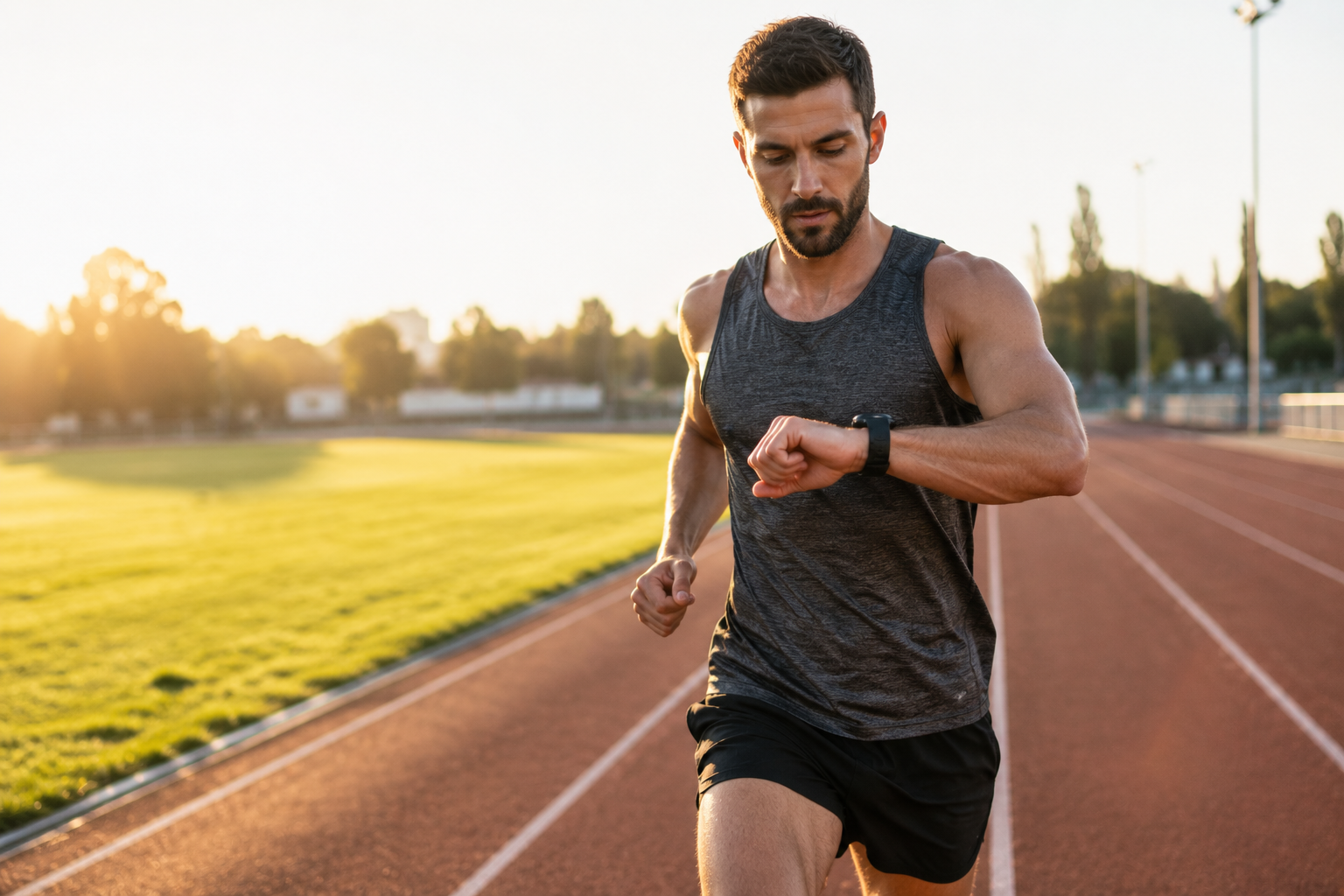
A metabolic cart is the gold-standard way to measure VO2max: you breathe into a mask while a machine analyzes every liter of oxygen you consume and carbon dioxide you exhale during a graded treadmill or bike test. It is precise, but it is also expensive, located mostly in university exercise labs and specialty performance centers, and not something most runners, cyclists, or weekend athletes can access on a random Tuesday. The good news is that exercise scientists have spent decades building field tests that estimate VO2max using nothing more than a stopwatch, a measured distance, and sometimes a heart rate monitor. None of these methods produce a lab-grade number, but several have been validated against metabolic cart data closely enough to give you a genuinely useful estimate of your aerobic fitness.
This guide walks through three validated field tests you can run yourself, explains how wearable-estimated VO2max compares to lab measurements, shows you how to interpret whatever number you land on, and outlines what actually moves that number over months of training.
A note on safety before you start: Several of the tests below (particularly the Cooper 12-Minute Run Test) ask you to run at close to maximal effort for an extended period. That kind of near-maximal exertion is generally safe for healthy, physically active adults, but if you have known cardiovascular disease, uncontrolled high blood pressure, chest pain with exertion, a family history of early heart disease, or you have been inactive for a long stretch, get medical clearance from a physician before attempting a maximal or near-maximal field test.
A submaximal option (the step test, described below) is a lower-risk starting point for anyone unsure of their cardiovascular status.
What “estimating” VO2max actually means
Every field test in this guide works the same way: it measures something that correlates strongly with oxygen uptake (distance covered, walking time and heart rate, or heart rate recovery after a fixed workload) and plugs that number into a regression equation built from data collected on real people who also had their VO2max measured directly in a lab. The equation is only as good as the population it was built on and how closely your body, fitness level, and testing conditions match that original sample. That is why field-test results are estimates with a margin of error, not substitutes for a metabolic cart reading. Treat the number as a training guide and a way to track your own trend over time, not as a medical-grade lab value.
Preparing for any field test
A field test only produces a meaningful number if you show up in a repeatable state. A handful of small preparation habits make the difference between a result you can trust and one that mostly reflects how tired or dehydrated you happened to be that day.
- Rest beforehand. Avoid hard training the day before a maximal or near-maximal test. A tired body will underperform regardless of true fitness.
- Hydrate normally. Neither over-hydrating nor showing up dehydrated; just follow your usual daily intake.
- Test at a similar time of day each time you retest. Heart rate, body temperature, and perceived effort all shift across the day, so comparing a morning test to an evening test introduces noise you do not need.
- Wear the same shoes and use the same course. Surface, grade, and footwear all affect running economy and, therefore, the distance you can cover in a fixed time.
- Skip caffeine and stimulant pre-workouts if you plan to compare results over time. They can shift heart rate and perceived exertion enough to distort a submaximal test like the Rockport walk or the step test.
None of this needs to be complicated. The goal is simply consistency: the same conditions every time you test, so that any change in your result reflects a change in fitness rather than a change in circumstances.
Field Test 1: The Cooper 12-Minute Run Test
Developed by Dr. Kenneth Cooper in 1968 for the U.S. Air Force, this is one of the oldest and most widely used field tests for aerobic capacity. It requires nothing but a track or a measured flat course and a way to time 12 minutes.
Step-by-step instructions
- Warm up for 8-10 minutes. Light jogging plus a few strides at a faster pace prepares your legs and cardiovascular system for near-maximal effort.
- Find a flat, measured course. A standard 400-meter track works well because it removes the guesswork of measuring distance.
- Start your timer and begin running. Pace yourself to cover as much ground as possible in exactly 12 minutes. Walking is allowed if you need to recover, but the goal is to minimize walking time.
- Record your total distance the moment the 12 minutes ends. Note it in miles or kilometers.
- Calculate your estimated VO2max using Cooper’s original formula:
Metric: VO2max = (22.351 x distance in km) – 11.288
Imperial: VO2max = (35.971 x distance in miles) – 11.288 - Cool down with 5-10 minutes of easy walking.
Cooper’s original research found a correlation of roughly 0.90 between distance covered and measured VO2max, which is why this formula has stayed in circulation for more than 50 years. That said, more recent validation work has found the original equation does not transfer perfectly to every population. A 2015 study on Indian male university students found the standard formula overestimated lab-measured VO2max by a meaningful margin, even though the underlying relationship between distance and oxygen uptake remained strong (r = 0.93). The researchers had to build a population-specific equation to close the gap. The takeaway: the Cooper test is excellent for tracking your own progress over time, but treat the absolute number with a bit of skepticism if your age, sex, training background, or fitness level differs substantially from young, moderately fit adults.
Field Test 2: The Rockport 1-Mile Walk Test
The Rockport test was built specifically as a lower-impact alternative to running tests, which makes it a reasonable option for beginners, older adults, or anyone easing back into structured exercise. It is submaximal, meaning you do not need to sprint to get a valid result.
Step-by-step instructions
- Warm up for 5-10 minutes with easy walking and light mobility work.
- Walk one mile as fast as you can on a flat track or treadmill while remaining in a walk the entire time (no jogging).
- Record your finishing time to the nearest few seconds.
- Take your heart rate immediately after crossing the mile mark, either by palpating your pulse for 15 seconds and multiplying by four, or by reading a chest strap or watch.
- Plug your numbers into the sex-specific formula:
Women: VO2max = 132.853 – (0.0769 x weight in lbs) – (0.3877 x age) – (3.2649 x walk time in minutes) – (0.1565 x heart rate)
Men: use the same formula, then add 6.315 - Cool down with 5 minutes of easy walking.
Validation research has reported a correlation coefficient around 0.88 between the Rockport formula and directly measured VO2max, and the protocol has separately been validated as a reliable alternative to a 1.5-mile maximal run test in U.S. Air Force personnel. Because it does not require sustained high-intensity effort, it is a sensible starting point if you have been sedentary or you are simply not ready to run near your limit yet.
Field Test 3: The Queens College Step Test
This test estimates VO2max from your heart rate response to a fixed, submaximal workload rather than from distance or speed, and it can be done indoors on a single step or sturdy box.
Step-by-step instructions
- Set up a 16.25-inch (41 cm) step or platform. A sturdy aerobic step with enough risers usually works.
- Warm up briefly with a couple of minutes of easy movement.
- Step up and down for 3 minutes at a set cadence: 22 steps per minute for women, 24 steps per minute for men, following a four-count “up, up, down, down” pattern, ideally paced with a metronome or app.
- Stop after exactly 3 minutes and remain standing.
- Count your pulse for 15 seconds starting 5 seconds after you stop, then multiply by four to get beats per minute.
- Apply the sex-specific formula:
Women: VO2max = 65.81 – (0.1847 x heart rate)
Men: VO2max = 111.33 – (0.42 x heart rate)
Because the workload is fixed and submaximal rather than an all-out effort, this test carries lower cardiovascular strain than the Cooper run or a maximal treadmill test, which makes it a reasonable first option if you are deconditioned, returning from a long layoff, or simply want a lower-intensity way to establish a baseline before attempting a harder test.
Comparing the three field tests
Each test trades off intensity, equipment, and accuracy differently. The table below summarizes the practical differences so you can pick the one that fits your fitness level and available space.
| Test | Duration | Equipment | Effort Level | Reported Correlation to Lab VO2max | Best For |
|---|---|---|---|---|---|
| Cooper 12-Minute Run | 12 minutes | Track or measured course, stopwatch | Near-maximal | r ~ 0.90 | Runners with a base fitness level |
| Rockport 1-Mile Walk | 10-18 minutes | Flat mile course, heart rate monitor | Submaximal | R ~ 0.88 | Beginners, older adults, low-impact needs |
| Queens College Step Test | 3 minutes | 16.25-inch step, metronome | Submaximal, fixed workload | Moderate | Indoor testing, deconditioned individuals |
How wearable-estimated VO2max compares to lab-measured values
Smartwatches and fitness bands from Garmin, Apple, and other manufacturers now display an “estimated VO2max” on the home screen, usually derived from a combination of resting heart rate, running pace, heart rate during runs, and GPS pace data collected passively during your normal training. It is convenient because it updates without you doing anything, but the accuracy story is mixed.
A 2024 validation study published in JMIR Biomedical Engineering compared Apple Watch Series 7 VO2max estimates against lab-measured values from graded exercise testing. The lab average came out to 45.88 mL/kg/min, while the Apple Watch estimated 41.37 mL/kg/min on average, a statistically significant underestimation. The study reported a mean bias of -4.51 mL/kg/min, a mean absolute percentage error of 15.79%, a root mean square error of 8.85 mL/kg/min, and an intraclass correlation coefficient of just 0.47, which indicates poor agreement between the two methods at the individual level even though the group-level averages were in a similar range.
What makes this more relevant for anyone using a watch to track progress is that the error was not uniform across fitness levels. Participants classified as having “poor” fitness saw their VO2max overestimated by the watch by about 3.80 mL/kg/min on average, while participants in the “excellent” fitness category were underestimated by a much larger 12.00 mL/kg/min. In other words, if you are already quite fit, your watch is more likely to undersell your true aerobic capacity, and if you are new to training, it may flatter you slightly. A separate industry comparison of consumer wearables against metabolic cart data during a supervised training intervention found similar directional issues, with device-based estimates drifting from measured values as training status changed over the course of the intervention.
None of this means wearable VO2max numbers are useless. They are convenient for spotting broad trends (is the number moving up or down over months of training), but they should not be treated as interchangeable with a lab test or even with a properly executed field test, particularly if you are near either end of the fitness spectrum.
Interpreting your result
Once you have a number, from a field test, a watch estimate, or both, the next question is what it actually means. VO2max is typically expressed in milliliters of oxygen consumed per kilogram of body weight per minute (mL/kg/min), and normative ranges are usually broken out by age and sex because aerobic capacity naturally declines with age and differs by sex due to body composition and hemoglobin differences.
Reading Your VO2max Number
Fitness categories commonly used by field-test and wearable calculators (approximate; exact cutoffs vary slightly by source and age bracket):
- Below average: Noticeably lower than same-age, same-sex peers; a reasonable starting point for building an aerobic base.
- Average: Typical for a generally healthy, moderately active adult of your age and sex.
- Above average: Consistent with regular structured cardio training.
- Excellent: Typical of dedicated endurance athletes; often requires years of consistent, progressive training to reach.
Because VO2max declines by roughly 1% per year on average after your late twenties without training intervention, comparing your number only to your own history, rather than chasing a single “good” number for your age, is usually the more useful long-term approach.
If you retest with the same protocol every 8-12 weeks, under similar conditions (similar time of day, similar hydration status, similar recent training load), the trend line matters more than any single session’s number. A field test result that jumps around by a few points from one week to the next is normal test-retest variability, not necessarily a real change in fitness.
Improving your VO2max over time
VO2max responds to a fairly narrow set of training stimuli, and the research on this is consistent across decades of exercise physiology literature.
- Build an aerobic base with easy-paced training. The majority of your weekly training volume, roughly 70-80% for most recreational athletes, should sit at a conversational, easy effort. This grows capillary density, mitochondrial content, and stroke volume, all of which raise your ceiling for oxygen delivery and use.
- Add structured high-intensity intervals. Sessions performed near or above your current VO2max intensity (short, hard efforts of roughly 3-5 minutes with recovery between them) are one of the most time-efficient ways to directly stimulate VO2max adaptations. One to two sessions per week is typically enough for most people.
- Be consistent for months, not weeks. Meaningful VO2max improvements in previously untrained or moderately trained individuals commonly take 8-12 weeks of consistent training to show up clearly on a retest, and continued gains slow as you approach your genetic ceiling.
- Prioritize recovery and sleep. Adaptations happen between sessions, not during them. Adequate sleep and rest days are part of the stimulus-recovery-adaptation cycle, not optional extras.
- Track trend, not noise. Retest with the same field test under similar conditions every couple of months rather than trying to interpret single-session fluctuations.
Genetics set a real ceiling on how high your VO2max can eventually climb, but most people who are new to structured cardio training, or who have let training lapse, have meaningful room to improve with a consistent easy-plus-intervals approach over several months.
A simple weekly structure that reflects this balance, for someone training four days a week, might look like: two easy, conversational-pace sessions of 30-45 minutes, one interval session built around 4-6 repeats of 3-4 minutes at a hard but sustainable effort with equal recovery time between repeats, and one longer steady session at an easy-to-moderate pace. Beginners should start with fewer, shorter sessions and build volume gradually over several weeks rather than jumping straight into this structure, since the biggest risk at the start of a new training block is doing too much too soon and getting sidelined by injury or burnout before the aerobic adaptations have a chance to accumulate.
Conclusion
You do not need a metabolic cart and a lab coat to get a useful read on your aerobic fitness. The Cooper 12-Minute Run Test, the Rockport 1-Mile Walk Test, and the Queens College Step Test each give you a validated way to estimate VO2max with equipment most people already have access to: a stopwatch, a measured distance, and sometimes a heart rate monitor. Wearable estimates add convenience but carry a wider margin of error, particularly at the fit end of the spectrum, so treat them as a rough trend indicator rather than a precise number. Whichever method you choose, retest under consistent conditions every couple of months, follow the training principles above, and get medical clearance first if you have cardiovascular risk factors and plan to attempt a near-maximal test.
Frequently Asked Questions
How accurate is a field-test VO2max estimate compared to a lab test?
It depends on the test and how closely you match the population it was validated on. The Cooper test and Rockport test both show correlations in the 0.88-0.90 range with lab-measured VO2max in their validation research, which is reasonably strong, but individual results can still be off by several mL/kg/min. Use the number as an estimate and training guide, not a diagnostic-grade value.
Which field test is best if I am a beginner or have joint issues?
The Rockport 1-Mile Walk Test or the Queens College Step Test are lower-impact and submaximal, making them more appropriate starting points than an all-out running test if you are new to exercise, returning from injury, or managing joint pain.
Is it safe to attempt a maximal-effort field test if I have cardiovascular risk factors?
Not without medical clearance first. Near-maximal exertion tests like the Cooper 12-Minute Run raise heart rate and blood pressure substantially. If you have known heart disease, uncontrolled hypertension, chest pain during exertion, or a family history of early cardiac events, talk to a physician before attempting a maximal or near-maximal test, and consider starting with the submaximal step test instead.
Can I just rely on my smartwatch’s VO2max estimate instead of doing a field test?
You can use it as a rough trend indicator, but validation research has found meaningful bias, particularly underestimation in highly fit individuals and overestimation in less fit individuals. A properly executed field test generally gives a more reliable one-time estimate than a passive watch algorithm.
How often should I retest my VO2max?
Every 8-12 weeks is a reasonable interval for most training blocks. Testing more frequently than that mostly captures normal day-to-day variability rather than real fitness change.
What is considered a good VO2max for my age?
Normative ranges vary by age, sex, and the specific classification source, and VO2max naturally declines by roughly 1% per year after your late twenties without training. Rather than chasing a single universal “good” number, compare your result to your own testing history using the same protocol each time.
References
- Cooper, K.H. (1968): original 12-minute run test protocol and distance-based VO2max formula. Summary via Topend Sports: Cooper 12-Minute Run Test.
- Validity of Cooper’s 12-minute run test for estimation of maximum oxygen uptake in male university students (PubMed).
- Rockport Walk Test: Calculator, Formula and VO2 Max (Marathon Handbook).
- Assessing the Accuracy of Smartwatch-Based Estimation of Maximum Oxygen Uptake Using the Apple Watch Series 7: Validation Study (JMIR Biomedical Engineering, 2024).
- Consumer Wearable-based VO2max Estimates Compared to Metabolic Cart During a Training Intervention (ResearchGate).
- The Cooper 12-Minute Run Test (PT Direct).