



























By Noah Sato
Forty-five minutes on a stationary bike at a pace where you could hold a conversation sounds easy on paper. In practice, it’s the workout most people quietly avoid. Zone 2 cardio is intentionally unglamorous: your heart rate sits around 60 to 70 percent of its maximum, you’re not gasping, and nothing about the session forces you to focus. That’s exactly what makes it effective for building aerobic base and mitochondrial capacity, and exactly what makes it feel like watching paint dry when you’re staring at the same wall in your living room.
Outdoors, a long steady run or ride comes with changing scenery, traffic to navigate, and weather to react to. Indoors, none of that exists. Your brain, understimulated by a workout that isn’t hard enough to demand attention, starts hunting for something to latch onto, and usually it finds the clock. This guide walks through a practical, step-by-step approach to making indoor zone 2 sessions tolerable, then genuinely enjoyable, without turning them into something they’re not supposed to be: an all-out effort.
None of the strategies below involve pushing harder, shortening the workout until it stops working, or buying expensive gear. The fixes are almost entirely about managing attention: what you put in front of your eyes and ears, how you break up the clock, who else is involved even indirectly, and how the physical room around you is arranged. Small adjustments in each of those four areas compound quickly, and most people notice a difference within the first week of applying even two or three of them consistently.
Why Long Steady Sessions Feel So Tedious Indoors
Zone 2 training works because it’s sustainable. You’re moving at an effort level low enough that fat oxidation and mitochondrial adaptation take center stage instead of the anaerobic systems that dominate at higher intensities. The Cleveland Clinic describes it as an effort that “should feel like a comfortable workout effort and something that you can do for a longer period of time,” typically landing in that 60 to 70 percent of max heart rate range for sessions of 30 minutes or more.
The tradeoff is psychological. A workout hard enough to hurt gives your brain a job: manage the discomfort, count down the intervals, survive. A workout easy enough to sustain for an hour gives your brain nothing to do, and an idle brain fixates on time. This is the same reason a 20-minute wait at the DMV feels longer than a 20-minute conversation with a friend. The activity itself hasn’t changed length, but the attention structure around it has.
Sports psychologists have studied this exact tension for decades. Research on attentional strategies, tracing back to Morgan and Pollock’s foundational work on marathoners, distinguishes between “associative” focus (tuning into internal body sensations like breathing and muscle fatigue) and “dissociative” focus (directing attention outward, away from the body). For competitive athletes racing near their limits, associative focus tends to help performance. For recreational exercisers doing submaximal, non-competitive work, dissociative strategies do the opposite job just as effectively: they lower the perceived difficulty of the session. Critically, this benefit only holds up cleanly below roughly 50 percent of maximum effort, which happens to describe most of the zone 2 range. In other words, the exact intensity that makes zone 2 tedious is also the exact intensity where distraction works best as a tool, not a crutch.
Step 1: Choose Equipment That Matches Your Joints and Your Attention Span
Not all indoor cardio machines create equal boredom. Some naturally support entertainment and side activities better than others, and some put your body in a position where 45 minutes is realistic without discomfort becoming the dominant sensation. Before addressing entertainment or structure, match the machine to how you plan to occupy your mind.
| Equipment | Joint Impact | Screen/Reading Compatibility | Best For |
|---|---|---|---|
| Stationary bike (upright or recumbent) | Very low | Excellent, hands and eyes free | Long sessions, binge-watching, reading on a stand |
| Treadmill (walk or slow jog) | Moderate | Good for audio, limited for reading | Podcasts, audiobooks, phone calls |
| Rowing machine | Low | Fair, screen needs to sit higher than eye level | Shorter zone 2 blocks, full-body variety |
| Elliptical | Very low | Excellent, stable upper body | Long sessions for people avoiding impact |
| Stair climber | Low to moderate | Fair, hands often gripping rails | Shorter sessions, music or podcasts |
If your plan is to watch a full episode of something, a bike or elliptical wins because your hands stay free and your torso stays stable enough to actually follow a plot. If audio is your main plan, a treadmill walk or incline hike works well because your ears are fully available and your eyes don’t need to track anything on a screen.
Rotating between two machines across the week also helps independent of any entertainment strategy. The novelty research on physical activity adherence found that repeating the exact same routine tends to reduce motivation over time and increase the likelihood of boredom-driven dropout, while variation in movement, even something as simple as alternating a bike day with a rowing day, supports the kind of engagement that predicts sticking with a program months later. You don’t need to overhaul your setup weekly. Owning access to two machines, or alternating a machine with a brisk incline walk outdoors when weather allows, is usually enough variety to keep the routine from calcifying into a chore.
Step 2: Pair Entertainment to the Session Deliberately, Not Randomly
The research on distraction and exercise is consistent on one point: passive entertainment reliably lowers how hard a low-to-moderate intensity session feels, without changing the actual physiological work being done. A study on television viewing during exercise found measurable psycho-physiological differences when participants watched TV compared with exercising in silence. Separate research examining various distraction stimuli during recumbent cycling found that different types of distraction produced different affective responses, meaning the choice of what you watch or listen to isn’t neutral, it actually shapes how the session feels in the moment.
A few practical pairing rules make this work reliably instead of by accident.
- Reserve one show exclusively for cardio. If a series is only available on the bike, you build a pull toward the workout instead of a push. This is the same principle behind “cardio-only Netflix,” and it works because your brain starts associating the show with the machine rather than the couch.
- Match intensity of content to intensity of effort. Fast-paced, plot-heavy shows suit an easy spin because you have spare attention to follow twists. Save calmer content, like documentaries or familiar comfort shows you’ve already seen, for days you’re more fatigued and want lower cognitive demand.
- Use audio-only for treadmill walks and hikes. Podcasts and audiobooks work better than video when your eyes need to watch your footing or a decline setting. Cue up something with a strong narrative pull, a true-crime series or a serialized fiction audiobook, so the pull to keep listening outlasts the workout itself.
- Save your best content as a lever, not a given. If a particular show is genuinely gripping, don’t watch it anywhere except during a session. Losing access to the next episode outside your scheduled cardio time turns the workout into the only path to finding out what happens next.
This lines up with the dissociation research directly: at zone 2 intensity, your body doesn’t need your full attention to function safely, so lending that spare attention to something engaging isn’t a distraction from the workout, it’s a legitimate tool for making a physiologically beneficial but mentally understimulating session sustainable long-term.
It’s also worth noting when to skip entertainment on purpose. Some people find that stripping away all input for a shorter 20-minute session, once or twice a week, works as a useful reset, letting the mind wander freely rather than staying anchored to a screen. This isn’t a contradiction of the dissociation approach so much as a reminder that the goal is a sustainable relationship with the workout, not a rule that every single session must be entertainment-paired to count.
Step 3: Structure the Session So Time Stops Feeling Like One Long Blob
Even with good entertainment, a 45-minute block with no internal structure can feel endless. Breaking the session into smaller chapters, even artificial ones, changes how your brain tracks time passing.
Engagement Strategies That Actually Shorten a Session Mentally
- Split the total time into three or four labeled chapters (warm-up, “episode one,” “episode two,” cool-down) rather than one undivided block.
- Cover or turn away from the workout timer for the middle portion of the session and check it only at planned chapters.
- Set a landmark goal partway through, like finishing a chapter of an audiobook or reaching a specific song, instead of watching the minute counter climb.
- Alternate small, low-effort focal points: a scenic loop video for five minutes, then a podcast segment, then back to a show, so no single stimulus has to hold your attention for the whole session.
- Save a small treat activity, a favorite song, a funny clip, a text check-in, for the final stretch to give the last few minutes a reason to feel lighter.
Covering the timer matters more than it sounds. Watching numbers climb slowly is one of the most reliable ways to make any duration feel longer than it is, since it gives your brain a constant, granular reference point for how little progress has been made. Chapters give you a handful of checkpoints instead of hundreds of individual seconds to notice.
A related trick is planning sessions around content boundaries rather than the clock. If a podcast episode runs 42 minutes, set your workout length to match it instead of picking a round number like 45. Finishing a session exactly when the episode ends creates a natural, satisfying endpoint, and it removes the temptation to check remaining time throughout, since the content itself tells you how much is left.
Landmark-based pacing works for physical structure too. Rather than thinking of a 40-minute ride as one continuous effort, frame it as three ten-minute blocks at a steady pace bracketed by a five-minute warm-up and cooldown. Small resistance or incline bumps at each block transition, even ones too minor to change your heart rate zone meaningfully, give your body a cue that time is moving forward in discrete steps rather than an undifferentiated stretch.
Step 4: Add a Social or Group Layer
Working out with, or alongside, other people changes the experience even when nobody is physically in the room. Research on group exercise membership has linked participation in group settings to stronger social support, a stronger sense of exercise identity, and higher overall amounts of physical activity. A separate longitudinal study on group fitness classes found that how strongly participants felt a sense of “groupness,” essentially, feeling like part of a shared effort, predicted more favorable recalled perceptions of exertion, enjoyment, and mood during the session.
You don’t need an in-person class to borrow this effect indoors. A few options translate the social layer to a solo home setup:
- Virtual group rides or runs. Apps that show a leaderboard or a pack of other riders moving in real time create a low-pressure version of shared effort, even when everyone is in a separate home.
- A standing check-in with a friend. Texting someone when you start and finish a session, or trading a quick voice message mid-workout, adds light accountability without requiring coordination of schedules.
- Scheduled “parallel” sessions. Agreeing with a friend or family member to do zone 2 cardio at the same time each week, even in separate locations, creates a shared appointment that’s harder to skip than a solo one.
- Community challenges or streaks. Group step challenges or monthly mileage totals shared with a small group tap into the same social support mechanism the research describes, without needing a group class format.
Step 5: Set Up an Environment That Removes Friction
A dedicated setup reduces the number of small annoyances that compound into wanting to quit early. None of this needs to be elaborate.
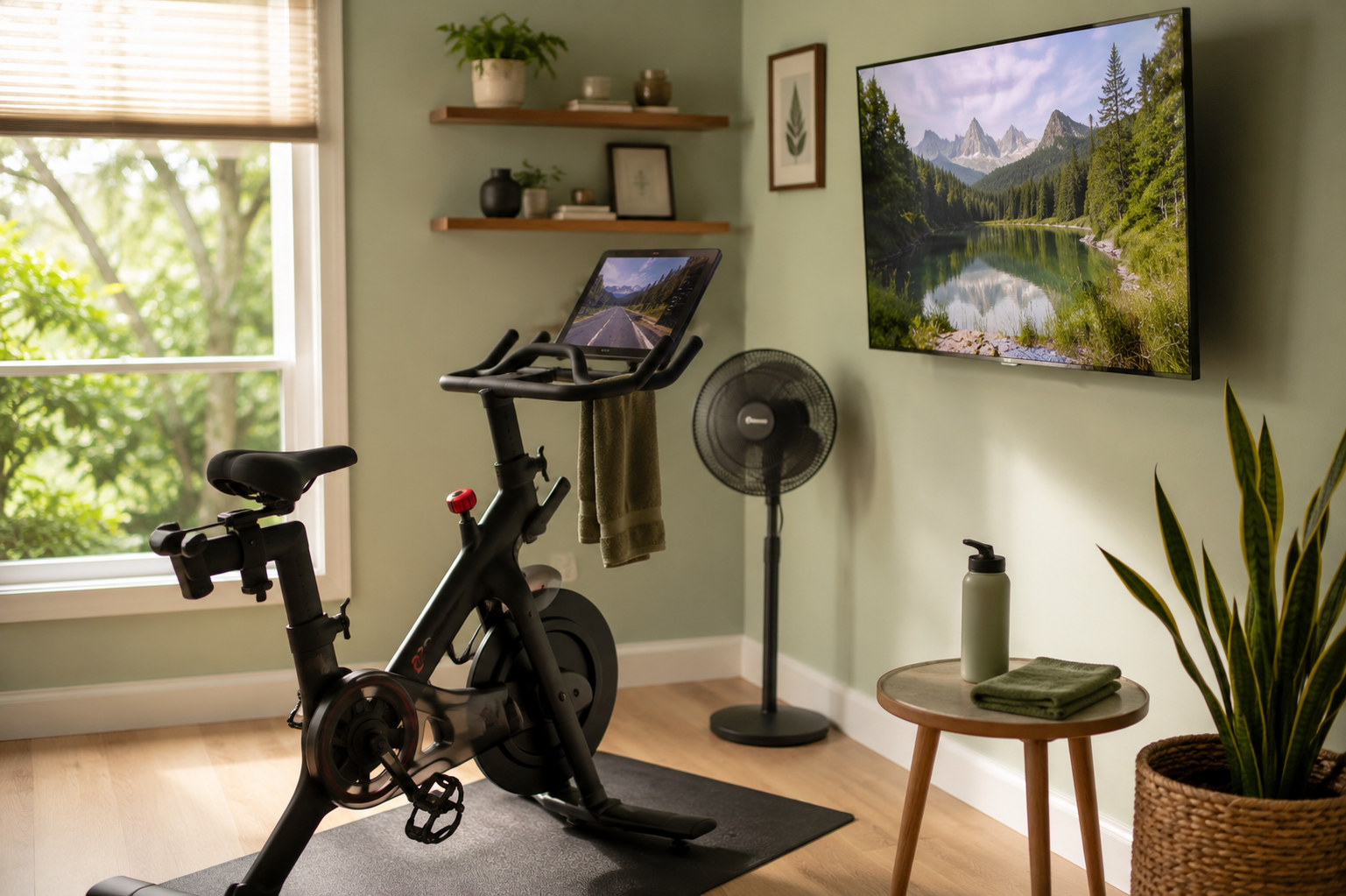
- Screen height and distance. Position a tablet, TV, or laptop at eye level so you’re not straining your neck downward or sideways for 40 minutes.
- Airflow. A fan pointed at your face or torso does more for comfort during a long session than most people expect, and a cooler environment tends to lower perceived effort at a given heart rate.
- Everything within reach. Water, a towel, and your phone should be on a small table or bike-mounted holder so you’re not interrupting the session to walk across the room.
- Lighting that isn’t harsh. Overhead fluorescent lighting makes a workout space feel clinical. A lamp or softer light source makes the same room feel more like a place you’d choose to spend 45 minutes.
- A consistent spot. Using the same corner of a room each time, rather than moving equipment around, builds a habitual cue that primes your brain for the session before you’ve started pedaling or walking.
- Room temperature. Aim for a slightly cooler room than feels comfortable at rest, since indoor cardio spaces heat up quickly once you’re moving and a stuffy room raises perceived effort faster than the actual workload justifies.
- A pre-workout ritual. Filling your water bottle, changing into workout clothes, and starting your chosen show or playlist in the same order each time reduces the friction of getting started, which is often the biggest barrier on low-motivation days.
None of these adjustments need to happen all at once. Most people find it easier to fix one friction point at a time, starting with whichever one causes the most day-to-day irritation, whether that’s a poorly positioned screen, a room that gets uncomfortably warm, or clutter that makes the space feel more like storage than a place to train.
Realistic Session-Length Planning
The American Heart Association recommends at least 150 minutes per week of moderate-intensity aerobic activity, a target zone 2 training satisfies directly. That total doesn’t need to come from one heroic session. Spreading it across three to five shorter blocks is both more sustainable and, based on the boredom mechanics above, considerably easier on your attention span than a single long sitting.
A reasonable indoor progression looks like this:
- Weeks 1 to 2: Three sessions of 20 to 25 minutes, focused on confirming your zone 2 heart rate range and getting comfortable with the equipment and entertainment setup.
- Weeks 3 to 4: Extend to 30 to 35 minutes per session, three to four times weekly, introducing the chapter-based structuring from Step 3.
- Weeks 5 and beyond: Build toward 45 to 60 minute sessions two to three times weekly, combined with shorter 25 to 30 minute sessions on other days to hit the weekly total without every session feeling like a marathon.
Use the talk test as your intensity check throughout: you should be able to speak in full sentences, just not comfortably sing. If you’re too breathless to talk, you’ve drifted out of zone 2 and into a harder zone where the dissociation strategies from Step 2 stop working as well, since higher intensities pull attention back toward the body regardless of what’s on screen.
It also helps to plan sessions the same way you’d plan any recurring appointment, by putting them on a calendar with a specific start time rather than leaving them as a vague daily intention. People who treat cardio sessions as fixed blocks, the same way they’d treat a scheduled meeting, tend to skip them less often than people relying on finding a spare 45 minutes whenever the day allows. Pairing a specific time slot with a specific piece of entertainment, for example, a standing 7am date with a particular podcast, layers the habit-formation benefits of consistency on top of the attention-management benefits already covered.
Bringing It Together
Indoor zone 2 cardio is boring by design, not by accident, because the intensity that makes it physiologically valuable is the same intensity that leaves your brain with spare capacity to notice every passing minute. The fix isn’t to push harder or shorten sessions until they stop working. It’s to give that spare attention somewhere useful to go: entertainment matched deliberately to the workout, a session broken into recognizable chapters, a social layer even in a solo home gym, and a physical setup that removes small frictions before they add up. Put those pieces together and a 45-minute ride stops being something to survive and starts being something you’d actually choose to do again tomorrow.
Frequently Asked Questions
How do I know if I’m actually in zone 2 and not drifting higher?
Use a heart rate monitor to stay within roughly 60 to 70 percent of your estimated max heart rate, and back it up with the talk test. If you can hold a full conversation without gasping for air between sentences, you’re in the right range. If you can only manage short phrases, ease off the resistance or pace.
Is it okay to watch TV the entire time instead of focusing on my breathing?
Yes, for this intensity level. Research on attentional focus during exercise shows dissociative strategies, like watching a show or listening to a podcast, are appropriate and effective for submaximal, non-competitive training. Reserving internal-focus breathing work for warm-ups or cooldowns is a reasonable split.
What’s the minimum session length that still counts as useful zone 2 training?
Most guidance points to at least 30 minutes per session for meaningful aerobic benefit, though shorter 20-minute sessions still contribute toward your weekly total and are a reasonable starting point if 30 minutes feels daunting at first.
Can I combine zone 2 cardio with work, like taking calls or reading?
On a stationary bike or elliptical, yes, since your hands and upper body stay stable. A treadmill walk at a gentle incline can also work for phone calls, though reading is harder due to the up-and-down motion. Match the activity to the equipment from Step 1.
Why does indoor cardio feel harder mentally than outdoor cardio at the same heart rate?
Outdoor sessions naturally provide changing visual scenery, terrain, and environmental variety that occupy attention without effort. Indoors, that variety has to be manufactured deliberately through entertainment, structure, and environment, which is the core problem this guide addresses.
Should I do zone 2 cardio every day?
Most people don’t need to. Three to five sessions weekly, sized to hit roughly 150 minutes total, aligns with general aerobic activity guidelines and leaves room for strength training or rest days without every day being dedicated to steady-state work.
References
- Cleveland Clinic. “What Is Zone 2 Cardio?” health.clevelandclinic.org/zone-2-cardio
- Frontiers in Psychology. “Make Fitness Fun: Could Novelty Be the Key Determinant for Physical Activity Adherence?” frontiersin.org
- iResearchNet, Sports Psychology. “Attentional Association and Dissociation,” summarizing Morgan and Pollock’s foundational research on attentional strategies in runners. psychology.iresearchnet.com
- PubMed Central. “Psycho-Physiological Effects of Television Viewing During Exercise.” pmc.ncbi.nlm.nih.gov/articles/PMC4974866
- PubMed Central. “The Influence of Various Distraction Stimuli on Affective Responses during Recumbent Cycle Ergometry.” pmc.ncbi.nlm.nih.gov/articles/PMC5968918
- PubMed Central. “Group Exercise Membership Is Associated with Forms of Social Support, Exercise Identity, and Amount of Physical Activity.” pmc.ncbi.nlm.nih.gov/articles/PMC9053316
- PubMed Central. “Perceptions of Groupness during Fitness Classes Positively Predict Recalled Perceptions of Exertion, Enjoyment, and Affective Valence.” pmc.ncbi.nlm.nih.gov/articles/PMC6756792
- American Heart Association. “American Heart Association Recommendations for Physical Activity in Adults.” heart.org