

























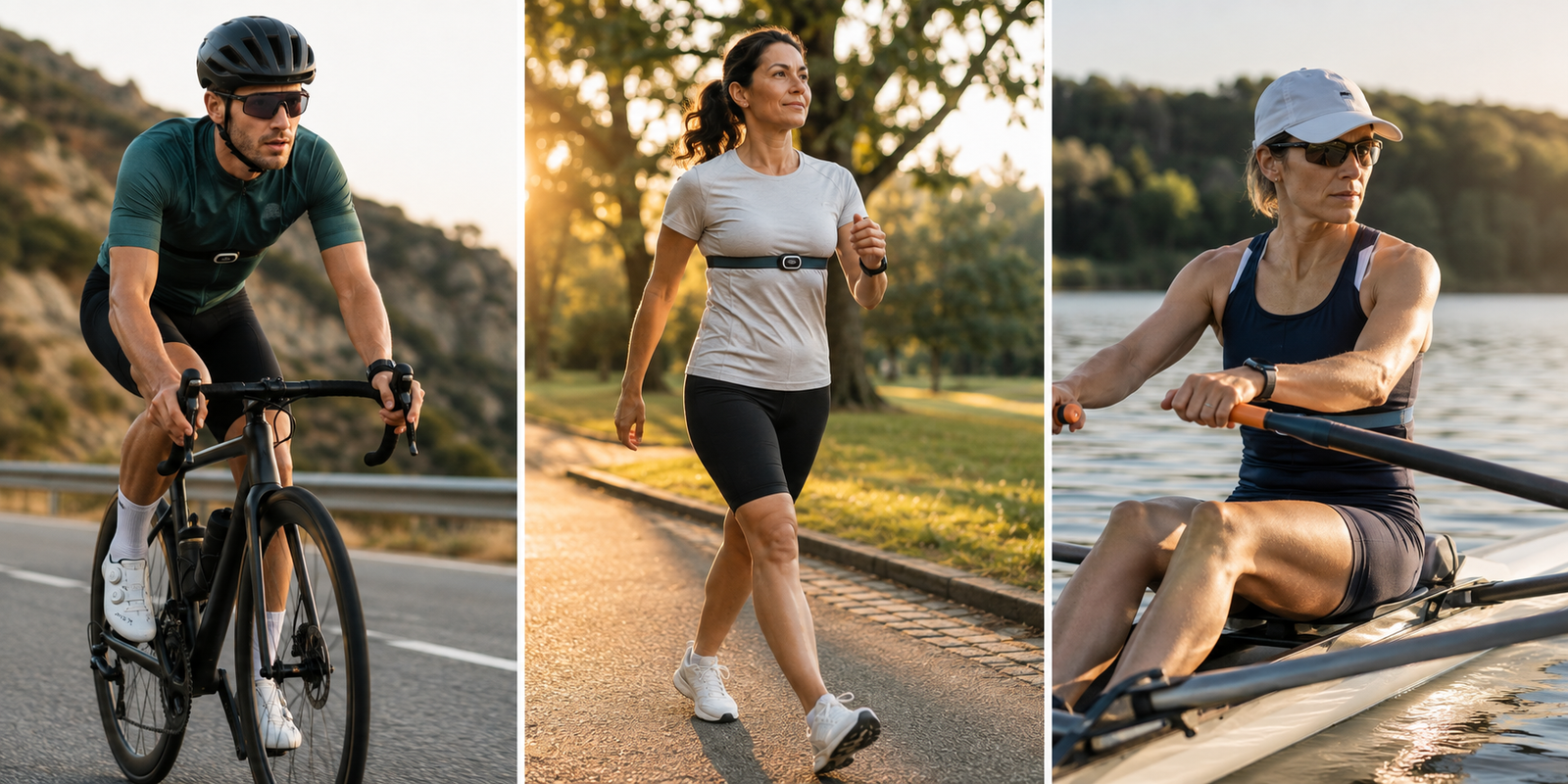
Most people who commit to zone 2 training do not quit because the science stops working. They quit because they picked a modality that did not fit their knees, their calendar, or their patience for staring at four walls. Zone 2 cardio, the long, conversational-pace effort that keeps your heart rate around 60 to 70 percent of its maximum, only pays off if you can repeat it several times a week for months. That makes the choice of activity a logistics question as much as a physiology one.
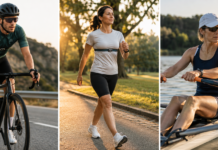
Cycling, walking, and rowing each get you into that same heart rate window, but they get you there through different joints, different muscles, and different amounts of gear and space. This comparison walks through the practical differences that decide whether a modality survives past the first few weeks: how much stress it puts on your joints, what it costs to start, which muscles carry the load, how easy it is to actually hold zone 2 once you start moving, and how weather and indoor options change the picture. A decision framework at the end ties those factors to your own circumstances so you are not guessing, and a set of sample profiles shows how the framework plays out for people in different situations.
None of these three activities is objectively superior for zone 2 purposes. The physiological target, a sustained heart rate in a specific low-to-moderate range, is identical no matter which one you pick. What changes is everything around that target: whether your knees tolerate the motion, whether you have thirty dollars or three hundred dollars to spend on gear, whether a treadmill or a stationary bike sits unused in your basement, and whether you actually enjoy the forty-five minutes you are about to spend doing it.
Why the Modality You Choose Matters More Than the Modality Itself
Zone 2 training builds an aerobic base by keeping effort low enough that your body relies primarily on fat oxidation for fuel rather than shifting to carbohydrate-burning at higher intensities. Over weeks of consistent sessions, this steady-state work is associated with increases in mitochondrial density and the small blood vessels that supply working muscle, which is why coaches and physiologists treat duration and consistency as the two variables that matter most, arguably more than the specific exercise used to produce the effort.
That emphasis on duration and consistency is exactly why modality selection deserves real thought. A session that hurts your knees by mile three will not get repeated. A session that requires a machine you do not own will not happen on a Tuesday when the gym is thirty minutes away. A session that bores you into checking your phone every ninety seconds will quietly get shorter and less frequent until it disappears. Picking the activity that fits your body, your wallet, and your daily routine is not a minor detail. It is the difference between a training block that finishes and one that fizzles out in October.
| Factor | Cycling | Walking | Rowing |
|---|---|---|---|
| Joint impact | Low; weight is supported by the saddle, but knee alignment and bike fit matter | Low to moderate; impact forces are far gentler than running, more so on soft surfaces | Very low; a non-weight-bearing, seated, sliding motion |
| Startup cost | Moderate to high for a road or indoor trainer setup; low if you already own a bike | Near zero; a pair of supportive shoes is usually enough | High for a home rowing machine; lower if a gym or club has one |
| Primary muscles | Quadriceps, hamstrings, glutes, calves | Glutes, calves, hip flexors, core for posture | Legs initiate the stroke, then back, core, and arms finish it |
| Ease of holding zone 2 | Moderate; terrain and gearing can push effort up quickly | High; pace naturally caps effort for most people | Moderate; stroke rate discipline is required to avoid drifting high |
| Weather dependence | High outdoors; solved with an indoor trainer | High outdoors; solved with a treadmill or mall walking | Low if using an indoor machine; high on open water |
Joint Impact: Which Modality Is Kindest to Your Body
Rowing is generally the gentlest of the three on joints because it is a seated, non-weight-bearing motion. Your body weight is supported by the seat and the slide rather than transmitted through your knees and hips with every stride, which is one reason rowing machines show up so often in rehab settings and in gyms serving older adults or people carrying extra weight.
Cycling is also low-impact in the sense that there is no repetitive ground strike, but it introduces a different risk: repetitive knee flexion under load. Saddle height and cleat alignment determine whether that repetitive motion stays comfortable or becomes irritating over hundreds of pedal strokes per session. A bike that is even slightly misfit can turn a joint-friendly activity into a source of nagging knee or hip pain, so a proper fit matters more here than in walking or rowing.
Walking sits between the two in a way that surprises people who assume all cardio pounds the joints equally. It is genuinely lower impact than running because the forces involved in a walking stride are a fraction of what running generates, and that gap widens further on forgiving surfaces such as dirt trails or rubberized tracks compared with concrete sidewalks. For anyone managing joint pain, arthritis, or recovering from an injury, walking on a soft surface at an easy pace is one of the most joint-friendly ways to accumulate zone 2 minutes, even if it is not quite as gentle as rowing for someone with acute knee issues.
Equipment and Cost: What It Takes to Actually Start
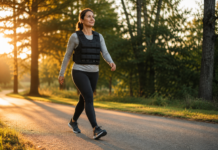
Walking wins this category without much competition. A pair of supportive shoes and a stretch of sidewalk, trail, or treadmill are enough to begin. There is no membership required, no assembly, and no learning curve beyond pace management. This accessibility is a large part of why walking is the modality most fitness professionals recommend first to people who are new to structured cardio or who have let a routine lapse.
Cycling occupies the middle ground. If you already own a bike, the marginal cost of a zone 2 session is close to zero. If you are starting from scratch, a road or hybrid bike, a helmet, and possibly an indoor smart trainer for bad-weather days represent a real upfront investment, often several hundred dollars at minimum for anything durable. Indoor cycling classes and studio bikes offer a lower-commitment alternative but add a recurring cost instead of a one-time purchase.
Rowing has the steepest entry cost of the three when done at home. A quality rowing machine is a significant purchase, and rowing on open water requires access to a boat, a body of water, and usually some coaching to row with safe technique. Many people solve this by using a rowing machine at a gym, which removes the purchase cost but reintroduces a membership and a commute, the same friction that undermines consistency for other gym-based routines.
Muscle Groups Used: Full Body Versus Lower Body Focus
Rowing recruits the largest share of total muscle mass among the three. The stroke moves through distinct phases: the legs drive the initial push, the back and core continue the pull, and the arms finish it before the recovery phase reverses the sequence. Because that sequence repeats hundreds of times per session, rowing is often described as engaging roughly 80 percent of the body’s muscles, spanning legs, glutes, back, shoulders, arms, and core in a single continuous movement.
Cycling is comparatively lower-body dominant. The quadriceps, hamstrings, glutes, and calves do the vast majority of the work, with the core playing a stabilizing rather than propulsive role. This makes cycling an efficient option for someone specifically trying to build leg endurance without loading the upper body, but it means the upper body gets essentially no aerobic training stimulus from the activity itself.
Walking falls between light full-body engagement and true lower-body focus. The glutes, calves, and hip flexors handle propulsion, while the core and, to a lesser degree, the arms contribute to posture and rhythm, especially if you walk with an active arm swing or add light hand weights. It is not a full-body workout in the way rowing is, but it is not as narrowly lower-body as cycling either.
Ease of Staying in Zone 2
Walking tends to be the easiest modality for holding a steady zone 2 heart rate because a comfortable walking pace has a natural ceiling for most people. It takes a genuinely brisk incline walk to push an average adult’s heart rate too high, which makes pacing largely self-regulating: if your heart rate creeps up, you slow the stride and it settles back down almost immediately.
Cycling requires more attention to hold in range. Hills, headwinds, and even excitement at the start of a ride can push effort into zone 3 before you notice, and indoor trainer sessions can drift the opposite direction if resistance is set too low. A heart rate monitor or power meter is genuinely useful here, more so than for walking, because the feedback loop between effort and perceived exertion is looser on a bike.
Rowing sits in between. The activity itself is efficient enough that it is easy to accidentally row too hard, since the stroke feels smooth even at a higher intensity, but stroke rate provides a built-in dial: keeping strokes per minute in a controlled range, typically in the low twenties for a steady zone 2 piece, is a reliable way to keep effort in check without constantly checking a monitor.
Weather and Indoor Considerations
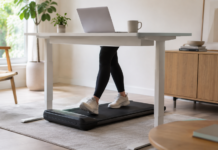
All three activities have workable indoor versions, but the tradeoffs differ. Walking indoors on a treadmill preserves nearly everything about the outdoor experience and requires no new skill. Cycling indoors on a smart trainer or stationary bike changes the sensory experience considerably, no wind, no scenery, no bike handling, but it removes weather as a variable entirely and lets you hold a steady wattage more precisely than outdoor riding allows.
Rowing indoors, on a machine, is in many ways more consistent than rowing on water, where wind, current, and the technical demand of balancing a boat add variables that make holding a steady zone 2 effort harder for anyone without real rowing experience. For most people doing zone 2 training specifically, the indoor rowing machine is the more practical version of the sport, not a compromise.
Building a Realistic Training Week
A common mistake is treating zone 2 as something to squeeze in whenever a schedule allows, without a structure that makes the sessions add up. A more durable approach is to anchor two or three sessions a week at a fixed time slot, then treat any additional sessions as a bonus rather than an obligation. For most healthy adults building a base, that means 30 to 60 minute sessions of continuous, steady effort, with total weekly zone 2 time gradually increasing over several months rather than jumping straight to long sessions.
The modality can rotate within that structure without undermining it. A typical week might include a rowing session on a day when time is short but full-body work is the goal, a longer walk on a day with more time available, and a bike ride on a weekend when weather and daylight cooperate. What matters for the training effect is total time spent in the target heart rate range across the week, not which single activity produced that time. Tracking total zone 2 minutes rather than tracking each modality separately tends to keep the habit intact even when one activity is not on the schedule for a stretch of weeks.
Common Mistakes That Push You Out of Zone 2
The single most common error across all three modalities is starting a session too fast. The first few minutes of any workout tend to feel easier than they actually are, and heart rate lags a few seconds behind effort, so a pace that feels comfortable at minute two can register as zone 3 by minute five. Easing into the first five to ten minutes of any session, then checking heart rate before settling into a rhythm, prevents most of this drift.
Terrain and equipment settings cause the second most common error. On a bike, an unexpected hill or a headwind can spike effort without a corresponding change in perceived exertion, since the body compensates gradually. On a rowing machine, a stroke rate set too high for a given resistance setting pushes heart rate up even though the movement still feels smooth and controlled. On a treadmill or outdoor walk, an incline that feels minor underfoot can add meaningfully to heart rate over a sustained session. In each case, checking a heart rate monitor periodically rather than relying purely on feel catches the drift before an entire session slides out of range.
The third mistake is skipping a warmup and expecting heart rate to settle into zone 2 immediately. All three activities benefit from three to five minutes of easy movement before settling into target pace, which gives the cardiovascular system time to catch up with the muscular demand being placed on it.
A Decision Framework Based on Your Circumstances
There is no single best modality here. The right pick depends on three things: what your joints can currently tolerate, what equipment and space you have access to, and what you can realistically stay motivated to repeat several times a week.
Quick Decision Guide
- If you have joint pain, arthritis, or are returning from a lower-body injury: start with rowing on a machine, or walking on a soft surface, before cycling. Both minimize repetitive joint loading, and rowing removes weight-bearing impact entirely.
- If you have zero budget and want to start today: walk. It requires no purchase beyond shoes you likely already own and no learning curve.
- If you want the most efficient use of limited training time and can tolerate a learning curve: rowing engages the most muscle mass per session, which can make it a time-efficient choice for people balancing zone 2 work with other priorities.
- If you already own a bike or enjoy time outdoors covering distance: cycling can be sustainable specifically because you enjoy it, and enjoyment is one of the strongest predictors of whether a habit survives past a few months.
- If weather or daylight limits your outdoor time for large parts of the year: prioritize whichever modality you can do indoors comfortably, a treadmill, a stationary bike, or a rowing machine, since consistency across seasons matters more than which activity is technically optimal.
It is also worth being honest about what you will actually do. A rowing machine gathering dust because it felt intimidating to learn is not a better choice than a daily walk you genuinely look forward to. Zone 2 training rewards repetition over years, not perfect exercise selection over a single month, so the modality that fits your life is functionally the correct one.
Three Sample Profiles
A 58-year-old with mild knee osteoarthritis who wants to build cardiovascular fitness without aggravating joint pain is likely best served by rowing on a machine, supplemented with walking on soft trails on days the machine is not available. Both minimize repetitive impact, and rowing adds a strength stimulus for the legs and back that walking alone does not provide.
A busy parent with twenty minutes free most mornings and no home gym equipment is better matched to walking, since it requires no setup, no travel, and no equipment beyond shoes already owned. A brisk incline walk or a few short hill repeats can deliver a meaningful zone 2 stimulus even in a short window.
A former competitive cyclist returning to fitness after a break who already owns a bike and an indoor trainer has an obvious head start with cycling, since the equipment barrier is already solved and the familiarity with the activity supports long-term adherence. Adding a rowing session once a week could round out the muscle groups that cycling leaves undertrained.
Combining Modalities Instead of Choosing Just One
Nothing about zone 2 training requires picking a single activity and sticking to it exclusively. Many people rotate between two or three modalities across a week: a long walk on a rest day, a bike ride when the weather cooperates, a rowing session when time is short but full-body engagement is the goal. This approach spreads the mechanical load across different joints and muscle groups, which can reduce overuse issues compared with doing the same repetitive motion every single day. It also protects against the seasonal and logistical gaps that derail single-modality routines, since a rained-out bike ride can simply become an indoor rowing session instead of a missed workout.
Frequently Asked Questions
Can walking alone get you real zone 2 training benefits?
Yes, provided the pace is brisk enough to sustain a heart rate around 60 to 70 percent of your estimated maximum for a continuous period. For many people, especially those newer to structured cardio, a purposeful walk on an incline or at a quick cadence is enough to reach and hold that range.
Is rowing harder on the lower back than cycling or walking?
Rowing can stress the lower back if the stroke technique relies too heavily on the back instead of sequencing legs first, then hips, then arms. With correct technique, the load is distributed across the legs and posterior chain rather than concentrated in the lower spine, and many people with existing back sensitivity find that proper form actually reduces strain compared with prolonged sitting.
Which modality burns the most calories for the same zone 2 heart rate?
Because rowing recruits more total muscle mass, it often produces a higher calorie burn at a given heart rate than cycling or walking, though individual fitness level, technique, and effort consistency affect this more than the activity choice alone.
Do I need a heart rate monitor to train in zone 2?
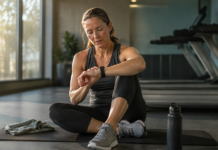
It helps, particularly for cycling and rowing, where effort can drift upward without an obvious cue. Walking is more forgiving because the talk test, being able to hold a light conversation, tends to track closely with an appropriate zone 2 effort for most people.
Can I switch between cycling, walking, and rowing week to week without losing progress?
Zone 2 adaptations are driven primarily by consistent time spent at the right intensity, not by the specific modality producing that intensity. Rotating between activities is a reasonable way to stay consistent, particularly if it prevents boredom or overuse issues that would otherwise interrupt training.
Is outdoor rowing a realistic option for beginners doing zone 2 training?
It is possible but has a steeper learning curve than the other two options, since balancing a boat and managing water conditions adds variables that make holding a steady heart rate harder. An indoor rowing machine is generally the more practical starting point for structured zone 2 work.
References
- Cleveland Clinic. “What Is Zone 2 Cardio?” health.clevelandclinic.org/zone-2-cardio
- Concept2. “Muscles Used While Rowing.” concept2.com/training/articles/rowing-muscles-used
- Healthline. “Low Impact Exercises.” healthline.com/health/fitness-exercise/low-impact-exercises